Skip to content
Tag

Traffic Offenses

Page 2 of 4 · 20 articles

Texting While Driving Law Texas

Texting While Driving in Texas | Texas' New Traffic Law

By Pricer · Traffic Offenses

Texting While Driving Law Texas
Virtually every state in America has a statewide law banning the use of cell phones or texting while driving. Until recently, Texas has had minimal restrictions on cell phone usage while driving. Such restrictions include:
  • drivers with learner's permits are prohibited from using handheld cell phones in the first six months of driving;
  • Drivers under the age of 18 are prohibited from using wireless communications devices;
  • school bus operators are prohibited from using cell phones while driving if children are present; and
  • in school zones, all drivers are prohibited from texting and using handheld devices while driving.

However, after many failed efforts, Texas has finally passed a law banning the use of handheld devices in certain situations, namely texting. On June 6, 2017, Governor Greg Abbott signed HB 62, which makes using a portable wireless communication device (i.e. a cell phone) to read, write, or send an electronic message (i.e. a text) while operating a motor vehicle a misdemeanor offense.

Notice is Required to be Posted by DPS of the New Ban

The Texas Department of Transportation will be required to post signs on interstate and U.S. highways entering the state indicating that texting while driving is prohibited and carries a fine. Additionally, the new law requires that the driver’s license test cover knowledge about the effects of texting while driving or other actions that constitute distracted driving.

What is the Punishment for Texting While Driving in Texas?

Under the new law, the sole offense of “texting while driving” is not an arrestable offense. A driver’s first offense will be punishable by a fine between $25 and $99, and any subsequent offenses will carry a fine between $100 and $200. Additionally, the Department of Motor Vehicles is not authorized to assign points to a driver’s license for a “texting while driving offense.”

However, if at trial for the offense it is shown that the defendant caused the death or serious bodily injury of another person, the offense will become a Class A misdemeanor punishable by a fine not to exceed $4,000 and confinement in jail for a term not to exceed one year. Additionally, if the conduct constituting the offense is also a violation of another law, the defendant may be prosecuted under either law, or both.

Possible Defenses to a Texting While Driving Charge:

A driver may have a defense to prosecution if the driver was:

  • not moving;
  • using a hands-free device, including voice-operated technology;
  • reporting illegal activity or summoning emergency help;
  • reading an electronic message that the person reasonably believed concerned an emergency;
  • relaying information to a dispatcher or digital network through a device affixed to the vehicle as part of the driver’s job;
  • activating functions to play music; or
  • using a GPS function.

Additionally, the law does not apply to drivers of authorized emergency or law enforcement vehicles acting in an official capacity or to drivers licensed by the Federal Communications Commission operating a radio frequency device other than a portable wireless communication device.
Furthermore, the law prohibits the search and seizure of a driver’s cell phone unless authorized by another law.

Concerns Regarding HB 62 (Texting While Driving Law)

Supporters of the law believe it will increase safety and reduce distracted driving incidents, while opponents see it as an overreach of the government into citizen’s lives. Some fear the law will allow law enforcement to gain more power to stop citizens by mistaking a person’s legal actions for texting. However, despite these reservations, this law takes effect on September 1, 2017, preempting local ordinances, and applies only to offenses committed on or after that date.

Links to the full text of the bill:

http://www.legis.state.tx.us/tlodocs/85R/billtext/pdf/HB00062F.pdf#navpanes=0
http://www.legis.state.tx.us/billlookup/History.aspx?LegSess=85R&Bill=HB62
Read full article
License Plate Scanner BROCA MARTINEZ

Whether "Unconfirmed" Insurance Creates Reasonable Suspicion to Stop

By Brandon Barnett · Reasonable Suspicion

Is "Unconfirmed" Insurance Enough to Justify a Traffic Stop?

License Plate Scanner BROCA MARTINEZWhile conducting surveillance on an illegal immigration investigation, Homeland Security agents saw a vehicle leave a residence suspected of harboring undocumented immigrants. The agents notified local police officers to be-on-the-lookout for the vehicle. While on patrol, an officer began to follow the defendant’s vehicle because it matched the description of the vehicle from Homeland Security. While following the vehicle, the local officer entered its license plate number into a computer database designed to return vehicle information such as insurance status. The computer indicated the insurance status was “unconfirmed.” Based on his experience using this system, the officer reasoned that the vehicle was most likely uninsured, which is, of course, a violation of Texas law. The officer then conducted a traffic stop of the vehicle and learned that the defendant was in the United States illegally. The officer issued the defendant citations for violating the insurance requirement and driving without a license while he waited for the Homeland Security agents to arrive.
Defendant Challenges the Stop, Arguing that the Officer Lacked Reasonable Suspicion.

The United States government charged the defendant with conspiracy to harbor illegal aliens. The defendant argued that the “unconfirmed” insurance status obtained from the state computer database did not provide the officer reasonable suspicion to stop the defendant. The trial court was unconvinced by this argument.

The 5th Circuit Court of Appeals recognized that it had not yet addressed whether a state computer database indication of insurance status establishes reasonable suspicion as a matter of law. However, the court commented that the Sixth, Seventh, Eighth, and Tenth Circuits have found that such information may give rise to reasonable suspicion as long as there is either some evidence suggesting the database is reliable or at least an absence of evidence that it is unreliable. In this case, the court followed the other circuits that have decided this issue and held that a state computer database indication of insurance status may establish reasonable suspicion when the officer is familiar with the database and the system itself is reliable.

5th Circuit Upholds the Stop, Finding that "Unconfirmed" Insurance Creates Reasonable Suspicion.

Here, the court found that the officer’s testimony established the reliability of the database. First, the officer explained the process for inputting license plate information. Second, the officer described how records in the database are kept and stated that he was familiar with these records. Finally, the officer testified that based on his knowledge and experience as a police officer, he knows a suspect vehicle is uninsured when an “unconfirmed” status appears because the computer system will either return an “insurance confirmed,” or “unconfirmed” response. As a result, the court held that the officer had reasonable suspicion to stop the defendant.

Read the court’s full opinion in UNITED STATES V. BROCA-MARTINEZ, 2017 U.S. App. LEXIS 7612 (5th Cir. Tex. Apr. 28, 2017)

Read full article
Community Caretaking Function Texas

Community Caretaking Function: Police May Stop without Reasonable Suspicion

By Brandon Barnett · DWI

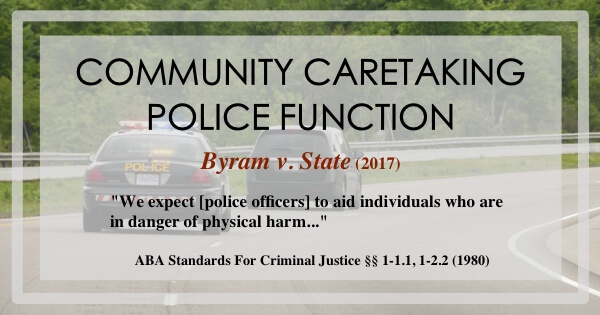
Community Caretaking Function TexasIn November of 2015, we wrote about State v. Byram, a DWI case out of Tarrant County. In Byram, the 2nd Court of Appeals held that a "hunched over" passenger in a vehicle was not enough to invoke the police "community caretaking" function to allow the police to initiate a traffic stop without reasonable suspicion of a violation.  The 2nd Court reversed the DWI conviction and remanded the case back to the trial court. The State appealed this decision to the Texas Court of Criminal Appeals, which issued its opinion today.

When May the Police Invoke the "Community Caretaking" Function to Make a Stop or Detention Without Reasonable Suspicion?

Byram v. State (Tex.Crim.App. 2017)

In this case, State argued that the police officer was engaged in his "community caretaking" function when he pulled the driver over. The State contends that this was a proper exercise of police authority and that the primary purpose of the stop need not be to investigate any alleged violation.

Reviewing the facts in the light most favorable to the trial court's ruling (denying the suppression motion), the CCA agreed with the State and explained its view on the Community Caretaking function:

Local police officers frequently engage in “community caretaking functions,” totally divorced from the detection, investigation, and acquisition of evidence relating to the violation of a criminal statute. Cady v. Dombrowski, 413 U.S. 433, 441 (1973). “As part of his duty to ‘serve and protect,’ a police officer may stop and assist an individual whom a reasonable person—given the totality of the circumstances—would believe is in need of help.” Wright v. State, 7 S.W.3d 148, 151 (Tex. Crim. App. 1999). However, because the reasonableness of a community-caretaking seizure sprouts from its dissociation from the competitive enterprise of ferreting out crime, “a police officer may not properly invoke his community caretaking function if he is primarily motivated by a non–community caretaking purpose.” Corbin v. State, 85 S.W.3d 272, 276-277 (Tex. Crim. App. 2002).

The Court went on to lay out a two-step test for determining whether an officer may properly invoke his community-caretaking function:

  1. whether the officer was primarily motivated by a community-caretaking purpose; and
  2. whether the officer’s belief that the individual needed help was reasonable.”*

*The standard for reasonableness is no different when the officer stops a vehicle to check the welfare of a passenger rather than the driver. Wright, 7 S.W.3d at 151.

In this particular case, the CCA held, "[the officer] saw a woman in a precarious situation, and acted reasonably to help her by first asking whether she was okay, and then conducting a traffic stop when his
question went unheeded. This is the sort of 'sound, commonsense police work that reason
commends, rather than condemns.'"

Read full article
traffic stop duration king

When Does a Traffic Stop End and Improper Police Conduct Begin?

By Brandon Barnett · Drug Crimes, Search & Seizure

A Traffic Stop for a Minor Traffic Infraction Leads to Search, Seizure, and Arrest: Exactly When Should Traffic Stops End?

traffic stop duration kingIf you've been a licensed (or even unlicensed) driver in Texas for long enough, you've experienced a traffic stop. Whether it be for speeding or something worse, a traffic stop is not generally a pleasant experience. But in some traffic stops across the state (hopefully not yours), the police conduct a search of the vehicle, then a search of the driver or passengers, and, finally make an arrest of some sort. How does something like a broken tail light or speeding lead to search, seizure, and arrest? When traffic stops for minor infractions potentially lead to serious criminal charges, it’s important to know how Texas courts define the moment when a traffic stop ends.

King v. State (2nd Court of Appeals - Fort Worth, 2016)

Broken Tail Light Leads to a Traffic Stop

Around 1:00 am, Jennifer Dowling drove Christopher King’s car home from a night on the town. Blue Mound Police noticed that the car had a broken right tail light and conducted a traffic stop pursuant to the infraction. Police ran the standard background check on Dowling, the driver, and King, the passenger, only to discover that neither had a valid driver’s license. As a result, Dowling was arrested for driving without a license. Police did not permit King to drive the car away and informed him that they would impound the car because leaving the car behind posed a safety hazard for other motorists.

Consent to Search Obtained, Traffic Stop Continued

To begin the impounding process, police asked King to exit the vehicle. When King got out of the car, police asked if they could perform a pat-down. Nervously, King complied with the request. When King stood up, a white cylinder-shaped container fell out of King’s pants onto the ground, and he admitted that the container held meth. King was arrested and charged with possession of a controlled substance.

Trial Court Holds That King Consented to the Pat-Down

Before trial, King filed a motion to suppress the physical evidence—the meth and the container—because the evidence was seized without a warrant. At the suppression hearing, the State prevailed, arguing that King consented to the pat-down, and the interaction was a consensual encounter. King lost his suppression motion, and plead guilty to the charges. The trial court sentenced King to twelve years confinement. Arguing that the traffic stop ended when Dowling was arrested and that the traffic stop was improperly extended to him, King appealed to the Second Court of Appeals.

Second Court of Appeals Discusses Traffic Stops

The Second Court of Appeals in Fort Worth relied upon existing case law from the Supreme Court to evaluate the merits of King’s appeal. “A lawful roadside stop begins when a vehicle is pulled over for investigation of a traffic violation.” Arizona v. Johnson, 555 U.S. 323, 333; 129 S. Ct. 781,, 788 (2009). “A traffic stop ends when police have no further need to control the scene.” Id., 129 S. Ct. at 783. According to the Second Court of Appeals, the police needed to control the scene even after Dowling was arrested. In asking King for a pat-down, they were taking reasonable steps to secure the area by ensuring that King was not a safety threat while waiting for a tow truck. Further, “the impoundment of the vehicle was a task tied to the traffic infraction, and King ma[de] no argument that the task [of impoundment] should have reasonably been completed at the time the police asked for consent to the pat-down.” The Second Court of Appeals affirmed the trial court’s holding that the traffic stop was not improperly extended.

What does all of this mean for motorists? So long as the police are reasonably securing the scene by taking steps in an effort to maintain safety, the police may continue the traffic stop until the conclusion of such safety measures, including but not limited to, pat-downs, security sweeps, background checks, and impoundments.  In this case, King would have had a more colorable argument if he had been a licensed driver and the police extended the stop rather than letting him drive the vehicle away from the scene.

Read full article
Failure to Maintain a Single Lane of Traffic DWI Attorney Fort Worth

Failure to Maintain a Single Lane of Traffic Leads to a DWI Conviction

By Brandon Barnett · Reasonable Suspicion

Does an Officer have "Reasonable Suspicion" to Make a Traffic Stop When Vehicle Weaves Inside a Traffic Lane?

Failure to Maintain a Single Lane of Traffic DWI Attorney Fort WorthJames Leming was convicted of DWI after erratic driving alarmed fellow motorists to call police. On January 20, 2012, a citizen filed a report of a “swerving Jeep” and Officer Manfred Gilow responded. As the dashboard camera confirmed, the Jeep traveled thirteen miles under the speed limit; Gilow followed the Jeep for several miles. Officer Gilow observed the Jeep, “drifting [within the] lane to the left [with] tires on the stripes… back to the right, almost hit[ting] the curb twice.”

Officer Gilow said he did not stop the Jeep immediately because the heavy traffic made a traffic stop unsafe at the time. He wanted to wait until the Jeep approached “the 3000 block because I knew there’s parking lots where he could pull over [safely].” Gilow justified the warrantless stop under the Community Caretaking Exception, “due to the …[low] speed…and…swerving, it was an indication that the driver [was] somehow either distracted or physically not able to operate [his] motor vehicle carefully.”

Eventually, the officer pulled Leming over, noting on the police report, the smell of liquor. Though Leming denied drinking, he said he had taken some prescription pills. Officer Gilow conducted field sobriety tests and placed Leming under arrest for DWI.

Read the full opinion in Leming v. State.

Leming's DWI Trial and Motion to Suppress the Stop

Before the trial began, Leming filed a motion to suppress the traffic stop, which was denied. At trial, Leming pled guilty to and was convicted of DWI. Because Leming had two prior DWI convictions (a felony under Texas law), the court assessed punishment at ten years’ imprisonment. Tex. Penal Code § 49.09(b)(2).

The Sixth Circuit Court of Appeals reversed the trial court’s ruling, holding that the trial court should have granted the motion to suppress. Leming v. State, 454 S.W.3d 78 (Tex. App.—Texarkana 2014). The Sixth Circuit concluded that Gilow lacked reasonable suspicion to detain Leming for the offense of failure to maintain a single lane under Section 545.0600(a) of the Texas Transportation Code. The court reasoned “in order for it to have been unlawful, the encroachment must have been made unsafely; [here,] there was no real danger of his colliding with another vehicle in an adjacent lane.” The State’s Prosecuting Attorney petitioned the Court of Criminal Appeals for discretionary review, arguing that the citizen’s report coupled with Officer Gilow’s observations were sufficient for reasonable suspicion that Leming was driving the Jeep under the influence.

The Issue Before the Texas Court of Criminal Appeals Regarding the Traffic Stop

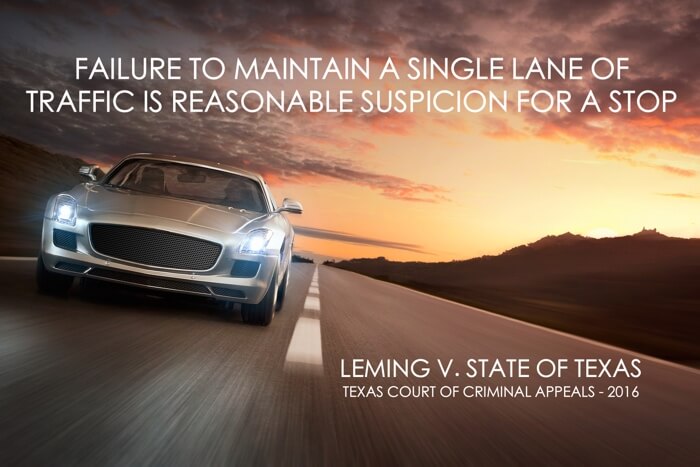
The Court of Criminal Appeals had to determine whether a driver must BOTH fail to maintain a single lane AND not change lanes without checking to assure the maneuver can be accomplished safely, before it may be said that a driver has committed an offense. Such an offense would rise to the level of reasonable suspicion for a constitutionally-sound traffic stop.

What Does the Texas Transportation Code Say About Driving Within a Single Lane?

Section 545.060(a) states that “an operator on a roadway divided into two or more clearly marked lanes for traffic (1) shall drive as nearly as practical entirely within a single lane; and (2) may not move from the lane unless that movement can be made safely.”

The CCA Holds that a Driver Must Maintain a Single Lane AND Must not Leave the Lane Unless it is Safe.

The CCA explains that the fact that both the requirement to stay within a single lane as for as practical and the prohibition to not leave that lane unless it is safe to do so, originally appeared in the same subsection of the statute, does not indicate that the Legislature intended that both must be violated before an offense has occurred. Rather, the CCA believes that the Legislature intended a violation of EITHER part of the statute constitutes separately actionable offenses.

The CCA says that Officer Gilow knew from personal observations, as well as from the citizen’s report, that Leming had some sort of trouble maintaining a steady driving pattern while traveling under the speed limit. “That was sufficient information to justify a temporary detention to investigate whether Leming had actually failed at some point to remain in his dedicated lane of traffic as far as it was practical to do so under the circumstances—it matters not whether that failure was unsafe.” Further, Officer Gilow had an objectively reasonable basis to suspect Leming of driving under the influence.

As a matter of principle, the CCA notes, “it [would be] counterproductive and contrary to common sense to set the reasonable suspicion bar for DWI so high that law enforcement must hesitate to investigate such hazardous driving for fear that the stop will later be invalidated.” In a Concurring Opinion, Judge Richardson adds, “I believe [the community caretaking exception] provided justification for the officer’s stop, where, a reasonable police officer—given the totality of the circumstances-would believe [someone] is in need of help.” Dissenting, Judge Keasler stated, “this is a close case…the majority reaches the wrong result by misconstruing the statute and finds reasonable suspicion on the basis of a single insufficient articulable fact.” Judge Newell also dissented in this case.

Read full article

Speak with a Fort Worth attorney

Call (817) 993-9249 or send us a message to discuss your case.