Skip to content
Tag

Texas Joint Possession Laws: Shared Drug Possession Explained

Page 1 of 9 · 41 articles

A judge’s gavel in front of cannabis containers, representing legal possession laws in Texas.

Understanding Possession in Texas Criminal Law

By Luke A. Williams · Criminal Defense, Drug Crimes

A judge’s gavel in front of cannabis containers, representing legal possession laws in Texas.
Understanding what counts as “possession” in Texas can make all the difference in a criminal case.

In Texas, the concept of "possession" can sometimes be a little tricky when we think about it in terms of the law as opposed to what we all commonly define as "possession". Whether it’s related to controlled substances, firearms, or stolen property, possession is a key element in many criminal offenses. But what does possession actually mean in the eyes of Texas law? This post will break down the definition, legal standards, and consequences of possession in the Lone Star State.

Definition of Possession in Texas Law

Under Texas Penal Code §1.07(a)(39), possession is defined as having "actual care, custody, control, or management." This broad definition means that possession isn’t limited to physical ownership. Instead, it can include situations where a person has any access to or control over an object, even if they don’t physically hold it at the moment.

Possession can be categorized into two types:

  1. Actual Possession: This occurs when the individual has physical custody of the item. For instance, if someone is holding a bag containing illegal drugs, they are in actual possession.
  2. Constructive Possession: This arises when an individual does not have physical custody but still has control or the right or ability to excersise control the item. For example, if illegal drugs are found in the glove compartment of a car that a person owns and operates, they may be deemed to have constructive possession. Even if they don't own or are operating the vehicle, police officer's may deem a passenger in the vehicle as having the ability to exercise care, custody, control or management of the illegal item.

Establishing Possession in a Criminal Case

To prove possession in a criminal case, the prosecution must demonstrate two key elements:

  1. Knowledge: The accused must have known about the presence of the item, and;
  2. Control: The accused must have exercised, or had the ability to exercise, control over the item.

Merely being near an illegal item is not enough to establish possession. For example, if drugs are found in a house shared by multiple roommates, the prosecution must show evidence linking the accused to the drugs specifically—such as fingerprints, ownership of the container, or incriminating statements.

Joint Possession

Texas law also recognizes the concept of joint possession. This means that more than one person can be found to have possession of the same item. For example, if two people are in a vehicle and illegal contraband is found in a location accessible to both, they could both potentially be charged with possession.

Consequences of Possession Charges

Possession charges can carry serious consequences in Texas, varying based on the type and quantity of the item in question. For instance:

  • Drug Possession: Penalties depend on the type of drug and the amount, with punishments ranging from misdemeanors to first-degree felonies.
  • Firearm Possession: Certain individuals, such as convicted felons, are prohibited from possessing firearms, and violating this prohibition can result in severe penalties.
  • Stolen Property: Possession of stolen property can lead to theft charges, with penalties depending on the value of the property.

Defenses to Possession Charges

There are several potential defenses to possession charges in Texas, including:

  • Lack of Knowledge: Demonstrating that the accused was unaware of the item's presence.
  • Lack of Control: Arguing that the accused did not have the ability to exercise control over the item.
  • Mistaken Identity: Showing that the item belonged to someone else and the accused had no connection to it.
  • Violation of Constitutional Rights: If law enforcement obtained evidence through an illegal search or seizure, that evidence may be suppressed.

Conclusion

"Possession" is a nuanced legal concept in Texas, encompassing both actual and constructive control over items. Understanding the intricacies of possession is crucial for anyone facing criminal charges. What you think may or may not be possession may be different than what the law defines it as. If you or someone you know is dealing with a possession-related charge, consulting an experienced criminal defense attorney is essential to ensure your rights are protected and to navigate the complexities of the legal system effectively.


Read full article
Christmastime Arrests Texas

Top 5 Reasons for Arrests During the Christmas Holiday Season

By Brandon Barnett · Criminal Defense

Christmastime Arrests TexasWhen you think about the Christmas season, you probably think about family time, presents, good food, and celebration. We think about those things too, but as criminal defense attorneys, we also think about the reasons that some of our clients get arrested during the holiday season. For this article, we took a look at the last 8 years of holiday season arrests (for clients that we represented) and compiled an (anecdotal) list of the top 5 reasons that folks get arrested during the Christmas/New Year's season. Our goal is that this list will serve as a warning, so that your holiday season can be filled with the good stuff, rather than jail, bail, and calls to our office. Here goes:
5. Shoplifting

Many retailers slash their prices and offer steep discounts in the weeks leading up to Christmas and even bigger discounts after Christmas, but we have yet to see any retailer offer the "five finger discount" for their merchandise. Regardless, we see plenty of shoplifting cases during the Christmas season, making it our #5 reasons that people get arrested during Christmas. Depending on the regular price value of the item (not the discounted price), shoplifting theft charges can range from misdemeanors to felonies. Learn more about Theft law in Texas here.

4. Package Theft

In a similar vein to shoplifting, our #4 reason for holiday arrests is package theft. Many shoppers choose the convenience of online shopping and have their Christmas purchases delivered right to their front door. Some people see this as an easy target, following behind UPS or FedEx trucks to steal those would-be Christmas gifts from the front porch. However, with the increase in doorbell cameras, it is getting easier to catch the porch pirates in the act. Further, some law enforcement agencies have begun using dummy packages to bait thieves into getting caught. Package theft can range from a misdemeanor to a felony depending on what unknown treasure lay inside the brown box.

3. Air Travleing Trouble (Guns, Drugs, and Intoxication)

Going to visit grandma can require air travel for many families. This means that thousands more people than usual flood through DFW Airport between Thanksgiving and New Year's. It matters not from where these travelers hail. From Maryland to Oregon to France, if a person is arrested at DFW Airport, their case will be filed in Tarrant County, Texas and they will have to travel back to DFW to attend court. During the holidays, we see a surge in airport arrests when people bring items into the airport that are not allowed or when folks over indulge during a layover. Specifically, we see the following airport arrests:

Even if the state from which a traveler is coming has legalized marijuana and the state to which they are traveling has legalized marijuana, if they are caught possessing marijuana in the airport, they will be arrested and charged. The combination of airport gun arrests, airport drug arrests, and airport public intox arrests make these types of cases our #3 reason for holiday arrests.

2. Assault Family Violence

In the movie Christmas Vacation, Clark Griswold showed an enormous amount of restraint when his extended family pushed him to the limit (especially Cousin Eddie), but not everyone is blessed with such a cool head. Christmas time brings added stressors into the family environment that can sometimes lead to verbal or physical altercations between family members, so much so, that these arrests rank at #2 in our book. Depending on the nature of the assault, a domestic violence arrest can be charged as a misdemeanor or a felony. Learn more about Family Violence under Texas law.

1. Driving While Intoxicated

With all of the Christmas and New Year's parties and the increase in No Refusal Weekends, it is not hard to guess that DWI arrests are #1 on our list. Driving While Intoxicated in Texas can range from a misdemeanor (if it is a first or second offense) to a felony (if there is a child in the car or if the person arrested has been convicted of DWI twice in the past). Our advice is to plan ahead and do not even take your car to a Christmas party when you plan to drink. Catch a ride from a friend or take an Uber or Lyft. That would be a lot cheaper than hiring an attorney and a lot less hassle too. Learn more about Texas DWI law here.

We Hope You Never Need Us, But We're Here if Your Do.

We wish you a very merry Christmas and a happy New Year. As always, we hope you never need us to represent you or one of your loved ones for a criminal offense. This is even more true during the Christmas season. Hopefully this list will help you avoid trouble that looms during the holiday season. If you do happen to need us, we are only a phone call away at (817) 993-9249.

Read full article
Marijuana Smell Warrantless Search Texas

Is the Smell of Marijuana Enough to Permit a Warrantless Vehicle Search?

By Brandon Barnett · Drug Crimes

Does the Smell of Marijuana Allow Officers to Search My Vehicle Without a Warrant?

Marijuana Smell Warrantless Search TexasIn Texas, the answer is yes. The possession of marijuana is a crime in Texas, so if an officer smells marijuana emanating from your car, he has probable cause to believe a crime is being committed. With probable cause, the law permits the officer to stop and search your car— regardless of whether you consent.


The officer has the ability to do this through what is called the “automobile exception” to the 4th Amendment’s warrant requirement.1 Generally, the 4th Amendment to the United States Constitution requires police officers to first obtain a warrant before they can search a person’s property. However, because automobiles can quickly move locations and evade law enforcement, the Supreme Court reasoned that it would be impractical to require officers to first secure a warrant before they are permitted to search a vehicle.2 So by claiming to smell marijuana, law enforcement officers can also claim to have probable cause to believe a crime is being committed—allowing them to take advantage of the automobile exception and search a vehicle without anything more.

Will the Search Laws Change if Marijuana Becomes Legal?

Maybe. There have been small changes in the law with the current trends in marijuana legalization. A couple of state courts adopted the rule that, after legalization or decriminalization, the smell of marijuana is no longer enough on its own to justify a warrantless search of a vehicle. For example, in Vermont, after the decriminalization of adult possession of less than one ounce of marijuana, the Vermont Supreme Court held that the odor of marijuana alone is insufficient to establish probable cause to search a vehicle.3 The Massachusetts Supreme Court ruled that the state’s decriminalization policy means that the possession of marijuana is now a civil infraction, making the smell of it an insufficient basis for officers to believe a crime is being committed.

However, most states where marijuana is legalized or decriminalized still follow the rule that the smell of it establishes probable cause in support of a vehicle search.4 This is because these states still criminalize the possession of larger amounts of marijuana—meaning that the smell of it still indicates that a crime could be underway. This is the logic that the Washington, Maryland, Colorado, and Arizona courts follow.5

But what about Texas?

As stated above, the possession of marijuana in Texas is a crime, and officers are still justified in searching vehicles if they smell marijuana coming from them. However, Texas legalized the cultivation of industrial hemp in 2019, which smells like just like marijuana. The issue of whether probable cause can still be supported by the odor of marijuana in light of hemp’s legalization was raised in state court in 2020, but the court left it undecided as the vehicle search in question occurred before the legalization of hemp.6 It remains to be seen if or when Texas will legalize marijuana, and what attitude Texas courts will take towards the question of marijuana odor and vehicle searches.


[1] Carroll v. United States, 267 U.S. 132 (1925).
[2] Id., at 153.
[3] Zullo v. State, 2019 Vt. LEXIS 1, * (Vt. January 4, 2019).
[4] Cece white, The Sativas and Indicas of Proof: Why the Smell of Marijuana Should Not Establish Probable Cause for a Warrantless Vehicle Search in Illinois, 53 UIC J. Marshall L. Rev. 187, 211 (2020).
[5] Id., at 211.
[6] Geberkidan v. State, 2020 WL 5406243, NO. 12-19-00296-CR (2020).

Read full article
Texas CBD Legal 2019

CBD Update: Texas Legislature Clarifies the CBD Issue

By Luke A. Williams · Drug Crimes

Gov. Greg Abbott has now signed House Bill 1325 into law, clarifying the legality of hemp-derived, low THC CBD products in Texas.

Texas CBD Legal 2019
On June 10, 2019, Gov. Abbot signed HB 1325 which modified sections of the Texas Agriculture Code and sections of the Texas Health and Safety Code.

The first major modifications come by way of the Texas Agriculture Code. The code now defines and legalizes “hemp” and establishes a legal production plan for the regulation of hemp and hemp-based products.

The Definition of Hemp

“Hemp” is now defined in in Section 121.001 0f the Texas Agriculture code as

“the plant Cannabis sativa L. and any part of that plant, including the seeds of the plant and all derivatives, extracts, cannabinoids, isomers, acids, salts, and salts of isomers, whether growing or not, with a delta-9 tetrahydrocannabinol [THC] concentration of not more than 0.3 percent on a dry weight basis.”

This definition is essentially the previous definition of marijuana under the Health and Safety Code but now isolates plants that contain less than .3% THC as being legal “hemp”.

By providing a clear definition of “Hemp” including plants or products that contain .3% THC or less, the legislature has resolved the issue that previously existed making the possession of any amount of THC regardless of it’s origin a felony level offense in Texas.

The Texas Agriculture Code has also been amended to establish a legal production plan for the regulation and sale of hemp and hemp-based products. The Code now establishes a licensing process for businesses looking to grow or sale hemp products.

New Rules for Peace Officers

The amendments to the Code also now give powers and duties to Peace Officers who come into contact with hemp regard to determining whether a plant or substance is marijuana or hemp. Under Sec. 122.358 of the Texas Agriculture Code, a peace officer may now inspect and collect a reasonable sized sample of any material from the plant Cannabis sativa L. found in a vehicle to determine the THC concentration of that material. Unless the officer has probable cause to believe the plant material is marijuana, the peace officer may not seize the plant material or arrest the person transporting the plant material. This would include hemp-derived CBD oil containing .3% THC.

In regards to the Health and Safety Code, HB 1325 has amended the code to exclude hemp (and more importantly the THC in hemp) as defined by Section 121.001 from the definition of a Controlled Substance. The bill also now specifically excludes hemp as defined by Section 121.001 (and the THC in hemp) from the definition of “Marijuana” in Section 481.002 (26) of the Health and Safety Code.

House bill 1325 has significantly clarified the previously confusing state of the law concerning CBD products in Texas. We advise those that are selling, buying or possessing CBD products to read the text of the bill for more details.

https://legiscan.com/TX/text/HB1325/id/2026154/Texas-2019-HB1325-Enrolled.html

Read full article
Tampering with Evidence Texas 37.09

Tampering with Evidence under Texas Law | Section 37.09 TX Penal Code

By Brandon Barnett · Evidence

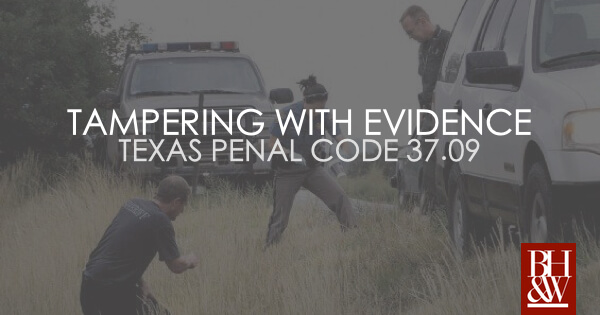
Tampering with Evidence Texas 37.09During routine traffic stops, police officers sometimes end up arresting individuals for the third-degree felony offense of Tampering with Evidence. How does this happen you ask? If, during the course of a traffic stop, an officer observes the driver toss an item or two out of the window, and those tossed items are later determined to be drugs and/or drug paraphernalia, the officer might just arrest the person for tampering with evidence pursuant to section 37.09 of the Texas Penal Code. The important question though, is whether section 37.09 was intended to prohibit this type of conduct?

What is the Purpose of Section 37.09 – Tampering with Evidence?

Texas Penal Code Section 37.09 provides:

(a) A person commits an offense if, knowing that an investigation or official proceeding is pending or in progress, he:
     (1) alters, destroys, or conceals any record, document, or thing with intent to impair its verity, legibility, or availability as evidence in the investigation or official proceeding;  or
     (2) makes, presents, or uses any record, document, or thing with knowledge of its falsity and with intent to affect the course or outcome of the investigation or official proceeding.

Texas courts have found that the purpose of section 37.09 is to uphold the integrity of our criminal justice system. 20 Tex. Jur. 3d Criminal Law: Offenses Against Public Administration § 63 citing Wilson v. State, 311 S.W.3d 452 (Tex. Crim. App. 2010); Haywood v. State, 344 S.W.3d 454 (Tex. App.—Dallas 2011 pet. ref’d). This includes prohibiting anyone from “creating, destroying, forging, altering, or otherwise tampering with evidence that may be used in an official investigation or judicial proceeding.” Id. However, section 37.09 is not without limitation.

What is the Scope of Section 37.09?

Early case law suggests the scope of 37.09 is very limited. But, as you will read below, the Court of Criminal Appeals rejects this notion by allowing the fact finder the ability infer the intent to tamper.

In Pannell v. State, 7 S.W.3d 222 (Tex. App.—Dallas 1999, pet. ref’d) the court of appeals held that section 37.09 requires a defendant to know that the item “altered, destroyed, or concealed, was evidence of an investigation, that is pending or in progress, as it existed at the time of the alteration, destruction, or concealment.” Id. In this case, the defendant threw a marijuana cigarette out of the window while he was being pulled over for speeding. Id. Because the officer was only investigating a speeding violation when the defendant threw the marijuana out of the window, the court held that there was no evidence that an investigation in which the marijuana would serve as evidence was “pending or in progress.” Id. The court explained that only after the officer observed the defendant throw out the marijuana did the investigation change to involve drugs. As a result, the court determined there was no evidence of tampering. This analysis, however, has been rejected, albeit not explicitly overruled, in Williams v. State, 270 S.W.3d 140 (Tex. Crim. App. 2008).

In Williams, an officer was conducting a traffic stop and decided to conduct a pat down search of the driver (i.e. defendant) for weapons. During the pat down a crack pipe fell onto the pavement, and the defendant immediately stomped on the pipe, crushing it with his foot. When deciding whether or not the above actions constituted tampering, the Court of Criminal Appeals rejected the lower court’s analysis, which stated that the traffic stop became a drug investigation once the officer and the defendant noticed the pipe on the pavement, and only then was there tampering. In rejecting this analysis, the Court held that requiring a change in the investigation, as the appellate court’s analysis and Pannell does, adds an additional mens rea element not required by section 37.09.

Thus, the Court held that when an officer is investigating a traffic stop and the suspect anticipates that the officer will begin a drug investigation if the officer finds evidence of drugs, and in accordance with that anticipation, the suspect destroys the drugs before the officer becomes aware of them, the suspect has tampered with evidence. As such, there is no requirement for the officer to “see the pipe” or “see the marijuana” before the suspect throws it out of the window in order for that action to constitute tampering. The determination will be made by the finder of fact using circumstantial evidence to draw inferences.

In Conclusion . . .

In conclusion, if the only evidence the State has of tampering is the fact that the defendant threw the item out of the window, without any other indicia of tampering, then the act alone does not rise to level of tampering under section 37.09. However, there are many reasonable circumstances, ever so slight, that could lend the fact finder to make an inference of intent to tamper. With that being said, because the offense of tampering is extremely fact-based, we recommend you reach out to our experienced attorneys to better understand your options.

Read full article

Speak with a Fort Worth attorney

Call (817) 993-9249 or send us a message to discuss your case.