
Skip to content
Tag

Second Court of Appeals Criminal Defense Rulings & Analysis

Page 1 of 5 · 24 articles

Confrontation Clause Violation When Accuser Does Not Appear at Trial

Confrontation Clause Violation When Accuser Does Not Appear at Trial

By Brandon Barnett · Confrontation Clause

Tarrant County Trial Court Admits Testimony in Violation of the Confrontation Clause
The Second Court of Appeals recently released a memorandum opinion, which reversed a defendant’s conviction due to a confrontation clause violation. The issue was whether the trial court (Criminal District Court Number 1, Tarrant County) erred in allowing an officer to testify about certain statements the alleged victim made regarding a prior assault allegation.

McDowell v. State—2nd Court of Appeals (2018)

The Facts—Defendant Was Convicted for Felony Domestic Violence

On August 21, 2016, officers were alerted to a domestic disturbance in progress. When officers arrived at the scene they made contact with the victim and the victim’s friend who had reported the disturbance. While talking with the two females, officers noticed multiple bruises on the victim and learned that the suspect (i.e. Defendant), who had allegedly assaulted the victim, was still inside the home. Officers subsequently entered the residence and arrested Defendant.

At trial, dash-cam video showing the accusations made by the two females was admitted. In addition, one of the officers testified to additional statements made by the victim suggesting that the defendant had a history of violence. These additional statements, however, were not included in the dash cam video. Defendant objected to these statements under Crawford because the victim did not appear at trial. Nonetheless, the trial court allowed the out-of-court statements to be admitted over objection.

In addition to the officer’s testimony regarding the hearsay statements, the jury heard from two other witnesses about the cycle of domestic violence. The State then referenced this testimony in relation to Defendant’s history of domestic violence during closing arguments. As a result, Defendant was convicted. Defendant later appealed his conviction arguing that the trial court erred when it allowed the officer to testify to the victim’s statements in violation of the confrontation clause of the 6th Amendment.

Court of Appeals Reverses and Remands Case—Holding the Trial Court Erred in Admitting the Officer’s Testimony

Generally, the Confrontation Clause bars admission of testimonial statements of a witness who does not appear at trial. In determining whether certain statements were testimonial in nature, “the Court looks to see whether circumstances were present at the time the statements were made that would indicate the existence of an ongoing emergency.” If such circumstances existed, the statements are admissible.

Here, the victim did not appear at trial. As such, the Court of Appeals attempted to analyze whether the victim’s statements were testimonial in nature by determining whether they were made during the ongoing emergency. However, the Court was unable to do so because there was no evidence from the State regarding when these statements were made. The Court concluded that without knowing the timing at which the statements were made, there was no way to determine the existence of an ongoing emergency. The Court explained that once there is an objection to the admission of evidence on confrontation grounds the burden shifts to the State. Here, the State was silent in regard to the confrontation objection. And, without the State providing more evidence, the Court could not conclude that the statements were nontestimonial. Accordingly, the Court held that the trial court erred in admitting the statements.

The Court then conducted a harm analysis to determine whether the error impacted the jury’s verdict, which would require a reversal. In making its determination, the Court noted that the majority of the officer’s testimony was based on the inadmissible statements. These statements portrayed a history of violence rather than just one instance. Further, the other witnesses’ testimony hinged on these inadmissible statements. Thus, because the inadmissible statements were a crucial part in establishing the elements of the offense, the Court could not say beyond a reasonable doubt that the trial court’s error did not contribute to Defendant’s conviction and, therefore, a reversal was required.
Read full article
Self-Defense Jury Charge Texas

When is a Defendant Entitled to a Jury Instruction on Self-Defense?

By Pricer · Self-Defense

Self-Defense Jury Charge TexasThe Court of Criminal Appeals recently released an opinion regarding when a defendant is entitled to a self-defense charge. The issue facing the Court was whether there was some evidence, from any source, that would support the elements of self-defense and whether self-defense was authorized when a deadly weapon was used in response to verbal provocation.
Gamino v. State, Court of Criminal Appeals (2017)

The Facts—The Trial Court Denied Defendant’s Request for a Self-Defense Instruction and Defendant was Subsequently Convicted.

On August 11, 2013, Cesar Gamino (Defendant) and his girlfriend were leaving downtown Fort Worth as the local bars were closing. While Defendant and his girlfriend were walking back to his truck they passed by a group of men who were heard saying lewd comments. Believing the comments were directed at his girlfriend, Defendant confronted the men. Khan, one of the men, told Defendant they were not talking about his girlfriend. According to Khan, Defendant then said “I got something for you,” went to his truck, retrieved a gun, and pointed it in their direction. Two police officers working nearby heard Defendant’s comment and saw Defendant with the gun. Defendant was subsequently arrested and charged with aggravated assault with a deadly weapon. Khan was also arrested and charged with public intoxication.

During trial, Defendant testified that the men threatened him and his girlfriend by saying “grab her ass” and that they would “F her if they wanted to,” and that they would “kick [his] ass.” Defendant further testified that one of the men got up and moved towards him in an aggressive manner. This behavior, coupled with the fact that Defendant was disabled, caused him to believe he and his girlfriend were in danger. As a result, Defendant testified that he reached into his truck, grabbed his gun and told the men, “[s]top, leave us alone, get away from us.” Defendant’s girlfriend also testified that he was in fact disabled and that the men had confronted them and threatened her—causing her to fear for her life.

At the end of the trial, the defense asked for a self-defense instruction in the jury charge and the trial court denied the request.

The Court of Appeals Reversed the Trial Court’s Decision—Holding Defendant was Entitled to a Self-Defense Instruction Regardless of the Fact that he was Charged with Aggravated Assault with a Deadly Weapon.

Section 9.31 of the Texas Penal Code governs self-defense. According to Section 9.31, a person is justified in using force against another when and to the degree that person reasonably believes the force is immediately necessary to protect himself against another person’s use or attempted use of unlawful force. Verbal provocation by itself is not enough.

Section 9.32 governs the use of “deadly force” in self-defense cases. In the case at hand, the lower court charged Defendant with using a deadly weapon. However, even if a defendant uses a deadly weapon, deadly force as defined in section 9.32 may not apply if it meets the requirements of Section 9.04.

Under Section 9.04, a threat to cause death or serious bodily injury by the production of a weapon as long as the actor’s purpose is limited to creating an apprehension that he will use deadly force if necessary, does not constitute the use of deadly force.

The Court of Appeals determined that Defendant reasonably believed his use of force was immediately necessary to protect against Khan’s use or attempted use of unlawful force, and Defendant produced his gun for the limited purpose of creating an apprehension. Thus, the Court of Appeals ruled that under Defendant’s version of events, the use of his gun did not constitute the use of deadly force, and Defendant was not disqualified from receiving a self-defense instruction even though he was charged with aggravated assault with a deadly weapon because he met the requirement of Section 9.04.

Accordingly, the trial court erred by not submitting an instruction on self-defense to allow the jury to decide the issue of self-defense.

The Court of Criminal Appeals Affirmed the COA—Holding that the Jury Should Have Been Given the Opportunity to Assess Whether Appellant’s Conduct was Justified as Self-Defense.

The Court of Criminal Appeals agreed that the trial court erred in taking away the self-defense issue from the jury. According to Texas case law, it is error for a trial court to deny a self-defense instruction if there is some evidence, from any source, that will corroborate the elements of a self-defense claim—even if the evidence is weak, contradicted or not credible.

The State argued, as well as the dissent, that Defendant was not entitled to a self-defense instruction because he did not admit to threatening the victim with imminent bodily injury. This argument was based on the idea that self-defense is a confession and avoidance justification, and the confession was missing here. The Court however disagreed, inferring a confession.

Here, Defendant testified that he displayed his gun and yelled, “stop,” “get away,” and “leave us alone.” Accordingly, the court held it to be reasonable for the jury to infer that if the men did not stop, Defendant would have used his gun for protection. As such, even though the evidence was contradicted by the State, Defendant believed the display of his gun was immediately necessary to protect himself against the use or attempted use of unlawful force, and that he displayed his weapon for the limited purpose of creating an apprehension that he would use deadly force if necessary.

Using the Court of Appeals’ analysis, the Court of Criminal Appeals affirmed their judgment holding that the jury should have been given the opportunity to analyze Defendant’s actions as self-defense.

See also the Gamino Dissenting Opinion

Read full article
Fire as Deadly Weapon in Arson Case

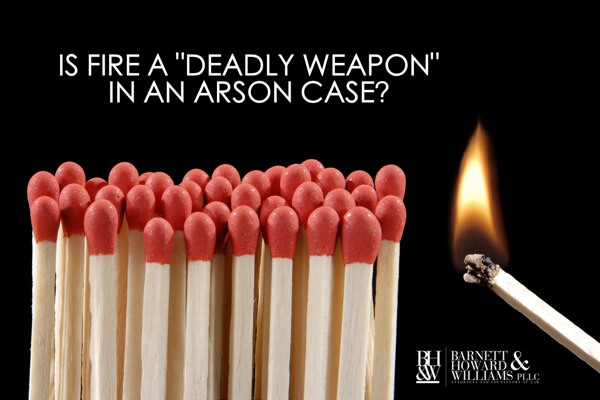
Is Fire a Deadly Weapon in an Arson Case?

By Brandon Barnett · Arson, Deadly Weapon

Defendant's Arson Charge was Enhanced when Fire was Alleged as a "Deadly Weapon."


Pruett v. State (2nd Court of Appeals - Fort Worth, 2016)

***UPDATE - This case was REVERSED by the Texas Court of Criminal Appeals in 2017. See opinion here.

Fire as Deadly Weapon in Arson CaseJeffery Pruett inherited a one-third shared interest in the family home with his two siblings after the death of their elderly parents. The adult siblings had a long history of quarreling over Pruett’s living arrangements, as he moved in and out of the residence prior to the deaths of their parents. Fed up, Pruett moved into a motor home, and was often seen by the neighbors driving around the neighborhood. Meanwhile, Pruett’s siblings listed the home for sale with the intention of dividing the proceeds equally between the three siblings.


On December 19, 2012, a neighbor spotted Pruett parking his motor home in front of the residence. Pruett exited the vehicle, went into the backyard of the residence, and then got back into the vehicle and drove away. Moments later, the neighbor saw smoke coming from the back of the house. The neighbor ran to the backyard, saw flames shooting out of the residence, and called the Fort Worth fire department. Neighbors were successful in using a garden hose to extinguish a large portion of the fire. When the fire department arrived, they confirmed that there was no one inside the home and put out the remaining flames. After an investigation, the arson investigator concluded that the fire had been intentionally started with a flammable ignition source.

Pruett’s Case Goes to Trial

At trial, the fire department’s battalion chief testified that had the flames not been put out, the fire would have consumed the home. Further, the arson investigator testified that the fire was “very dangerous,” putting neighbors, fire fighters, and anyone inside the home in immediate danger of death or serious injury. Considering his use of fire to be a deadly weapon, the trial court convicted Pruett of arson, sentencing him to twenty years imprisonment. Pruett appealed to the Second Court of Appeals, arguing that the court lacked sufficient evidence to support the finding of fire as a deadly weapon. Fire as a deadly weapon carries a heavier penalty in Texas.

What does Texas Law say about fire as deadly weapon?

Fire is not considered a deadly weapon in the Texas Penal Code, however, a Court can find that fire was used as a deadly weapon if the surrounding circumstances meet a three-pronged test. Mims v. State, 335 S.W. 3d 247, 249-50. In order for fire to be deemed a deadly weapon, the evidence must prove

  1. the object meets the definition of a deadly weapon;
  2. the deadly weapon was used…during the transaction on which the felony conviction was based; and
  3. other people were put in actual danger.”

Brister v. State, 449 S.W.3d 490,494 (Tex. Crim. App. 2014).

The Second Court of Appeals Weighs In - The Court must determine whether the fire set by Pruett was capable of causing death or serious bodily injury.

Did the fire meet the statutory definition of a deadly weapon?

Under Texas law, a deadly weapon can be “anything that in the manner of its use or intended use is capable of causing death or serious bodily injury.” Tex. Penal Code Ann. § 1.07(a)(17)(West Supp. 2015). To determine whether the object was “capable” of causing death or serious bodily injury, such “capability” must be evaluated based on what actually happened, not conjecture about what might have happened if the facts had been different than they were.” Williams v. State, 946 S.W.2d 432, 435-36 (Tex. App.—Fort Worth 1997).

Here, the Court says the neighbor had put out most of the fire with the garden hose by the time the fire department arrived on the scene. Further, the neighbor who called the fire department was not placed in danger. Even though the arson investigator testified that the firefighters were placed in danger, such danger is part of the job. Since there was no one else in the home at the time of the fire, there is no evidence that the firefighters were put in actual danger of death or seriously bodily injury. The Court concludes, “the facts—viewed…in light of what did happen [not what could have happened]—do not support [fire as a deadly weapon] in this case.” The Second Court of Appeals orders the deadly weapons finding to be deleted from Pruett’s judgment.

CASE UPDATE (1/25/17) - CCA Reverses the COA Decision

In reversing the Court of Appeals, the CCA held:

"An arsonist is not the same as an intoxicated driver, and the degree of danger and harm that each offender is capable of causing is materially different. In the case at bar, the deadly nature of the fire is not difficult to appreciate. Fire is inherently dangerous in a way that cars are not and it is capable of inflicting serious bodily harm, especially when it is intentionally started in a residential neighborhood. This fire was dangerous because it was left unattended and because appellant used an accelerant. As a result, the fire endangered not only the lives of the firefighters who responded to the call but also the lives of neighbors who could have been killed or seriously injured if the fire continued to spread. The fire also posed a danger from both the heat effects and the emissions of toxic chemicals. In this case, the State adequately demonstrated that the fire that appellant started was capable of causing death or serious bodily injury...When evidence at trial demonstrates that someone ignites combustible material to intentionally burn down a house in a residential neighborhood, a deadly-weapon finding may appropriately attach to the arson conviction when the fire is capable of causing death or serious bodily injury. That is what happened in this case. "
Read full article
traffic stop duration king

When Does a Traffic Stop End and Improper Police Conduct Begin?

By Brandon Barnett · Drug Crimes, Search & Seizure

A Traffic Stop for a Minor Traffic Infraction Leads to Search, Seizure, and Arrest: Exactly When Should Traffic Stops End?

traffic stop duration kingIf you've been a licensed (or even unlicensed) driver in Texas for long enough, you've experienced a traffic stop. Whether it be for speeding or something worse, a traffic stop is not generally a pleasant experience. But in some traffic stops across the state (hopefully not yours), the police conduct a search of the vehicle, then a search of the driver or passengers, and, finally make an arrest of some sort. How does something like a broken tail light or speeding lead to search, seizure, and arrest? When traffic stops for minor infractions potentially lead to serious criminal charges, it’s important to know how Texas courts define the moment when a traffic stop ends.
King v. State (2nd Court of Appeals - Fort Worth, 2016)

Broken Tail Light Leads to a Traffic Stop

Around 1:00 am, Jennifer Dowling drove Christopher King’s car home from a night on the town. Blue Mound Police noticed that the car had a broken right tail light and conducted a traffic stop pursuant to the infraction. Police ran the standard background check on Dowling, the driver, and King, the passenger, only to discover that neither had a valid driver’s license. As a result, Dowling was arrested for driving without a license. Police did not permit King to drive the car away and informed him that they would impound the car because leaving the car behind posed a safety hazard for other motorists.

Consent to Search Obtained, Traffic Stop Continued

To begin the impounding process, police asked King to exit the vehicle. When King got out of the car, police asked if they could perform a pat-down. Nervously, King complied with the request. When King stood up, a white cylinder-shaped container fell out of King’s pants onto the ground, and he admitted that the container held meth. King was arrested and charged with possession of a controlled substance.

Trial Court Holds That King Consented to the Pat-Down

Before trial, King filed a motion to suppress the physical evidence—the meth and the container—because the evidence was seized without a warrant. At the suppression hearing, the State prevailed, arguing that King consented to the pat-down, and the interaction was a consensual encounter. King lost his suppression motion, and plead guilty to the charges. The trial court sentenced King to twelve years confinement. Arguing that the traffic stop ended when Dowling was arrested and that the traffic stop was improperly extended to him, King appealed to the Second Court of Appeals.

Second Court of Appeals Discusses Traffic Stops

The Second Court of Appeals in Fort Worth relied upon existing case law from the Supreme Court to evaluate the merits of King’s appeal. “A lawful roadside stop begins when a vehicle is pulled over for investigation of a traffic violation.” Arizona v. Johnson, 555 U.S. 323, 333; 129 S. Ct. 781,, 788 (2009). “A traffic stop ends when police have no further need to control the scene.” Id., 129 S. Ct. at 783. According to the Second Court of Appeals, the police needed to control the scene even after Dowling was arrested. In asking King for a pat-down, they were taking reasonable steps to secure the area by ensuring that King was not a safety threat while waiting for a tow truck. Further, “the impoundment of the vehicle was a task tied to the traffic infraction, and King ma[de] no argument that the task [of impoundment] should have reasonably been completed at the time the police asked for consent to the pat-down.” The Second Court of Appeals affirmed the trial court’s holding that the traffic stop was not improperly extended.

What does all of this mean for motorists? So long as the police are reasonably securing the scene by taking steps in an effort to maintain safety, the police may continue the traffic stop until the conclusion of such safety measures, including but not limited to, pat-downs, security sweeps, background checks, and impoundments.  In this case, King would have had a more colorable argument if he had been a licensed driver and the police extended the stop rather than letting him drive the vehicle away from the scene.

Read full article
Hernandez Racial Slur Error 2016

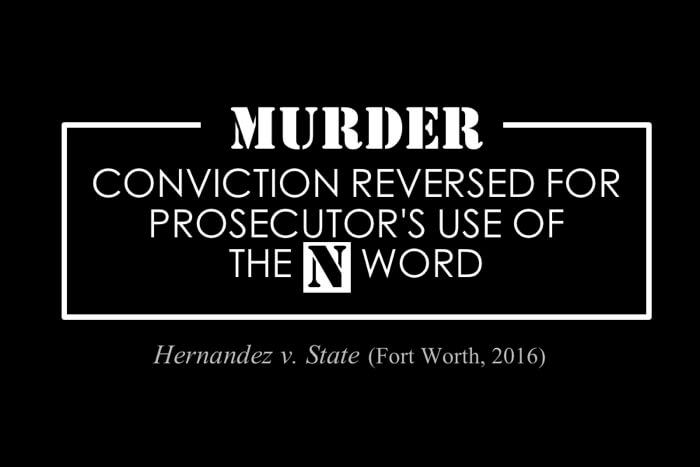
Murder Conviction Reversed for Prosecutor's Use of Racial Slur

By Brandon Barnett · Jury Trial, Trial Advocacy

Texas Prosecutor Uses the "N" Word During Closing Argument. Court of Appeals Reverses the Conviction.

Hernandez Racial Slur Error 2016In December of 2014, Appellant Luis Miguel Hernandez was convicted of the murder of Devin Toler, an African-American man. During the trial, Appellant claimed self-defense, arguing that Toler attacked him and that by killing him, he was defending himself from the attack. The prosecution, however, presented evidence that Appellant provoked Toler by his words, some of them racial slurs. The actual words of the alleged racial slurs were never presented to the jury in the testimony of any witness or otherwise. However, during closing argument, the prosecutor said the following:

"What were the words of provocation? I’ll tell you what the words of provocation were. [Appellant] called Devin and his family 'niggas.' That’s what it was."

The defense attorney promptly objected to the prosecutor's use of the racial slur as it was inflammatory and outside the evidence in the case. Ultimately, (after a heated bench conference) the judge sustained the objection and instructed the jury to disregard the counsel's comment, but did not specify which counsel or what comment the jury was to disregard. The defense did not move for a mistrial. The jury returned a verdict of guilty and sentenced Appellant to 14 years in prison.

See the majority opinion in Hernandez v. State (2nd Court of Appeals - Fort Worth, 2016)

What is a Proper Jury Argument?

On appeal to the Second Court of Appeals (Fort Worth), the Appellant challenged the judge's failure to declare a mistrial after the prosecutor's use of the "N" word. The court explained:

Proper jury argument falls into one of four areas: (1) summation of the evidence; (2) reasonable deduction from the evidence; (3) an answer to the argument of opposing counsel; and (4) a plea for law enforcement. Generally, error resulting from improper jury argument is subject to a harm analysis.

The appellate court held that not only were the prosecutor's comments in using the "N" word error, but that the prosecutor's comments constituted an "incurably prejudicial argument;" one that required a mistrial.

Is the "Incurably Prejudicial Argument" Waived if the Defendant Does Not Move for a Mistrial?

Texas courts have consistently held that to preserve error for an improper argument, the defendant must do 3 things:

  1. Make a timely and specific objection;
  2. Request and instruction to disregard if the objection is sustained; and
  3. Move for a mistrial if the instruction to disregard is granted.

Cockrell v. State, 933 S.W.2d 73, 89 (Tex. Crim. App. 1996), cert. denied, 520 U.S. 1173 (1997)

In this case, the defense satisfied 1 and 2, but did not move for a mistrial. The appellate court was then presented with the issue of whether the improper jury argument objection is waived if the defense does not move for a mistrial.  Texas precedent says the issue can be waived for failure to move for a mistrial. But the court does not find this to be wise.

"Logically, this position makes no sense. An incurably prejudicial argument requires a mistrial. If the trial court does not grant the mistrial, the court has committed error that requires setting aside the conviction and re-trying the case. Respectfully, if the argument is so prejudicial that it has deprived the defendant of a fair trial, the injury is fundamental."

The court provides further reasoning to depart from precedent, citing the tenuous political atmosphere surrounding race relations in America at the time of the trial.

The impact of the improper statement by the prosecuting attorney must be viewed in the context of the political atmosphere at the time of trial. The trial took place in early December 2014. On February 26, 2012, George Zimmerman, whose mother was from Peru, killed Trayvon Martin. Emotional discussions of Zimmerman’s ethnicity filled news commentary. Other killings made headlines. Among them was the death of Eric Garner while he was selling loose cigarettes in New York on July 17, 2014. The officer who killed him was Daniel Pantaleo. On August 9, 2014, Michael Brown was killed in Ferguson, Missouri. On August 11, 2014, Ezell Ford was killed in Los Angeles by two police officers, one of whom was Hispanic. And on November 23, 2014, twelve-year-old Tamir Rice was killed in Cincinnati, Ohio. Additionally, the Black Lives Matter organization was formed in 2013 in response to the acquittal of George Zimmerman in his trial for the murder of Trayvon Martin and was actively involved in protests nationwide.

With that, the Second Court held that the improper jury argument was not cured (and could not have been cured) by the judge's "perfunctory" instruction to disregard and that the error was preserved for appeal. The court then reversed the case and remanded back to the trial court.

Dissent Agrees that the Error Was Prejudicial, But Would Not Depart From Precedent

Justice Sudderth dissented. She is not willing to depart from Court of Criminal Appeals' precedent regarding the formal requirement to move for a mistrial. She writes:

Of all of the words in modern American English usage, including the slang and the vulgar, the “n-word” is of such infamy that it is generally referenced and understood only by its first letter. And with very few exceptions, such racially charged inflammatory language has no place in jury argument.

This is certainly the case when a prosecutor, using that language to secure a conviction, goes outside of the record to introduce it. Therefore, I agree with the majority that the prosecutor’s behavior was improper. It was inexcusable. It cannot be condoned. And the trial judge committed error in permitting it. Nevertheless, because we are constrained by precedent of the court of criminal appeals requiring preservation of this type of error, I am compelled to dissent.

It will be interesting to see whether the Court of Criminal Appeals will stick to their previous precedent or take this opportunity to change the law when it comes to an "incurably prejudicial argument" involving racial slurs.

Read full article

Speak with a Fort Worth attorney

Call (817) 993-9249 or send us a message to discuss your case.