Skip to content

July 2016

Page 1 of 2 · 6 articles

License to Carry Handgun LTC CHL

License to Carry a Handgun After Arrest or Criminal Charge in Texas

By Luke A. Williams · Weapons Charges
License to Carry Handgun LTC CHLThere are many consequences for persons arrested and charged with a crime in Texas.  One of the often overlooked considerations is whether and to what extent a criminal accusation impacts one's authorization to carry a weapon with a License to Carry (LTC), formerly a Concealed Handgun License (CHL). The reality of gun possession in today’s political climate is that the restrictions are many and increasing.

Texas has very specific guidelines regarding qualifications for obtaining a License to Carry a Handgun. But, what most do not realize is that there are also strict regulations in place while a person possesses that license – especially if a person is arrested and charged with a crime.

What happens to my License to Carry or CHL if I’m arrested and charged with a crime?

Texas Government Code 411.187 spells out the scenarios that require the Texas Department of Public Safety (DPS) to suspend one’s LTC or CHL. In regards to criminal charges, the department SHALL suspend an LTC if the license holder is charged with the commission of:

  • a Class A or Class B Misdemeanor;
  • an offense under Section 42.01 of the Texas Penal Code (Disorderly Conduct); or
  • any Felony offense.

In addition, a person’s LTC or CHL will be suspended if a person is arrested for any offense involving family violence or disorderly conduct and is subject to an active protective order.

How long will my License to Carry be suspended if I’m arrested and charged with a crime?

Unfortunately, the law is clear that the suspension will remain in place until the dismissal of the charges or for the duration of the protective order (in a family violence case.) Texas Government Code 411.187(c)(3).

What happens to my LTC or CHL if I’m convicted of the charge?

If you are convicted of any felony or of the offense of “Unlawful Carrying of a Handgun by a License Holder,” your license to carry a handgun will be revoked permanently. Texas Government Code 411.186 (3) & (4).

If you are convicted of a class A or class B misdemeanor, your license will remain suspended and you will only be able to re-apply for a new LTC when you once again meet the initial eligibility requirements.

A person is eligible for a LTC if they have not, in the five years preceding the application, been convicted of a Class A or Class B misdemeanor or disorderly conduct. What this essentially establishes is a 5-year waiting period from the time of your conviction to the time when you can apply again for your handgun license.

What about being convicted of offenses involving family violence?

Offenses involving family violence carry more significant consequences. If you are convicted of a Class C, Class B or Class A misdemeanor involving family violence, then Federal Law prohibits you from owning or possessing a firearm. Also, under Federal Law, even a plea to deferred adjudication constitutes a conviction and bars a person from owning or possessing a firearm. Because of this, a conviction for any misdemeanor involving family violence would prohibit you from ever being eligible to obtain your concealed handgun license in Texas. See Texas Government Code 411.172 (a) (9).
Read full article
Possesion of a Firearm by a Felon

Defining "Felon in Possession (of a Firearm) in Furtherance of a Crime"

By Brandon Barnett · Weapons Charges

5th Circuit Holds that Prosecutors need not provide evidence for each one of the Ceballos-Torres ‘Felon in Possession in Furtherance of a Crime’ factors.

Possesion of a Firearm by a FelonUS v Walker (5th Circuit 2016)

At trial, Henry David Walker pleaded guilty to conspiracy to possess with intent to distribute meth and possession of a firearm in furtherance of a drug-trafficking crime, violations of 21 U.S.C. §§ 846, 841(a)(1) and 18 U.S.C. § 924(c)(1)(A). On record at the arraignment hearing and post-plea, Walker admitted to possessing nine firearms, including a 32-caliber firearm, two 22-caliber rifles, two 20-gauge shotguns, two revolvers, and a 9-millimeter semiautomatic gun—all of which were found at the scene of the arrest. US v. Walker, 218 F.3d 415. The district court sentenced Walker to concurrent terms of 151 months in prison for the conspiracy charge, and an additional 60 month statutorily-imposed mandatory sentence for the possession of a firearm in furtherance of a drug-trafficking crime. Walker appeals to the Fifth Circuit Court of Appeals, arguing that “factual basis” established after the guilty plea was insufficient to prove that he possessed the firearms in furtherance of a drug-trafficking crime.

The Big Issues before the Fifth Circuit: Did the Government Satisfy the "Felon in Possession" Requirements?

Walker’s plea came before the factual basis for the charge was established on record—was the apple put before the cart? The Court must determine whether a factual basis can be established after a guilty plea, and if so, whether the factual basis for Walker’s conviction was sufficient. The Court must also determine whether prosecutors need to provide evidence for each “felon in possession” factors.

Federal Law Regarding Felon in Possession in Furtherance of a Crime

A guilty plea is insufficient in itself to support a criminal conviction—the court must satisfy itself, through an inquiry of the defendant or examination of the relevant materials in the record, than an adequate factual basis exists for the elements of the offense.” Fed. R. Crim. P. 11(b)(3); United States v. Adams, 961 F.2d 505, 508 (5th Cir. 1992).

Any person who, during and in relation to any crime of violence or drug trafficking crime…uses or carries a firearm, or who in furtherance of any such crime, possesses a firearm, shall, in addition to the punishment provided for such crime of violence or drug trafficking crime …be sentenced to a term of imprisonment of not less than 5 years…” 18 U.S.C. § 924(c)(1)(A)(i).

The mere presence of a firearm is not enough—possession of a firearm is ‘in furtherance’ of the drug trafficking offense when it furthers, advances, or helps forward that offense. United States v. Palmer, 456 F.3d 484, 489-90 (5th Cir. 2006); United States v. Ceballos-Torres, 218 F.3d 409, 410-411.

Factors that help courts determine whether the possession of the firearm was in furtherance of a drug-trafficking crime include: (1) type of drug activity; (2) accessibility of the firearm; (3) type of weapon; (4) whether weapons are stolen; (5) whether the possession is legitimate or illegal; (6) whether the gun is loaded; (7) proximity to the drugs or money; and, (8) the time and circumstances under which the weapons are found. Ceballos-Torres at 414.
The Fifth Circuit Analyzes the Ceballos-Torres Factors to Determine Walker’s Fate

Walker appeals to the Fifth Circuit, arguing that his case more closely aligns with United States v. Palmer, a case in which the Fifth Circuit reversed a defendant’s conviction based on lack of support under the Ceballos-Torres factors. The Fifth Circuit compares the three cases to analyze the factors.

 
WALKER PALMER CEBALLOS-TORRES
 Claiming no evidence of proximity of guns to the drugs.  Gun was locked in a safe.  Guns found alongside a substantial amount of drugs.
 Ammo matched the guns; most guns loaded.  Gun was not loaded.  Weapons loaded.
 Claiming no evidence of accessibility of the gun (no easy access). Ammo in the house did not match the gun. Ammo present that matched the guns.
 Walker is not a meth supplier.  Defense claimed he bought the gun for self-defense. Convicted felon in possession of a firearm.
 Nine firearms.  One unloaded firearm.  Multiple firearms.
 Denies weapons used in the furtherance of drug-related activity.  Denied the gun was used in relation to drug trafficking.  Court found weapons were in furtherance of drug-related crimes.

Here, the Fifth Circuit say that “the factual basis need not provide evidence for every single one of the Ceballos-Torres factors for a court to conclude that the defendant possessed a firearm in furtherance of a drug-trafficking crime,” rather, they are examples a court “might include” in its analysis “to help determine” a judgment. Further, the government need not provide evidence supporting each and every factor to determine guilt.

Because Walker possessed the firearms at his residence alongside the meth he supplied to dealers, he was a convicted felon at the time of the possession of the firearms, and because there were so many weapons present at the scene, the Fifth Circuit affirmed the district court’s conviction and sentence.

Read full article
Texas Police Protection Act

New Law To Increase Penalties for Violence Against Police Officers

By Brandon Barnett · Legislative Update, Police Violence

Texas Governor, Greg Abbott, Proposes Police Protection Act, Which Would Stiffen the Punishment for Violence Against Law Enforcement

Texas Police Protection ActOn Monday, Governor Greg Abbott called on both citizens and Texas lawmakers to get behind his proposed Police Protection Act in the 2017 legislative session. “While our state and the nation continue to mourn the heroes lost in Dallas, it is time for us to unite as Texans to say no more,” says Governor Abbott. The proposed legislation will strengthen penalties against those who are convicted of crimes where police officers are the target. Just this month alone, five Dallas police officers have been fatally shot and nine others injured when a shooter targeted police following a public demonstration. This past weekend, three Baton Rouge police officers were gunned down by a shooter who was also targeting law enforcement officers.

The purpose of the Police Protection Act (the “Act”) is to “make clear to anyone targeting law enforcement officials that their actions will be met with severe justice.” Under the proposed Act, Governor Abbott will extend hate crime protections to law enforcement officers, increase criminal penalties for any crime in which the victim is a law enforcement officer, whether or not the crime qualifies as a hate crime, and create a culture of respect for law enforcement by organizing a campaign to educate young Texans on the value that law enforcement officers bring to their communities, among other provisions. “At a time when law enforcement officers increasingly come under assault simply because of the job they hold, Texas must send a resolute message that the State will stand by the men and women who serve and protect our communities,” says Governor Abbott.

Governor Abbott’s proposed Act would make the police a protected class, where penalties for those perpetrating crimes against law enforcement would be increased incrementally. For example, assaults on police officers could be reclassified from Class C felonies to Class B felonies, and so on. Further, the Act will support efforts by Texas State Senator, John Coryn, and his proposed “Back the Blue Act,” which makes it a federal crime to kill, attempt to kill, or aspire to kill a police officer.

In recent weeks, lawmakers in other states have also made legislative provisions that protect police in the wake of the officer-targeted shootings. In North Carolina, Governor Pat McCrory signed a bill into law this week that makes dashcam video and bodycam footage exempt from public record, except under narrow sets of circumstances. In May, Louisiana Governor John Bel Edwards signed the “Blue Lives Matter” bill into law that makes an assault on veterans, police officers, emergency responders, and firefighters a possible hate crime. Louisianans convicted of misdemeanor hate crimes against officers will be fined $500 and face an additional sentence of up to six months.

In Texas, word of Governor Abbott’s proposed Act is already gaining favorable ground. Grimes County Sheriff Donald Sewell emphatically states, "The Sheriff's Association of Texas is very pleased to hear our Governor is behind an effort to protect peace officers across our state…and we support our Governor. We look forward to working with the Governor during the 2017 legislative session to pass these important protections." Dallas Police Association President, Rob Pinkston, echoes Sewell, saying “The Dallas Police Association applauds Governor Abbott’s bold plan in response to the recent wave of attacks on police officers.”

About the violence on law enforcement, Governor Abbott tweeted, “Texas is saying no more,” and, “We must unite and strengthen our commitment to protect law enforcement.” Ray Hunt, President of the Houston Police Officer’s Association says, “Governor Abbott’s solution is the right approach for Texas law enforcement officers and the people of Texas who support them.” Texas lawmakers will review the Police Protection Act in the 2017 legislative session, which begins January 10, 2017.


Read full article
THC Controlled Substance Analogue Designer Drug

Controlled Substance Analogue Ratio Equates to Higher Federal Sentence

By Brandon Barnett · Drug Crimes

THC Controlled Substance Analogue Designer DrugSynthetic Cannabinoids became popular in the 2000's when they were first marketed as "legal herbs." In 2008, chemical analysis revealed that these designer drugs were more than just herbs.  The military, in particular, had a big problem with Spice and K2 (two forms of synthetic marijuana) in the late 2000's, because they gave users a similar (or greater) high than marijuana, but they were not included in any federal schedule of controlled substances.  As these substances became more popular and widely consumed, the DEA banned their use in 2010 using emergency temporary powers and then later by placing them on Schedule I of Controlled Substance Act.

How Do Controlled Substances Analogues (Designer Drugs) Fit Into the Federal Drug Control Scheme?


United States v Malone (5th Circuit Court of Appeals - 2016)

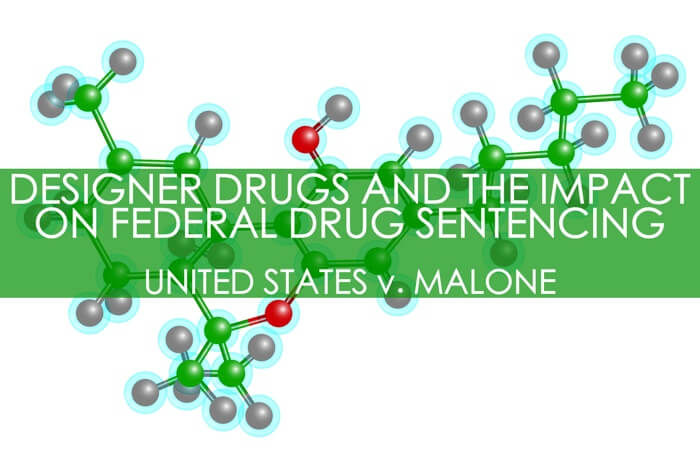
Thomas Malone and his business partner Drew Green owned NutraGenomics Manufacturing, LLC, a distributor of JWH-018, a synthetic cannabinoid substance, also known as “Spice” and “K2” on the street. However, in 2011 federal and state legislatures banned JWH-018 and other similar designer drugs or synthetic cannabinoids. Malone and Green began selling other synthetic cannabinoids, namely, AM-2201, known as “Mr. Miyagi…a mixture of AM-2201 and vegetable material that visually resemble[s] marijuana.” Eventually, Malone and Green ordered the mass manufacture of Mr. Miyagi, selling in bulk to a distributor in Louisiana. Although labeled as potpourri, Mr. Miyagi was supposed to be smoked like marijuana.

Malone Faced Federal Indictment For Possession and Distribution of Mr. Miyagi

A federal grand jury returned an indictment, charging Malone with one count of conspiracy to distribute and possess with intent to distribute AM-2201, and, one count of conspiracy to commit money laundering. Malone decided to take a plea agreement, pleading guilty to one count of conspiracy to distribute and possess with the intent to distribute a Schedule I Controlled Dangerous Substance, a violation of 21 U.S.C. §§846, 841(b)(1)(c), 813, 802(32)(A). The district court accepted Malone’s guilty plea of distributing not less than 1400 kilograms of AM-2201, and ordered a pre-sentence report. A pre-sentence report “PSR” is a report created by a probation office in anticipation of the punishment phase of a trial—the PSR in this case set out to determine “the base offense level using the marijuana equivalency of the most closely related controlled substance to AM-2201.”

Pre-Sentencing Report’s Mathematical Formula Indicated Severe Penalty

The PSR listed Tetrahydrocannabinol, THC, as the most closely related controlled substance to AM-2201. Further, the federal Drug Equivalency Tables indicated that a 1 to 167 ration be applied to convert the 1400 kilograms of AM-2201 into marijuana for the purpose of sentences under the federal Sentencing Guidelines. Using this mathematical equation, it was determined that Malone should be sentenced for 233,800 kilograms of marijuana—the highest level set forth by the Drug Equivalency Tables. At trial, each side put forth an expert witness arguing for and against the use of the THC and the THC ratio set forth in the PSR.

Battle of the Experts at Trial

The Government’s Expert

The Government called Dr. Jordan Trecki to testify that THC is the most closely related substance to AM-2201. Dr. Trecki relied on a scientific study “showing that both THC and AM-2201 bind to the same cannabinoid receptor” in the brain. Second, he testified about a study on rats where the rats could not tell the difference between THC and AM-2201. Third, he discussed AM-2201’s potency and effects on humans. Dr. Trecki told the court that THC and AM-2201 are close in chemical make-up and in effect on the structures of the brain. Dr. Trecki said, however, that there was no scientific basis for the 1:167 ratio.

Malone’s Expert

Malone’s attorney called Dr. Nicholas Cozzi, who stressed the importance of comparison of the two drug compounds—THC and AM-2201—in humans, not just in animals. Dr. Cozzi criticized Dr. Trecki’s analysis because Trecki “combined the results of several studies” and that the studies were not conducted on humans, rather they were animal studies. Dr. Cozzi stated that marijuana, not THC, was the most closely related substance to AM-2201 because it’s smoked and inhaled, like marijuana, and because both substances are consumed for their effect. Dr. Cozzi agreed with Dr. Trecki on one point—that the 1:167 ratio was not rooted in science.

The Big Issue Before the Fifth Circuit

Relying heavily on Dr. Trecki’s expert testimony, the District Court sentenced Malone to 117 months imprisonment and three years of supervised release following prison. The court noted that “the ratios in sentencing guidelines are often arbitrary… [however] the ratios seek to outline the relative harm of certain drugs.” Malone appeals to the Fifth Circuit Court of Appeals.

The Fifth Circuit must determine whether THC really is the most closely-related substance to the controlled substance analogue, AM-2201, and if so, whether the 1:167 ratio is a reasonable conversion for sentencing purposes.

The Fifth Circuit Weighs In

Here, the Fifth Circuit points out that the district court spent a day holding an evidentiary hearing on the equivalency of AM-2201 to other drugs, “it is significant that the district court gave this matter studied attention.” The court notes that each side had the ability to present an expert witness and to cross examine. “Nothing in the record leaves us with…the conviction that a mistake [was made].”

Second, the Fifth Circuit compares AM-2201 and marijuana, disagreeing with Dr.Cozzi’s assertion that both drugs are smoked and inhaled in the same manner. “Marijuana is not consumed way…there is no evidence that a user would smoke a pure form of AM-2201, just as a user would not smoke pure THC.”

Third, the Fifth Circuit says that the district court did not have to “engage in a piece-by-piece analysis of empirical grounding behind…[the] sentencing guidelines.” United States v. Duarte, 569 F.3d 357, 366-67 (5th Cir. 2009). Accordingly, the Court says that only the Commission on sentencing guidelines can change the guidelines, and therefore, does not rule on this issue. The Fifth Circuit agrees with the holding and reasoning of the district court—Malone’s sentence is affirmed.
*This case consolidates two cases, United States v. Malone and United States v. Green.

Read full article
Exigent Circumstances Warrantless Blood Draw

Understaffing of Police Cannot Create the “Exigency” to Justify a Warrantless Blood Draw

By Brandon Barnett · DWI

In a Warrantless DWI Blood Draw Case, State Offers "Understaffing of Police" as an Exigent Circumstance.

Exigent Circumstances Warrantless Blood DrawBonsignore v State (2nd Court of Appeals - Fort Worth, 2016)

After traveling eighty miles an hour in a forty miles per hour zone, Jeremy Bonsignore pulled into a Waffle House and started walking toward the restaurant. Unknown to Bonsignore, law enforcement had been following him for several minutes. Once the officer pulled into the parking lot, he activated his lights and began yelling at Bonsignore to stop walking. Bonsignore turned around, stumbled, and lost his balance. The officer noted the presence of a strong odor of alcohol and that Bonsignore’s eyes appeared glassy.

Bonsignore admitted to having a few drinks earlier in the day, which prompted the officer to conduct several field sobriety tests. Bonsignore failed them and then abruptly refused to do anymore tests or provide a breath or blood sample. Bonsignore was placed under arrest at 1:49 am. Dispatch informed the officer that Bonsignore had two prior DWI convictions, which could amount to Bonsignore being a repeat DWI offender, a felony offense. With this information in mind, the officer instructed a second officer to take Bonsignore to the hospital for a mandatory blood draw. The blood draw was conducted at 2:55 am. Bonsignore did not consent to the taking of his blood and the officer did not obtain a warrant.

Warrantless Blood Draw Issue at Trial

Before trial began, Bonsignore filed a motion to suppress the results of the blood draw, arguing that the blood draw was warrantless, and therefore, unconstitutional. The motion was never officially ruled upon, although the court did take the motion under advisement. During trial, when asked why he ordered the blood draw, the officer said that Bonsignore’s “two prior convictions were his only authority for obtaining the blood draw.” The officer did not attempt to obtain a search warrant, and he acknowledged that Bonsignore did not give his consent to a blood draw.

The officer testified that he relied solely on the statute, Texas Transportation Code 724.012, for authority to order the draw against Bonsignore’s will. Pleading guilty to the charges, the trial court issued Bonsignore a two-year sentence. Bonsignore appealed, arguing that his motion to suppress the evidence should have been ruled upon because the blood draw was taken without his consent and without a search warrant, violating the ruling in Missouri v. McNeely, 133 S. Ct. 1552 (2013). The State argues that (1) Bonsignore’s blood-alcohol level would dissipate over time, (2) he was a repeat felony offender, and (3) the police department was small and understaffed, and that obtaining a warrant in this case would have been overly-burdensome for the officers that night.

Is "Dissipation" an Exigent Circumstance to Justify a Warrantless Search?

In the wake of the McNeely case, the Second Court of Appeals must determine whether Bonsignore’s blood draw was constitutional, and, whether the State may rely on an exigency “emergency circumstances” argument as an exception to the Fourth Amendment.

Texas Transportation Code

Section 724.012(b)(3)(B) states that blood or breath samples may be required to be taken when the suspect is arrested for DWI and he refuses to give the specimen voluntarily, so long as the suspect has two prior DWI convictions, “although [the code] does not expressly authorize taking the specimen without a warrant.” State v. Swan, 483, S.W.3d 760, 764 (Tex. App.—Fort Worth 2016, no pet.).

However, “the explicit refusal to submit to blood testing overrides the existence of any implied consent and that implied consent that has been withdrawn by a suspect cannot serve as a substitute for the free and voluntary consent that the Fourth Amendment requires.” State v. Villarreal, 475 S.W.3d 784, 800.

Precedent Case Law: Missouri v. McNeely

“The natural metabolism of alcohol in the bloodstream [does not] present a per se exigent circumstance justifying an exception to the Fourth Amendment’s warrant requirement for nonconsensual blood testing in all drunk-driving cases.” McNeely, 133 S. Ct. at 1556, 1558.

The Second Court of Appeals Weighs In

The Second Court of Appeals agreed with Bonsignore. “The police may not create their own exigency to make a warrantless arrest or search.” Parker v. State, 206 S.W.3d 593, 598 (Tex. Crim. App. 2006). “Exigent circumstances do not meet Fourth Amendment standards if [law enforcement] deliberately creates the [circumstances].” Id.

Here, the Court held, law enforcement knew that it was not a “No Refusal Weekend” in Texas. Further, the police department knew that it only had three officers on duty the entire night Bonsignore was arrested. In fact, understaffing the department was a typical occurrence. There was nothing out of the norm about the number of officers on duty that night. “Deliberately scheduling an insufficient number of patrol officers on an evening shift does not constitute an exigent circumstance.” State v. McClendon, NO. 02-15-00019-CR, 2016 WL 742018 (Tex. App.—Forth Worth, Feb. 25, 2016, no pet.).

Additionally, the department had a protocol for obtaining warrants, even in the absence of magistrates “on call.” Also, there was no earth-shattering emergency or problem that prevented the officers from making attempts to secure a warrant for Bonsignore’s search. The Court makes a point to highlight the efficiency of fax machines for the purposes of securing warrants, “thanks to the fax machine, [law enforcement] could …request a search warrant” and “thanks again to a fax machine…once [law enforcement] had the search warrant, [they] could fax it directly to a hospital instead of driving [the warrant] there.” The argument that the police department is small was unpersuasive for the Second Court of Appeals. For these reasons, the Second Court of Appeals reversed the trial court’s ruling, and remanded the case to the trial court for a new trial.

Read full article

Speak with a Fort Worth attorney

Call (817) 993-9249 or send us a message to discuss your case.