
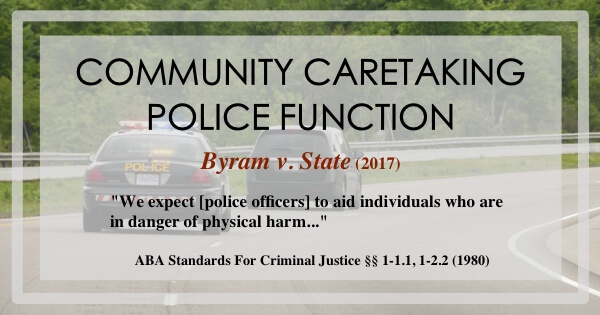
Community Caretaking Function: Police May Stop without Reasonable Suspicion
By Brandon Barnett · DWI
 In November of 2015, we wrote about State v. Byram, a DWI case out of Tarrant County. In Byram, the 2nd Court of Appeals held that a "hunched over" passenger in a vehicle was not enough to invoke the police "community caretaking" function to allow the police to initiate a traffic stop without reasonable suspicion of a violation. The 2nd Court reversed the DWI conviction and remanded the case back to the trial court. The State appealed this decision to the Texas Court of Criminal Appeals, which issued its opinion today.
When May the Police Invoke the "Community Caretaking" Function to Make a Stop or Detention Without Reasonable Suspicion?
Byram v. State (Tex.Crim.App. 2017)
In this case, State argued that the police officer was engaged in his "community caretaking" function when he pulled the driver over. The State contends that this was a proper exercise of police authority and that the primary purpose of the stop need not be to investigate any alleged violation.
Reviewing the facts in the light most favorable to the trial court's ruling (denying the suppression motion), the CCA agreed with the State and explained its view on the Community Caretaking function:
Local police officers frequently engage in “community caretaking functions,” totally divorced from the detection, investigation, and acquisition of evidence relating to the violation of a criminal statute. Cady v. Dombrowski, 413 U.S. 433, 441 (1973). “As part of his duty to ‘serve and protect,’ a police officer may stop and assist an individual whom a reasonable person—given the totality of the circumstances—would believe is in need of help.” Wright v. State, 7 S.W.3d 148, 151 (Tex. Crim. App. 1999). However, because the reasonableness of a community-caretaking seizure sprouts from its dissociation from the competitive enterprise of ferreting out crime, “a police officer may not properly invoke his community caretaking function if he is primarily motivated by a non–community caretaking purpose.” Corbin v. State, 85 S.W.3d 272, 276-277 (Tex. Crim. App. 2002).
The Court went on to lay out a two-step test for determining whether an officer may properly invoke his community-caretaking function:
- whether the officer was primarily motivated by a community-caretaking purpose; and
- whether the officer’s belief that the individual needed help was reasonable.”*
*The standard for reasonableness is no different when the officer stops a vehicle to check the welfare of a passenger rather than the driver. Wright, 7 S.W.3d at 151.
In this particular case, the CCA held, "[the officer] saw a woman in a precarious situation, and acted reasonably to help her by first asking whether she was okay, and then conducting a traffic stop when his
question went unheeded. This is the sort of 'sound, commonsense police work that reason
commends, rather than condemns.'"

 Jeffery Pruett inherited a one-third shared interest in the family home with his two siblings after the death of their elderly parents. The adult siblings had a long history of quarreling over Pruett’s living arrangements, as he moved in and out of the residence prior to the deaths of their parents. Fed up, Pruett moved into a motor home, and was often seen by the neighbors driving around the neighborhood. Meanwhile, Pruett’s siblings listed the home for sale with the intention of dividing the proceeds equally between the three siblings.
 Many people have the perception that the juvenile system is simply a slap on the wrist for kids, regardless of the offense. The reason for this belief is the fact that most kids in the juvenile system get probation. But, probation is not always that simple or easy. This is an introduction to juvenile probation in Tarrant County. This article will cover the reasons behind the tendency towards probation, the length and parameters of probation and what it can include.
 What happens when an old criminal law is rendered null and void? Do people convicted of such crimes get to walk free, or, are the convictions upheld in the interests of justice? The Texas Court of Criminal Appeals (“CCA”) filed an ex parte case (the court filed the case on its own volition) to determine whether David Lea's punishment for his 2008 child pornography conviction should be set aside on constitutional grounds. The case was met with a dissent by Judge Yeary and the CCA reached a very interesting conclusion.
 Barnett Howard & Williams PLLC recently completed a full renovation of the historic Atelier Building (1905) in downtown Fort Worth. The Atelier Building is one of the oldest buildings in downtown Fort Worth, Texas that stills stands today. Built in 1905, the Atelier Building housed several different businesses over its 112-year history, including architects, banks, and a restaurant at one time. Located on 8th street between Houston and Throckmorton, the Atelier Building is marked by its dual terra-cotta fireplaces and marble facade.