
Skip to content

April 2016

Page 1 of 2 · 7 articles

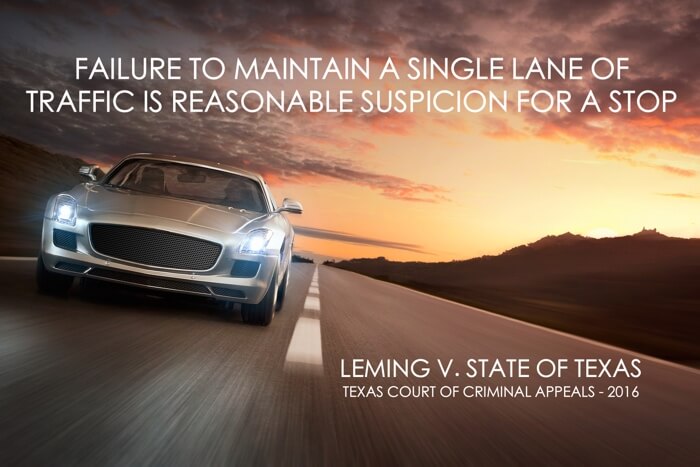
Failure to Maintain a Single Lane of Traffic DWI Attorney Fort Worth

Failure to Maintain a Single Lane of Traffic Leads to a DWI Conviction

By Brandon Barnett · Reasonable Suspicion

Does an Officer have "Reasonable Suspicion" to Make a Traffic Stop When Vehicle Weaves Inside a Traffic Lane?

Failure to Maintain a Single Lane of Traffic DWI Attorney Fort WorthJames Leming was convicted of DWI after erratic driving alarmed fellow motorists to call police. On January 20, 2012, a citizen filed a report of a “swerving Jeep” and Officer Manfred Gilow responded. As the dashboard camera confirmed, the Jeep traveled thirteen miles under the speed limit; Gilow followed the Jeep for several miles. Officer Gilow observed the Jeep, “drifting [within the] lane to the left [with] tires on the stripes… back to the right, almost hit[ting] the curb twice.”

Officer Gilow said he did not stop the Jeep immediately because the heavy traffic made a traffic stop unsafe at the time. He wanted to wait until the Jeep approached “the 3000 block because I knew there’s parking lots where he could pull over [safely].” Gilow justified the warrantless stop under the Community Caretaking Exception, “due to the …[low] speed…and…swerving, it was an indication that the driver [was] somehow either distracted or physically not able to operate [his] motor vehicle carefully.”

Eventually, the officer pulled Leming over, noting on the police report, the smell of liquor. Though Leming denied drinking, he said he had taken some prescription pills. Officer Gilow conducted field sobriety tests and placed Leming under arrest for DWI.

Read the full opinion in Leming v. State.

Leming's DWI Trial and Motion to Suppress the Stop

Before the trial began, Leming filed a motion to suppress the traffic stop, which was denied. At trial, Leming pled guilty to and was convicted of DWI. Because Leming had two prior DWI convictions (a felony under Texas law), the court assessed punishment at ten years’ imprisonment. Tex. Penal Code § 49.09(b)(2).

The Sixth Circuit Court of Appeals reversed the trial court’s ruling, holding that the trial court should have granted the motion to suppress. Leming v. State, 454 S.W.3d 78 (Tex. App.—Texarkana 2014). The Sixth Circuit concluded that Gilow lacked reasonable suspicion to detain Leming for the offense of failure to maintain a single lane under Section 545.0600(a) of the Texas Transportation Code. The court reasoned “in order for it to have been unlawful, the encroachment must have been made unsafely; [here,] there was no real danger of his colliding with another vehicle in an adjacent lane.” The State’s Prosecuting Attorney petitioned the Court of Criminal Appeals for discretionary review, arguing that the citizen’s report coupled with Officer Gilow’s observations were sufficient for reasonable suspicion that Leming was driving the Jeep under the influence.

The Issue Before the Texas Court of Criminal Appeals Regarding the Traffic Stop

The Court of Criminal Appeals had to determine whether a driver must BOTH fail to maintain a single lane AND not change lanes without checking to assure the maneuver can be accomplished safely, before it may be said that a driver has committed an offense. Such an offense would rise to the level of reasonable suspicion for a constitutionally-sound traffic stop.

What Does the Texas Transportation Code Say About Driving Within a Single Lane?

Section 545.060(a) states that “an operator on a roadway divided into two or more clearly marked lanes for traffic (1) shall drive as nearly as practical entirely within a single lane; and (2) may not move from the lane unless that movement can be made safely.”

The CCA Holds that a Driver Must Maintain a Single Lane AND Must not Leave the Lane Unless it is Safe.

The CCA explains that the fact that both the requirement to stay within a single lane as for as practical and the prohibition to not leave that lane unless it is safe to do so, originally appeared in the same subsection of the statute, does not indicate that the Legislature intended that both must be violated before an offense has occurred. Rather, the CCA believes that the Legislature intended a violation of EITHER part of the statute constitutes separately actionable offenses.

The CCA says that Officer Gilow knew from personal observations, as well as from the citizen’s report, that Leming had some sort of trouble maintaining a steady driving pattern while traveling under the speed limit. “That was sufficient information to justify a temporary detention to investigate whether Leming had actually failed at some point to remain in his dedicated lane of traffic as far as it was practical to do so under the circumstances—it matters not whether that failure was unsafe.” Further, Officer Gilow had an objectively reasonable basis to suspect Leming of driving under the influence.

As a matter of principle, the CCA notes, “it [would be] counterproductive and contrary to common sense to set the reasonable suspicion bar for DWI so high that law enforcement must hesitate to investigate such hazardous driving for fear that the stop will later be invalidated.” In a Concurring Opinion, Judge Richardson adds, “I believe [the community caretaking exception] provided justification for the officer’s stop, where, a reasonable police officer—given the totality of the circumstances-would believe [someone] is in need of help.” Dissenting, Judge Keasler stated, “this is a close case…the majority reaches the wrong result by misconstruing the statute and finds reasonable suspicion on the basis of a single insufficient articulable fact.” Judge Newell also dissented in this case.
Read full article
Texting While Driving Cell Phone Search

Driving While InTEXTicated: Hand Over Your Cell Phone or Lose Your License

By Brandon Barnett · Search & Seizure

Lawmakers and Forensic Engineers Introduce the Textalyzer to Combat Distracted Driving in New York

Texting While Driving Cell Phone SearchDid you talk on your mobile phone while driving to work this morning? Check your email? Have you ever asked Siri for help selecting a restaurant for dinner while you are driving around a new city? What about the urgent text from your boss—did you glance at that while driving? Ideally, we should answer each question with an emphatic, “No!” However, we don’t live in an ideal world—many drivers on Texas roads are distracted by mobile devices every time they drive. Just look over at the driver next to you and you'll see it.


Distraction.gov, the official government website for distracted driving statistics, reports that in 2014, over 3,000 people were killed in the United States by distracted drivers. To combat the growing problem, lawmakers in New York are reviewing proposed legislation that would allow police to obtain the mobile devices of each person involved in a car accident for immediate testing by a Textalyzer.

What is the Textalyzer?

The Textalyzer is a mobile kiosk installed into law enforcement vehicles. The Textalyzer helps law enforcement determine whether someone involved in a car accident was distracted by a mobile device at the time of the accident. Created by the Israeli-based mobile forensics technology firm, Cellebrite, the Textalyzer, known in the techie world as the “UFED InField Kiosk,” conducts a scan of the phone to determine whether the device’s voice, text, or data features were used at the time of an auto accident.

According to Cellebrite’s UFED InField Kiosk datasheet, “officers and investigators can conduct a forensically sound, logical extraction of mobile device text messages, call logs, emails, etc., and quickly view and act decisively on potential evidence.” Almost every type of mobile device can be accessed by the UFED InField Kiosk, “the UFED Series is able to extract, decode, analyze and report data from thousands of mobile devices, including, smart phones, legacy and feature phones, portable GPS devices, tablets, memory cards and phones manufactured with Chinese chipsets.”

The New York Law | New York Senate Bill S6325A

In New York, Senate Bill S6325A is currently “in committee” but progressing with strong support. If signed into law, it would require drivers who have had car accidents to provide law enforcement with all of their mobile devices so that police could conduct a Textalyzer scan on the device at the scene. Although the Textalyzer is able to “scrape” all of the data from a phone, the mobile kiosks in New York would only be able to tell law enforcement whether the device was used and at what time, circumventing some Fourth Amendment privacy arguments. Information obtained at the scene would likely become evidence to be used in a case against the owner of the mobile device. Motorists who are found “guilty” will face more serious charges and tougher penalties than those found not guilty of being distracted.  If a motorist refuses to provide his or her cell phone to police officers for inspection, the new law provides that the person's driver's license could be suspended (similar to the refusal of breath or blood testing in a DWI context).

The bill began as a result of intense lobbying in part by the Distracted Operators Risk Casualties group, a group focused on creating tougher laws and stricter penalties for distracted drivers to protect innocent people from injuries caused by distracted driving. The co-founder of the group lost his son to distracted driving.

Mobile Forensics Data Collection and Analysis Creates Many Unanswered Legal Questions

The technology to “check” each of our phones at the scene of a car accident is here. The question remains—what will lawmakers decide to do with it? Further, unless legislatures provide clarification it, it will be up to the courts to wade through ambiguities. For example, what if drivers use “hands-free” options on mobile devices while operating a motor vehicle—how is such use different from using the radio or talking with a passenger—isn’t radio use just as distracting? Or what if a driver is distracted by a device and passes that device to a passenger after having an accident? Further, what if a distracted driver does not disclose he possesses a mobile device? What if a distracted driver has two phones, but only discloses one of the phones—the phone he wasn’t distracted by—to law enforcement? The “what ifs” are endless.

The Fourth Amendment protects from unreasonable searches and seizures—will the data itself (contact lists, the context of text messages, music playlists, the content of email, etc) be collected? If so, could the content of the data be held against a “distracted driver” in other court cases? Will we, perhaps, lose any reasonable expectation privacy altogether in our phones? Safety or privacy—which do you value more? Currently, Texas does not have a law like this in the works, but it could only be a matter of time if other states continue with this trend.

Read full article
HIPAA Medical Record Search Warrant DWI

HIPAA Does Not Bar Admissibility of Private Medical Records in Criminal Case

By Jason H. Howard · DWI, Evidence

Does HIPAA Impact Fourth Amendment Standing When the State Obtains Medical Records in a Criminal Investigation?

HIPAA Medical Record Search Warrant DWIWe’ve all signed the “HIPAA” privacy statements at the doctor’s office before treatment. The HIPAA Privacy Rule mandates nationwide standards to protect our medical records and personal health information by establishing safeguards, such as disclosure rules, patient authorization, and uniform protocols for the electronic transmission of medical data. HIPAA also grants patients the right to their own health information, but what about others? Does HIPAA prohibit the release of health information in a criminal investigation? What if that information is obtained via a grand jury subpoena?

State v. Huse (Tex. Crim. App. 2016)

One Month After Car Accident, Man is Charged with DWI

On February 13, 2010, Hayden Huse ran off the road and crashed into a cotton field at two in the morning. When law enforcement responded to the scene, they smelled alcohol on Huse’s breath. Instead of giving him a sobriety test, they transported him to the local hospital for injuries he sustained. During the medical exam, the hospital ran routine blood work. A few hours later during an interview with law enforcement, Huse admitted that he consumed six or seven alcoholic drinks the previous evening. However, he refused law enforcement’s request for a breath or blood specimen for blood alcohol analysis.

One month later, based upon the police report taken of Huse’s car accident, a Lubbock County Assistant District Attorney filed an application for a grand jury subpoena to obtain Huse’s medical records from the hospital, even though no grand jury had been investigating Huse. The hospital complied with the subpoena, providing Huse’s medical records, along with a business records affidavit. The records revealed that approximately two hours after the car accident, Huse’s blood alcohol concentration was .219—an amount well above the legal limit.

Huse Files a Motion to Suppress the Evidence

Huse filed a motion to suppress the records at a suppression hearing. The trial court granted his motion to suppress on the grounds that the records were obtained in violation of the Fourth Amendment and that the Assistant District Attorney misused the grand jury subpoena process. The State appealed to the Seventh Court of Appeals, which reversed the trial court’s suppression order because “[Huse] lacked standing to raise a Fourth Amendment challenge…and [because] the State did not acquire [Huse’s] medical records through an unlawful grand jury subpoena.” State v. Huse, No. 07-12-00383-CR, 2014 WL 931265 (Tex. App.—Amarillo Mar. 6, 2014). Huse filed a petition to the Court of Criminal Appeals for a discretionary review of his case.

The Two Big Issues for The Court of Criminal Appeals

The Court of Criminal Appeals set out to determine whether the Health Insurance Portability and Accountability Act of 1996 (“HIPAA”) impacts Fourth Amendment standing when the State obtains medical records in a criminal matter, and, whether the State acquired Huse’s records via a grand jury subpoena that potentially violated HIPAA.

The Fourth Amendment and Reasonable Expectation of Privacy

Under the Fourth Amendment, “the right of the people to be secure in their persons, houses, papers, and effects, against unreasonable searches and seizures, shall not be violated.” U.S. CONST. amend. IV. “The provision protects people, not places.” Katz v. United States, 389 U.S. 347, 351 (1967). In order to raise a Fourth Amendment claim, a person must have legal standing, that may be “predicated on…a reasonable expectation of privacy principle.” United States v. Jones, 132 S.Ct. 945 (2012); Florida v. Jardines, 133 S.Ct. 1409 (2013).

State v. Hardy: The Precedent Case for the CCA

In Hardy, the CCA recognized that when the State itself extracts blood from a DWI suspect, and then subsequently conducts a blood alcohol analysis, then two “discrete searches” have occurred for a Fourth Amendment analysis. State v. Hardy, 963 S.W.2d 516 (Tex. Crim. App. 1997). The State neither extracted the sample nor conducted the blood alcohol analysis. As a result, the CCA concluded that the “Fourth Amendment does not apply to a search or seizure, even an arbitrary one, effected by a private party on its own initiative.” Skinner v. Railway Labor Exec. Assn., U.S. 602, 624 (1989). Further, “society [does not] recognize a reasonable expectation of privacy in privately-generated and maintained medical records that would show the result of a blood alcohol analysis [in a DWI investigation].” Hardy, 963 S.W.2d at 525-27.

The CCA Decides Whether HIPAA Trumps the Holding In Hardy?

Here, the CCA says that the State neither extracted nor analyzed Huse’s blood sample—the third-party hospital did. Huse, therefore, has no Fourth Amendment standing because he had no reasonable expectation of privacy in his privately-generated and maintained medical records. Further, “whatever interests society may have in safeguarding the privacy of medical records, [such interests] are not strong to require protection of blood-alcohol test results taken by hospital personnel solely for medical purposes after a traffic accident.” Id. But what about HIPAA? Does HIPAA trump the holding in Hardy?

The CCA explains that while HIPAA “might support a broader claim that society recognizes that patients have a legitimate expectation of privacy in their own medical records, generally, HIPAA does not undercut the Court’s holding in Hardy.” Further, the CCA states, “HIPAA expressly permits the disclosure of otherwise protected health information when it is sought by grand jury subpoena.”

In sum, Huse had no expectation of privacy in third-party generated and maintained medical records for a Fourth Amendment claim, and, no provisions in HIPAA specifically deny the disclosure of health information in the event of a criminal investigation. The CCA affirms the judgment Seventh Court of Appeals that Huse's medical records shall not be suppressed.

Read full article
Johnny Manziel Grand Jury Domestic Violence

Why is Johnny Football's Case Going To The Grand Jury?

By Luke A. Williams · Domestic Violence, Grand Jury

Is it unusual for a misdemeanor case go to a grand jury? Simply put, YES.

Johnny Manziel Grand Jury Domestic ViolenceMost misdemeanor cases in Texas are charged by way of a document called an ”information." An information does not have to be issued by a grand jury. The information can simply be prepared and reviewed by a District Attorney and then subsequently filed in a court with proper jurisdiction. Felony cases, on the other hand, must be indicted by a grand jury unless a defendant chooses to waive indictment and proceed without one.
What is a Grand Jury?

A grand jury in Texas is a group of 12 lay people qualified under the Texas Code of Criminal Procedure. These people must be citizens of the county in which the grand jury sits amongst other basic qualifications. Ultimately, the grand jury’s job is to listen to facts presented to them regarding the cases that they review and determine if probable cause exists for the State to continue forward to court. The grand jury does not have to be convinced beyond a reasonable doubt as to the person’s guilt; they simply need to determine whether it is probable that the person committed the alleged offense based on the facts and testimony presented.

People often mistake a grand jury for a petit jury like they see in movies and television. A grand jury is very different from the juries that hear and decide the final trial. During a grand jury proceeding, there are no arguing defense attorneys or heated opening and closing statements, and there is no judge that physically presides over the process. The grand jury meets together in private room with prosecutors and witnesses. A major distinction of the grand jury is that all grand jury proceedings are secret. The Texas code of criminal procedure clearly states that all grand jury proceedings “shall be secret.” Another basic distinction is that the grand jury is organized and run solely by the district attorney’s office. The grand jury is essentially a tool used by and for the district attorney.

Why is Johnny Manziel's Misdemeanor Allegation Going Before the Dallas Grand Jury?

So – now that you know what a grand jury is and what they do – what does this mean for Johnny Football? If the filing of an "information" is the normal course of action for misdemeanor cases in Texas, why will Dallas County grand jurors review Johnny Manziel’s case tomorrow? That answer rests solely with the Dallas County District Attorney. We can only speculate as to why this may be.

Manziel’s case is obviously high profile for Dallas. If the Dallas DA’s office were to take the case and simply file it with an information or not reject it without the review of the grand jury, they face scrutiny from both sides of the aisle. If they file the case, Manziel’s supporters would claim that the DA’s office is trying to unfairly make an example of his celebrity status and constant publicized antics. However, if they refuse to file the case, Manziel’s critics and domestic abuse activists might claim that his popularity, money, and status are unfairly allowing him out of another sticky situation.

So, what better way to take the District Attorney’s name off of the ultimate decision than to let the Dallas County community – a.k.a. the grand jury – make it? More than likely this is precisely why, unlike most other misdemeanor cases in Dallas County, the grand jury will review Johnny Manziel’s case.

Does this make Johnny Manziel's Case a Felony?

No. A grand jury can hear a misdemeanor case just like it can hear a felony case, we just do not see grand juries used for misdemeanor cases very often. If the grand jury votes to issue an indictment, Manziel only faces a misdemeanor charge for Assault (Bodily Injury) to a Family Member.  This offense is a Class A misdmeanor which carries a punishment range of 0-365 days in county jail and a fine up to $4,000.

Ultimately, this may just be the fairest way for the State to proceed and review Johnny Football’s case and precisely the right time to use the grand jury for a misdemeanor case. As a defense attorney, I wish all of my misdemeanor clients got the benefit of a grand jury review, but the volume of cases is just too high for the State to be expected to process all felonies and misdemeanors through a grand jury.

The jury is still out on Johnny Football’s NFL career, but tomorrow the Dallas county grand jury gets to decide if even more juries lie ahead for this once seemingly-invincible Heisman Trophy winner.

Links to more Manziel Grand Jury Articles:

Read full article
Dismissal Acquittal Double Jeopardy

Dismissal or Acquittal? The Difference Matters

By Brandon Barnett · Double Jeopardy, DWI

DWI Charge Did Not Include a Year in the Allegation

Dismissal Acquittal Double JeopardyLouis Jarvis, Jr. and his wife Jennifer Jones were charged with driving while intoxicated arising out of separate but related incidents on the same evening. Both pled no contest to the charges against them. But before they were found guilty, it was discovered that neither complaint against Jarvis or Jones alleged a year that the offense was committed. The trial court granted their motions to acquit. The State appealed.

The trial court stated, “The date of an offense is a key element of the offense which must be pled and proved. There is no question that it was not pled in this case nor was any trial amendment requested to amend the Information to amend the pleadings. It is my belief that the law is very clear in this case, that the State accepted its burden of proof and failed to meet it.”

The State filed a motion for a rehearing in the two cases and argued that “acquittals could not be entered because jeopardy had not attached, the trial court had never accepted the no-contest pleas and found the defendants guilty, and effectively dismissing with prejudice the prosecutions was improper.” The trial court denied the motions for rehearing. The State appealed.

10th Court of Appeals Holds that the Acquittals were Actually Dismissals

The Tenth Court of Appeals then reviewed the appeal. The Tenth Court of Appeals disagreed that the State had accepted a burden of proof. The Court held that the State is not required to introduce any evidence to support a plea to a misdemeanor and that the trial court has not authority to weigh the sufficiency of the evidence in a guilty plea to a misdemeanor case. The Court found that the Trial Court’s problem was with the State’s charging instruments, not with the State’s evidence. The Appellate Court concluded that this was not an acquittal but was a dismissal with prejudice without the State’s consent.

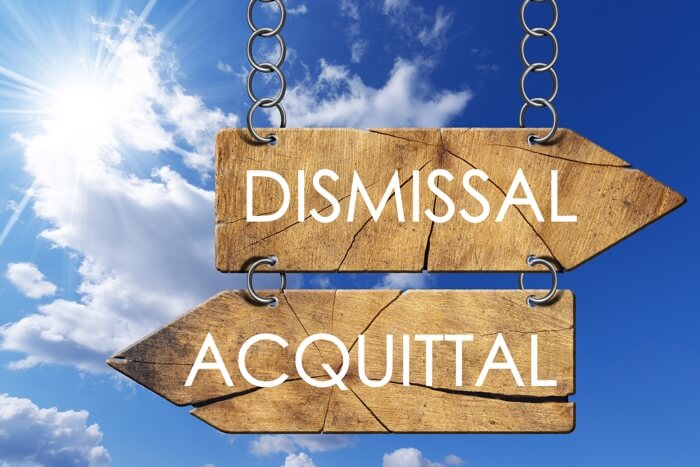
This might sound like the same outcome, but it is in fact very different. A dismissal, usually occurring before trial begins, means that a case can be tried again so long as the statute of limitations has not expired. Whereas, an acquittal means that a trial was held (and jeopardy attached) and now the defendant cannot be tried again for this matter. Though these seem like subtle nuances, the difference between an acquittal and a dismissal can have huge implications on the defendant.

Double Jeopardy Does Not Bar Further Prosecution

The Tenth Court of Appeals went on to determine whether Jeopardy attached in Jarvis’s case. The Court determined, “even if jeopardy attached, because, as we have held, the trial court granted a defense motion to dismiss the prosecution on a legal basis unrelated to guilt or innocence and ‘without ultimately addressing the issue of guilt or innocence, there is no double jeopardy impediment to the State’s appeal.’” In essence, because the cases concluded with a DISMISSAL and not an ACQUITTAL, the defendants can now be retried under a new information that alleges the proper date.

For more information, read the court’s full opinion in State v. Jarvis.

Read full article

Speak with a Fort Worth attorney

Call (817) 993-9249 or send us a message to discuss your case.