

Skip to content

December 2016

3 articles

traffic stop duration king

When Does a Traffic Stop End and Improper Police Conduct Begin?

By Brandon Barnett · Drug Crimes, Search & Seizure

A Traffic Stop for a Minor Traffic Infraction Leads to Search, Seizure, and Arrest: Exactly When Should Traffic Stops End?

traffic stop duration kingIf you've been a licensed (or even unlicensed) driver in Texas for long enough, you've experienced a traffic stop. Whether it be for speeding or something worse, a traffic stop is not generally a pleasant experience. But in some traffic stops across the state (hopefully not yours), the police conduct a search of the vehicle, then a search of the driver or passengers, and, finally make an arrest of some sort. How does something like a broken tail light or speeding lead to search, seizure, and arrest? When traffic stops for minor infractions potentially lead to serious criminal charges, it’s important to know how Texas courts define the moment when a traffic stop ends.

King v. State (2nd Court of Appeals - Fort Worth, 2016)

Broken Tail Light Leads to a Traffic Stop

Around 1:00 am, Jennifer Dowling drove Christopher King’s car home from a night on the town. Blue Mound Police noticed that the car had a broken right tail light and conducted a traffic stop pursuant to the infraction. Police ran the standard background check on Dowling, the driver, and King, the passenger, only to discover that neither had a valid driver’s license. As a result, Dowling was arrested for driving without a license. Police did not permit King to drive the car away and informed him that they would impound the car because leaving the car behind posed a safety hazard for other motorists.

Consent to Search Obtained, Traffic Stop Continued

To begin the impounding process, police asked King to exit the vehicle. When King got out of the car, police asked if they could perform a pat-down. Nervously, King complied with the request. When King stood up, a white cylinder-shaped container fell out of King’s pants onto the ground, and he admitted that the container held meth. King was arrested and charged with possession of a controlled substance.

Trial Court Holds That King Consented to the Pat-Down

Before trial, King filed a motion to suppress the physical evidence—the meth and the container—because the evidence was seized without a warrant. At the suppression hearing, the State prevailed, arguing that King consented to the pat-down, and the interaction was a consensual encounter. King lost his suppression motion, and plead guilty to the charges. The trial court sentenced King to twelve years confinement. Arguing that the traffic stop ended when Dowling was arrested and that the traffic stop was improperly extended to him, King appealed to the Second Court of Appeals.

Second Court of Appeals Discusses Traffic Stops

The Second Court of Appeals in Fort Worth relied upon existing case law from the Supreme Court to evaluate the merits of King’s appeal. “A lawful roadside stop begins when a vehicle is pulled over for investigation of a traffic violation.” Arizona v. Johnson, 555 U.S. 323, 333; 129 S. Ct. 781,, 788 (2009). “A traffic stop ends when police have no further need to control the scene.” Id., 129 S. Ct. at 783. According to the Second Court of Appeals, the police needed to control the scene even after Dowling was arrested. In asking King for a pat-down, they were taking reasonable steps to secure the area by ensuring that King was not a safety threat while waiting for a tow truck. Further, “the impoundment of the vehicle was a task tied to the traffic infraction, and King ma[de] no argument that the task [of impoundment] should have reasonably been completed at the time the police asked for consent to the pat-down.” The Second Court of Appeals affirmed the trial court’s holding that the traffic stop was not improperly extended.

What does all of this mean for motorists? So long as the police are reasonably securing the scene by taking steps in an effort to maintain safety, the police may continue the traffic stop until the conclusion of such safety measures, including but not limited to, pat-downs, security sweeps, background checks, and impoundments.  In this case, King would have had a more colorable argument if he had been a licensed driver and the police extended the stop rather than letting him drive the vehicle away from the scene.


Read full article
sexting laws texas

When Is "Sexting" a Crime in Texas?

By Christy Dunn · Sex Crimes

sexting laws texas"Sexting" has become a very popular activity amongst teenagers and young adults in the last several years. This generation sees it as just another ordinary part of life with cell phones. For parents, prosecutors, and law enforcement officers, however, sexting is a dangerous habit that has wide-ranging effects. While sexting has the potential to severely damage lives and reputations, the very nature of it makes it difficult for authorities to adequately address the problems it causes. This article will explore what sexting is, how common it is, the applicable laws, and the practical implications of applying those laws to common instances of sexting.

What Is Sexting?

Sexting is derived from the words “sex” and “texting.” It means the sending of nude or sexually explicit photos or sexually suggestive text messages by text, email, or instant messenger using a mobile device. Many times, the person depicted in the photographs has either consented to the photo being taken or has taken the pictures of themselves. Typically, the person in the photograph, either on their own initiative or at the request of another, takes the photo and then voluntarily sends it to a significant other or a person they are attracted to. The intent is generally for the picture to be kept private by the initial recipient.

The problem with sexting arises when the photograph is either posted on the internet, usually through a social media platform, or is shared with others through text or email. In many cases, this posting or sharing is not consented to by the person depicted in the picture.

How Common is Sexting?

A study done by Drexel University in 2015 found that over 80% of adults surveyed admitted to sexting within the last year. The study was presented during the American Psychological Association’s 2015 convention. According to GuardChild.com, 20% of all teenagers have sent or posted nude or semi-nude photos or videos of themselves and 39% of teenagers have sent sexually suggestive messages through either email, text, or instant messaging.

Criminal Laws Applicable to Texting in Texas

In the State of Texas, there are several laws which could be used to prosecute instances of sexting, especially if it involves a minor. These laws can range from a Class C misdemeanor to a first-degree felony.

Unlawful Disclosure or Promotion of Intimate Visual Material

Texas law makes it unlawful for a person to intentionally disclose photographs or videos of a person engaged in sexual conduct or with their intimate parts exposed without the consent of the person depicted if the person in the photo/video had a reasonable expectation that the material would remain private, the person depicted is harmed and the identity of the person in the photo/video is revealed through the disclosure. This is a Class A misdemeanor.

Sale, Distribution, or Display of Harmful Material to a Minor

A person who sells, distributes, or shows “harmful material” to a minor, knowing that the material is harmful and the person is a minor, or displays harmful material and is reckless about whether a minor is present who would be offended is guilty of this offense in Texas. This is a Class A misdemeanor unless the person uses a minor to commit the offense, and then it is a third-degree felony.

Sexual Performance by a Child

The offense of sexual performance of a child is committed when a person employs, authorizes, or induces a child under the age of 18 to engage in sexual conduct. In this context, “sexual conduct” includes the lewd exhibition of the genitals, anus or breast. This offense is a third-degree felony, but if the victim was under the age of 14 at the time of the offense, then it is enhanced to a second-degree felony.

Possession or Promotion of Child Pornography

A person commits the offense of possession or promotion of child pornography if he intentionally or knowingly promotes or possesses with the intent to promote material that depicts a child engaged in sexual conduct knowing that the material depicts a child. This is a third-degree felony, but it can be enhanced to a second or first-degree felony.

The Sexting Law - Electronic Transmission of Certain Visual Material Depicting Minor

This is Texas’ “sexting” statute. Under it, a person under the age of 18 commits an offense if he intentionally or knowingly possesses or promotes to another minor visual material that depicts a minor engaged in sexual conduct by electronic means if he produced the material or knows that another minor produced it. This is a Class C misdemeanor, but it can be enhanced to either a Class B or Class A misdemeanor in certain situations.

Practical Implications

An instance of sexting in Texas can be prosecuted under any of the above laws. However, there are problems with each of these statutes that makes it difficult to prosecute sexting cases under them. These problems are what led the Texas legislature to create the sexting law several years ago.

Problems with the Sexting Law

However, there are two major problems with this law. First, the sexting statute only applies to persons under the age of 18. This means that an 18-year-old high school student who shares sexting photos with others in his high school cannot be prosecuted under this law. The second problem with it is that it creates a defense to prosecution if the person in possession of the visual material destroys it. So, the law that makes sexting illegal also allows those who break the law to get away with it by destroying the evidence. Because of these problems, it is almost impossible to prosecute someone under this law.

Problems with Using the Other Laws to Prosecute Sexting

The main issue with using the other laws laid out above to prosecute sexting cases is that they were not created to address this specific behavior. So, it becomes a situation where prosecutors are having to shove a square peg into a round hole to make it work in many cases. For instance, the Unlawful Disclosure or Promotion of Intimate Visual Material law requires that the person in the pictures had a reasonable expectation that the photos would remain private. GuardChild.com found in their compilation of sexting statistics that 44% of teenagers believe it is common for sexually suggestive text messages to be shared with others, and 35-40% of them feel that it is common for nude or semi-nude photos to be shared with others beyond the intended recipient. These beliefs undermine the “reasonable expectation of privacy” prong of the law.

Similarly, the Possession or Promotion of Child Pornography statute is problematic when used in sexting cases because it does not include any protections from prosecution for the victim. This means that when a teen age girl takes a nude photo of herself and sends it to her boyfriend, who then shares it with other students, the girl who took the photo of herself is as guilty of promotion of child pornography as the boy who shared it with others. Most people would agree that the victim shouldn’t face charges for child pornography. Yet, prosecutors must either prosecute both of them or do nothing.

Sex Offender Registration for a Sexting Conviction

Another major practical ramification of sexting is that if a person is convicted or adjudicated for sexting under the possession or promotion of child pornography law, he will be required to register as a sex offender for life if the person is prosecuted in the adult system or for ten years past the end of his sentence if he is adjudicated as a juvenile. Depending on the facts of the case, this can be a very harsh consequence for a behavior that is so common in this modern world we live in. But it is important for anyone who engages in sexting, and their parents, to realize that sex offender registration for life is a very real possibility if prosecuted.

Conclusion

While many parents may not know that sexting even exists, the fact remains that it is much more common than we would like to think. It can have devastating consequences for the person depicted in the photos, and for anyone who shares or possesses these photos. Many teenagers engage in this behavior without realizing what the ramifications can be.

This is one area where the law hasn’t caught up to technology yet. So, the job of protecting our children from the harms associated with sexting still falls primarily to parents. It is important for parents to educate themselves about the practice and then talk to their teenagers and pre-teens about the dangers of sexting.


Fort Worth Sexual Crimes Defense Attorney
Rating: ★★★★★ 5 / 5 stars
Rated By Google User “This firm was a Godsend in handling our case!”


Read full article
Cell Phone Text Message Search Love 2016

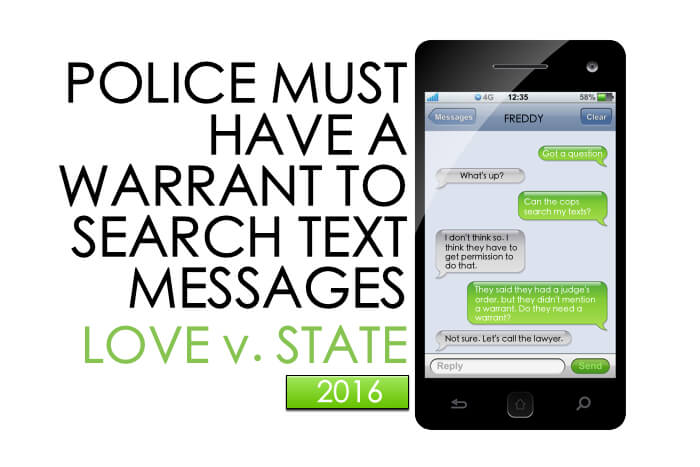
Police Must Obtain Search Warrant to See Content of Text Messages

By Brandon Barnett · Search & Seizure

Cell Phone Text Message Search Love 2016From call logs, to cell tower info, to sent and received text messages, many criminal investigations involve the contents of a defendant's cell phone.  Under the Stored Communications Act, cell phone providers can provide a users cell phone data to police during an active criminal investigation with a simple court order (like a subpoena).  But what about the actual content of text messages?  Can the police or the prosecutor get the actual content from those text messages with the same court order?

Capital Murder Conviction Gained After Judge Admits Content of Text Messages

Recently, the Texas Court of Criminal Appeals considered a capital murder (death penalty) case in which the State relied on text message evidence during trial. During the trial, the state admitted (over defense objection) the contents of text messages sent and received by the defendant. The messages established the defendant's presence at the scene of the murder and implied his direct involvement. The state leaned on this evidence during both its opening and closing statements in the case. The defendant was convicted of capital murder and sentenced to death.

The Content of Text Messages are Not Covered by the Stored Communications Act

The appellant argued on appeal that while the Stored Communications Act allows the state to gain evidence of text messages sent and received, it does not allow the dissemination of the content of those messages. The appellant argued that the State should have obtained a search warrant backed by probable cause in order to get these records. The CCA agreed, drawing comparisons to the contents of letters sent in the mail and email stored on a server. Text message enjoy the same reasonable expectation of privacy and should be protected.

The Question in Love v. State is Whether Appellant had an Expectation of Privacy in his Service Provider’s Records

LOVE v. STATE (Tex. Crim. App - 2016), Majority Opinion

Judge Yeary penned the majority opinion in Love. The following excerpts are taken from the opinion:

Many courts have treated text messages as analogous to the content of an envelope conveyed through the United States mail...Admittedly, the analogy is not a perfect one...A letter remains in its sealed envelope until it arrives at its destination, and the telephone company does not routinely record private telephone conversations. But internet and cell phone service providers do routinely store the content of emails and text messages, even if they do not necessarily take the time to read them...[E]mpirical data seem to support the proposition that society recognizes the propriety of assigning Fourth Amendment protection to the content of text messages...All of this leads us to conclude that the content of appellant’s text messages could not be obtained without a probable cause–based warrant. Text messages are analogous to regular mail and email communications. Like regular mail and email, a text message has an “outside address ‘visible’ to the third-party carriers that transmit it to its intended location, and also a package of content that the sender presumes will be read only by the intended recipient...Consequently, the State was prohibited from compelling Metro PCS to turn over appellant’s content-based communications without first obtaining a warrant supported by probable cause.

Finding that "the probable impact of the improperly-admitted text messages was great," the CCA then reversed the conviction and remanded the case back to the trial court for a new trial.

TAKEAWAY: Not all records can be gained so easily through a court order. Some require a probably cause warrant.  Is there a reasonable expectation of privacy in the message? It might take a new analysis as our media is changing daily, but it can be worth the fight.

Note: Presiding Judge Keller dissented. She did not believe that the appellant preserved this issue for appeal.

Read full article

Speak with a Fort Worth attorney

Call (817) 993-9249 or send us a message to discuss your case.