
Skip to content

December 2025

3 articles

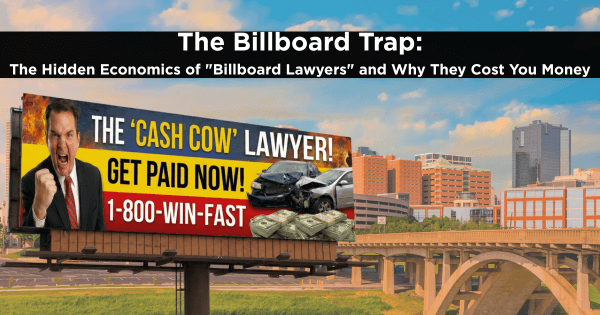
Satirical billboard of a 'Cash Cow' settlement mill lawyer against the Fort Worth skyline, illustrating the dangers of hiring high-volume injury firms.

The Billboard Trap: The Hidden Economics of "Billboard Lawyers" and Why They Cost You Money

By Jesse Lotspeich · Personal Injury

Satirical billboard of a 'Cash Cow' settlement mill lawyer against the Fort Worth skyline, illustrating the dangers of hiring high-volume injury firms.
Don't let a catchy slogan cost you thousands. While 'Settlement Mill' firms spend millions on billboards to process volume, true trial lawyers focus on maximizing value in the courtroom.

They promise "Easy Money" and shout from every billboard on I-35. But behind the marketing budget lies a high-volume factory model that insurance companies have learned to exploit. Here is the in-depth reality of why the lawyer you see the most is often the one the insurance company fears the least.

If you live in Dallas-Fort Worth, you cannot escape them. The "Strong Arms." The "Hammers." The catchy jingles promising instant checks and aggressive representation.

When you are injured, in pain, and watching medical bills pile up, these advertisements are designed to trigger a psychological response: relief. They promise a fast, easy solution to a complex problem.

But before you dial that 1-800 number, you need to understand the business mechanics behind those ads. You are not just hiring a lawyer; you are entering a business ecosystem known in the legal industry as a "Settlement Mill."

Hiring a firm based on a billboard is often the single most profitable thing you can do— for the insurance company.

The Economics of the "Settlement Mill"

To understand why these firms often deliver lower results, you have to look at their balance sheet.

Marketing on television and billboards in a major metroplex like DFW costs millions of dollars per month. To cover that massive overhead, these firms require one thing above all else: Volume.

They cannot survive by handling 50 cases a year with extreme care and precision. They need to sign up 500, 1,000, or 2,000 cases a year to pay their advertising bills.

This creates a factory mentality:

  • The Intake Floor: When you call, you are rarely speaking to a lawyer. You are speaking to a call center trained to sign you up immediately.
  • The Conveyor Belt: Once signed, your case enters a queue. To keep the lights on, the firm needs to move your case from "Open" to "Settled" as fast as possible.
  • The Conflict: Taking a case to trial takes time (often 12-18 months or more) and costs money. Settling a case takes 90 days. For a volume firm, a quick settlement of $15,000 is often more profitable for them than fighting for two years to get you $100,000.

The "Case Manager" Reality

The most common complaint we hear from clients who fire billboard or television commercial firms to hire HLAW is simple: "I never met my attorney."

In the Settlement Mill model, attorneys are expensive. To maximize profit, these firms assign your case to a "Case Manager" or "Pre-Litigation Specialist." These are often non-lawyers with no legal degree. Their job is to gather your medical records and process your claim like data entry.

At Howard Lotspeich Alexander & Williams (HLAW), we reject this model. Our partners are former prosecutors and local attorneys with well over a decade of courtroom and trial experience. When you hire us, you get us. We believe that strategic legal decisions should be made by trial lawyers, not administrative staff.

The "Colossus" Factor: How Insurance Companies Profile Your Lawyer

This is the secret the industry tries to keep quiet: Insurance companies use AI and data profiling to value your case.

Major carriers like Allstate, State Farm, and Geico use evaluation software (such as Colossus) to determine how much to offer you. One of the most heavily weighted inputs in that algorithm is the identity of your lawyer.

The insurance industry maintains vast historical data on law firms. They know exactly which firms:

  1. File lawsuits: (The firms that fight).
  2. Settle pre-litigation: (The firms that fold).

If you hire a billboard lawyer who settles 99% of their cases without ever filing a lawsuit, the software flags your claim as "Low Risk." The computer knows there is no threat of a jury verdict, so it spits out a "Lowball" offer range.

Conversely, when an adjuster sees HLAW on the letterhead, the risk profile changes. They see a firm led by serious litigators who are comfortable in a courtroom. To avoid the cost and risk of a trial, the software—and the adjuster—are forced to increase the offer.

The Missing Weapon: The Stowers Doctrine

Texas law provides a powerful weapon for injury victims called the Stowers Doctrine.

In simple terms, a Stowers demand forces an insurance company to pay their policy limits now, or risk being on the hook for the entire jury verdict later (even if it exceeds the policy). It is the ultimate pressure tactic.

But a Stowers demand is a bluff unless you can back it up.

If a Settlement Mill sends a Stowers demand, the insurance company often laughs it off. They know that firm has no intention of going to trial. They know that if they say "no," the billboard lawyer will likely just convince the client to take the lower amount.

At HLAW, our Stowers demands have teeth. We prepare every case as if it is going to trial. We take depositions. We hire experts. We build the pressure until the insurance company realizes that paying you fairly is their only safe option.

The "Litigation Gap"

Here is a scenario that happens every day in Fort Worth: A client hires a TV lawyer. The insurance company denies liability or makes a tiny offer. Because the TV lawyer relies on "easy" settlements, they don't want to do the hard work of filing a lawsuit.

So, they drop the client. They send a letter saying, "We can no longer represent you."

Now, the client has lost months of time and has to start over. At HLAW, we are Battle-Tested Trial Lawyers. We don't cherry-pick only the easy cases. If the insurance company refuses to be fair, we don't drop you—we sue them.

Don't Be a Statistic. Be a Priority.

Marketing is not the same as legal ability. A catchy jingle doesn't scare a billion-dollar insurance corporation. A billboard doesn't win a cross-examination.

Your injury settlement is likely the only compensation you will ever receive for your pain, your surgery, and your lost future wages. Do not entrust that financial lifeline to a firm that views you as a unit of inventory.

Choose the firm that insurance companies respect—and take seriously.

Contact HLAW today for a free consultation and case evaluation. We don’t need billboards to tell you who we are. We let our results in the courtroom do the talking.
Read full article
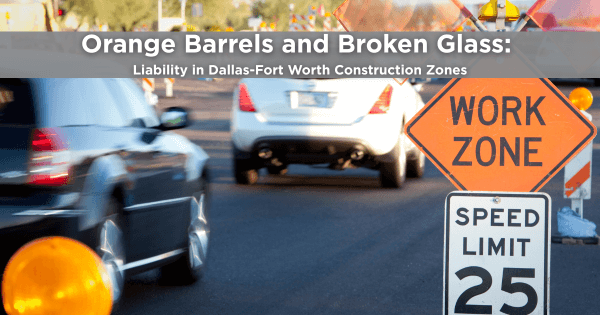
Cars driving through a construction work zone in Dallas-Fort Worth with orange barrels and speed limit signs, illustrating accident liability risks.

Orange Barrels and Broken Glass: Liability in Dallas-Fort Worth Construction Zones

By Jesse Lotspeich · Personal Injury

Cars driving through a construction work zone in Dallas-Fort Worth with orange barrels and speed limit signs, illustrating accident liability risks.
Navigating the maze of orange barrels in Dallas-Fort Worth: When confusion leads to a crash, proving liability often requires looking beyond the driver to the construction company itself.


If you live in Keller or commute through Fort Worth, you know the reality: the orange barrels seem permanent. Whether it is the massive widening projects along I-30 from Linkcrest Drive to I-820, or the perpetual "North Tarrant Express" updates on I-35W, Tarrant County drivers are constantly navigating a shifting maze of concrete barriers.

But here is the hard truth that many drivers overlook: Construction zones do not just cause traffic; they actively create hazards.

When a crash happens in these confused, narrow chutes of highway, the default assumption is "driver error." The police report might simply say "Failure to Control Speed." However, as experienced attorneys, we know that in many cases, the road design was the true culprit.

If you were injured because a construction company created a "trap" on the roadway, who is responsible? The answer lies in a complex intersection of engineering standards and Texas law.

The Anatomy of a "Construction Negligence" Case

It is not enough to say the road was confusing. To win a personal injury claim involving road construction, we must prove that the setup violated the Standard of Care.

In Texas, construction companies are bound by specific safety protocols, usually outlined in the Texas Manual on Uniform Traffic Control Devices (TMUTCD).

Common violations we see in Fort Worth include:

The "Ghost Lane" Phenomenon

When traffic is shifted to a new pavement section, the old white lines must be completely obliterated. Often, contractors do a poor job of grinding them off. When it rains or the sun hits at a certain angle (glare), the old lines reappear. If you drifted into a car because you were following what looked like a valid lane, that is a failure of the contractor's duty to warn.

The "Edge Drop-Off" Hazard

During widening projects (like on I-30), contractors often leave a significant drop-off between the paved lane and the shoulder. If a wheel slips off the edge, a driver’s natural reaction is to jerk the steering wheel back, often causing a rollover or a crossover head-on collision. If that drop-off was not properly marked or shielded with barriers, the contractor may be liable.

Inadequate Signage Spacing

The TMUTCD mandates exactly how far in advance a "Right Lane Closed" sign must be placed based on the speed limit. If the speed limit is 65 MPH but they placed the warning sign only 100 feet before the taper, they effectively deprived you of the reaction time needed to merge safely.

The Legal Hurdle: Sovereign Immunity vs. Private Liability

This is the most critical legal concept for victims to understand.

The Government (TxDOT): Under the doctrine of Sovereign Immunity, the government is generally immune from lawsuits. You generally cannot sue TxDOT for a design decision they made years ago.

The Private Contractor: TxDOT hires private consortiums and construction firms to execute the work. These private companies do not enjoy the same immunity. If a private contractor deviates from the approved Traffic Control Plan (TCP)—for example, if the plan said "place barrels every 20 feet" and they placed them every 50 feet—they can be sued for negligence.

  • The "Derivative Immunity" Defense: Contractors often try to argue, "We were just doing what TxDOT told us to do."
  • How We Defeat It: We subpoena the daily logs and inspection reports. If we can prove the contractor cut corners, ignored the blueprints, or failed to fix a known hazard (like a pothole or missing sign) within a reasonable time, they lose that protection.

The "Proportionate Responsibility" Trap

Insurance adjusters love construction zone accidents because they are chaotic. Their favorite tactic in Texas is to use the Modified Comparative Negligence rule (the "51% Bar").

They will argue: "Sure, the lane lines were confusing, but you were driving 5 MPH over the work-zone speed limit. Therefore, you are more than 50% at fault, and we owe you nothing."

In a construction zone case, fighting this percentage is everything. We counter this by hiring accident reconstruction experts who can prove that no reasonable driver could have navigated that hazard safely, regardless of a minor speed variance. We shift the focus from your driving to the inevitability of the crash caused by the trap they set.

The Investigation: What We Look For

If you hire a generalist lawyer, they might just pull the police report. At Howard Lotspeich Alexander & Williams (HLAW), we dig much deeper for construction-specific evidence:

  1. The Traffic Control Plan (TCP): The literal blueprint of where every cone and sign should have been. We compare this to photos of where they actually were.
  2. The Contractor’s Daily Logs: Site superintendents must keep logs of work performed and inspections made. Did they check the signs that morning? Did they note that a barrier had been knocked over but fail to fix it?
  3. 311 and TxDOT Complaint Logs: Often, other drivers have reported the exact same hazard days before your crash. If the contractor knew about the danger and ignored it, that moves the case from simple negligence to potentially gross negligence.
  4. Body Cam & Dash Cam Footage: Police body cams often capture the officer complaining about the confusing road setup. This is powerful jury evidence.

Steps to Protect Your Claim Immediately

Construction zones change daily. The evidence that exists today will be paved over tomorrow.

  • Take Wide-Angle Photos: Don't just photograph the damage to your car. Photograph the approach to the crash site. We need to see what the signs looked like before you hit the hazard.
  • Check for Witnesses: Did other drivers stop? Ask them if they found the lane configuration confusing.
  • Preserve Your Vehicle: If the crash was caused by a mechanical failure due to road debris or a drop-off, the physical damage to your tires and suspension is evidence. Do not let the insurance company salvage the car until we have inspected it.

Why Local Representation Matters

Navigating a claim against a major construction consortium is not a DIY project. These companies have teams of lawyers whose sole job is to blame the driver.

You need a firm that understands both the Criminal (traffic citations) and Civil (injury) sides of the law to protect your rights fully. If you or a loved one has been injured in a confusing construction zone in Keller or Fort Worth, don't assume it was just "bad luck."

[Contact HLAW Today for a Case Evaluation]

Let our team investigate if a failure in the road design turned your commute into a crisis.

Read full article
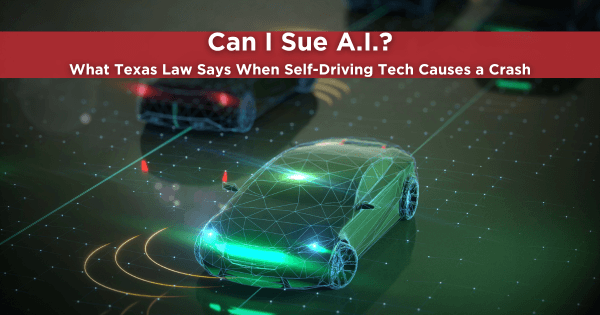
Autonomous vehicle with digital AI overlay representing self-driving technology and legal liability in Texas car accidents

Can I Sue AI? What Texas Law Says When Self-Driving Tech Causes a Crash

By Jesse Lotspeich · Personal Injury

Autonomous vehicle with digital AI overlay representing self-driving technology and legal liability in Texas car accidents
AI-driven vehicles raise serious legal questions — Texas law allows injury victims to pursue claims against manufacturers, developers, and operators when technology causes harm.

As autonomous vehicles and AI-driven safety systems become more common, many Texans are asking:

If the car’s computer makes the mistake — can I still sue?

In Texas, the answer is yes — but you don’t sue “the AI.” Instead, you sue the real people or companies behind it: the vehicle maker, AI/software developer, distributor, or others in the supply chain. Under state law, AI-related crashes can be treated as traditional product-liability or negligence claims.


✅ Why Texas Law Makes It Possible

The Legal Framework: Texas Civil Practice and Remedies Code — Chapter 82

Texas governs product-liability lawsuits under Chapter 82 of the Code. A “products liability action” can be based on strict tort liability, negligence, breach of warranty, misrepresentation, or any combination. 

That means even if the manufacturer or developer wasn’t negligent in a traditional sense, they can still be held liable if the product (e.g., a self-driving system) was defective and caused injury. 

What “Defective” Means — Design, Manufacturing, or Warning Defects

Under Texas product-liability law, a product may be defective because of:

  • Design defects — when the design itself is unreasonably dangerous (even if built as intended). 
  • Manufacturing defects — when something went wrong during production or assembly. 
  • Marketing / Warning defects (“Failure to Warn”) — when the product lacks adequate instructions or warnings about hazards or limitations (for example, if a self-driving feature requires constant human monitoring, but the user manual underplays that). 

That means a defective AI-based driving system — whether flawed design, poor manufacture, or inadequate warnings — could trigger liability under Texas law.

Strict Liability — Lower Burden of Proof

Because Texas recognizes strict liability in many defective-product cases, you may not need to show negligence. Instead, you must show the product was defective, it was defective when it left the manufacturer, and the defect caused your injury.   That can make it easier to pursue a claim, which is crucial when dealing with complex technology like AI.

Statute of Limitations & Statute of Repose

In Texas, you generally must file a product-liability lawsuit within two years of the date you were injured (or discovered the injury).  But there’s also a statute of repose: a claimant must bring a products liability action no later than 15 years after the product’s sale (with exceptions). 

If you delay too long — even if the defect only just manifested — you may lose your right to sue.


🚗 What This Means for AI-Related Car Crashes

When you’re dealing with a car crash involving AI or autonomous driving systems, it’s not simply another auto-accident claim. These cases intersect with product liability — and may even raise novel questions about software, design, data, and system updates.

Potential claims might include:

  • A design-defect claim if the AI’s logic or control system is inherently unsafe.
  • A manufacturing-defect claim if a flaw occurred during construction or assembly (hardware or software).
  • A failure-to-warn claim if the manufacturer, developer, or automaker failed to clearly explain the limits of autonomy or the need for human supervision.
  • A negligence claim if the company ignored known defects or failed to test properly.
  • Even a cybersecurity/loss-of-control claim, if misuse, hacking, or software corruption caused the crash.

Because these are often “black-box” technologies, with many potential responsible parties (manufacturer, software developer, installer, potentially updater or fleet operator), liability can be complex — but it exists under Texas law.


🔎 Why Hiring a Skilled Texas Personal Injury Lawyer Matters

  • Identifying the correct defendant(s): Lawsuits may involve multiple parties — automaker, hardware supplier, software developer, installer.
  • Preserving evidence quickly: Software logs, event-data recorder outputs, AI-system telemetry and error reports can vanish or be overwritten in hours or days.
  • Proving defect and causation: You’ll likely need engineering, automotive, and AI experts to show how the system malfunctioned, why it was defective, and how that caused your crash/injury.
  • Accounting for deadlines: With the two-year limitation and 15-year repose on product liability claims, timing is critical.

These aren’t average crash cases — treat them like complex product-liability and corporate-defect cases from the start.


✳️ What To Do If You’ve Been Injured by an AI-Equipped Vehicle in Texas

  1. Seek medical treatment immediately. Your health and safety come first — but also, prompt treatment helps create a record of injury.
  2. Preserve as much evidence as possible. Don’t delete or reset vehicle or device data. Photograph damage, take statements, and record everything.
  3. Report the crash and request all data — including software/black-box logs, event history, maintenance records, update logs, AI-system version info.
  4. Contact an experienced Texas personal injury / product liability attorney — ideally with knowledge of automotive technology and AI-based litigation.
  5. Act fast. Don’t wait until the statute of limitations is about to expire before contacting counsel.


🔹 Why This Matters for Fort Worth and All of Texas

As more automakers — and even rideshare, delivery, and trucking companies — deploy self-driving or semi-autonomous vehicles on Texas roads, crashes involving AI are likely to rise. That makes it more important than ever for Texans injured by these systems to know their rights under the law.

With the legal tools provided by Chapter 82 of the Texas Civil Practice & Remedies Code — including strict liability for defective products — victims of AI-related crashes can still demand accountability and fair compensation.

Speak With a Texas AI Injury Lawyer Today — Free Case Evaluation

When powerful technology causes harm, you deserve powerful legal representation.

If you or someone you love was injured in a crash involving autonomous technology, driver-assistance systems, or AI-controlled vehicles, do not assume the case is too complex or unwinnable. These matters demand immediate legal attention, strategic investigation, and preservation of critical digital evidence before it disappears.

At Howard Lotspeich Alexander & Williams, PLLC (HLAW), we understand how to confront deep-pocketed manufacturers, software developers, and corporate insurers. We don’t let technology shield negligence. We demand accountability.

Our team will help you determine:

  • Whether AI failure contributed to your crash
  • Which parties may be legally responsible
  • What compensation you may be entitled to pursue
  • How to preserve the evidence necessary to protect your case

There is no cost to speak with us, and no obligation to move forward.

📞 Call today to schedule your free case evaluation (817-993-9249)

💻 Or submit your case online for confidential review

Deadlines apply. Evidence fades. Corporations move fast.

You should too.

Read full article

Speak with a Fort Worth attorney

Call (817) 993-9249 or send us a message to discuss your case.