Skip to content

February 2018

4 articles

Natural Gas Home Explosion Injuries

Dallas Home Explosion Raises Injury Liability Questions

By Jesse Lotspeich · Premises Liability

The Dangers of Natural Gas in the Home

Natural Gas Home Explosion InjuriesUsing natural gas in your home can be very beneficial: it is more efficient than electricity, coming at cheaper cost, while getting more work done. However, gas does have some dangers associated with it. Natural gas is highly flammable and sometimes undetectable to the everyday person. This can lead to fires or even explosions in the home, causing thousands of dollars of damage.

Home Explosion in Dallas, Texas in February 2018

Natural gas is believed to be the related to a recent explosion at a home in Dallas. Current reports indicate that one person was tragically killed and others severely injured. Neighbors have evacuated their homes, while the city and the gas company look into the problem. Initial reports indicate that the explosion occurred near a gas heater in the house.

According to NBC DFW, the explosion prompted the evacuation of over 700 students from nearby Stephen C. Foster Elementary School.

For more on this story, click here.

For information on the Railroad Commission of Texas' Gas Services, click here.
Pipeline Investigations from the National Transportation Safety Board, click here.

What to do if you have damage from a natural gas explosion/fire:

If you have suffered injuries or the loss of a loved one caused by a fire or explosion, it is important to know your rights.

Following a fire or an explosion, an investigation should be done to determine the cause of the incident. Depending on the cause, there may be several liability issues to address. For instance, faulty or leaking gas lines may implicate the utility company. If defective appliances contributed to the explosion, the sellers and manufacturers may be liable. These are complicated liability issues that should be discussed with your attorney.

Should you have damage from a fire or explosion that is caused by natural gas, contact your attorney to work through investigation and discuss your course of action.

Read full article
Distracted Driving Injury Lawyers

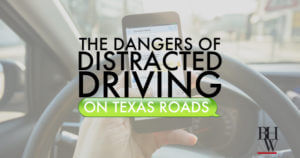
The Dangers of Distracted Driving in Texas

By Jesse Lotspeich · Car Wreck

Distracted Driving Injury LawyersSince the invention of cellphones and the growing popularity of texting, car accidents resulting from distracted driving have increased year after year. According to the National Highway Traffic Safety Administration (NHTSA), distracted driving claimed 3,477 lives and injured 391,000 people nationwide in 2015. The Texas Department of Transportation (TxDOT) reports that 1 in 5 crashes in Texas are caused by distracted driving. This is a nationwide issue that is taking the lives of Americans every day. However, distracted driving is an issue that can be prevented.

What is Distracted Driving?

The NHTSA defines distracted driving as "any activity that diverts attention from driving." There are three types of distractions, according to DMV.org; visual, manual, and cognitive. Visual distractions involve taking your eyes off the road, for example looking at something in the vehicle or an event taking place on the side of the road. Manual distractions include removing one or both hands from the steering wheel, such as adjusting the air conditioning controls or radio. Cognitive distractions take your mental focus and attention away from driving, for example, day dreaming or deep thinking. Common distractions include eating, drinking, smoking, talking on the phone, talking to a passenger, adjusting the radio or air conditioner, looking in the mirror, applying makeup or shaving, watching a video, responding to emails, and texting. Using a cellphone or texting while driving is incredibly dangerous because it combines visual, manual, and cognitive distractions. To send a text while driving, a driver takes his eyes off the road to look down at his phone screen, he takes at least one hand off the steering wheel to hold the phone, and stops paying attention mentally to think about what he is typing. Looking down at the phone just for 5 seconds while going 55 mph means that the vehicle traveled the distance of a football field without the driver paying any attention. In that distance, many things can happen, including an accident with devastating effects.

Distracted Driving Impact on Texas

Distracted driving is a growing problem in Texas. In 2016, TxDOT reported that distracted drivers in Texas caused:

  • 109,658 crashes (a 3% increase from 2015),
  • 3,000 injuries, and
  • 455 deaths

In Tarrant County alone, distracted drivers were responsible for 8,210 crashes, 23 of which were fatal crashes in 2016.

Texas Laws Regarding Texting While Driving

Laws regulating cellphone use while driving differ between states and cities. As of September 1, 2017, the use of a "wireless communication device for electronic messaging" while operating a motor vehicle is prohibited in the state of Texas after the adoption of House Bill Number 62. The offense is considered a misdemeanor and punishable with a fine between $25-$99, however it may increase to between $100-$200 if there is a prior conviction for the same offense. This includes texting and emailing while driving. The Texas Transportation Code Title 7. Sections 545.424, 545.425, 545.4251, 545.4252 provides, in relevant part:

  • If the driver is under 18, they cannot use a wireless communication device.
  • A bus driver may not use a wireless communication device while operating the bus if a minor is present.
  • All drivers are prohibited from using handheld devices while driving in school zones.

Exceptions to these laws exist for cases of emergency, reporting illegal activity, using a hands-free device, using a global positioning system, playing music, or when the device is permanently affixed to the vehicle and is part of the operator's duties.

Ways to Bring About Change in Distracted Driving

Distracted driving isn't someone else's problem. It's our problem and it could impact you or your loved ones. There is no badge of honor for multitasking while driving. We all share the road and when we are distracted while we are driving, we endanger the lives of everyone around us. Here some things you can do to prevent distracted driving and make a difference on the road:

1. Eliminate Distractions

Before you start driving, enter your destination into the GPS, adjust the air conditioning, find the right radio station or queue up your songs, and send your last text or email. Secure loose objects that might roll around once you start driving so you aren't temped to reach for them and so they don't roll under your feet. Take care of grooming and eat at home. Get everything done before you start driving. If you absolutely need to respond to something, pull over to a safe spot on the side of the road.

2. Some Apps are Good

Recent iPhone software iOS 11 has a "Do Not Disturb While Driving" feature that can be manually or automatically enabled or be activated when connected to a car Bluetooth system. This feature can sense when you are driving and silences notifications such as text messages. It can even send an auto-reply to people who have messaged you, telling them that you are busy driving. Phone calls will only come in if connected to a Bluetooth hands-free system. The customizable feature can be found in the "Settings" app under "Do Not Disturb." An app with similar functions is "LifeSaver," which can be downloaded in the App Store or in Google Play.

3. Speak Up When You are Riding With a "Distracted Driver"

While we can only control our own actions, we can encourage those we ride with to avoid distracted driving as well. When you're a passenger in a vehicle and the driver is distracted, speak up and remind them about the importance of focusing while driving. Offer to take care of the distraction for them. Politely tell them that you're uncomfortable riding in their car while they're distracted. Talk to your friends and family about the dangers of distracted driving and hold each other accountable.

4. Make a Pledge

Hold yourself accountable by making a pledge not to drive distracted. There are many websites with pledges, some where you can donate to different foundations or dedicate your pledge to someone, such as the "Just Drive" pledge with the National Safety Council.

Injured By a Distracted Driver? Free Case Evaluation

If you or a loved one have been injured by a distracted driver, contact our personal injury attorneys for a free case evaluation. We have offices in Fort Worth and Keller or we can send one of our attorneys to meet with you if you have a difficult time traveling. We do not charge any fees for injury cases unless we win a damages award for you. Contact us today at (817) 993-9249 or send us a message.


Read full article
Additonal Notice for Suppression Hearing

No Additional Notice Required for Suppression Hearing on Trial Date

By Brandon Barnett · Trial Advocacy

Texas Court of Criminal Appeals Determines That There Needs to be No Additional Notice Provided to the State When Holding a Suppression Hearing On the Day of a Trial

Additonal Notice for Suppression HearingThe Court of Criminal Appeals recently handed down a decision affirming a trial court judge's decision to hold a suppression hearing on the day the trial was set, but before voir dire or any trial proceedings occurred. State v. Velasquez, 2018 Tex. Crim. App. LEXIS 52. After a prior motion for continuance by the State was granted, the defense submitted 16 pretrial motions, including a motion to suppress evidence. On the day of the trial, both sides announced ready, and the judge chose to hold the suppression hearing before jury selection. The State objected because they were not provided with proper notice of the hearing (and because their witnesses were not present to testify for the motions hearing before jury selection), but the objection was overruled and the judge ruled in favor of the defendant. The Fourth Court of Appeals reversed the trial judge's decision, but that was overturned by the Court of Criminal Appeals, affirming the trial court ruling on the motion.

Texas Code of Criminal Procedure Article 28.01

The State based its appeal on Article 28.01 of the Texas Code of Criminal Procedure. This statute enables the judge to schedule pretrial hearings (Section 1), requires notice of these hearings to be provided to the defense (Section 2), and gives the required means of providing notice (Section 3). The State claimed that it was not provided adequate notice of the pretrial suppression hearing under this statute, and therefore, should have been given an opportunity to delay the hearing and trial.

Section 1

Article 28.01(1) allows for the court to set a pretrial hearing before it is set for a trial upon the merits. The Court of Criminal Appeals recognized that this creates two separate settings and that the court must provide adequate notice for any new and separate hearing. Included in this list of settings is a suppression hearing in Section 1(6). The court also acknowledges that many suppression hearings are done as a part of trial, and that parties should be capable of arguing for or against suppression at the time of the trial. In this case, the State was not prepared for the suppression hearing and refused to argue, forcing the court to rule in favor of the defendant.

Section 2

Article 28.01(2) requires the court to provide notice of at least 10 days to the defendant in order to allow the defendant enough time to respond and raise any additional preliminary matters. The State argues that it is entitled to notice, however, the Court points out that the statute only provides for notice given to the defendant. The Court decided that the State has no right to additional notice for a pretrial motion that will be handled on the day of the trial, so long as notice of the trial day setting was given to the State.

Section 3

Article 28.01(3) establishes the acceptable methods for providing notice to the defendant. Notice can be given through an announcement in open court in front of the defendant and his/her attorney, personal service to defendant, or by mail.

Court of Criminal Appeals' Conclusion

Ultimately, the CCA held that it was appropriate for the trial court to hold a suppression hearing on the same day as trial, despite not giving additional notice to the State. The notice of the trial setting was sufficient to make the State aware of the possibility of a suppression hearing, and the State should have been ready for that hearing. The court sees a distinction between a pretrial setting and handling a matter just before the trial begins. Because suppression hearings are often held in conjunction with trials, this action was proper. Article 28.01 does not apply in this instance because there was no new, separate setting, and the party complaining about notice was the State. The Court understands that there could be improvements to the notice requirements, but as a member of the judicial branch, they are not empowered to make those changes.

Read full article
Bus Driver Consent Search Wise 2017

Can a Bus Driver Give Consent to Search the Passenger Compartment?

By Brandon Barnett · Search & Seizure

The Case of the Not Too "Wise" Bus Passenger

United States v. Wise, 877 F.3d 209 (5th Cir. TX 2017)

Bus Driver Consent Search Wise 2017FACTS: In this case, police officers were conducting bus interdictions at a Greyhound bus stop. After a certain bus stopped, the driver got off the bus and the officers approached him requesting consent to search the passenger cabin of the bus. The bus driver consented to a search and two experienced narcotics officers in plain clothes boarded the bus. The officers did not block the exit or otherwise obstruct any of the passengers from departing the bus. One officer walked to the back of the bus while the other officer remained at the front.

The officer at the front of the bus noticed a man who was pretending to be asleep. The officer found this suspicious, because in his experience, criminals on buses often pretended to be asleep to avoid police contact. The officer walked past the "sleeping" man and turned around. The sleeping man (named Morris Wise) then turned to look back at officer, revealing that he was not asleep after all. The officer then approached Wise (now awake) and asked to see his bus ticket. Wise gave the officer a bus ticket, bearing the name "James Smith." The officer had a hunch that James Smith was a fake name. The officer then asked Wise if he had any luggage with him on the bus. Wise said yes and motioned to the luggage rack directly above his head.

Wise then gave the officers consent to search the duffle bag in the overhead compartment. The officers did not find any contraband in the duffle bag. The officers also noticed a backpack near Wise and asked if the backpack belonged to him. Wise denied ownership of the backpack. The officers then asked the other passengers about the backpack and no one claimed it, so the officers removed the backpack at the bus driver's request.

Outside the bus, a trained police canine alerted to the backpack. The officers then cut a small lock off the backpack, searched it, and found seven brick-type packages that appeared to contain cocaine.

The officers then went back onto the bus and asked Wise if he would mind getting off the bus to speak to the officers. Wise complied with the officers' request and got off the bus. The officers asked Wise if he had any weapons, which he denied that he had any weapons, and then they asked him to empty his pockets.

From his pockets, Wise gave the officers his ID card with bearing the name "Morris Wise" and a lanyard with several keys attached to it. Not surprisingly, one of the key opened the lock that the officers had to cut off of the backpack (that Wise said was not his). The officer then arrested Wise, and the government charged him with several drug-related offenses.

Motion to Suppress the Search as the Fruits on an Illegal "Checkpoint Stop"

Wise filed a motion to suppress the evidence as a violation of his 4th amendment right against unreasonable searched and seizures. The district court held that the officers' conduct in searching the bus constituted an unconstitutional checkpoint stop. In addition, the district court held that the bus driver did not voluntarily consent to the officers' search of the luggage compartment where the backpack was located. As a result, the district court suppressed all evidence the officers seized after the stop.

The government appealed to the Fifth Circuit Court of Appeals.

First, the court held that the district court incorrectly characterized the officers' bus interdiction as an unconstitutional checkpoint. The court noted that the Supreme Court's cases involving checkpoints involve roadblocks or other types of conduct where the government initiates a stop to interact with motorists. In this case, the officers did not require the bus driver to stop at the station. Instead, the driver made the scheduled stop as required by his employer, Greyhound. In addition, the officers only approached the driver after he had disembarked from the bus, and the driver voluntarily agreed to speak with them. The court concluded that the interaction between the officers and the driver was better characterized as a "bus interdiction."

Second, although Wise had a reasonable expectation of privacy in his luggage, the court held that as a passenger, Wise did not have a reasonable expectation of privacy in the luggage compartment of the commercial bus. As a result, the court concluded that Wise had no standing to challenge the officers' search of that compartment, to which the bus driver consented.

Third, the court held that the officers did not seize Wise, within the meaning of the Fourth Amendment, when they approached him, asked to see his identification, and requested his consent to search his luggage. Instead, the court concluded that Wise's interaction with the officers was a consensual encounter because a reasonable person in Wise's position would have felt free to decline the officers' requests or otherwise terminate the encounter.

Finally, the court held that Wise voluntarily answered the officer's questions, voluntarily emptied his pockets, and voluntarily gave the officer his identification and keys.

Read full article

Speak with a Fort Worth attorney

Call (817) 993-9249 or send us a message to discuss your case.