Skip to content
Tag

Blood Draw

Page 1 of 3 · 11 articles

Best Fort Worth DWI Attorney

Do's and Don'ts When You're Pulled Over for a DWI

By Jason H. Howard · DWI

Finding those blue and red lights in your rearview mirror is never ideal. If it’s a DWI stop, it can feel like your heart is racing twice as fast. But while the nerves are understandable, the key here is knowing what to do—and maybe more importantly, what not to do. Let’s dive into a few tips that might make a difference if you find yourself in this situation.

Stay Calm and Collected if Stopped for DWI

Do: Breathe. Take a moment, gather your thoughts, and remember that keeping calm can really help. When the officer approaches, be respectful and polite. A calm demeanor doesn’t mean you’re admitting guilt; it simply shows maturity and may influence how the officer views you. Even if your pulse is racing, a little “fake it till you make it” can go a long way.

Don’t: React emotionally or aggressively. Panicking or being rude won’t help. It could even escalate the situation. The officer is there to do their job, and unfortunately, this may involve some tough questioning. But stay focused—cool and collected is the goal.

Comply with Basic Requests, But Know Your Rights

Do: Hand over your license, insurance, and registration when asked. This is standard procedure, and providing these essentials without fuss can keep things running smoothly.

Don’t: Overshare. Remember, officers will often ask questions about where you’ve been or how much you’ve had to drink. It may seem like casual conversation, but it’s often their way of gathering information. Instead of diving into a full recap of your evening, keep it simple and to the point. You don’t have to answer beyond basic questions, so politely decline to offer additional details if you feel uncomfortable.

Field Sobriety Tests – The Art of the Polite Refusal

Do: Know your right to say “no.” Field sobriety tests, like the “walk and turn” or the “one-leg stand,” are voluntary in Texas (unless you’re on probation). Politely refusing can be a smart move, as these tests are designed in a way that even sober people can struggle with them—stress, nerves, and uneven ground can all affect the results.

Don’t: Feel pressured to go along just because the officer doesn’t explicitly ask if you’re willing to participate. Officers might assume you’ll comply and jump straight into the tests. So, if you’d rather not do them, a simple, “I prefer not to take these tests” can be your best option. Remember, you’re not obligated to help build the state’s case against you.

Breath and Blood Tests – Understanding the Consequences

Do: Know what’s at stake. Breath and blood tests fall into a slightly different category. In Texas, refusing a breath or blood test can have immediate consequences, like a license suspension, but it’s still within your rights unless an officer presents a warrant.

Don’t: Refuse if a valid warrant is presented. If an officer has obtained a warrant for a blood test, you’re legally required to comply. Failing to do so could lead to additional legal trouble, which might make a bad situation worse. Think carefully, and when in doubt, ask for clarity.

Remain Silent Beyond Basic Information

Do: Use your right to remain silent wisely. Beyond providing identification, you’re not obligated to answer detailed questions. Many people feel the need to explain themselves in these situations, but even seemingly innocent statements could later be used as evidence.

Don’t: Spill the details of your evening. This isn’t the time for full transparency about how much you had to drink or why you may look tired. Politely telling the officer, “I’m not comfortable answering that” is within your rights and can help prevent anything being taken out of context later.

Plan Ahead – Use Alternative Transportation

Do: Make a game plan in advance. Look, no one wants to be in a situation where they’re stopped for DWI. Using rideshare options like Uber or Lyft can save a lot of trouble and maybe even a lot of money. If there’s even a slight chance that you’re over the limit, it’s best to leave the car keys behind.

Don’t: Wait until it’s too late. Last-minute decision-making is stressful, and being proactive is way easier than facing DWI charges. Think of it as a minor investment in your peace of mind—and definitely cheaper than the potential costs of a DWI.

Wrap-Up: Staying Smart and Safe on the Road

Getting pulled over is never a pleasant experience, especially when a DWI is involved. The best steps are often the simplest: stay calm, comply with basic requests, know your rights, and remember the power of a polite refusal. Ultimately, avoiding this situation by planning ahead—calling that Uber—is the smartest move you can make. But if it ever does happen, hopefully, these do’s and don’ts will guide you through with confidence.

Here’s to making smart choices and staying safe on the road.
Read full article
DWI No Refusal Christmas Fort Worth

Twas the Night Before No Refusal Weekend in Tarrant County

By Brandon Barnett · DWI

Tarrant County No Refusal Period for the Christmas and New Year's Holidays

Tarrant County typically implements a No Refusal period during major holidays.  Being in the Christmas spirit, we thought that our No Refusal warning would be better if it rhymed.  Enjoy our Christmas No Refusal poem.

DWI No Refusal Christmas Fort Worth

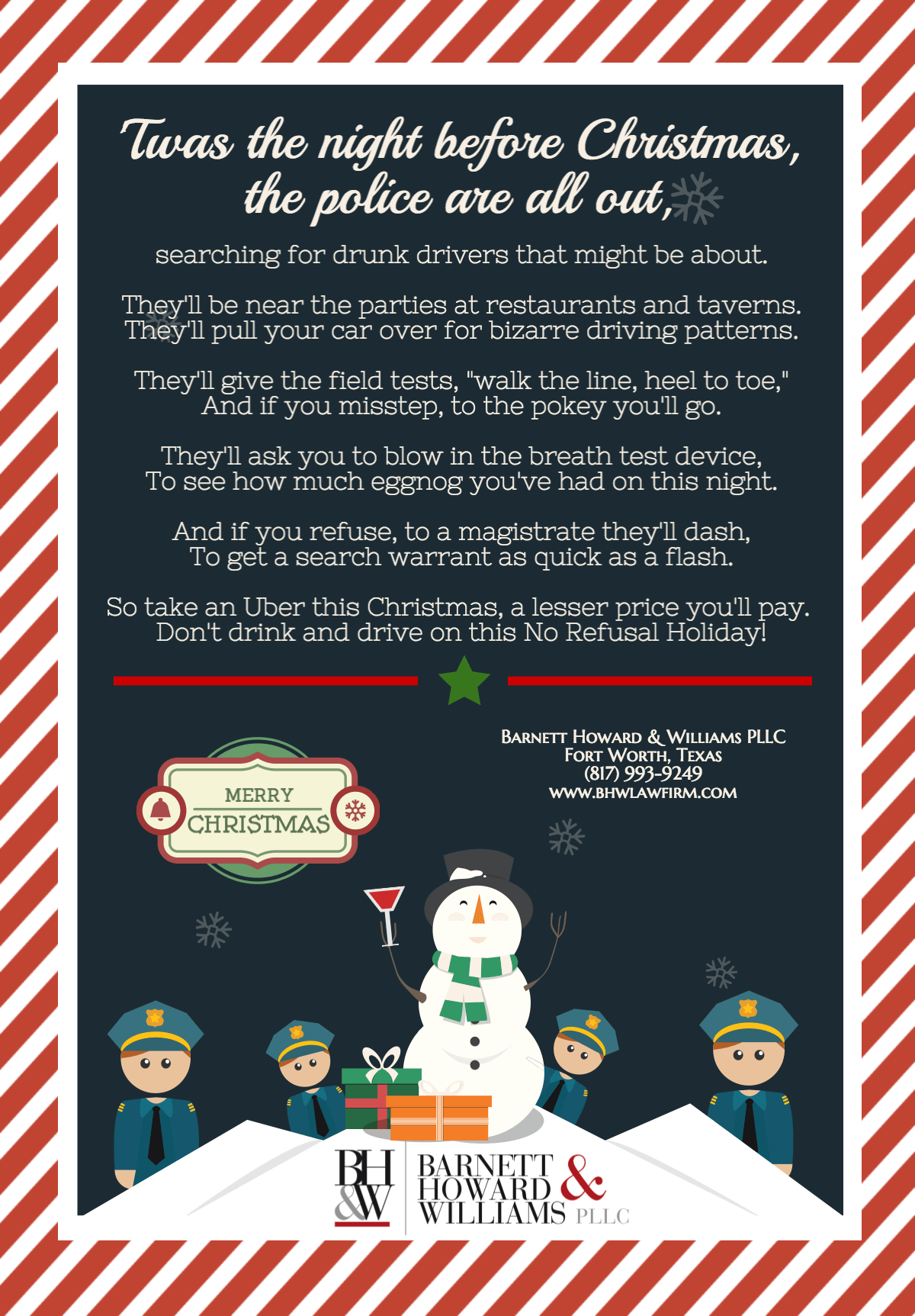
Twas the night before Christmas, the police are all out, Searching for drunk drivers that might be about. They'll be near the parties at restaurants and taverns. They'll pull your car over for bizarre driving patterns. They'll give the field test, "walk the line, heel to toe," And if you misstep, to the pokey you'll go. They'll ask you to blow in the breath test device, To see how much eggnog you've had on this night. And if you refuse, to a magistrate they'll dash, To get a search warrant as quick as a flash. So take an Uber this Christmas, a lesser price you'll pay. Don't drink and drive on this No Refusal Holiday.

Read full article
Birchfield v. North Dakota Supreme Court Breath Test

Criminal Penalties for Refusing a Breath Test—Are They Coming to Texas?

By Brandon Barnett · DWI

Can Texas Charge a Person with a Crime for Refusing a Breath or Blood Test During a DWI Stop?

In Texas, when a person refuses to provide a breath or blood specimen when being arrested for alleged drunk driving offense, their driver’s license is typically suspended. But, can a state have a law that additionally makes it a crime to refuse a breath or blood test? In Birchfield v. North Dakota, the United States Supreme Court held that a state can attach a criminal penalty to those that refuse to submit to a warrantless breath test but they cannot for those that refuse to submit to a warrantless blood test.

In a previous blog post we discussed the oral arguments that took place in this case and briefed the three cases facing the court, Birchfield , Bernard and Beylund.  Birchfield had been criminally prosecuted for refusing a warrantless blood draw; Bernard had been criminally prosecuted for refusing a warrantless breath test; and Beylund, while not criminally prosecuted for refusing a test, submitted to a blood test after the officer told him the law required it. Birchfield v. North Dakota 579 U.S. ____ (2016).

U.S. Supreme Court Issues Opinion in Birchfield Upholding Criminal Penalty for Breath Test Refusal (But Not Blood)

SUPREME COURT DECISION - Birchfield v. North Dakota

First, the Court determined whether warrantless breath and blood tests were proper searches incident to arrest for drunk driving. The Court held that since “breath tests are significantly less intrusive than blood tests” and in most cases adequately serve law enforcement interests, the Fourth Amendment permits a warrantless breath test but not blood test as a search incident to arrest for drunk driving.

Next, the Court addressed the argument that when making the decision to drive on a public road, drivers are deemed to have given consent to submit to a blood test. Applying the Fourth Amendment reasonableness standard, the Court held that “motorists cannot be deemed to have consented to submit to a blood test on pain of committing a criminal offense.” Birchfield, 579 U.S. ____ (2016).

Finally, the Court applies these legal conclusions to the three cases.  In Birchfield, the Court held that the judgment affirming his conviction must be reversed because the warrantless blood draw was not a justified search incident to arrest and he was thus, threatened with an unlawful search. In Bernard, the Court held that Bernard had no right to refuse the breath test because it was a proper search incident to arrest. In Beylund, the Court vacated the judgment and remanded the case to the state court to reconsider Beylund’s consent given the partial inaccuracy of the officer’s statement that “the law required it.”

In conclusion, the Supreme Court held that States may enact laws that attach criminal penalties to the refusal to submit to a breath test but they may not enact such laws that will apply to refusal to submit a blood test. So what does this mean for Texas? Well, while we do not currently have laws in place that attaches a criminal penalty to refusal of a breathalyzer, the State could enact a law that makes it a crime to refuse to provide a warrantless breath test incident to arrest of drunk driving.

Read full article
Exigent Circumstances Warrantless Blood Draw

Understaffing of Police Cannot Create the “Exigency” to Justify a Warrantless Blood Draw

By Brandon Barnett · DWI

In a Warrantless DWI Blood Draw Case, State Offers "Understaffing of Police" as an Exigent Circumstance.

Exigent Circumstances Warrantless Blood DrawBonsignore v State (2nd Court of Appeals - Fort Worth, 2016)

After traveling eighty miles an hour in a forty miles per hour zone, Jeremy Bonsignore pulled into a Waffle House and started walking toward the restaurant. Unknown to Bonsignore, law enforcement had been following him for several minutes. Once the officer pulled into the parking lot, he activated his lights and began yelling at Bonsignore to stop walking. Bonsignore turned around, stumbled, and lost his balance. The officer noted the presence of a strong odor of alcohol and that Bonsignore’s eyes appeared glassy.

Bonsignore admitted to having a few drinks earlier in the day, which prompted the officer to conduct several field sobriety tests. Bonsignore failed them and then abruptly refused to do anymore tests or provide a breath or blood sample. Bonsignore was placed under arrest at 1:49 am. Dispatch informed the officer that Bonsignore had two prior DWI convictions, which could amount to Bonsignore being a repeat DWI offender, a felony offense. With this information in mind, the officer instructed a second officer to take Bonsignore to the hospital for a mandatory blood draw. The blood draw was conducted at 2:55 am. Bonsignore did not consent to the taking of his blood and the officer did not obtain a warrant.

Warrantless Blood Draw Issue at Trial

Before trial began, Bonsignore filed a motion to suppress the results of the blood draw, arguing that the blood draw was warrantless, and therefore, unconstitutional. The motion was never officially ruled upon, although the court did take the motion under advisement. During trial, when asked why he ordered the blood draw, the officer said that Bonsignore’s “two prior convictions were his only authority for obtaining the blood draw.” The officer did not attempt to obtain a search warrant, and he acknowledged that Bonsignore did not give his consent to a blood draw.

The officer testified that he relied solely on the statute, Texas Transportation Code 724.012, for authority to order the draw against Bonsignore’s will. Pleading guilty to the charges, the trial court issued Bonsignore a two-year sentence. Bonsignore appealed, arguing that his motion to suppress the evidence should have been ruled upon because the blood draw was taken without his consent and without a search warrant, violating the ruling in Missouri v. McNeely, 133 S. Ct. 1552 (2013). The State argues that (1) Bonsignore’s blood-alcohol level would dissipate over time, (2) he was a repeat felony offender, and (3) the police department was small and understaffed, and that obtaining a warrant in this case would have been overly-burdensome for the officers that night.

Is "Dissipation" an Exigent Circumstance to Justify a Warrantless Search?

In the wake of the McNeely case, the Second Court of Appeals must determine whether Bonsignore’s blood draw was constitutional, and, whether the State may rely on an exigency “emergency circumstances” argument as an exception to the Fourth Amendment.

Texas Transportation Code

Section 724.012(b)(3)(B) states that blood or breath samples may be required to be taken when the suspect is arrested for DWI and he refuses to give the specimen voluntarily, so long as the suspect has two prior DWI convictions, “although [the code] does not expressly authorize taking the specimen without a warrant.” State v. Swan, 483, S.W.3d 760, 764 (Tex. App.—Fort Worth 2016, no pet.).

However, “the explicit refusal to submit to blood testing overrides the existence of any implied consent and that implied consent that has been withdrawn by a suspect cannot serve as a substitute for the free and voluntary consent that the Fourth Amendment requires.” State v. Villarreal, 475 S.W.3d 784, 800.

Precedent Case Law: Missouri v. McNeely

“The natural metabolism of alcohol in the bloodstream [does not] present a per se exigent circumstance justifying an exception to the Fourth Amendment’s warrant requirement for nonconsensual blood testing in all drunk-driving cases.” McNeely, 133 S. Ct. at 1556, 1558.

The Second Court of Appeals Weighs In

The Second Court of Appeals agreed with Bonsignore. “The police may not create their own exigency to make a warrantless arrest or search.” Parker v. State, 206 S.W.3d 593, 598 (Tex. Crim. App. 2006). “Exigent circumstances do not meet Fourth Amendment standards if [law enforcement] deliberately creates the [circumstances].” Id.

Here, the Court held, law enforcement knew that it was not a “No Refusal Weekend” in Texas. Further, the police department knew that it only had three officers on duty the entire night Bonsignore was arrested. In fact, understaffing the department was a typical occurrence. There was nothing out of the norm about the number of officers on duty that night. “Deliberately scheduling an insufficient number of patrol officers on an evening shift does not constitute an exigent circumstance.” State v. McClendon, NO. 02-15-00019-CR, 2016 WL 742018 (Tex. App.—Forth Worth, Feb. 25, 2016, no pet.).

Additionally, the department had a protocol for obtaining warrants, even in the absence of magistrates “on call.” Also, there was no earth-shattering emergency or problem that prevented the officers from making attempts to secure a warrant for Bonsignore’s search. The Court makes a point to highlight the efficiency of fax machines for the purposes of securing warrants, “thanks to the fax machine, [law enforcement] could …request a search warrant” and “thanks again to a fax machine…once [law enforcement] had the search warrant, [they] could fax it directly to a hospital instead of driving [the warrant] there.” The argument that the police department is small was unpersuasive for the Second Court of Appeals. For these reasons, the Second Court of Appeals reversed the trial court’s ruling, and remanded the case to the trial court for a new trial.

Read full article
Preserve Appeal in DWI Blood Draw Case

Warrantless Blood Draw Case Turns on Defense Failure to Preserve Appellate Issue

By Brandon Barnett · DWI

Court of Criminal Appeals Considers Whether Defense Failed to Preserve Appeal

Preserve Appeal in DWI Blood Draw Case

Smith v. State (Tex Crim. App. 2016)

Warrantless Blood Draw Provides Evidence of DWI

William Smith was stopped by police for driving without a seatbelt. Immediately, law enforcement suspected Smith of driving under the influence because of the “extremely strong smell of alcohol” coming from Smith. Accordingly, law enforcement administered several field sobriety tests and determined that Smith “exhibited clues of intoxication.” Smith became belligerent after being arrested, and refused a breathalyzer. Law enforcement searched Smith’s car incident to his arrest, finding three open containers that were “cold to the touch.” Dashboard camera footage captured the entire stop.

Law enforcement decided to transport Smith to a local hospital for a blood draw because a quick check of Smith’s ID showed that he had two prior DWI convictions. The blood sample taken at the hospital reflected a blood-alcohol concentration of .21 grams of alcohol per 100 milliliters of blood—well above the legal limit of .08. Smith elected a bench trial.

Defense Counsel Argues that Blood Draw was Unconstitutional, Trial Judge Seems to Agree

At trial, the State called a forensic scientist to testify about Smith’s blood sample. The forensic scientist testified that Smith’s blood alcohol level exceeded the statutory minimum of .08. Shortly thereafter, there was discussion between the judge and counsel about Texas case law in regards to whether the court must have an “order” signed by a judge or magistrate in order for a blood alcohol test to be admitted into evidence. The defense counsel stated, “I would…object…on constitutional grounds [because] there should be a written order [in evidence].” The State replied that law enforcement was “operating under the laws of the State.” The judge seemed to agree with defense counsel, “No…the legislature allows for this…but that doesn’t mean the law is constitutional.” The judge decided to “carry” the constitutional issue so that each side could research and make a formal brief before the court. However, at the end of the trial, Smith was convicted of DWI. The judge stated the “video of [Smith] showed signs of intoxication, but the judge was surprised…that [Smith]…did as well as he did on the [field sobriety tests]” given the .21 blood alcohol concentration. The judge sentenced Smith to twenty-five years imprisonment. There were no further objections on the record made by defense counsel post-judgment.

Appeal Turns on Lawfulness of the Blood Draw

On appeal, the court of appeals reversed Smith’s conviction because the blood sample was obtained without a warrant, violating the Fourth Amendment. State appeals to the Court of Criminal Appeals, arguing that Smith did not preserve error at trial with regard to his Fourth Amendment issue, and as a result of the failure, Smith was precluded from raising a constitutional argument on appeal.

The Issue Before the CCA - Did the Defense Preserve Appeal of the Blood Draw Issue?

The CCA must determine whether defense preserved error so that the fourth amendment search and seizure issue could be raised on appeal. To preserve error, defense counsel must obtain a ruling on the complaint, or object to the trial judge’s refusal to rule.” Tex. R. App. P. 33.1(a)(2) However, “even evidence that is improperly admitted is considered in determining whether the evidence is sufficient to support a conviction.” Soliz v. State, 432 S.W.3d 895, 900 (Tex. Crim. App. 2014).

The CCA Holds that Appellate Issue was NOT Preserved

Here, the CCA determined that the trial judge declined to rule on the Fourth Amendment constitutional issue at the time, but decided to “carry” the issue. Garza v. State, 126 S.W.3d 79, 83 (Tex. Crim. App. 2004). The CCA says that although the trial judge admitted the blood-alcohol test results, he did not rule on Smith’s initial objection, and thus, error was not preserved in this case. “In any event,” says the CCA, “there was…evidence to support [Smith’s] conviction aside from the blood-test results.” “Smith never asked for a ruling on the [constitutional issue], nor did defense counsel object to the trial judge’s failure to rule. In sum, failure to preserve error on a fourth amendment search and seizure argument for warrantless blood draws in DWI cases precludes a defendant from raising the constitutional argument on appeal.

Read full article

Speak with a Fort Worth attorney

Call (817) 993-9249 or send us a message to discuss your case.