

Skip to content

January 2020

4 articles

Criminal Negligence Texas

Defining Criminal Negligence Under Texas Law

By Brandon Barnett · Criminal Defense, Criminal Negligence

What is Criminal Negligence in Texas?

Criminal Negligence TexasIn Texas, there are some criminal offenses for which a person can be liable if they acted with “criminal negligence.” When most people think of “negligence,” they think of a civil standard used in lawsuits for money damages. But criminal negligence, the courts have reasoned, is different from ordinary civil negligence.

Section 6.03(d) of the Texas Penal Code states that “a person acts with criminal negligence, or is criminally negligent, with respect to circumstances surrounding his conduct or the result of his conduct when he ought to be aware of a substantial and unjustifiable risk that the circumstances exist or the result will occur. The risk must be of such a nature and degree that the failure to perceive it constitutes a gross deviation from the standard of care that an ordinary person would exercise under all the circumstances as viewed from the actor’s standpoint.”

How does Criminal Negligence Differ from Civil Negligence in Texas?

Civil or simple negligence means the failure to use ordinary care, that is, failing to do that which a person of ordinary prudence would not have done under the same or similar circumstances. Montgomery v. State, 369 S.W.3d 188, 193 (Tex. Crim. App. 2012). Conversely, conduct that constitutes criminal negligence involves a greater risk of harm to others, without any compensating social utility, than does simple negligence. Id. The carelessness required for criminal negligence is significantly higher than that for civil negligence; the seriousness of the negligence would be known by any reasonable person sharing the community’s sense of right and wrong. Id. The risk must be substantial and unjustifiable, and the failure to perceive it must be a gross deviation from reasonable care as judged by general societal standards by ordinary people. Id.

For example: The Texas Court of Criminal Appeals has held that criminally negligent homicide requires not only a failure to perceive a risk of death, but also some serious blameworthiness in the conduct that caused it (i.e., risk must be “substantial and unjustifiable,” and the failure to perceive that risk must be a “gross deviation” from reasonable care).

In finding a defendant criminal negligent, a jury is determining that the defendant’s failure to perceive the associated risk is so great as to be worthy of a criminal punishment. The degree of deviation from reasonable care is measured solely by the degree of negligence, not any element of actual awareness. Whether a defendant’s conduct involves an extreme degree of risk must be determined by the conduct itself and not by the resultant harm. Nor can criminal liability be predicated on every careless act merely because its carelessness results in death or injury to another.

Case Law Examples of Criminal Negligence Standard in Texas

McKay v. State, 474 S.W.3d 266 (Tex. Crim. App. 2015): The Court of Criminal Appeals holding insufficient evidence of criminal negligence to support Defendant’s conviction for injury to a child after he spilled hot water on the two-year-old child while he was in the kitchen, because there was no evidence that Defendant failed to perceive a substantial and unjustifiable risk to the child. There was no showing that the child was often underfoot or that defendant knew the child could likely be under his feet while moving around in the kitchen.

Queeman v. State, 520 S.W.3d 616 (Tex. Crim. App. 2017): The Court of Criminal Appeals holding insufficient evidence to support defendant’s conviction of criminally negligent homicide because the evidence presented does not show that Defendant’s failure to maintain a safe driving speed and keep a proper distance from other vehicles was a gross deviation from the standard of care that an ordinary diver would exercise under all the circumstances as viewed from Defendant’s standpoint at the time of his conduct.

Tello v. State, 180 S.W.3d 150 (Tex. Crim. App. 2005): The Court of Criminal Appeals upheld Appellant’s criminal negligent homicide conviction reasoning that Appellant should have perceived a substantial and unjustifiable risk of death from using a faulty trailer hitch without safety chains on a public road. The homemade trailer unhitched from Appellant’s truck and killed a pedestrian.

Read full article
TSA Airport Gun Charges Texas

What to do if Arrested for Bringing a Gun to the Airport (Accidentally)

By Brandon Barnett · Criminal Defense, Weapons Charges

Unlawful Carrying of a Weapon at an Airport in Texas

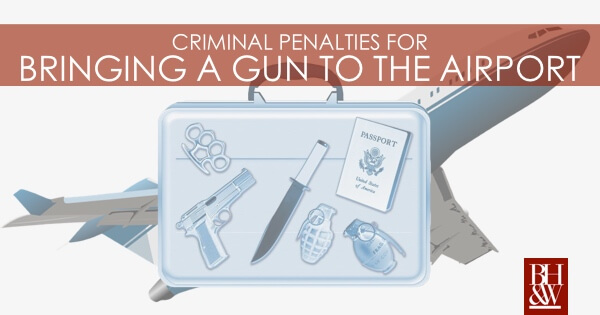
TSA Airport Gun Charges TexasWe love our guns in Texas. After all, those licensed to carry a handgun can now choose to conceal the handgun or wear it on their hip like in the old west. But carrying a handgun comes with its risks. Many places are designated as “off limits” for handguns. Chief among them is the airport. And everyday, well-meaning folks forget about their trusty handgun when they pack their bags and head to DFW International Airport or Love Field, only to be reminded by a less-than-friendly TSA agent as they attempt to pass through security. In fact, Texas is the #1 state for airport gun seizures in the country (and DFW International Airport leads the way in Texas).


 

CALL US TODAY - (817) 993-9249


What Can Happen if I Accidentally Bring a Gun Through Security at DFW Airport or Love Field Airport?

Generally, if you carry a firearm through the security checkpoint at an airport, you can be detained and arrested. Carrying a firearm, either on your person or in your carry-on luggage, is a violation of Texas Penal Code Section 46.03. The detention and arrest could take several hours and will likely cause you to miss your flight as you move through the process. The DFW Airport or Love Field Police will also confiscate your handgun. If you are arrested for bringing a handgun to the airport, your case will be filed with the Tarrant County District Attorney (for DFW Airport case) or Dallas County District Attorney (for Love Field cases).

How Serious is an Arrest for Bringing a Firearm to the Airport in Texas?

Depending on how the authorities choose to proceed, you will likely be charged with 3rd Degree Felony. A 3rd Degree Felony carries a range of punishment from 2-10 years in prison and a fine up to $10,000. The Tarrant County DA typically files the case as a 3rd Degree Felony, while cases that originate in Dallas Love Field Airport usually wait for Grand Jury review before they are filed.

What Should I Do After I am Arrested for an Airport Gun Charge?

After you post bond and are released from custody, you need to hire a lawyer to help defend you on the charges. You should also consider signing up for a local gun safety course so that you can demonstrate that you understand the severity of your mistake and are taking steps to ensure that it does not happen again. Other than that, follow the advice of your attorney. Do not attempt to get your gun back. Your lawyer can help you do that with a court order, if appropriate, once the case is closed.


CALL US TODAY - (817) 993-9249


I Have an LTC (CHL). Are There Any Exceptions for Me?

Yes. In 2015, the Texas legislature added some language to Section 46.03 to provide for LTC holders who accidentally forgot about their weapon. Section 46.03 now provides:

(e-1) It is a defense to prosecution under Subsection (a)(5) that the actor: (1) possessed, at the screening checkpoint for the secured area, a concealed handgun that the actor was licensed to carry under Subchapter H, Chapter 411, Government Code;  and (2) exited the screening checkpoint for the secured area immediately upon completion of the required screening processes and notification that the actor possessed the handgun. (e-2) A peace officer investigating conduct that may constitute an offense under Subsection (a)(5) and that consists only of an actor's possession of a concealed handgun that the actor is licensed to carry under Subchapter H, Chapter 411, Government Code, may not arrest the actor for the offense unless: (1) the officer advises the actor of the defense available under Subsection (e-1) and gives the actor an opportunity to exit the screening checkpoint for the secured area;  and (2) the actor does not immediately exit the checkpoint upon completion of the required screening processes.

So, basically, they are going to give you a chance to leave the secured area as soon as your mistake is realized. They cannot arrest a valid LTC holder unless the person refuses to leave the secured area immediately. There is no such exception for non-LTC holders. Licensed concealed firearm holder from other states should also be given the same opportunity to leave the secured area immediately in order to avoid arrest.

How Can I Lawfully Carry a Firearm on a Flight?

To carry a firearm on a flight, you must place the firearm in your checked baggage and declare it at the time you check your bags. Also, you should check the TSA guidelines before packing to ensure that you follow all of the rules and regulations.

TSA Sent Me a Demand for Money After I was Arrested. What Should I Do?

The law allows for TSA to send a civil demand letter for money damages. TSA officials consider the “severity” of your violation and then send a demand for money within the range that they consider appropriate. They will typically allow for your to pay less than the demanded amount if you pay quickly.

*See this sample TSA Civil Demand Letter.

You may pay the full demand, file a written response, or contact TSA to see if you can work out an arrangement. We have been able to help our clients pay less than what is demanded, but every case is different.

Will I Receive a Criminal Conviction on My Record For Accidentally Bringing My Gun to the Airport?

It depends. Many of our clients that were charged with Unlawfully Carrying a Weapon in the airport have had their cases dismissed. In fact, most have had their cases dismissed. But again, every case is different. The key is to contact an attorney right away so that your rights may be preserved throughout the criminal justice process.  Our team regularly handles airport gun cases arising out of DFW International Airport or Love Field Airport. We have offices in Keller and Fort Worth and offer free consultations.


CALL US TODAY - (817) 993-9249

Read full article
Airbag Injuries Texas

Airbag Injuries

By Jesse Lotspeich · Car Wreck

Airbag Injuries TexasAirbags can often mitigate chances of severe or deadly injuries to the driver and other passengers. According to the US National Highway Traffic Safety Administration, airbags have saved more than 50,000 lives in the United States alone. In some cases, however, an airbag can malfunction during a collision or can be deployed improperly during a non-accident, leading to additional injuries. In many of the car or truck accident cases that we handle, our clients sustain injuries from the airbag. Because airbags were designed to operate instantaneously by using a range of sensors and an internal explosion, even the tiniest malfunction within its system can create devastating effects.

Causes of Malfunctioning Airbags and Resulting Circumstances

Common reasons airbags malfunction may include:

  • Nonactivated sensors;
  • Defective airbag sensors;
  • Faulty electrical components; and
  • Defective crash sensors;

If the airbag malfunctions for any of these reasons, it may result in a variety of problematic circumstances:

  • The airbag may be deployed during a non-accident;
  • The airbag may fail to deploy during a collision;
  • The airbag may deploy in the wrong area of the vehicle; or
  • The airbag may deploy too late (after the accident has already occurred)

Common Injuries Related to Airbags

Airbag injuries can occur even if the airbag functions properly during a collision. Airbags may lead to a range of injuries to various parts of the body. The force of the airbag, which is estimated to deploy at 100 to 220 mph, along with the chemicals used within the device, may create significant trauma to the body. Common injuries include:

  • Abrasions;
  • Burns;
  • Broken bones;
  • Eye injuries;
  • Brain injury;
  • Internal bleeding; and
  • Broken ribs

What Are Your Options and Solutions if You are Injured by an Airbag in Texas?

If you experienced airbag-related injuries due to the negligence of another driver in an automobile accident, you may be entitled to recovery. If you are experiencing discomfort or pain after an airbag related injury, it is important to seek medical attention. We do not charge a fee on injury cases unless we collect damages for you. Call us today at (817) 993-9249 or contact us online.

Read full article
Left Lane Passing Texas Law

Why Driving Slowly in the Left Lane Can Cause Accidents

By Jesse Lotspeich · Car Wreck

We've all been there...stuck on the highway while the driver in the left lane (i.e. the "fast" lane) is going slower or the same speed as the cars on the right. This can cause congestion and considerable frustration to drivers wanting to pass. Texas Transportation Code Section 545.051 actually requires slower drivers to use the right hand lane. However, it would appear that many drivers are unaware of this requirement.

Does Driving Slowly in the Left Lane Cause Accidents?

As personal injury attorneys, we have seen many car accidents that happened on the highway due to unsafe passing. This typically happens when the faster driver weaves in and out of lanes trying to pass the slower drivers. Vox published a helpful video that does a fair job explaining the danger of driving slowly in the left lane.


Texas is Cracking Down on Driving in the Left Lane

Texas DPS has ramped up its enforcement of left-lane citations in the last several years. DPS officials have noted that driving slowly in the left lane is a hazard and requires enforcement.

Whether it was a car wreck, a truck accident, or a wrongful death, if you or a loved one have been seriously injured on a Texas highway, contact our experienced Personal Injury Attorneys today for a free consultation and case evaluation.

Read full article

Speak with a Fort Worth attorney

Call (817) 993-9249 or send us a message to discuss your case.