Skip to content
Tag

4th Amendment

Page 1 of 8 · 38 articles

Bitcoin Privacy 4th Amendment

Are Bitcoin Transactions Private Under the Law?

By Brandon Barnett · Warrantless Search

Do You Have a Fourth Amendment Privacy Interest in Your Bitcoin Transactions?

Bitcoin Privacy 4th AmendmentNo, the Fifth Circuit Court of Appeals recently held that people do not have a reasonable expectation of privacy in the information (1) contained on the Bitcoin blockchain and (2) that you provide to cryptocurrency exchanges.1 The Court reached this decision through an analysis of the facts under the “third party doctrine” of Fourth Amendment jurisprudence. This doctrine is explained in further detail below.

Read full case HERE. US v. Gratkowski, 964 F.3d 307 (5th Cir. 2020).

First Off, what is Bitcoin?

Bitcoin is a “collection of concepts and technologies that form the basis of a digital money ecosystem.”2 More colloquially, the word “bitcoin” refers to a bitcoin—a unit of digital currency used to store and transmit value among participants in the bitcoin network. Bitcoin derives its value not from physical characteristics like gold or trust in a central authority like fiat money. Instead, bitcoin is backed by the cryptographic technology behind it.

Bitcoin is powered by open-source code known as blockchain, which creates a shared public ledger that is viewable by anyone. Each transaction is a “block” that is “chained” to the code, creating a permanent record of each transaction. In order to transfer anything in this world, you need to be able to send and receive your items to and from a certain location. Bitcoin is no different. Like an email, Bitcoin is transferred between locations on the internet called Bitcoin addresses. A Bitcoin address indicates the source or destination of a Bitcoin payment. The Bitcoin blockchain contains only the sender’s address, the receiver’s address, and the amount of bitcoin transferred. Bitcoin wallets provide these addresses and utilize software that allows you to securely send, receive, and store bitcoin in the bitcoin network.

The central tenet behind the creation of Bitcoin was that willing parties should be able to transact directly with each other without the need for a trusted third party.3 A large part of the value in that kind of decentralization is in the privacy that it assumes will accompany the transaction. However, as the use and influence of cryptocurrencies expands, so too does the need of law enforcement to crack down on the illicit activities of crypto users that our society finds to be reprehensible. Analyzing the block chain for evidence of crimes involving bitcoin inevitably means that information of bitcoin transactions will be collected. This kind of forensic analysis, aside from collecting information on whether the bitcoin was used for something illegal, “can include the collection of large amounts of personal information about a user’s spending habits [and] total holdings[.]”4 The natural question for criminal law attorneys is whether a bitcoin user has a Fourth Amendment privacy interest in the information related to their bitcoin transactions.

Bitcoin Transactions and the 4th Amendment

The Fifth Circuit Court of Appeals in United States v. Gratkowski recently held that individuals do not have a Fourth Amendment privacy interest the information related to their bitcoin transactions.5 More specifically, the court found that there is no Fourth Amendment privacy interest in: (1) information on the bitcoin blockchain itself, and (2) bitcoin transactions in virtual currency exchanges.6

Gratkowski became the subject of a federal investigation when federal agents began investigating a child-pornography website. Users like Gratkowski paid the website bitcoin in exchange for downloadable child pornography. As mentioned above, the bitcoin blockchain only contains the sender’s address, the receiver’s address, and the amount of bitcoin transferred between the two parties. The identity of the owners do not appear on the bitcoin blockchain, but it is possible to discover the owner of a bitcoin address by analyzing the blockchain:

“For example, when an organization creates multiple Bitcoin addresses, it will often combine its Bitcoin addresses into a separate, central Bitcoin address (i.e., a “cluster”). It is possible to identify a “cluster” of Bitcoin addresses held by one organization by analyzing the Bitcoin blockchain’s transaction history. Open source tools and private software products can be used to analyze a transaction.”7

Federal agents used an outside service to analyze the publicly viewable bitcoin blockchain and identify a cluster of bitcoin addresses controlled by the website.8 They then served a grand jury subpoena on Coinbase (a prominent cryptocurrency exchange) for all information the exchange had on the Coinbase customers whose accounts sent Bitcoin to any of the addresses in the child-pornography website’s cluster. Coinbase turned over Gratkowski’s information, and federal agents obtained a warrant to search Gratkowski’s house. The agents found a hard drive containing child pornography and subsequently charged Gratkowski with one count of receiving child pornography and one count of accessing websites with intent to view child pornography.

At trial, Gratkowski moved to suppress the evidence the government obtained under the warrant, arguing that both the subpoena to Coinbase and the analysis done on the blockchain violated the Fourth Amendment. For the government to infringe upon an individual’s Fourth Amendment protection against unreasonable searches, the person must have a “reasonable expectation of privacy” in the items obtained.9 The “third-party doctrine” instructs that a person generally “has no legitimate expectation of privacy in information he voluntarily turns over to third parties.”10

For instance, the Supreme Court in United States v. Miller held that bank records were not subject to Fourth Amendment Protections.11 The Court also held that telephone call logs were not subject to Fourth Amendment protections because the telephone numbers we dial are voluntarily conveyed to the phone company when we place a call.12 However, the Supreme Court recently held that individuals do have a privacy interest in their cell phone location records, despite the records being held by a third party.13 In deciding this, the Court set-up the current framework under which courts are to determine whether the third-party doctrine applies to certain information that is shared with third parties: The sole act of sharing the information is no longer determinative as to whether we have a Fourth Amendment privacy interest in it. Rather, courts are to consider, “‘(1) the nature of the particular documents sought,’ which includes whether the sought information was limited and meant to be confidential, and (2) the voluntariness of the exposure.”14

The Fifth Circuit reasoned that the information on the Bitcoin blockchain is more similar to bank records and telephone call logs than to cell phone location records.15 The court held that the information contained on the Bitcoin blockchain (the amount of Bitcoin transferred and the Bitcoin addresses of the sender and receiver) is limited, and Bitcoin users are unlikely to expect that information to be kept private as it is well known that it is recorded on the publicly available blockchain.16 The court also reasoned that the public exposure of this information is voluntary because transferring and receiving Bitcoin requires an affirmative act by the Bitcoin address holder.17 The Fifth Circuit therefore held that there is no reasonable expectation of privacy in the information contained on the Bitcoin blockchain.18

The Court used similar reasoning regarding the question of privacy in the Bitcoin transactions on Coinbase. Coinbase is a financial institution like a bank. Both are subject to the Bank Secrecy Act as regulated financial institutions, and both keep records of customer identities and currency transactions. The Court held that, “[h]aving access to Coinbase records does not provide agents with ‘an intimate window into a person’s life’; it provides only information about a person’s virtual currency transactions.”19 The court also held that, “[s]econd, transacting Bitcoin through Coinbase or other virtual currency exchange institutions requires an ‘affirmative act on the part of the user[,]’ which speaks to the voluntariness with which the information was turned over to Coinbase.20

Conclusion

The Gratkowski decision makes it difficult to imagine any situation in which a court would find there to be a Fourth Amendment privacy interest in information on the Bitcoin blockchain itself. Although Bitcoin users may truly value and believe in the privacy considerations contained in the monetary philosophy of Bitcoin, there is no getting around the fact that a “block” on the blockchain requires two Bitcoin addresses and the amount of bitcoin exchanged. And as long as private blockchain analytics companies continue to analyze only that information in determining the identity of Bitcoin users, courts will likely continue to find there to be no Fourth Amendment privacy interest in that information.

There appears to be more room to work with when it comes to cryptocurrency exchanges. Perhaps a court could find there to be a privacy interest in information given to an exchange whose business centers around user confidentiality. However, exchanges must comply with the same federal financial laws that govern Coinbase, and the record-keeping requirements under those laws would likely provide for a strong analogy to the Gratkowski case.

ENDNOTES:

1. United States v. Gratkowski, 964 F.3d 307 (5th Cir. 2020).
2. A. M. Antonopoulos, Mastering bitcoin: Programming the open blockchain (2nd ed.). Beijing etc.: O'Reilly.
3. Satoshi Nakamoto, Bitcoin: A Peer-to-Peer Electronic Cash System, https://bitcoin.org/bitcoin.pdf (2008).
4. Sasha Hodder & Rafael Yakobi, Bitcoin Fungibility, Mixing and the Legal Limits on Maintaining Privacy, https://bitcoinmagazine.com/culture/bitcoin-fungibility-mixing-and-the-legal-limits-on-maintaining-privacy (2020).
5. Gratkowski, 964 F.3d 307 (5th Cir. 2020).
6. Id.
7. Id. at 309.
8. Private blockchain analytics companies also provide services of this nature to cryptocurrency exchanges to help the exchanges meet their obligations under federal money laundering laws. See footnote 4 on the previous page for a discussion of privacy and these laws.
9. United States v. Jones, 565 U.S. 400, 406 (2012).
10. Smith v. Maryland, 442 U.S. 735, 743–44 (1979).
11. United States v. Miller, 425 U.S. 435, 439-40 (1976).
12. Smith v. Maryland, 442 U.S. 735, 743-44 (1979).
13. Carpenter v. United States, 138 S. Ct. 2206, 2217 (2018).
14. Gratkowski (quoting Carpenter, at 2219-20).
15. Id., at 311.
16. Id. at 312.
17. Id.
18. Id.
19. Id. (quoting Carpenter, at 2217).
20. Id. (quoting Carpenter, at 2220).
Read full article
Recording Conversations Texas Wiretapping

Can I Record a Conversation Without the Other Party's Consent in Texas?

By Brandon Barnett · Criminal Defense

Recording Conversations Without Consent in Texas | Wiretapping Laws

Recording Conversations Texas WiretappingWith roadway cameras at nearly every street corner, video surveillance in businesses, doorbell cameras on homes, web cams on computers, and recording capabilities on mobile phones – we must navigate carefully in a digital world. We’ve seen titillating news reports exposing a secret audio tape of a public figure having scandalous phone conversations, or video surveillance of questionable traffic stops that escalate in shocking fashion. You may have had a suspicious feeling that you were being recorded, or on the other hand, felt as if you needed to record a conversation with another for your own protection.


With privacy seemingly harder to come by as compared with days long past—what does Texas law say about recording conversations? Is it illegal to record a phone conversation with another person? What about in person?

The short answer is: YES, you can record a conversation with another person without that person's consent. But this answer requires more explanation.

Recording Phone Calls in Texas | Texas is a One-Party Consent State

Under Texas Law, it is a crime intercept or record any wire, oral or electronic communication without the consent of at least one party. The good news is that you count as one party and if you're recording then you have probably given yourself consent to record the conversation. Generally speaking, state wiretapping laws turn on whether the state is a one-party consent state. While some states require the consent of all of the parties to a conversation prior to recording, Texas permits the recording of telephone calls, so long as the consent of one of the parties is obtained. As stated, if you are one of the parties on the phone call, then you may consent to having your own conversation recorded—you need not alert the other party. Additionally, a parent may give vicarious consent to the recording of a child’s conversation if the parent has a good faith objectively reasonable belief that the recording is necessary for the welfare of the child.

However, if during a phone call there are multiple parties who are in different states, then be aware that other state laws may require pre-recording consent of all of the parties. In this scenario, if the recording party obtains consent from the other parties before the recording begins, then the recorder is not in violation of wiretapping laws.

See this link to learn more about the various state wiretapping laws.

Recording In-Person Conversations in Texas | Can I Record Someone Else's Public Conversation?

Texas law (Penal Code §16.02) does not permit you to record in-person communications when the parties have an expectation that such communication is not subject to interception (i.e. If there is a reasonable expectation of privacy). If you wish to record a conversation to which you are not a party, all of the parties must give consent before the recording device is turned on or there must be no reasonable expectation of privacy (e.g. If the recording is taken from your doorbell camera and the parties are standing on you doorstep). If you are a party to the conversation, record away.

Further, you are able to record in-person communication at a public place, like a mall food court or at a football game for example, where parties do not have the expectation of privacy. Remember—if you say it in a public place, within earshot of others who may overhear, you do not have an expectation of privacy in those statements. Generally, such statements may be recorded without violating that state’s wiretapping laws.

A Word of Caution of Recording Conversations in Texas

Please be aware that there are both federal and state wiretapping laws that may limit your ability to making recordings of telephone calls or in person conversations. This article addresses state wiretapping laws in Texas only. Additionally, if a person has violated a state or federal wiretapping statute, he may be both charged criminally and be sued civilly by the damaged party.

Further, while a person may have successfully recorded a conversation under state and federal wiretapping laws, the act of disclosing the recording to other third parties could be, in and of itself, punishable criminally or civilly under other legal theories (such as slander, for example).

If you are faced with a wiretapping charge, or have questions about wiretapping, please contact an attorney who will address both the state and federal regulations as they are related to the facts of your specific case. Wiretapping charges are potentially serious felonies that could land a person in jail or prison, with fines ranging from $200 to $10,000. If you are faced with charges related to wiretapping in Texas, please contact our offices at (817) 993-9249 for a consultation.

Summary on Texas Wiretapping

  • A person can record a conversation to which you are a party in Texas without violating wiretapping laws, so long as the other party is in a “one party consent” state.
  • A person can record a conversation (to which he is not a party) if one of the participants gives him permission.
  • A person can record a conversation when, in a public setting, the participants do not have a reasonable expectation of privacy.
  • It is almost always illegal to record a phone call or private conversation to which one is not a party, does not have consent from at least one of the parties, and could not naturally overhear the conversation.

This article is for educational purposes only and should never be substituted for legal advice.

Read full article
Supreme Court Holds Police May Not Search Vehicle in Driveway Without a Warrant

Supreme Court Holds Police May Not Search Vehicle in Driveway Without a Warrant

By Brandon Barnett · Search & Seizure

Collins v. Virginia - US Supreme Court Considers Whether Police May Search a Vehicle in a Driveway Without a Warrant


Collins v. Virginia (US Supreme Court 2018)

In Collins v. Virginia, police officers were looking for a motorcycle that they suspected was stolen. They tracked the motorcycle to a home where it appeared to be parked in the driveway and covered by a tarp. Officers walked up the driveway, removed the tarp, discovered the motorcycle and conducted a search of the license plates. The license plate search indicated that the motorcycle was indeed stolen. The officers then replaced the tarp over the motorcycle and waited in their car for the driver of the motorcycle. When Collins appeared, they arrested him.

Collins's Motion to Suppress the Warrantless Search

In the trial court, Collins made a motion to suppress evidence, claiming that the officers violated his 4th Amendment right when they entered the curtilage of his home and conducted a warrantless search of the driveway. The trial court denied the motion and Collins was convicted of Receipt of Stolen Property. The Virginia appellate court and State Supreme Court affirmed Collins' conviction, reasoning that the "automobile exception" to the warrant requirement applied to the search in this case.

What is the Automobile Exception to the Warrant Requirement?

Generally, the "automobile exception" to the 4th Amendment allows officers to search a vehicle without a warrant if they have probable cause. The rationale behind this exception is that automobiles should be treated differently than houses because of the "ready mobility" of the automobile. Virginia argued that the automobile exception should apply in this case, because the motorcycle was capable to being driven away from the home.

Supreme Court Overturns the Virginia Courts, Defining the "Curtilage" of the Home to Include the Driveway

The US Supreme Court, Justice Sotomayor writing for a nearly unanimous court, held that the officers violated Collins' 4th Amendment right to be free from unreasonable searches and seizures. The Court emphasized that the area of the driveway where the motorcycle was parked was a protected area of the home.

[T]he part of the driveway where Collins’ motorcycle was parked and subsequently searched is curtilage. When Officer Rhodes searched the motorcycle, it was parked inside a partially enclosed top portion of the driveway that abuts the house. Just like the front porch, side garden, or area "outside the front window," that enclosure constitutes "an area adjacent to the home and 'to which the activity of home life extends.' "

Justice Sotomayor further explained that:

Nothing in this Court’s case law suggests that the automobile exception gives an officer the right to enter a home or its curtilage to access a vehicle without a warrant. Such an expansion would both undervalue the core Fourth Amendment protection afforded to the home and its curtilage and “ ‘untether’ ” the exception " from the justifications underlying' " it.

In holding that the search violated the 4th Amendment, the Court reversed the decision of the Virginia Supreme Court and remanded to case back to the state.

Takeaway

The curtilage of the home extends to the driveway and items that might be found therein. Of course, if the officers had been able to view the license plates from the street, without removing the tarp, things would likely be different. However, as it stands, the Supreme Court is unwilling to adopt any rule that would allow police to enter the curtilage of the home to conduct a warrantless search.

Read full article
Bus Driver Consent Search Wise 2017

Can a Bus Driver Give Consent to Search the Passenger Compartment?

By Brandon Barnett · Search & Seizure

The Case of the Not Too "Wise" Bus Passenger

United States v. Wise, 877 F.3d 209 (5th Cir. TX 2017)

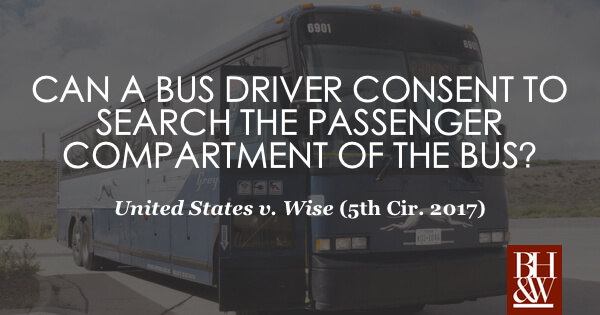
Bus Driver Consent Search Wise 2017FACTS: In this case, police officers were conducting bus interdictions at a Greyhound bus stop. After a certain bus stopped, the driver got off the bus and the officers approached him requesting consent to search the passenger cabin of the bus. The bus driver consented to a search and two experienced narcotics officers in plain clothes boarded the bus. The officers did not block the exit or otherwise obstruct any of the passengers from departing the bus. One officer walked to the back of the bus while the other officer remained at the front.

The officer at the front of the bus noticed a man who was pretending to be asleep. The officer found this suspicious, because in his experience, criminals on buses often pretended to be asleep to avoid police contact. The officer walked past the "sleeping" man and turned around. The sleeping man (named Morris Wise) then turned to look back at officer, revealing that he was not asleep after all. The officer then approached Wise (now awake) and asked to see his bus ticket. Wise gave the officer a bus ticket, bearing the name "James Smith." The officer had a hunch that James Smith was a fake name. The officer then asked Wise if he had any luggage with him on the bus. Wise said yes and motioned to the luggage rack directly above his head.

Wise then gave the officers consent to search the duffle bag in the overhead compartment. The officers did not find any contraband in the duffle bag. The officers also noticed a backpack near Wise and asked if the backpack belonged to him. Wise denied ownership of the backpack. The officers then asked the other passengers about the backpack and no one claimed it, so the officers removed the backpack at the bus driver's request.

Outside the bus, a trained police canine alerted to the backpack. The officers then cut a small lock off the backpack, searched it, and found seven brick-type packages that appeared to contain cocaine.

The officers then went back onto the bus and asked Wise if he would mind getting off the bus to speak to the officers. Wise complied with the officers' request and got off the bus. The officers asked Wise if he had any weapons, which he denied that he had any weapons, and then they asked him to empty his pockets.

From his pockets, Wise gave the officers his ID card with bearing the name "Morris Wise" and a lanyard with several keys attached to it. Not surprisingly, one of the key opened the lock that the officers had to cut off of the backpack (that Wise said was not his). The officer then arrested Wise, and the government charged him with several drug-related offenses.

Motion to Suppress the Search as the Fruits on an Illegal "Checkpoint Stop"

Wise filed a motion to suppress the evidence as a violation of his 4th amendment right against unreasonable searched and seizures. The district court held that the officers' conduct in searching the bus constituted an unconstitutional checkpoint stop. In addition, the district court held that the bus driver did not voluntarily consent to the officers' search of the luggage compartment where the backpack was located. As a result, the district court suppressed all evidence the officers seized after the stop.

The government appealed to the Fifth Circuit Court of Appeals.

First, the court held that the district court incorrectly characterized the officers' bus interdiction as an unconstitutional checkpoint. The court noted that the Supreme Court's cases involving checkpoints involve roadblocks or other types of conduct where the government initiates a stop to interact with motorists. In this case, the officers did not require the bus driver to stop at the station. Instead, the driver made the scheduled stop as required by his employer, Greyhound. In addition, the officers only approached the driver after he had disembarked from the bus, and the driver voluntarily agreed to speak with them. The court concluded that the interaction between the officers and the driver was better characterized as a "bus interdiction."

Second, although Wise had a reasonable expectation of privacy in his luggage, the court held that as a passenger, Wise did not have a reasonable expectation of privacy in the luggage compartment of the commercial bus. As a result, the court concluded that Wise had no standing to challenge the officers' search of that compartment, to which the bus driver consented.

Third, the court held that the officers did not seize Wise, within the meaning of the Fourth Amendment, when they approached him, asked to see his identification, and requested his consent to search his luggage. Instead, the court concluded that Wise's interaction with the officers was a consensual encounter because a reasonable person in Wise's position would have felt free to decline the officers' requests or otherwise terminate the encounter.

Finally, the court held that Wise voluntarily answered the officer's questions, voluntarily emptied his pockets, and voluntarily gave the officer his identification and keys.

Read full article
Cell Phone Text Message Search Love 2016

Police Must Obtain Search Warrant to See Content of Text Messages

By Brandon Barnett · Search & Seizure

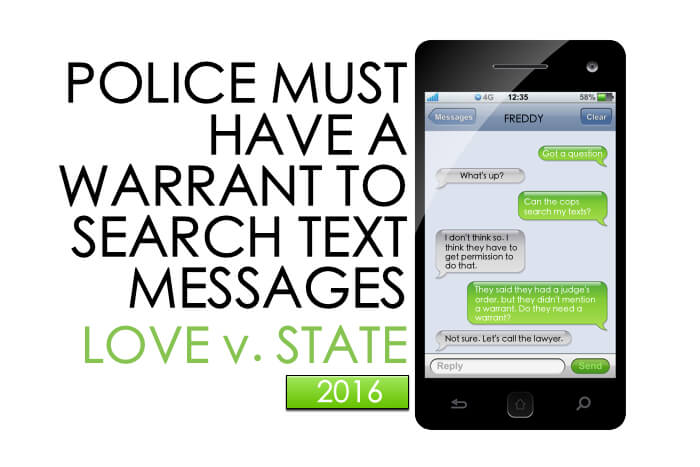
Cell Phone Text Message Search Love 2016From call logs, to cell tower info, to sent and received text messages, many criminal investigations involve the contents of a defendant's cell phone.  Under the Stored Communications Act, cell phone providers can provide a users cell phone data to police during an active criminal investigation with a simple court order (like a subpoena).  But what about the actual content of text messages?  Can the police or the prosecutor get the actual content from those text messages with the same court order?

Capital Murder Conviction Gained After Judge Admits Content of Text Messages

Recently, the Texas Court of Criminal Appeals considered a capital murder (death penalty) case in which the State relied on text message evidence during trial. During the trial, the state admitted (over defense objection) the contents of text messages sent and received by the defendant. The messages established the defendant's presence at the scene of the murder and implied his direct involvement. The state leaned on this evidence during both its opening and closing statements in the case. The defendant was convicted of capital murder and sentenced to death.

The Content of Text Messages are Not Covered by the Stored Communications Act

The appellant argued on appeal that while the Stored Communications Act allows the state to gain evidence of text messages sent and received, it does not allow the dissemination of the content of those messages. The appellant argued that the State should have obtained a search warrant backed by probable cause in order to get these records. The CCA agreed, drawing comparisons to the contents of letters sent in the mail and email stored on a server. Text message enjoy the same reasonable expectation of privacy and should be protected.

The Question in Love v. State is Whether Appellant had an Expectation of Privacy in his Service Provider’s Records

LOVE v. STATE (Tex. Crim. App - 2016), Majority Opinion

Judge Yeary penned the majority opinion in Love. The following excerpts are taken from the opinion:

Many courts have treated text messages as analogous to the content of an envelope conveyed through the United States mail...Admittedly, the analogy is not a perfect one...A letter remains in its sealed envelope until it arrives at its destination, and the telephone company does not routinely record private telephone conversations. But internet and cell phone service providers do routinely store the content of emails and text messages, even if they do not necessarily take the time to read them...[E]mpirical data seem to support the proposition that society recognizes the propriety of assigning Fourth Amendment protection to the content of text messages...All of this leads us to conclude that the content of appellant’s text messages could not be obtained without a probable cause–based warrant. Text messages are analogous to regular mail and email communications. Like regular mail and email, a text message has an “outside address ‘visible’ to the third-party carriers that transmit it to its intended location, and also a package of content that the sender presumes will be read only by the intended recipient...Consequently, the State was prohibited from compelling Metro PCS to turn over appellant’s content-based communications without first obtaining a warrant supported by probable cause.

Finding that "the probable impact of the improperly-admitted text messages was great," the CCA then reversed the conviction and remanded the case back to the trial court for a new trial.

TAKEAWAY: Not all records can be gained so easily through a court order. Some require a probably cause warrant.  Is there a reasonable expectation of privacy in the message? It might take a new analysis as our media is changing daily, but it can be worth the fight.

Note: Presiding Judge Keller dissented. She did not believe that the appellant preserved this issue for appeal.

Read full article

Speak with a Fort Worth attorney

Call (817) 993-9249 or send us a message to discuss your case.