Skip to content

January 2015

Page 1 of 2 · 10 articles

When the Jury's Sentence is Outside the Punishment Range

By Brandon Barnett · Jury Trial

Jury Trial Sentencing in Texas

Every level of criminal offense in Texas has a corresponding punishment range for the jury to consider.  With the exception of enhancements or other minor differences, the Texas punishment ranges are as follows:

  • Class B Misdemeanor = 0-180 days County Jail and $0-$2,000 fine
  • Class A Misdemeanor = 0-365 days County Jail and $0-$4,000 fine
  • State Jail Felony = 6 months - 2 years State Jail and $0-$10,000 fine
  • 3rd Degree Felony = 2-10 years Prison and $0-$10,000 fine
  • 2nd Degree Felony = 2-20 years Prison and $0-$10,000 fine
  • 1st Degree Felony = 5-99 years Prison and $0-$10,000 fine

A jury verdict on sentencing should be within the punishment range to the particular offense.  But what happens if the jury deviates from the punishment range?

The Court of Appeals for the Seventh District (Amarillo) recently considered this scenario in Melton v. State. In Melton, the defendant was facing 2-20 years and up to a $10,000 fine if convicted.  The jury returned a sentence of 15 years in prison and a $15,000 fine.  Of course, the $15,000 fine was outside the punishment range.

The court of appeals wrestled with the option of remanding the case back to the trial court for a new sentencing hearing on BOTH the term of confinement and the fine or the fine only.  Ultimately, the court reasoned:

Article 37.10(b) contemplates that a jury can assess more than one type of punishment, to-wit: "punishment that is authorized by law for the offense and punishment that is not authorized by law for the offense . . . ." Because this statutory provision contemplates the situation where the period of confinement is authorized by law and the amount of the fine is not authorized by law, we conclude the Legislature intended to allow the reformation of a judgment as to the issue of the fine only.

Accordingly, the COA remanded the case back to the trial court for a new sentencing hearing on the fine only.  The term of confinement was sustained.

Read full article

DWI: Is Passing on the Shoulder Evidence of a Traffic Offense?

By Brandon Barnett · DWI

DWI Conviction Overturned | Passing on the Shoulder Permitted in Certain Circumstances

In many ways, Texas Court of Criminal Appeals also acts the State's highest traffic court. What follows is a synopsis of Lothrop v. State, wherein the CCA opines on the legality of using the right shoulder of a road to pass a slower vehicle.

In Lothrop, the police stopped Appellant after observing him use the right shoulder of the road to pass a vehicle that was slowing down.  Appellant was later arrested for Driving While Intoxicated (DWI). At trial, he filed a motion to suppress the evidence gained from the stop, arguing that the police officer did not have reasonable suspicion to make the stop. Appellant pointed to Section 545.058(a) of the Texas Transportation Code, which provides:

(a) An operator may drive on an improved shoulder to the right of the main traveled portion of a roadway of that operation is necessary and may be done safely, but only:

(1) to stop, stand, or park;

(2) to accelerate before entering the main traveled lane of traffic;

(3) to decelerate before making a right turn;

(4) to pass another vehicle that is slowing or stopped on the main traveled portion of the highway, disabled, or preparing to make a left turn;

(5) to allow another vehicle traveling faster to pass;

(6) as permitted or required by an official traffic-control device; or

(7) to avoid a collision.

The trial court denied the motion and Appellant pled guilty to DWI. The 2nd Court of Appeals (Fort Worth) affirmed the conviction, holding that "driving on an improved shoulder, regardless of circumstance, is prima facie evidence of an offense, and that Section 545.058(a) merely establishes defenses that a defendant may raise at trial."

Think again, said the Traffic Court (a.k.a. CCA):

[T]he offense of illegally driving on an improved shoulder can be proved in one of two ways: either driving on the improved shoulder was not a necessary part of achieving one of the seven approved purposes, or driving on an improved shoulder could not have been done safely. Merely driving on an improved shoulder is not prima facie evidence of an offense. Thus if an officer sees a driver driving on an improved shoulder, and it appears that driving on the improved shoulder was necessary to achieving one of the seven approved purposes, and it is done safely, that officer does not have reasonable suspicion that an offense occurred.

With that, the CCA reversed the Court of Appeals and remanded the case back to the trial court.   So there you have it - your traffic lesson for today from the CCA. You are free to drive on the improved shoulder of the road (without worrying that you will be pulled over) IF you are doing it safely and for one of the seven listed purposes.

Read full article

The Genius of Specialty Courts

By Brandon Barnett · Specialty Courts

As I'm sure you've noticed by now, specialty courts (drug courts, DWI courts, Mental health courts, reentry courts, etc.) are rapidly becoming the norm in most criminal jurisdictions.  Why the increase in popularity?  Simple.  They work.

The National Association of Drug Court Professionals' website cites the five primary goals these programs are working to achieve.

1) They reduce crime 2) They save money 3) They ensure compliance 4) They combat addiction 5) They restore families

Incarcerating addicts only delays their inevitable addiction cycle.  Specialty courts offer a real, life-changing alternative that not only aid individuals in their battle against addiction, but also improve the crime rates in every community in which they exist.  These specialty courts work to provide intense supervision through the cooperative efforts of local probation offices, prosecutors, defense attorneys, and, most importantly, judges. Read more about drug courts.

If you haven't researched specialty courts in your jurisdiction, I'd highly encourage you to do so immediately.  These programs could offer an incredible opportunity that may not have been available before.  Let's hope specialty courts continue to gain traction, and that more specialty court keep popping up throughout Texas.  It is important to remember that the criminal justice system is not always about punishment, it's also about rehabilitation.

Read full article

Attenuating of the Taint of Unlawful Police Conduct in Drug Crimes

By Brandon Barnett · Drug Crimes

In Brown v. Illinois, 422 U.S. 590 (1975), the U.S. Supreme Court identified three factors that courts should consider when determining whether the taint of an unlawful arrest was attenuated prior to obtaining a confession:

1. The temporal proximity of the arrest and the confession;
2. The presence of intervening circumstances; and
3. The purpose and flagrancy of the official misconduct (in making the arrest).

In May of 2012, in State v Mazuca, the Texas Court of Criminal Appeals considered the proper application of the "attenuation of taint doctrine," not to a confession, as in Brown, but to contraband that is seized immediately following an unconstitutional detention or arrest.  The question presented was this:

Will the discovery of an outstanding arrest warrant in the relatively few moments that ensue between the illegal stop and the seizure of the contraband invariably serve as an intervening event sufficient to purge the taint of the primary illegality?

In Mazuca, an El Paso police officer stopped the car in which appellee was a passenger because the officer believed he saw white light (rather than red) emitting from the tail lights.  Photos at trial would later prove that the tail lights were indeed red and that the car was not in violation of the Texas Transportation Code.  During the stop, the officer requested to see appellee's driver's license, and quickly learned that appellee had outstanding warrants.  During the course of the stop (after learning about the warrants) the officer seized both ecstasy and marijuana from appellee.  Appellee moved to suppress the contraband as the fruits of an illegal search.  The trial court granted the motion, making, inter alia, the following findings of fact and conclusions of law:

1. The driver of the Mustang did not violate Section 547.322 of the Transportation Code on December 11, 2008. 2. The Police Officers did not have probable cause or reasonable suspicion to perform a traffic stop on that date. 3. The arrest warrants of the Defendant did not purge the taint of the illegal stop due to the flagrancy of the police action, the close temporal proximity and the fact that no Miranda warnings were read.

The 8th Court of Appeals (El Paso) affirmed.  The CCA considered the Supreme Court precedent, as well as the Texas Court of Appeals opinions in coming up with the rule below:

When police find and seize physical evidence shortly after an illegal stop, in the absence of the discovery of an outstanding arrest warrant in between, that physical evidence should ordinarily be suppressed, even if the police misconduct is not highly purposeful or flagrantly abusive of Fourth Amendment rights. Under this scenario, temporal proximity is the paramount factor. But when an outstanding arrest warrant is discovered between the illegal stop and the seizure of physical evidence, the importance of the temporal proximity factor decreases. Under this scenario, the intervening circumstance is a necessary but never, by itself, wholly determinative factor in the attenuation calculation, and the purposefulness and/or flagrancy of the police misconduct, vel non, becomes of vital importance.

While the rule sounds simple enough, the CCA's application of the rule to the facts of the case is a bit troubling.  The CCA reversed the Court of Appeals, and held that...

[T]he behavior of the arresting officers, although clearly unlawful at the outset, was not so particularly purposeful and flagrant that the discovery of the appellee's outstanding arrest warrants may not serve to break the causal connection between the illegal stop and the discovery of the ecstasy in the appellee's pants pocket, thus purging the primary taint.  We hold that the trial court erred to conclude otherwise.

The opinion in this case seems a logically disconnected from the ultimate outcome. Apparently, some of the judges agree.  Here's what Judge Meyers had to say in his dissenting opinion:

The result fashioned by the majority opens the door for police to ignore the probable cause requirement and make traffic stops without adequate grounds for doing so.  The majority's analysis of the weight of the Brown factors may be correct, but the result discounts the trial court's findings as to the credibility of the officers.

Judge Johnson dissented as well, writing:

I would hold that the court of appeals correctly recognized that, without the highly improper traffic stop, the officers could not have learned appellee's name, found active warrants, or searched him and recovered contraband, all fruits of the poisonous tree.  We, like the court of appeals, should "afford almost total deference to a trial court's determination of historical facts that are supported by the record, particularly when such findings are based on an evaluation of witnesses' credibility and demeanor" and affirm its suppression of the evidence that was obtained because of the improper traffic stop.  I respectfully dissent.

If you were the subject on an unlawful arrest on a drug crimes case, contact the Fort Worth, Texas drug crimes defense lawyers at Barnett Howard & Williams PLLC today.  (817) 993-9249.

Read full article
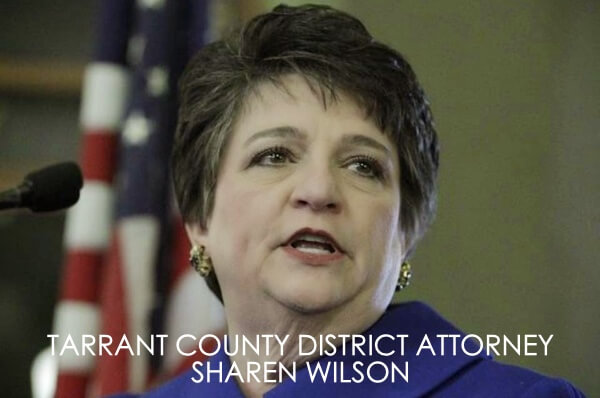
Sharen Wilson Tarrant County District Attorney

Tarrant County District Attorney Sharen Wilson Oversees all Fort Worth Prosecutors

By Brandon Barnett · Criminal Defense

Tarrant County District Attorney Sharen Wilson

Sharen Wilson Tarrant County District Attorney

Sharen Wilson, who took office in 2015, is the elected Tarrant County District Attorney. She is the top of all Fort Worth prosecutors, managing a large office of Assistant District Attorneys, investigators, support staff, and even a therapy dog.  Prior to assuming her new role as the Tarrant County District Attorney, Sharen Wilson presided over Criminal District Court Number 1 as a District Judge.  Her office receives cases from the various police departments across Tarrant County, investigates the cases, and files misdemeanor or felony criminal cases.  The Assistant District Attorneys under Sharen Wilson present cases to grand juries and manage dockets in the 20 Tarrant County criminal courts and the Courts of Appeals.  If you are interested in observing a criminal trial in Tarrant County, check out the Tarrant County Trial Board for a list of cases each week.

Fort Worth Prosecutors | Tarrant County DA

The Tarrant County District Attorney office has over 150 Fort Worth prosecutors and over 50 investigators. The office has a budget of $38 million dedicated to criminal prosecutions and investigations in Tarrant County.  Colloquially, every Assistant District Attorney is referred to as a "Tarrant County DA" or "prosecutor," but the ultimate authority over criminal prosecutions is retained by Sharen Wilson.  Fort Worth prosecutors are known across the state as fair and collegial attorneys.  They have a reputation for taking a fair look at each case and providing all available information to the defense bar in a timely manner.  Although the Tarrant County District Attorney office is one of the largest in the state, in one of the largest counties in the state, the office and its staff carry themselves with small-town values.  While each criminal case is different and may have its own challenges, our criminal defense attorneys have always been satisfied with the professionalism of the Tarrant County DA office.

Free Consultation of Tarrant County Criminal Cases

Our Fort Worth criminal defense attorneys square off every day with the Tarrant County DA office. We have a proven track record of favorable results for our clients. We understand that every case and every client are different. We take a personal approach to every client and pursue every option to address our clients' individual needs. For a FREE consultation of your Tarrant County criminal case, contact our team at (817) 993-9249.

Read full article

Speak with a Fort Worth attorney

Call (817) 993-9249 or send us a message to discuss your case.