Skip to content

June 2016

Page 1 of 2 · 7 articles

Defense of Third Party Defense of Others

Defense of Third Party Not Allowed in Fort Worth Domestic Violence Case

By Brandon Barnett · Domestic Violence

Defense of Third Party Defense of OthersThis week, the Texas Court of Criminal Appeals released Henley v. State. In a 4-3 decision the divided court held that the defendant was not allowed to offer “defense of a third party” as a legal argument in his assault case, because it “was not material to, nor probative of, any fact that was of consequence to the determination of this action.”

Henley v. State (Tex. Crim. App. 2016)

Henley was Charged with Domestic Violence in Tarrant County and Offered a “Defense of Others” Argument at Trial

Mr. Henley was charged with misdemeanor assault causing bodily injury to a family member (domestic violence). Henley was alleged to have pulled his ex-wife out of her car by her hair, punched her in the face several times, and hit her head against the concrete driveway.

At trial, Henley asserted a “defense of others” defense, which is an extension of the traditional self-defense argument. The rationale he provided for this defense was that he did not think his ex-wife was a fit parent because her new husband had sexually and possibly physically assaulted the children. The mother’s new husband was not present during the altercation and did not pose any immediate threat, but Henley tried to argue nonetheless that he was defending his children from being exposed to a physically and sexually abusive environment.

The trial judge did not allow Henley to present the defense of others claim and he was convicted. The 2nd District Court of Appeal (Fort Worth) reversed the trial court, holding that Henley should have been allowed to present his defense. The State appealed to the Court of Criminal Appeals.

What is the Standard to Assert Defense of a Third Party?

To claim defense of a third person, a defendant must reasonably believe his intervention was immediately necessary to protect the third person from the threat of force.

The question in this case was not, “is defense of a third person an effective defense when considered by the jury?” Rather the question was “should the defendant be allowed to bring that defense at all under these facts?”

A Divided CCA Holds that the Trial Judge Did Not Err in Denying Henley the Ability to Raise Defense of a Third Person

The slim majority said no,. Henley should not be able to bring this defense because his aim was not to offer material or probative evidence, but rather to introduce evidence of how bad of a mother. Henley’s ex-wife is, and perhaps try to finagle a jury nullification. The majority saw Henley’s attempted defense as nothing more than an attempt to circumvent the judicial and evidentiary process and try to make an emotional appeal to the jury rather than a factual one.

The dissenting judges (Keller, Hervey, and Newell) argued that the defense should have been allowed because anything thing that is of consequence to the determination of the action more probable or less probable than it would be without the evidence should be deemed relevant and therefore admissible. Further, the question of whether Henley’s defense claims were reasonable belonged to the jury not the judge. It was the jury who should decide if Henley, in fact, acted reasonably on that day in question.

What are the Implications of this Holding for the Defense of Third Person Claim in Texas?

This case demonstrates that Defense of a Third Person is not as easy as simply claiming it. There must be evidence to show that the defense is reasonable. The evidence must show that the “intervention was immediately necessary to protect the third person from the threat of force” or it could be disallowed by the trial judge. The valid defense of others is still viable; as viable as it ever was. It simply must fit the facts.

Read full article
Movie Plot Defense Opens Door 404b

Movie Plot Defense Opens the Door to Evidence of Other Crimes

By Brandon Barnett · Drug Crimes

The Fugitive, The Doctrine of Chances, and The Texas Rules of Evidence Collide: CCA Reviews a “Movie Plot” Defense Strategy

Movie Plot Defense Opens Door 404bDabney v. State (Tex. Crim. App. 2016)

Have you ever seen a movie like The Fugitive or Double Jeopardy where the main character finds himself in suspicious circumstances, only to be arrested and convicted, with the rest of the movie focused on proving the main character’s innocence? The defense counsel in Dabney v. State used this sort of analogy as the theme of his case to the jury—that the defendant was trapped in a bad movie plot and wasn’t actually guilty of any crime.

A Mystery Meth Lab Was Constructed at the Defendant's Home

Defense counsel made a memorable opening statement at Ronnie Dabney’s trial. Dabney had been arrested and charged with manufacturing meth. Defense counsel told the jury that the evidence would show that the meth lab found on Dabney’s property was set up by others, without his knowledge, and that Dabney arrived home mere moments before law enforcement arrived to discover the lab. Defense counsel offered a movie-plot defense theory, “Have you ever seen a movie like The Fugitive or Double Jeopardy where a person is found in suspicious circumstances and [they] arrest and convict them?” The defense added, “Ronnie Dabney has been living this movie where he’s innocent, found in suspicious circumstances, and he’s trying to prove himself not guilty.”

In response to the movie-plot defense theory, the State filed a brief arguing that it should be permitted to present evidence of a previous incident years ago, in which Dabney was present when a search warrant was executed on his property and an active meth lab was found. The State argued that the opening statements about the movie-plot amounted to a defensive theory, where evidence or mistake is at issue, worthy of a rebuttal argument supported by rebuttal evidence allowed under Rule 404(b) of the Texas Rules of Evidence.

Before trial, Dabney submitted a request for “notice” of the State’s intent to use evidence of past “extraneous” offenses under the Texas Rules of Evidence 404(b). The state failed to give proper notice of any 404(b) allegations. However, after hearing the defense opening statement, the State argued that the similarities between the case at bar and a previous case “rebutted [Dabney’s] defensive theory of accident or mistake” and requested permission to use the previous incident as 404(b) evidence to show the absence of mistake. The judge concluded the evidence of the previous crime was admissible. During closing remarks, the State averred, “[Dabney is] the unluckiest man in the world…[he] wants you to think [he] is Harrison Ford from the Fugitive…[with] a confluence of unfortunate events that frame him…but…common sense says it’s not an accident if it has happened twice…it’s the Doctrine of Chances.” Ronnie Dabney was found guilty of manufacturing meth and the jury sentenced him to 30 years imprisonment.

Dabney appealed to the Second Court of Appeals arguing the State failed to give proper notice of intent to use evidence of Dabney’s past crimes in its rebuttal argument under Texas evidentiary rules. The Fort Worth Court of Appeals reversed the trial court’s judgment, holding that the evidence of Dabney’s past crimes was inadmissible without proper notice from the State. Dabney v. State, No. 02-12-00530-CR, 2014 Tex. App. LEXIS 11496 (Tex. App.—Fort Worth, Oct. 16, 2014) (mem.op., not designated for publication). The State petitioned the Court of Criminal Appeals for review, arguing that notice is not required for rebuttal evidence because defensive theories cannot be predicted ahead of time. Dabney asserts that the State has a duty to anticipate all defensive issues that may come up in rebuttal.

The Court of Criminal Appeals considered the following issues (among others not discussed in this article):

(1) Did the court of appeals incorrectly add a “notice requirement” for rebuttal evidence?
(2) Did the court of appeals improperly ignore the overwhelming evidence of Dabney’s guilt?

Texas Evidentiary Rules Regarding Other Crimes, Wrongs, or Acts

Rule 404(b) of the Texas Rules of Evidence states

evidence of crimes, wrongs, or acts is not admissible to prove the character of a person in order to show action in conformity [of the crime being prosecuted].” “However, [such evidence] may be admissible for other purposes, such as…intent, preparation…knowledge…absence of mistake or accident, provided that upon timely request by the [defendant], reasonable notice is given in advance of trial of intent to introduce in the State’s case.

A defense opening statement can open the door for the admission of extraneous-offense evidence to rebut the defensive theory presented in opening statements. Bass v. State, 270 S.W.3d 557 (Tex. Crim. App. 2008).

The Doctrine of Chances tells [the court] that highly unusual events are unlikely to repeat themselves inadvertently or by happenstance.” LaPaz v. State, 279 S.W. 3d 336, 347 (Tex. Crim. App. 2009).

Rule 404(b) is a rule of inclusion, rather than of exclusions—it excludes only evidence that is offered solely for the purpose of proving bad character and conduct in conformity with that bad character. Id. at 343.

The CCA Holds that the Court of Appeals Improperly Added a Notice Requirement for Rebuttal Evidence

Here, the CCA reversed the decision of the court of appeals, holding that the court of appeals improperly added a notice requirement for rebuttal evidence and ignored the overwhelming evidence pointing to Dabney’s guilt. Because of the exception to the notice requirement when the defense opens the door to rebuttal evidence by presenting a defensive theory that the State may rebut using extraneous-offense evidence, the evidence of the prior crime was proper at trial, even without notice to defense beforehand. “To hold otherwise would impose upon the State the impossible task of anticipating, prior to the beginning of any trial, any and all potential defenses that a defendant may raise.” Also, there was no evidence that the prosecution acted in bad faith, or attempted to willfully avoid a discovery order. “Under the Doctrine of Chances, [Dabney’s] defense that he found himself in an unfortunate, highly unlikely situation becomes less credible when presented with evidence that he has been found in the exact same situation before.”

In sum, [Dabney] presented his defensive theory in opening statements and the State could use extraneous-offense evidence to rebut this theory in its case-in-chief, instead of waiting until the defense rested. Bass at 563. Defendants who are planning to use the “movie plot” defensive theory in the future, must be prepared to have the theory tested in front of a jury with 404(b) rebuttal evidence of other crimes, wrongs, or acts.

Read full article
Preserve Appeal in DWI Blood Draw Case

Warrantless Blood Draw Case Turns on Defense Failure to Preserve Appellate Issue

By Brandon Barnett · DWI

Court of Criminal Appeals Considers Whether Defense Failed to Preserve Appeal

Preserve Appeal in DWI Blood Draw Case

Smith v. State (Tex Crim. App. 2016)

Warrantless Blood Draw Provides Evidence of DWI

William Smith was stopped by police for driving without a seatbelt. Immediately, law enforcement suspected Smith of driving under the influence because of the “extremely strong smell of alcohol” coming from Smith. Accordingly, law enforcement administered several field sobriety tests and determined that Smith “exhibited clues of intoxication.” Smith became belligerent after being arrested, and refused a breathalyzer. Law enforcement searched Smith’s car incident to his arrest, finding three open containers that were “cold to the touch.” Dashboard camera footage captured the entire stop.

Law enforcement decided to transport Smith to a local hospital for a blood draw because a quick check of Smith’s ID showed that he had two prior DWI convictions. The blood sample taken at the hospital reflected a blood-alcohol concentration of .21 grams of alcohol per 100 milliliters of blood—well above the legal limit of .08. Smith elected a bench trial.

Defense Counsel Argues that Blood Draw was Unconstitutional, Trial Judge Seems to Agree

At trial, the State called a forensic scientist to testify about Smith’s blood sample. The forensic scientist testified that Smith’s blood alcohol level exceeded the statutory minimum of .08. Shortly thereafter, there was discussion between the judge and counsel about Texas case law in regards to whether the court must have an “order” signed by a judge or magistrate in order for a blood alcohol test to be admitted into evidence. The defense counsel stated, “I would…object…on constitutional grounds [because] there should be a written order [in evidence].” The State replied that law enforcement was “operating under the laws of the State.” The judge seemed to agree with defense counsel, “No…the legislature allows for this…but that doesn’t mean the law is constitutional.” The judge decided to “carry” the constitutional issue so that each side could research and make a formal brief before the court. However, at the end of the trial, Smith was convicted of DWI. The judge stated the “video of [Smith] showed signs of intoxication, but the judge was surprised…that [Smith]…did as well as he did on the [field sobriety tests]” given the .21 blood alcohol concentration. The judge sentenced Smith to twenty-five years imprisonment. There were no further objections on the record made by defense counsel post-judgment.

Appeal Turns on Lawfulness of the Blood Draw

On appeal, the court of appeals reversed Smith’s conviction because the blood sample was obtained without a warrant, violating the Fourth Amendment. State appeals to the Court of Criminal Appeals, arguing that Smith did not preserve error at trial with regard to his Fourth Amendment issue, and as a result of the failure, Smith was precluded from raising a constitutional argument on appeal.

The Issue Before the CCA - Did the Defense Preserve Appeal of the Blood Draw Issue?

The CCA must determine whether defense preserved error so that the fourth amendment search and seizure issue could be raised on appeal. To preserve error, defense counsel must obtain a ruling on the complaint, or object to the trial judge’s refusal to rule.” Tex. R. App. P. 33.1(a)(2) However, “even evidence that is improperly admitted is considered in determining whether the evidence is sufficient to support a conviction.” Soliz v. State, 432 S.W.3d 895, 900 (Tex. Crim. App. 2014).

The CCA Holds that Appellate Issue was NOT Preserved

Here, the CCA determined that the trial judge declined to rule on the Fourth Amendment constitutional issue at the time, but decided to “carry” the issue. Garza v. State, 126 S.W.3d 79, 83 (Tex. Crim. App. 2004). The CCA says that although the trial judge admitted the blood-alcohol test results, he did not rule on Smith’s initial objection, and thus, error was not preserved in this case. “In any event,” says the CCA, “there was…evidence to support [Smith’s] conviction aside from the blood-test results.” “Smith never asked for a ruling on the [constitutional issue], nor did defense counsel object to the trial judge’s failure to rule. In sum, failure to preserve error on a fourth amendment search and seizure argument for warrantless blood draws in DWI cases precludes a defendant from raising the constitutional argument on appeal.

Read full article
Utah v. Strieff Illegal Police Conduct

US Supreme Court Allows Evidence From Illegal Police Stop in a Shocking Decision

By Brandon Barnett · Search & Seizure

In a 5-3 Split, Utah v. Strieff Causes Strife for the Supreme Court: What Happens When an Illegal Stop Leads to the Discovery of an Outstanding Warrant?
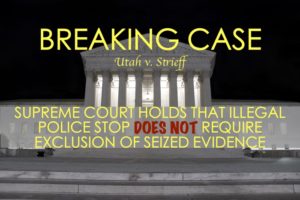
Utah v. Strieff Illegal Police ConductUtah v. Strieff (United States Supreme Court - 2016)

The Supreme Court has had a busy term already! Handed down just yesterday, Utah v. Strieff divided the Supreme Court over the question of what happens when an illegal stop leads to the discovery of an outstanding warrant? And when that warrant is executed, what happens when drug paraphernalia is found incident to arrest? Should evidence obtained at a search incident to arrest be suppressed when the stop was unlawful from the start?

Surveillance of a Suspected Drug House Leads to an Arrest for a Traffic Violation

In Strieff, law enforcement conducted surveillance of a Salt Lake City, Utah, residence, after an anonymous tipster called a drug hotline to report to police that drugs were being sold in the home. During the surveillance, police observed a large number of people visiting the home for mere minutes at a time and leaving, increasing law enforcement’s suspicion that the residents were dealing drugs. Shortly after Edward Strieff visited the home, law enforcement stopped and detained Strieff, asking him the reason for visiting the home. Next, police ran Strieff’s identification information through their electronic records, discovering an outstanding arrest warrant on Strieff for a traffic violation. Strieff was arrested and searched. During the search, police found a baggie of meth and other drug paraphernalia in Strieff’s pockets. Strieff was charged with unlawful possession of methamphetamine and drug paraphernalia.

Strieff Moves to Suppress the Evidence as the Fruits of an Illegal Police Stop.

At trial, Strieff moved to suppress the evidence as a result of an unlawful investigatory stop. Strieff argued that because law enforcement’s stop was illegal from the beginning, then any evidence found on him as a result of the stop was “tainted.” The State argued that the evidence was in fact admissible because it was found as a result from a search incident to a lawful arrest with a warrant, and that the warrant itself attenuated the connection between the unlawful stop and the discovery of the drugs and drug paraphernalia. Agreeing with the State, and finding the presence of the arrest warrant to be an “extraordinary intervening circumstance” the trial court denied Strieff’s motion to suppress. United States v. Simpson, 439 F.3d 490, 496 (CA8 2006). Strieff pleaded guilty to a lesser charge, but preserved his right to appeal.

Utah Supreme Court Holds that Illegal Police Conduct Was Not Attenuated.

On appeal, Strieff argued that the evidence should have been suppressed at trial. However, the Utah Court of Appeals affirmed the trial court’s ruling. 2012 UT App. 245, 286 P. 3d 317. On appeal to the Utah Supreme Court, Strieff argued that the evidence should have been suppressed at trial and that the court of appeals was incorrect in their verdict. The Utah Supreme Court agreed with Strieff, and reversed the lower courts’ rulings, ordering the evidence to be suppressed. 2015 UT 2, 357 P. 3d 532. In declining to apply the attenuation doctrine, the Utah Supreme court held, “the evidence is inadmissible because only a voluntary act of a defendant’s free will sufficiently breaks the connections between an illegal search and the discovery of evidence.” Id. at 536.

The State of Utah appealed to the United States Supreme Court. Strieff contends that the facts of his case show that he was stopped illegally for the purpose of obtaining his identifying information, and that because of flagrant police misconduct, he was detained and searched unlawfully.

US Supreme Court Must Determine Whether Illegal Police Conduct Must Result in Exclusion of the Tainted Evidence.

When a police officer lawfully stops a person and asks for identification, then, discovers that there is a traffic warrant for this person’s arrest, and in the process of arresting and searching him discovers drugs and drug paraphernalia, the evidence found in the search of a person can be used against him.

However, what if the initial stop was not lawful. Doctrinally, does the “attenuation doctrine”—an exception to the exclusionary rule of the Fourth Amendment—apply when law enforcement makes an unconstitutional investigatory stop, discovering during that stop that the suspect is subject to a valid arrest warrant, and then, arrests the suspect, seizing incriminating evidence during a search incident to arrest?

The Law of the Land: The Fourth Amendment

The Fourth Amendment to the United States Constitution provides, “ the right of the people to be secure in their persons, houses, papers, and effects, against unreasonable searches and seizures, shall not be violated, and no Warrants shall issue, but upon probable cause.” U.S. CONST. amend. IV. To enforce the Fourth Amendment’s prohibition against unreasonable searches and seizures, “[the Supreme] Court has required…courts to exclude evidence obtained by unconstitutional police conduct” via the exclusionary rule. Utah v. Strieff, 579 U.S. ___(2016).

The Exclusionary Rule to the Fourth Amendment

The Exclusionary Rule to the Fourth Amendment is a legal principal, put forth by the Supreme Court in precedent case law, protecting defendants in criminal cases where evidence is collected in violation of a person’s constitutional rights, by deeming the evidence inadmissible for criminal prosecution. Mapp v. Ohio, 367 U.S. 643, 655 (1961). The Exclusionary Rule encompasses both the “primary evidence obtained as a direct result of an illegal search or seizure [and] evidence later discovered and found to be derivative of an illegality.” Segura v. United States, 468 U.S. 796, 804 (1984). However, courts will only apply the exclusionary rule, “where the deterrence benefits outweigh its substantial social costs.” Hudson v. Michigan, 547 U.S. 586, 591 (2006).

The Exception to the Exclusionary Rule: Attenuation Doctrine (and Brown Factors)

Over the years, the Supreme Court has recognized several exceptions to the Exclusionary Rule, one of which is called the “Attenuation Doctrine.” The Attenuation Doctrine provides for admissibility when the connection between unconstitutional police conduct and evidence is sufficiently remote or has been interrupted by some intervening circumstances. Id. at 593. The doctrine “evaluates the causal link between the government’s unlawful act and the discovery of evidence.” Strieff, 579 U.S. ___ (2016).

The factors, articulated in Brown v. Illinois, 422 U.S. 590 (1975) (the “Brown factors”), are used by courts in legal analyses to determine whether the Attenuation Doctrine is applicable to the facts of a case. The three factors are temporal proximity, intervening circumstances, and flagrant police misconduct.

  1. Temporal proximity—For example, how much time did it take for police to stop the suspect and to arrest him, and under what circumstances?
  2. Intervening circumstances—For example, did the suspect make a confession, or volunteer some other information to law enforcement to indicate that he has committed a crime?
  3. Flagrant police misconduct—For example, did police act in an unethical manner to discover evidence, or, is there a pattern of misconduct for that officer or police department as a whole?

The Supreme Court Holds That The Valid Arrest Warrant Attenuated the Taint of the Illegal Stop.

In a 5-3 split, the Supreme Court reverses the Utah Supreme Court’s ruling, holding that the evidence the officer seized as part of the search incident to arrest is admissible because the officer’s discovery of the arrest warrant attenuated the connection between the unlawful stop and the evidence seized incident to arrest. Essentially, the arrest warrant was, in and of itself, the attenuation or the reason that the evidence seized is admissible. “The evidence [law enforcement] seized incident to Strieff’s arrest is admissible based on an application of attenuation factors from Brown v. Illinois, 422 U.S. 590.”

First, the “temporal proximity” factor “favors suppressing the evidence,” the Supreme Court states, as the stop was initially unlawful and because law enforcement discovered the drug paraphernalia on Strieff mere minutes after he an illegal stop. However, the other two factors strongly favor the State.

Second, the “intervening circumstances” factor is met under the facts of the case. “The existence of a valid arrest warrant, predating the investigation and entirely unconnected with the stop, favors…attenuation between the unlawful conduct and the discovery of evidence.” Further, the warrant itself authorized law enforcement to arrest Strieff—once the arrest was authorized by a magistrate’s signature on a warrant, a search incident to an arrest is “undisputedly lawful.”

Third, the “flagrant police misconduct” factor strongly “favors the state” as law enforcement was “at most negligent…but [these] errors in judgment hardly rise to a purposeful or flagrant violation of Strieff’s Fourth Amendment rights.” In this case, there was no indication that the stop was part of any systemic police misconduct. Police misconduct and flagrancy requires more than “mere absence of proper cause.”

Additionally, the Supreme Court says that Strieff’s arguments are not persuasive. Law enforcement did not stop Strieff randomly. Strieff had visited a suspicious house that was under surveillance. Law enforcement’s purpose in surveilling the residence was to “gather information about activity inside a house whose occupants were legitimately suspected of dealing drugs.” Further, it is “unlikely that the prevalence of outstanding warrants will create dragnet searches,” says the Supreme Court.

Three Supreme Court Justices Dissent and Would Hold That the Illegal Stop Requires Exclusion of the Seized Evidence.

There were three dissenters who put forth two written dissents to the holding in this case. In the first dissent, Justices Sotomayor and Ginsburg (in part) state that, “the discovery of a warrant for an unpaid parking ticket will forgive a police officer’s violation of your Fourth Amendment rights.” Further the Justices add, “If the officer discovers a warrant for a fine you forgot to pay, courts will now excuse his illegal stop and will admit into evidence anything he happens to find by searching you after arresting you on the warrant.” “Two wrongs don’t make a right” they implore, “as it is tempting in a case like this, where illegal conduct by an officer uncovers illegal conduct by a civilian.” The holding in this case, they say, undermines the heart of the constitutional protections, “the Fourth Amendment should prohibit, not permit.”

Additionally, Justices Kagan and Ginsburg dissented together. The Justices argue that the majority misapplied the Brown factors altogether, and that an outstanding warrant in and of itself does not an intervening circumstance make. Further, they argue that the outcome of this case invites law enforcement to stop citizens, even without reasonable suspicion. “If the target[ed] [citizen] is one of the many millions of people in this country with an outstanding arrest warrant, anything the officer finds in a search is fair game for use in criminal prosecution,” the Justices argue. Thus, law enforcement’s incentive to violate the Fourth Amendment increases, which is in opposition to the purpose of the Exclusionary Rule altogether—to remove potential temptation from police to stop random individuals without reasonable suspicion.

Commentary

This is a very troubling decision. While we never hope that our police officers would engage in illegal conduct to stop folks that have not committed a violation, it is never good to allow a 4th Amendment violation to be trumped by the later discovery of a traffic warrant. If we subscribe to an "ends justify the means" mentality, all of our constitutional rights are in serious jeopardy. It will be interesting to see how this decision plays out in real life, but I predict that it will not be good in the short term.

Read full article
Child Sexual Assault Deferred Adjudication Sentence

Is Deferred Adjudication an Authorized Sentence if Victim is 3 Years-Old?

By Brandon Barnett · Sex Crimes

Trial Judge Properly Imposed Deferred Adjudication in Sexual Assault Case, says CCA

Child Sexual Assault Deferred Adjudication SentenceAnthony v. State (Texas Court of Criminal Appeals, 2016)

Note: This article contains sensitive subject matter dealing with the sexual assault of a minor.

Defendant Pleads Guilty to Sexual Assault Allegations in Exchange for Deferred Adjudication

In 2009, John Anthony was indicted for aggravated sexual assault of a child under fourteen years old. In a plea agreement, Anthony pleaded guilty to the charge in exchange for the prosecution’s recommendation of deferred-adjudication with community supervision. Generally speaking, deferred-adjudication is a type of probation in which a defendant enters a plea of guilty, but the judge defers the ruling for a set amount of time. If the set amount of time passes without further criminal activity or other technical violations by the defendant, the judge sets aside the plea and dismisses the case. For Anthony, the trial judge ordered a deferred period of eight years.  During this time, the defendant would remain on community supervision, under the watch of a probation officer. The judge listed the victim’s age as three years old on the official trial judge’s order for deferred adjudication—not "under fourteen years old" as was listed on Anthony’s indictment.

Several years passed until 2013, when the State moved to adjudicate because Anthony allegedly violated his community supervision directives. Finding the new allegations to be true, the judge adjudicated Anthony guilty and sentenced him to life in prison. Once again, the judgment listed the victim’s age as three years old, not fourteen years old as was listed on Anthony’s original indictment.

Age Discrepancy on Judge’s Orders Leads to Sentence Reversal

Anthony appealed his adjudicated sentence with court-appointed counsel, who eventually filed an Anders brief. See Anders v. California, 386 U.S. 738 (1967). While reviewing the Anders brief, the court of appeals became concerned about the discrepancy in the victim’s age listed on the judge’s orders and on the original indictment. Specifically, the court of appeals was concerned that the trial court’s “finding” that the victim was three years old meant that under section 42.12 of the Texas Code of Criminal Procedure, the trial judge was entirely precluded from imposing deferred adjudication in the first place. TEX. CODE CRIM. PROC. Art. 42.12, § 5(d)(3)(B) (West 2006 & Supp. 2015). Additionally, the court of appeals was concerned that the age discrepancy error led to a potential flaw in sentencing. Further, the sentencing flaw potentially pointed to the fact that Anthony’s trial counsel could have been ineffective, possibly inducing Anthony into pleading “guilty” to a deal that should have never been made at all. Accordingly, the court of appeals reversed the trial court’s judgment. The State petitioned the Court of Criminal Appeals to review the case.

Can the Trial Court Place a Defendant on Deferred Adjudication for a Sexual Offense involving a 3 Year-Old Victim?

Now, the Court of Criminal Appeals must determine whether the potential age discrepancy error on the original indictment and on the trial judge’s orders created a procedural error during sentencing, possibly leading to ineffective assistance of counsel. If the age discrepancy is problematic procedurally, what should happen to Anthony’s original sentence?

Here, the Court of Criminal Appeals says that the trial judge properly imposed deferred adjudication. Because the indictment read that the victim was “younger than fourteen years old” and because there is nothing in the trial record to indicate that the State intended to prosecute under more stringent statutes with more stringent punishment guidelines, the CCA holds that the original sentence is proper. Further, the CCA deems Anthony’s previous trial counsel to be effective. Accordingly, the CCA strikes the “three year old” victim language in the trial court’s order, amending the language to reflect that the victim, “was younger than fourteen years of age at the time of the offense.” TEX. CODE CRIM. PROC. art. 42.015(b); TEX. R. APP. P. 78.1(c). Anthony’s sentence of life imprisonment stands because his deferred adjudication was properly imposed in 2009.

Read full article

Speak with a Fort Worth attorney

Call (817) 993-9249 or send us a message to discuss your case.