Skip to content
Category

Search & Seizure

Page 1 of 5 · 22 articles

Supreme Court Holds Police May Not Search Vehicle in Driveway Without a Warrant

Supreme Court Holds Police May Not Search Vehicle in Driveway Without a Warrant

By Brandon Barnett · Search & Seizure

Collins v. Virginia - US Supreme Court Considers Whether Police May Search a Vehicle in a Driveway Without a Warrant


Collins v. Virginia (US Supreme Court 2018)
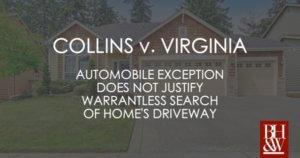
In Collins v. Virginia, police officers were looking for a motorcycle that they suspected was stolen. They tracked the motorcycle to a home where it appeared to be parked in the driveway and covered by a tarp. Officers walked up the driveway, removed the tarp, discovered the motorcycle and conducted a search of the license plates. The license plate search indicated that the motorcycle was indeed stolen. The officers then replaced the tarp over the motorcycle and waited in their car for the driver of the motorcycle. When Collins appeared, they arrested him.

Collins's Motion to Suppress the Warrantless Search

In the trial court, Collins made a motion to suppress evidence, claiming that the officers violated his 4th Amendment right when they entered the curtilage of his home and conducted a warrantless search of the driveway. The trial court denied the motion and Collins was convicted of Receipt of Stolen Property. The Virginia appellate court and State Supreme Court affirmed Collins' conviction, reasoning that the "automobile exception" to the warrant requirement applied to the search in this case.

What is the Automobile Exception to the Warrant Requirement?

Generally, the "automobile exception" to the 4th Amendment allows officers to search a vehicle without a warrant if they have probable cause. The rationale behind this exception is that automobiles should be treated differently than houses because of the "ready mobility" of the automobile. Virginia argued that the automobile exception should apply in this case, because the motorcycle was capable to being driven away from the home.

Supreme Court Overturns the Virginia Courts, Defining the "Curtilage" of the Home to Include the Driveway

The US Supreme Court, Justice Sotomayor writing for a nearly unanimous court, held that the officers violated Collins' 4th Amendment right to be free from unreasonable searches and seizures. The Court emphasized that the area of the driveway where the motorcycle was parked was a protected area of the home.

[T]he part of the driveway where Collins’ motorcycle was parked and subsequently searched is curtilage. When Officer Rhodes searched the motorcycle, it was parked inside a partially enclosed top portion of the driveway that abuts the house. Just like the front porch, side garden, or area "outside the front window," that enclosure constitutes "an area adjacent to the home and 'to which the activity of home life extends.' "

Justice Sotomayor further explained that:

Nothing in this Court’s case law suggests that the automobile exception gives an officer the right to enter a home or its curtilage to access a vehicle without a warrant. Such an expansion would both undervalue the core Fourth Amendment protection afforded to the home and its curtilage and “ ‘untether’ ” the exception " from the justifications underlying' " it.

In holding that the search violated the 4th Amendment, the Court reversed the decision of the Virginia Supreme Court and remanded to case back to the state.

Takeaway

The curtilage of the home extends to the driveway and items that might be found therein. Of course, if the officers had been able to view the license plates from the street, without removing the tarp, things would likely be different. However, as it stands, the Supreme Court is unwilling to adopt any rule that would allow police to enter the curtilage of the home to conduct a warrantless search.
Read full article
Bus Driver Consent Search Wise 2017

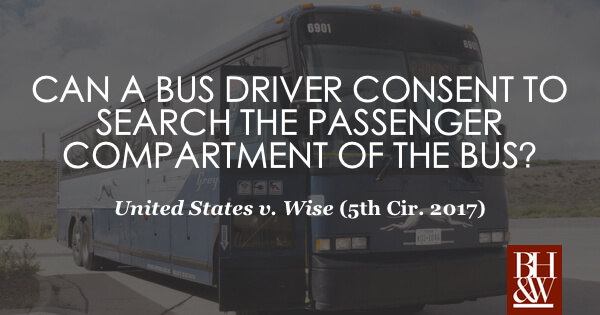
Can a Bus Driver Give Consent to Search the Passenger Compartment?

By Brandon Barnett · Search & Seizure

The Case of the Not Too "Wise" Bus Passenger

United States v. Wise, 877 F.3d 209 (5th Cir. TX 2017)

Bus Driver Consent Search Wise 2017FACTS: In this case, police officers were conducting bus interdictions at a Greyhound bus stop. After a certain bus stopped, the driver got off the bus and the officers approached him requesting consent to search the passenger cabin of the bus. The bus driver consented to a search and two experienced narcotics officers in plain clothes boarded the bus. The officers did not block the exit or otherwise obstruct any of the passengers from departing the bus. One officer walked to the back of the bus while the other officer remained at the front.

The officer at the front of the bus noticed a man who was pretending to be asleep. The officer found this suspicious, because in his experience, criminals on buses often pretended to be asleep to avoid police contact. The officer walked past the "sleeping" man and turned around. The sleeping man (named Morris Wise) then turned to look back at officer, revealing that he was not asleep after all. The officer then approached Wise (now awake) and asked to see his bus ticket. Wise gave the officer a bus ticket, bearing the name "James Smith." The officer had a hunch that James Smith was a fake name. The officer then asked Wise if he had any luggage with him on the bus. Wise said yes and motioned to the luggage rack directly above his head.

Wise then gave the officers consent to search the duffle bag in the overhead compartment. The officers did not find any contraband in the duffle bag. The officers also noticed a backpack near Wise and asked if the backpack belonged to him. Wise denied ownership of the backpack. The officers then asked the other passengers about the backpack and no one claimed it, so the officers removed the backpack at the bus driver's request.

Outside the bus, a trained police canine alerted to the backpack. The officers then cut a small lock off the backpack, searched it, and found seven brick-type packages that appeared to contain cocaine.

The officers then went back onto the bus and asked Wise if he would mind getting off the bus to speak to the officers. Wise complied with the officers' request and got off the bus. The officers asked Wise if he had any weapons, which he denied that he had any weapons, and then they asked him to empty his pockets.

From his pockets, Wise gave the officers his ID card with bearing the name "Morris Wise" and a lanyard with several keys attached to it. Not surprisingly, one of the key opened the lock that the officers had to cut off of the backpack (that Wise said was not his). The officer then arrested Wise, and the government charged him with several drug-related offenses.

Motion to Suppress the Search as the Fruits on an Illegal "Checkpoint Stop"

Wise filed a motion to suppress the evidence as a violation of his 4th amendment right against unreasonable searched and seizures. The district court held that the officers' conduct in searching the bus constituted an unconstitutional checkpoint stop. In addition, the district court held that the bus driver did not voluntarily consent to the officers' search of the luggage compartment where the backpack was located. As a result, the district court suppressed all evidence the officers seized after the stop.

The government appealed to the Fifth Circuit Court of Appeals.

First, the court held that the district court incorrectly characterized the officers' bus interdiction as an unconstitutional checkpoint. The court noted that the Supreme Court's cases involving checkpoints involve roadblocks or other types of conduct where the government initiates a stop to interact with motorists. In this case, the officers did not require the bus driver to stop at the station. Instead, the driver made the scheduled stop as required by his employer, Greyhound. In addition, the officers only approached the driver after he had disembarked from the bus, and the driver voluntarily agreed to speak with them. The court concluded that the interaction between the officers and the driver was better characterized as a "bus interdiction."

Second, although Wise had a reasonable expectation of privacy in his luggage, the court held that as a passenger, Wise did not have a reasonable expectation of privacy in the luggage compartment of the commercial bus. As a result, the court concluded that Wise had no standing to challenge the officers' search of that compartment, to which the bus driver consented.

Third, the court held that the officers did not seize Wise, within the meaning of the Fourth Amendment, when they approached him, asked to see his identification, and requested his consent to search his luggage. Instead, the court concluded that Wise's interaction with the officers was a consensual encounter because a reasonable person in Wise's position would have felt free to decline the officers' requests or otherwise terminate the encounter.

Finally, the court held that Wise voluntarily answered the officer's questions, voluntarily emptied his pockets, and voluntarily gave the officer his identification and keys.

Read full article
Terry Stop Officer Pat Down Search

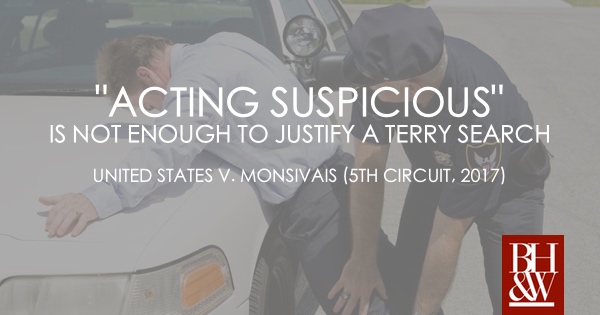
“Acting Suspicious” is Not Enough to Justify a Pat Down Search

By Pricer · Search & Seizure

Does an Officer’s Testimony That a Person was “Acting Suspicious” Establish Reasonable Suspicion to Support a Terry Stop?

Terry Stop Officer Pat Down SearchThe Fifth Circuit Court of Appeals recently handed down an opinion concerning the reasonable suspicion standard required for law enforcement officers to conduct a Terry stop—an exception to the warrant requirement. The issue facing the Court was whether merely “acting suspicious” is enough to establish reasonable suspicion to justify a law enforcement officer to initiate a Terry stop.

United States v. Monsivais, 848 F.3d 353 (5th Cir. 2017)

The Facts — District Court Found the Terry Stop to be Lawful Based On the Defendant's Demeanor, Remarks, and for Officer-safety Reasons

While on patrol in a marked police car, two officers observed Monsivais walking down the side of the I-20 interstate away from an apparently disabled truck. The officers stopped in front of Monsivais and activated the car’s emergency lights in order to ask Monsivais if he needed roadside assistance. As Monsivais approached, he ignored the officers and walked past their patrol car. At this point, the officers exited their vehicle, and asked Monsivais where he was going and if he needed any help. Monsivais told the officers he was heading to Fort Worth (even though his vehicle was pointed towards Abilene). During questioning, Monsivais appeared nervous and repeatedly placed his hands in his pockets; however upon the officer’s request, Monsivais removed his hands. Additionally, Monsivais responded politely to all of the officers’ questions. After approximately four minutes, one of the officers advised Monsivais that he was going to pat Monsivais down for weapons because of his behavior, inconsistent statements and for officer safety reasons. Shortly thereafter, Monsivais told the officer that he had a firearm in his waistband. The officer seized the firearm and Monsivais was later charged with possession of a firearm while being unlawfully present in the United States.

Monsivais filed a motion to suppress the firearm and other evidence, arguing that the officer violated the Fourth Amendment because he did not have reasonable suspicion to believe Monsivais was involved in criminal activity when he detained him. The district court denied Monsivais' motion to suppress, holding only that the “consensual encounter was transformed into a lawful Terry frisk due to the Defendant's demeanor, remarks, and for officer-safety reasons.”

The Court of Appeals Reversed the District Court’s Decision—Holding the Officers Lacked a Basis to Reasonably Suspect Monsivais of a Criminal Act

The Court first determined that the officer seized Monsivais for Fourth Amendment purposes when he told Monsivais that he was going to pat him down. At this point, the officer converted the roadside assistance “welfare check” into an investigative detention—otherwise known as a Terry stop.

“The Fourth Amendment generally requires officers to obtain a warrant before searching or seizing an individual.” However, pursuant to a narrow exception announced in Terry v. Ohio, 392 U.S. 1, 88 (1968), police officers may briefly detain a person for investigative purposes if under the totality of relevant circumstance they can point to “specific and articulable facts” that give rise to reasonable suspicion that a particular person has committed, is committing, or is about to commit a crime. United States v. Hill, 752 F.3d 1029, 1033 (5th Cir. 2014).

Here, the Court found that while Monsivais’ behavior might not have been typical of all stranded motorists, the officers could not point to any specific and articulable facts that Monsivais had committed, was committing, or was about to commit a crime before seizing him.

The court explained that Monsivais’ nervous demeanor alone was insufficient to create reasonable suspicion of criminal activity in order to justify a Terry stop. In fact, the Court gives little or no weight to an officer's statement that a suspect appeared nervous. United States v. Portillo–Aguirre, 311 F.3d 647, 656 (5th Cir. 2002). Moreover, the Court held that evidence of Monsivais placing his hands in his pocket is of little significance. The Court noted that any number of people walking down the street might have their hands in their pockets. Additionally, the Court determined there were no inconsistencies in Monsivais’ story; and, even if there were, the inconsistencies would not connect Monsivais with any reasonably suspected unlawful conduct. Moreover, Monsivais’ choice to ignore the officers’ presence by merely walking past them, not fleeing, did not give rise to criminal activity.

In conclusion, the officer testified that he never suspected Monsivais was involved in any criminal activity, but rather that Monsivais was just acting “suspicious.” As such, the court found that the officer seized Monsivais without reasonable suspicion and that the evidence obtained from the unlawful seizure should have been suppressed.

Read full article
traffic stop duration king

When Does a Traffic Stop End and Improper Police Conduct Begin?

By Brandon Barnett · Drug Crimes, Search & Seizure

A Traffic Stop for a Minor Traffic Infraction Leads to Search, Seizure, and Arrest: Exactly When Should Traffic Stops End?

traffic stop duration kingIf you've been a licensed (or even unlicensed) driver in Texas for long enough, you've experienced a traffic stop. Whether it be for speeding or something worse, a traffic stop is not generally a pleasant experience. But in some traffic stops across the state (hopefully not yours), the police conduct a search of the vehicle, then a search of the driver or passengers, and, finally make an arrest of some sort. How does something like a broken tail light or speeding lead to search, seizure, and arrest? When traffic stops for minor infractions potentially lead to serious criminal charges, it’s important to know how Texas courts define the moment when a traffic stop ends.

King v. State (2nd Court of Appeals - Fort Worth, 2016)

Broken Tail Light Leads to a Traffic Stop

Around 1:00 am, Jennifer Dowling drove Christopher King’s car home from a night on the town. Blue Mound Police noticed that the car had a broken right tail light and conducted a traffic stop pursuant to the infraction. Police ran the standard background check on Dowling, the driver, and King, the passenger, only to discover that neither had a valid driver’s license. As a result, Dowling was arrested for driving without a license. Police did not permit King to drive the car away and informed him that they would impound the car because leaving the car behind posed a safety hazard for other motorists.

Consent to Search Obtained, Traffic Stop Continued

To begin the impounding process, police asked King to exit the vehicle. When King got out of the car, police asked if they could perform a pat-down. Nervously, King complied with the request. When King stood up, a white cylinder-shaped container fell out of King’s pants onto the ground, and he admitted that the container held meth. King was arrested and charged with possession of a controlled substance.

Trial Court Holds That King Consented to the Pat-Down

Before trial, King filed a motion to suppress the physical evidence—the meth and the container—because the evidence was seized without a warrant. At the suppression hearing, the State prevailed, arguing that King consented to the pat-down, and the interaction was a consensual encounter. King lost his suppression motion, and plead guilty to the charges. The trial court sentenced King to twelve years confinement. Arguing that the traffic stop ended when Dowling was arrested and that the traffic stop was improperly extended to him, King appealed to the Second Court of Appeals.

Second Court of Appeals Discusses Traffic Stops

The Second Court of Appeals in Fort Worth relied upon existing case law from the Supreme Court to evaluate the merits of King’s appeal. “A lawful roadside stop begins when a vehicle is pulled over for investigation of a traffic violation.” Arizona v. Johnson, 555 U.S. 323, 333; 129 S. Ct. 781,, 788 (2009). “A traffic stop ends when police have no further need to control the scene.” Id., 129 S. Ct. at 783. According to the Second Court of Appeals, the police needed to control the scene even after Dowling was arrested. In asking King for a pat-down, they were taking reasonable steps to secure the area by ensuring that King was not a safety threat while waiting for a tow truck. Further, “the impoundment of the vehicle was a task tied to the traffic infraction, and King ma[de] no argument that the task [of impoundment] should have reasonably been completed at the time the police asked for consent to the pat-down.” The Second Court of Appeals affirmed the trial court’s holding that the traffic stop was not improperly extended.

What does all of this mean for motorists? So long as the police are reasonably securing the scene by taking steps in an effort to maintain safety, the police may continue the traffic stop until the conclusion of such safety measures, including but not limited to, pat-downs, security sweeps, background checks, and impoundments.  In this case, King would have had a more colorable argument if he had been a licensed driver and the police extended the stop rather than letting him drive the vehicle away from the scene.

Read full article
Cell Phone Text Message Search Love 2016

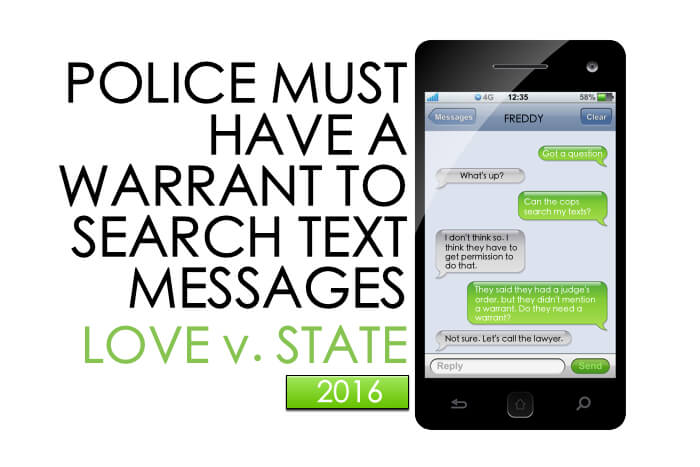
Police Must Obtain Search Warrant to See Content of Text Messages

By Brandon Barnett · Search & Seizure

Cell Phone Text Message Search Love 2016From call logs, to cell tower info, to sent and received text messages, many criminal investigations involve the contents of a defendant's cell phone.  Under the Stored Communications Act, cell phone providers can provide a users cell phone data to police during an active criminal investigation with a simple court order (like a subpoena).  But what about the actual content of text messages?  Can the police or the prosecutor get the actual content from those text messages with the same court order?

Capital Murder Conviction Gained After Judge Admits Content of Text Messages

Recently, the Texas Court of Criminal Appeals considered a capital murder (death penalty) case in which the State relied on text message evidence during trial. During the trial, the state admitted (over defense objection) the contents of text messages sent and received by the defendant. The messages established the defendant's presence at the scene of the murder and implied his direct involvement. The state leaned on this evidence during both its opening and closing statements in the case. The defendant was convicted of capital murder and sentenced to death.

The Content of Text Messages are Not Covered by the Stored Communications Act

The appellant argued on appeal that while the Stored Communications Act allows the state to gain evidence of text messages sent and received, it does not allow the dissemination of the content of those messages. The appellant argued that the State should have obtained a search warrant backed by probable cause in order to get these records. The CCA agreed, drawing comparisons to the contents of letters sent in the mail and email stored on a server. Text message enjoy the same reasonable expectation of privacy and should be protected.

The Question in Love v. State is Whether Appellant had an Expectation of Privacy in his Service Provider’s Records

LOVE v. STATE (Tex. Crim. App - 2016), Majority Opinion

Judge Yeary penned the majority opinion in Love. The following excerpts are taken from the opinion:

Many courts have treated text messages as analogous to the content of an envelope conveyed through the United States mail...Admittedly, the analogy is not a perfect one...A letter remains in its sealed envelope until it arrives at its destination, and the telephone company does not routinely record private telephone conversations. But internet and cell phone service providers do routinely store the content of emails and text messages, even if they do not necessarily take the time to read them...[E]mpirical data seem to support the proposition that society recognizes the propriety of assigning Fourth Amendment protection to the content of text messages...All of this leads us to conclude that the content of appellant’s text messages could not be obtained without a probable cause–based warrant. Text messages are analogous to regular mail and email communications. Like regular mail and email, a text message has an “outside address ‘visible’ to the third-party carriers that transmit it to its intended location, and also a package of content that the sender presumes will be read only by the intended recipient...Consequently, the State was prohibited from compelling Metro PCS to turn over appellant’s content-based communications without first obtaining a warrant supported by probable cause.

Finding that "the probable impact of the improperly-admitted text messages was great," the CCA then reversed the conviction and remanded the case back to the trial court for a new trial.

TAKEAWAY: Not all records can be gained so easily through a court order. Some require a probably cause warrant.  Is there a reasonable expectation of privacy in the message? It might take a new analysis as our media is changing daily, but it can be worth the fight.

Note: Presiding Judge Keller dissented. She did not believe that the appellant preserved this issue for appeal.

Read full article

Speak with a Fort Worth attorney

Call (817) 993-9249 or send us a message to discuss your case.