Skip to content
Category

Search & Seizure

Page 2 of 5 · 22 articles

Stop and Frisk Furr v. State 2016

Reasonable Suspicion to Stop and Frisk Upheld | Furr v. State (2016)

By Luke A. Williams · Reasonable Suspicion, Search & Seizure

Texas Court of Criminal Appeals Upholds a Stop and Frisk Case

Stop and Frisk Furr v. State 2016Furr v. State (Tex. Crim. App. 2016)

On September 21st the Criminal Court of Appeals decided Furr v. State. In Furr, the Court held that an anonymous tip was sufficiently corroborated to establish reasonable suspicion to stop and frisk Appellant Furr. To support the stop and frisk, the court noted that Appellant:

  • watched the officer as he drove by,
  • repeatedly looked at the officer as he walked away,
  • was nervous, anxious and sort of out of it,
  • appeared under the influence of drugs, and
  • did not initially respond as to whether he was armed.

Further, the Court stated it is not per se objectively reasonable for a police officer to execute a pat down of a suspect for weapons simply because they are accused of drug possession.

The Facts of Furr v. State

Corpus Christi Police Department received an anonymous tip that two men were doing drugs on a particular street corner, one dressed in all black and the other in a black shirt carrying a brown backpack. In response, an officer drove past the street corner. He observed two men that fit the description from the tip and noticed in his rearview mirror that the men were watching him as he drove by. The officer then approached the two men but one of the men, Furr, walked away into the nearby shelter, repeatedly looking over his shoulder at the officer. The officer described Furr's actions as furtive, “like he was trying to get away.”

When another officer arrived, the officers made contact with Furr. Furr was described as nervous, anxious, evasive, and was sweating excessively. Furr did not respond when the officers initially asked if he had any weapons on him. Officers said he appeared “kind of out of it” and “like he was under the influence of a drug. As a result, for safety reasons, officers frisked Furr for weapons and found a glass crack pipe in Furr’s front pocket. When removing the pipe, the officer also found two syringes, and after arrest, two small balloons of heroin.

Furr was charged with possession of a controlled substance. He pled guilty, reserving his right to appeal after his motion to suppress was denied. Furr argued on Appeal that officers did not have reasonable suspicion to stop and frisk him and that the trial court erred by not granting the Motion to Suppress the search.

The Court of Appeals Affirmed the Trial Courts Decision

The court of appeals held that Furr’s nervousness coupled with the observation that he seemed to be under the influence of a drug sufficiently corroborated the tip to support the investigative detention and that Furr’s failure to initially respond about being armed coupled with the other circumstances justified the frisk.

The Criminal Court of Appeals Concluded that there Was Reasonable Suspicion to Detain and Frisk Furr.

1. The Analysis of the Detention

In order to detain a person, the police officer must have reasonable suspicion based on “specific articulable facts, when combined with rational inferences from those facts, would lead him to reasonably conclude that the person detained is, has been, or soon will be engaged in criminal activity.” Wade v. State, 422 S.W.3d 661, 668 (Tex. Crim. App. 2013). Anything that happens or that is observed before the detention will be considered in determining whether the officer indeed had reasonable suspicion to detain Furr.

Furr argued that the anonymous tip alone was not enough.  The Court, however, explains that if there had only been the anonymous tip, it would not have established reasonable suspicion, but here there was more. The Court identifies several independent observations:

  • Furr and the other man were at the specified location and matched the informant’s description.
  • The area was a “high drug, high crime” area.
  • Furr and the other man watched the officer as he drove past
  • When the officer approached the two, Furr walked away “furtively.”
  • When the officers came upon Furr in the shelter he was sweaty, nervous, anxious, and appeared out of it as if he was under the influence of a drug.

Thus, the reasonable suspicion here was not solely based on the informant’s tip, but instead that tip was corroborated by independent observations made by the police officers. Looking at the totality of these circumstances, the Court held that the officers had reasonable suspicion to stop Furr and investigate the information from the anonymous tip that Furr and the other man were using and possessing a drug.

2. The Terry Frisk

The Court rejected the State’s request to adopt a rule that it is, “per se, objectively reasonable for the police to pat down a suspect for weapons if they are accused of possessing drugs,” because reasonable suspicion to frisk a suspect cannot be established by accusations of drug possession alone.

The Court further rejects the State’s argument that the officer was objectively justified in patting Furr down for weapons because this was outside of a homeless shelter for two reasons: 1) Nothing in the record shows that the shelter was a homeless shelter; and 2) Even if it was a homeless shelter, the Court does not see a correlation between being armed and dangerous and being at a homeless shelter.

Even so, the Court ultimately agrees with the court of appeals that reasonable suspicion was established here because the anonymous tip was corroborated by all of the circumstances surrounding the officers’ interactions with Furr. Specifically, the Court noted the tip, personal observations by the officers and the high drug, high crime area would warrant a belief that the safety of officers and others was in danger.

DISSENT - Stop and Frisk Should Have Been Held Unlawful

Judge Meyers dissented from the majority and opined that the stop and frisk of Furr was unlawful and that the motion to suppress should have been granted. Judge Meyers concluded that neither Furr’s action of looking over his shoulder or the anonymous tip, alone or combined, were sufficient to establish reasonable suspicion. Thus, there was no need to analyze the legality of the frisk. Judge Meyers believes that the majority made its decision “not based on law but on the feeling that Furr should not get relief.”
Read full article
Utah v. Strieff Illegal Police Conduct

US Supreme Court Allows Evidence From Illegal Police Stop in a Shocking Decision

By Brandon Barnett · Search & Seizure

In a 5-3 Split, Utah v. Strieff Causes Strife for the Supreme Court: What Happens When an Illegal Stop Leads to the Discovery of an Outstanding Warrant?

Utah v. Strieff Illegal Police ConductUtah v. Strieff (United States Supreme Court - 2016)

The Supreme Court has had a busy term already! Handed down just yesterday, Utah v. Strieff divided the Supreme Court over the question of what happens when an illegal stop leads to the discovery of an outstanding warrant? And when that warrant is executed, what happens when drug paraphernalia is found incident to arrest? Should evidence obtained at a search incident to arrest be suppressed when the stop was unlawful from the start?

Surveillance of a Suspected Drug House Leads to an Arrest for a Traffic Violation

In Strieff, law enforcement conducted surveillance of a Salt Lake City, Utah, residence, after an anonymous tipster called a drug hotline to report to police that drugs were being sold in the home. During the surveillance, police observed a large number of people visiting the home for mere minutes at a time and leaving, increasing law enforcement’s suspicion that the residents were dealing drugs. Shortly after Edward Strieff visited the home, law enforcement stopped and detained Strieff, asking him the reason for visiting the home. Next, police ran Strieff’s identification information through their electronic records, discovering an outstanding arrest warrant on Strieff for a traffic violation. Strieff was arrested and searched. During the search, police found a baggie of meth and other drug paraphernalia in Strieff’s pockets. Strieff was charged with unlawful possession of methamphetamine and drug paraphernalia.

Strieff Moves to Suppress the Evidence as the Fruits of an Illegal Police Stop.

At trial, Strieff moved to suppress the evidence as a result of an unlawful investigatory stop. Strieff argued that because law enforcement’s stop was illegal from the beginning, then any evidence found on him as a result of the stop was “tainted.” The State argued that the evidence was in fact admissible because it was found as a result from a search incident to a lawful arrest with a warrant, and that the warrant itself attenuated the connection between the unlawful stop and the discovery of the drugs and drug paraphernalia. Agreeing with the State, and finding the presence of the arrest warrant to be an “extraordinary intervening circumstance” the trial court denied Strieff’s motion to suppress. United States v. Simpson, 439 F.3d 490, 496 (CA8 2006). Strieff pleaded guilty to a lesser charge, but preserved his right to appeal.

Utah Supreme Court Holds that Illegal Police Conduct Was Not Attenuated.

On appeal, Strieff argued that the evidence should have been suppressed at trial. However, the Utah Court of Appeals affirmed the trial court’s ruling. 2012 UT App. 245, 286 P. 3d 317. On appeal to the Utah Supreme Court, Strieff argued that the evidence should have been suppressed at trial and that the court of appeals was incorrect in their verdict. The Utah Supreme Court agreed with Strieff, and reversed the lower courts’ rulings, ordering the evidence to be suppressed. 2015 UT 2, 357 P. 3d 532. In declining to apply the attenuation doctrine, the Utah Supreme court held, “the evidence is inadmissible because only a voluntary act of a defendant’s free will sufficiently breaks the connections between an illegal search and the discovery of evidence.” Id. at 536.

The State of Utah appealed to the United States Supreme Court. Strieff contends that the facts of his case show that he was stopped illegally for the purpose of obtaining his identifying information, and that because of flagrant police misconduct, he was detained and searched unlawfully.

US Supreme Court Must Determine Whether Illegal Police Conduct Must Result in Exclusion of the Tainted Evidence.

When a police officer lawfully stops a person and asks for identification, then, discovers that there is a traffic warrant for this person’s arrest, and in the process of arresting and searching him discovers drugs and drug paraphernalia, the evidence found in the search of a person can be used against him.

However, what if the initial stop was not lawful. Doctrinally, does the “attenuation doctrine”—an exception to the exclusionary rule of the Fourth Amendment—apply when law enforcement makes an unconstitutional investigatory stop, discovering during that stop that the suspect is subject to a valid arrest warrant, and then, arrests the suspect, seizing incriminating evidence during a search incident to arrest?

The Law of the Land: The Fourth Amendment

The Fourth Amendment to the United States Constitution provides, “ the right of the people to be secure in their persons, houses, papers, and effects, against unreasonable searches and seizures, shall not be violated, and no Warrants shall issue, but upon probable cause.” U.S. CONST. amend. IV. To enforce the Fourth Amendment’s prohibition against unreasonable searches and seizures, “[the Supreme] Court has required…courts to exclude evidence obtained by unconstitutional police conduct” via the exclusionary rule. Utah v. Strieff, 579 U.S. ___(2016).

The Exclusionary Rule to the Fourth Amendment

The Exclusionary Rule to the Fourth Amendment is a legal principal, put forth by the Supreme Court in precedent case law, protecting defendants in criminal cases where evidence is collected in violation of a person’s constitutional rights, by deeming the evidence inadmissible for criminal prosecution. Mapp v. Ohio, 367 U.S. 643, 655 (1961). The Exclusionary Rule encompasses both the “primary evidence obtained as a direct result of an illegal search or seizure [and] evidence later discovered and found to be derivative of an illegality.” Segura v. United States, 468 U.S. 796, 804 (1984). However, courts will only apply the exclusionary rule, “where the deterrence benefits outweigh its substantial social costs.” Hudson v. Michigan, 547 U.S. 586, 591 (2006).

The Exception to the Exclusionary Rule: Attenuation Doctrine (and Brown Factors)

Over the years, the Supreme Court has recognized several exceptions to the Exclusionary Rule, one of which is called the “Attenuation Doctrine.” The Attenuation Doctrine provides for admissibility when the connection between unconstitutional police conduct and evidence is sufficiently remote or has been interrupted by some intervening circumstances. Id. at 593. The doctrine “evaluates the causal link between the government’s unlawful act and the discovery of evidence.” Strieff, 579 U.S. ___ (2016).

The factors, articulated in Brown v. Illinois, 422 U.S. 590 (1975) (the “Brown factors”), are used by courts in legal analyses to determine whether the Attenuation Doctrine is applicable to the facts of a case. The three factors are temporal proximity, intervening circumstances, and flagrant police misconduct.

  1. Temporal proximity—For example, how much time did it take for police to stop the suspect and to arrest him, and under what circumstances?
  2. Intervening circumstances—For example, did the suspect make a confession, or volunteer some other information to law enforcement to indicate that he has committed a crime?
  3. Flagrant police misconduct—For example, did police act in an unethical manner to discover evidence, or, is there a pattern of misconduct for that officer or police department as a whole?

The Supreme Court Holds That The Valid Arrest Warrant Attenuated the Taint of the Illegal Stop.

In a 5-3 split, the Supreme Court reverses the Utah Supreme Court’s ruling, holding that the evidence the officer seized as part of the search incident to arrest is admissible because the officer’s discovery of the arrest warrant attenuated the connection between the unlawful stop and the evidence seized incident to arrest. Essentially, the arrest warrant was, in and of itself, the attenuation or the reason that the evidence seized is admissible. “The evidence [law enforcement] seized incident to Strieff’s arrest is admissible based on an application of attenuation factors from Brown v. Illinois, 422 U.S. 590.”

First, the “temporal proximity” factor “favors suppressing the evidence,” the Supreme Court states, as the stop was initially unlawful and because law enforcement discovered the drug paraphernalia on Strieff mere minutes after he an illegal stop. However, the other two factors strongly favor the State.

Second, the “intervening circumstances” factor is met under the facts of the case. “The existence of a valid arrest warrant, predating the investigation and entirely unconnected with the stop, favors…attenuation between the unlawful conduct and the discovery of evidence.” Further, the warrant itself authorized law enforcement to arrest Strieff—once the arrest was authorized by a magistrate’s signature on a warrant, a search incident to an arrest is “undisputedly lawful.”

Third, the “flagrant police misconduct” factor strongly “favors the state” as law enforcement was “at most negligent…but [these] errors in judgment hardly rise to a purposeful or flagrant violation of Strieff’s Fourth Amendment rights.” In this case, there was no indication that the stop was part of any systemic police misconduct. Police misconduct and flagrancy requires more than “mere absence of proper cause.”

Additionally, the Supreme Court says that Strieff’s arguments are not persuasive. Law enforcement did not stop Strieff randomly. Strieff had visited a suspicious house that was under surveillance. Law enforcement’s purpose in surveilling the residence was to “gather information about activity inside a house whose occupants were legitimately suspected of dealing drugs.” Further, it is “unlikely that the prevalence of outstanding warrants will create dragnet searches,” says the Supreme Court.

Three Supreme Court Justices Dissent and Would Hold That the Illegal Stop Requires Exclusion of the Seized Evidence.

There were three dissenters who put forth two written dissents to the holding in this case. In the first dissent, Justices Sotomayor and Ginsburg (in part) state that, “the discovery of a warrant for an unpaid parking ticket will forgive a police officer’s violation of your Fourth Amendment rights.” Further the Justices add, “If the officer discovers a warrant for a fine you forgot to pay, courts will now excuse his illegal stop and will admit into evidence anything he happens to find by searching you after arresting you on the warrant.” “Two wrongs don’t make a right” they implore, “as it is tempting in a case like this, where illegal conduct by an officer uncovers illegal conduct by a civilian.” The holding in this case, they say, undermines the heart of the constitutional protections, “the Fourth Amendment should prohibit, not permit.”

Additionally, Justices Kagan and Ginsburg dissented together. The Justices argue that the majority misapplied the Brown factors altogether, and that an outstanding warrant in and of itself does not an intervening circumstance make. Further, they argue that the outcome of this case invites law enforcement to stop citizens, even without reasonable suspicion. “If the target[ed] [citizen] is one of the many millions of people in this country with an outstanding arrest warrant, anything the officer finds in a search is fair game for use in criminal prosecution,” the Justices argue. Thus, law enforcement’s incentive to violate the Fourth Amendment increases, which is in opposition to the purpose of the Exclusionary Rule altogether—to remove potential temptation from police to stop random individuals without reasonable suspicion.

Commentary

This is a very troubling decision. While we never hope that our police officers would engage in illegal conduct to stop folks that have not committed a violation, it is never good to allow a 4th Amendment violation to be trumped by the later discovery of a traffic warrant. If we subscribe to an "ends justify the means" mentality, all of our constitutional rights are in serious jeopardy. It will be interesting to see how this decision plays out in real life, but I predict that it will not be good in the short term.

Read full article
Texting While Driving Cell Phone Search

Driving While InTEXTicated: Hand Over Your Cell Phone or Lose Your License

By Brandon Barnett · Search & Seizure

Lawmakers and Forensic Engineers Introduce the Textalyzer to Combat Distracted Driving in New York

Texting While Driving Cell Phone SearchDid you talk on your mobile phone while driving to work this morning? Check your email? Have you ever asked Siri for help selecting a restaurant for dinner while you are driving around a new city? What about the urgent text from your boss—did you glance at that while driving? Ideally, we should answer each question with an emphatic, “No!” However, we don’t live in an ideal world—many drivers on Texas roads are distracted by mobile devices every time they drive. Just look over at the driver next to you and you'll see it.
Distraction.gov, the official government website for distracted driving statistics, reports that in 2014, over 3,000 people were killed in the United States by distracted drivers. To combat the growing problem, lawmakers in New York are reviewing proposed legislation that would allow police to obtain the mobile devices of each person involved in a car accident for immediate testing by a Textalyzer.

What is the Textalyzer?

The Textalyzer is a mobile kiosk installed into law enforcement vehicles. The Textalyzer helps law enforcement determine whether someone involved in a car accident was distracted by a mobile device at the time of the accident. Created by the Israeli-based mobile forensics technology firm, Cellebrite, the Textalyzer, known in the techie world as the “UFED InField Kiosk,” conducts a scan of the phone to determine whether the device’s voice, text, or data features were used at the time of an auto accident.

According to Cellebrite’s UFED InField Kiosk datasheet, “officers and investigators can conduct a forensically sound, logical extraction of mobile device text messages, call logs, emails, etc., and quickly view and act decisively on potential evidence.” Almost every type of mobile device can be accessed by the UFED InField Kiosk, “the UFED Series is able to extract, decode, analyze and report data from thousands of mobile devices, including, smart phones, legacy and feature phones, portable GPS devices, tablets, memory cards and phones manufactured with Chinese chipsets.”

The New York Law | New York Senate Bill S6325A

In New York, Senate Bill S6325A is currently “in committee” but progressing with strong support. If signed into law, it would require drivers who have had car accidents to provide law enforcement with all of their mobile devices so that police could conduct a Textalyzer scan on the device at the scene. Although the Textalyzer is able to “scrape” all of the data from a phone, the mobile kiosks in New York would only be able to tell law enforcement whether the device was used and at what time, circumventing some Fourth Amendment privacy arguments. Information obtained at the scene would likely become evidence to be used in a case against the owner of the mobile device. Motorists who are found “guilty” will face more serious charges and tougher penalties than those found not guilty of being distracted.  If a motorist refuses to provide his or her cell phone to police officers for inspection, the new law provides that the person's driver's license could be suspended (similar to the refusal of breath or blood testing in a DWI context).

The bill began as a result of intense lobbying in part by the Distracted Operators Risk Casualties group, a group focused on creating tougher laws and stricter penalties for distracted drivers to protect innocent people from injuries caused by distracted driving. The co-founder of the group lost his son to distracted driving.

Mobile Forensics Data Collection and Analysis Creates Many Unanswered Legal Questions

The technology to “check” each of our phones at the scene of a car accident is here. The question remains—what will lawmakers decide to do with it? Further, unless legislatures provide clarification it, it will be up to the courts to wade through ambiguities. For example, what if drivers use “hands-free” options on mobile devices while operating a motor vehicle—how is such use different from using the radio or talking with a passenger—isn’t radio use just as distracting? Or what if a driver is distracted by a device and passes that device to a passenger after having an accident? Further, what if a distracted driver does not disclose he possesses a mobile device? What if a distracted driver has two phones, but only discloses one of the phones—the phone he wasn’t distracted by—to law enforcement? The “what ifs” are endless.

The Fourth Amendment protects from unreasonable searches and seizures—will the data itself (contact lists, the context of text messages, music playlists, the content of email, etc) be collected? If so, could the content of the data be held against a “distracted driver” in other court cases? Will we, perhaps, lose any reasonable expectation privacy altogether in our phones? Safety or privacy—which do you value more? Currently, Texas does not have a law like this in the works, but it could only be a matter of time if other states continue with this trend.

Read full article
Reasonable Suspicion Brodnex Texas 2016

Turns Out That Walking Late at Night in a High-Crime Area Is Not Criminal Activity

By Brandon Barnett · Reasonable Suspicion, Search & Seizure

Reasonable Suspicion Brodnex Texas 2016Frequently the public’s perception as to what officers can and cannot do during encounters is convoluted and even wrong. Many people are unaware of what their 4th Amendment rights actually afford them when it comes to contact with police officers. First, it’s important to know that an officer is completely free to approach whomever he wants and have a consensual encounter with someone whether or not he has a specific reason. However, an officer cannot detain you on a simple hunch, the police officer must have reasonable suspicion of criminal activity. Then comes the question of what exactly is reasonable suspicion.
What is Reasonable Suspicion?

According to Fourth Amendment law, reasonable suspicion exists when there are specific articulable facts that, when combined with rational inferences from the facts, would lead a reasonable officer to believe crime was afoot. The police officer must have more than a hunch that a crime was in progress. If a police officer detains, frisks, or searches someone without reasonable suspicion that officer has violated the 4th Amendment and evidence coming from that unlawful detention must be suppressed.

The 4th Amendment in Action - Brodnex v State of Texas (2016)

In a case just decided by the Court of Criminal Appeals of Texas, the Court overturned a conviction because it found the officer did not have reasonable suspicion to detain the defendant, thus, violating the 4th Amendment.

In Brodnex v. State, the defendant was arrested and convicted of possession of a controlled substance. The arresting officer observed Brodnex and a female walking in an area known for narcotic activity around 2 a.m.. The officer approached the two individuals, asked them their names and what they were doing. When Brodnex identified himself, the officer asked him “Didn’t you just get picked up?” and Brodnex replied “Hell no.” The Officer then searched Brodnex and found a cigar tube with crack cocaine.

The Officer’s reasons for detaining Brodnex were:

  • The time of day;
  • The area’s known narcotic activity, and
  • His belief, based on what other officers had told him, that Brodnex was a “known criminal.”

Brodnex filed a motion to suppress challenging both the stop and search. The trial court denied the motion and the appellate court affirmed.

The CCA Overturns the Conviction for Lack of Reasonable Suspicion

The Court of Criminal Appeals of Texas held that Brodnex was illegally detained because at the time of detention, under the totality of the circumstances, the facts apparent to the officer “did not provide him with a reasonable suspicion for the detention.” Therefore, the crack cocaine should have been suppressed. The court's holding relied on the fact that the officer had simply seen Brodnex walking, not doing anything that would suggest he was engaged or about to engage in criminal activity. Additionally, the court found that the officer’s limited personal knowledge of Brodnex’s criminal history was not enough to support the belief that Brodnex was lying about not being picked up.

Know Your Rights

This case explains that the officer must have sufficient information that links the suspect to a particular crime before reasonable suspicion exists. While the time of day and high-crime area are factors that Texas courts consider, those alone are insufficient to develop reasonable suspicion. Since reasonable suspicion is based on the totality of the circumstances, it is often not completely clear as to whether a particular set of facts rises to the level of reasonable suspicion.

If you are facing criminal charges that resulted from a detention or search that might not have been supported by reasonable suspicion, any evidence found from might be able to be suppressed. Contact our criminal defense team today to discuss your case and determine whether a reasonable suspicion issue is present.

*To know your rights on the go, download our FREE Mobile App.

Read full article
Warrantless Search Mattress Protective Sweep Texas

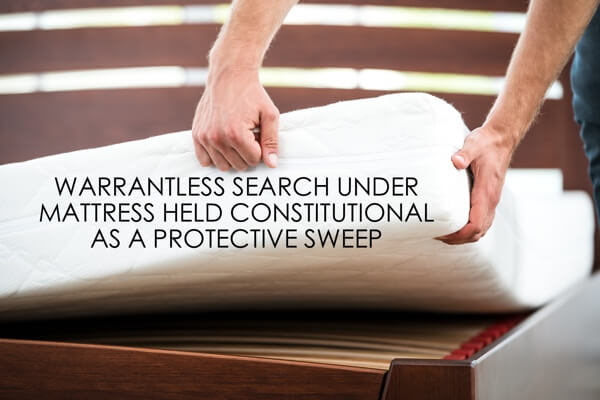
Warrantless Search Under a Man’s Mattress Held Constitutional

By Brandon Barnett · Search & Seizure

United States v. Garcia-Lopez (5th Circuit, 2016)

Warrantless Search Mattress Protective Sweep TexasFACTS: On February 5, 2014, the Wharton County Deputy Sheriff’s Department served a felony arrest warrant on Yonari Garcia at his father’s trailer home. Yonari’s father told law enforcement that Yonari was not home, however, consented to a search of the trailer. Upon entry, Garcia-Lopez, Yonari’s brother, made a beeline for a bedroom, closing and locking the door. Law enforcement followed Garcia-Lopez and demanded that the door be unlocked. Garcia-Lopez opened the door and the police entered, continuing the search for Yonari. Garcia-Lopez asked if he could sit on his bed and eat his dinner while police searched the room. The police obliged the odd request. A minute later, law enforcement discovered two sets of bullet-proof vests in plain sight, prompting a background check. Garcia-Lopez was a convicted felon and having the body armor was a violation for being a felon in possession of body armor, U.S.C. § 922(g)(1). The police arrested Garcia-Lopez after being in the home a total of three minutes. After the arrest, police continued searching the Garcia-Lopez’s room. Concerned Yonari might be sheltered in a hollowed-out mattress, the police lifted the bed up, discovering ammunition and three handguns sandwiched between the mattress and box springs. After a total of seven minutes inside the trailer, the police left with Garcia-Lopez under arrest.

See the 5th Circuit's full opinion in United States v Garcia Lopez.

Garcia-Lopez Indicted for Federal Firearms Charges

In March 2014, Garcia-Lopez was indicted on six counts of being a felon in possession of a firearm in violation of USC §§ 922(g)(1) and 924(a)(2). During an evidentiary hearing, the district court denied Garcia-Lopez’s motion to suppress the guns found under the mattress because law enforcement was originally in the trailer for a legitimate purpose and they had a right to search the home pursuant to the valid arrest warrant for Yonari. The court added that upon the valid search of the premises, law enforcement found contraband and arrested Garcia-Lopez. Further the court stated that upon his arrest, law enforcement had the right to make a protective sweep, so long as it did not last an unreasonable amount of time. Additionally, there was testimony that indicated that suspects have been known to hide in hollowed-out mattress to evade arrest. According to the district court, the search for Yonari and seizure of the guns was proper in every way. Garcia-Lopez was sentenced to forty-six years imprisonment and two years of supervised release. Garcia-Lopez appealed to the Fifth Circuit Court of Appeals, arguing that law enforcement’s belief that Yonari might have been hiding in the bed was unreasonable, and thus, unconstitutional.

Was Lifting the Mattress an Unconstitutional Search or a Lawful Protective Sweep?

The Court of Appeals must determine whether the act of “lifting up the mattress” and seizing the guns violated Garcia-Lopez’s constitutional rights. In other words, was lifting the mattress an unconstitutional search under the Fourth Amendment’s protection against unreasonable searches and seizures?

Under the Fourth Amendment, warrantless searches are pre se unreasonable. Coolidge v. New Hampshire, 403 U.S. 443, 474-75 (1971). A protective sweep may be conducted with [a lower threshold of] reasonable suspicion, probable cause is not necessary. Maryland v. Buie, 494 U.S. 325-27 (1990). “There must be articulable facts which, taken together with the rational references from those facts, would warrant a reasonably prudent officer in believing that the area to be swept harbors an individual posing danger to those on the arrest scene.” Id. A protective sweep [must be] quick and…limited to the safety of the police. Id. Evidence seen in plain view during a lawful sweep can be seized and admitted into evidence during trial. United States v. Jackson, 596 F. 3d 236, 242 (5th Cir. 2010).

5th Circuit Holds that the Warrantless Search of the Mattress was Reasonable

Here, the Court of Appeals held that the district court’s finding of reasonable suspicion was correct because of the amount of evidence supporting such a claim. First, law enforcement became suspicious because of the standoff over the locked door. Second, Garcia-Lopez’s odd request to sit back down on the bed while the police conducted the search is suspicious in light of the circumstances. Third, the belief that a suspect could be hiding in a hollowed-out mattress is reasonable given police training and data supporting such a claim. Fourth, the search lasted a total of seven minutes—a reasonable amount of time to conduct a protective sweep. In sum, the Court says it was logical under the specific facts of this case to suspect that Yonari might have been hiding in the mattress. The Court affirms the district court’s judgment—the warrantless search under Garcia-Lopez’s mattress was not unconstitutional under the circumstances.

Read full article

Speak with a Fort Worth attorney

Call (817) 993-9249 or send us a message to discuss your case.