Skip to content

News and Insights

Page 21 of 102 · 510 articles

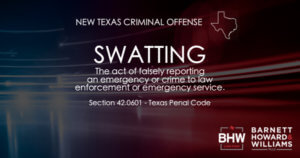
Swatting False Report of Crime in Texas

New Texas Offense: Swatting (Making a False Emergency Report)

By Brandon Barnett · False Report, Legislative Update

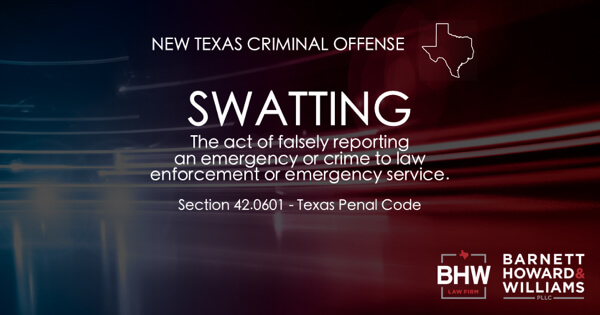
Swatting False Report of Crime in TexasTexas legislators enacted several new criminal laws in the 2021 legislative session. Below, we highlight one of them - Swatting. Being from Texas, I initially thought this might have something to do with mosquitoes, but, as it turns out, Swatting is the act of falsely reporting a crime or emergency to law enforcement or emergency personnel. This new offense is a Class A misdemeanor unless the prosecutor can show that you've been convicted of this same offense in the past.


NEW OFFENSE: Article 42.0601, Texas Penal Code - Swatting (False Report to Induce Emergency Response)
Senate Bill 1056: Summary of the legislation

Text of the new law:
     Sec. 42.0601. FALSE REPORT TO INDUCE EMERGENCY RESPONSE.

(a) A person commits an offense if:

(1) the person makes a report of a criminal offense or an emergency or causes a report of a criminal offense or an emergency to be made to a peace officer, law enforcement agency, 9-1-1 service as defined by Section 771.001, Health and Safety Code, official or volunteer agency organized to deal with emergencies, or any other governmental employee or contractor who is authorized to receive reports of a criminal offense or emergency; (2) the person knows that the report is false; (3) the report causes an emergency response from a law enforcement agency or other emergency responder; and (4) in making the report or causing the report to be made, the person is reckless with regard to whether the emergency response by a law enforcement agency or other emergency responder may directly result in bodily injury to another person.

PENALTY: A violation of the Swatting statute is a Class A misdemeanor, which carries a range of punishment of 0-365 days in jail and a fine up to $4,000. The offense is enhanced to a State Jail Felony if the actor has been convicted of the same offense twice before. The offense is enhanced to the 3rd Degree Felony if a person is killed or seriously injured as a result of the false emergency call and response.

EFFECTIVE DATE: The Swatting law went into effect on 9/1/21.

SPONSORS: Senate Bill 1056 was a bipartisan bill sponsored by Senator Joan Huffman (R) and Representative Eugene Wu (D). It was approved by both the Senate and the House in unanimous votes.

Read full article
New Criminal Laws 2021

Texas Legislature Update: New Criminal Laws 2021

By Brandon Barnett · Legislative Update

New Criminal Laws 2021
The 2021 Texas legislative session has now closed and there were several updates to our criminal statutes. Below are some of the more notable changes or additions to Texas criminal laws that took effect on September 1, 2021:

Constitutional Carry – HB 1927

All Texans over the age of 21 are now able to carry a handgun in public without a license or training as long as they are not prohibited from possessing a gun by state or federal law. In addition, the carrying a firearm while intoxicated is now a Class A misdemeanor, punishable by up to a year in jail and a maximum $4,000 fine, and the carrying a firearm in a vehicle by a gang member is now a third-degree felony punishable by two to 10 years in prison and a maximum $10,000 fine. HB 1927 also allows a peace officer to disarm a citizen at any time if they believe it is necessary to protect the individual, the officer, or another person. The officer, however, must return the handgun before leaving the scene if the officer determines the person was not a threat and didn’t commit a violation. Finally, HB 1927 allows for the expungement of records for those previously convicted of Unlawful Carrying a Weapon before September 1, 2021.

Obstructing Emergency Vehicles – HB 9

HB 9 makes it a state jail felony to knowingly block an emergency vehicle with its lights and sirens on or to obstruct access to a hospital or health care facility. This offense is punishable by six months to two years behind bars and a maximum $10,000 fine. Individuals convicted of this offense are required to spend at least 10 days in jail, even if they are sentenced to probation.

False Reporting to Induce Emergency Response – SB 1056

SB 1056 makes it a Class A misdemeanor, punishable by up to a year in jail and a maximum $4,000 fine, to falsely report a crime or an emergency to elicit an emergency response from law enforcement or other emergency responders. The charge becomes a state jail felony, punishable by six months to two years in state jail, if the defendant has been previously convicted twice of the offense and a third-degree felony, punishable by two or ten years in prison, if a person is seriously injured or killed as a result of the emergency response.

Enhancement for Reckless Driving Exhibition – SB 1495

SB 1495 heightens the penalty for obstructing a highway or passageway from a Class B misdemeanor to a Class A misdemeanor, punishable by up to a year in jail and a maximum $4,000 fine, for an individual who engages in a reckless driving exhibition. SB 1495 enhances the penalty to a state jail felony for a person who has been previously convicted of this offense, a person who operates a vehicle while intoxicated, or who causes someone to suffer bodily injury.

Harassment Extension to Social Media Posts – SB 530

SB 530 makes it a Class B misdemeanor, punishable by up to 180 days in jail and a maximum $2,000 fine, to harass another person by publishing repeated electronic communications on a website with the intent to harass, annoy, alarm, torment, or embarrass that person. The penalty, however, can be increased to a Class A misdemeanor, punishable by up to a year in jail and a maximum $4,000 fine, if the actor has been previously convicted of the offense or it if involved a child under age 18 with the intent to cause the child serious bodily injury or to commit suicide.

Silencer Legalization – HB 957

HB 957 removes firearm silencers from the list of weapons that are prohibited in Texas. In addition, firearms suppressors that are manufactured and remain in Texas are not subject to federal law or regulation.
Enhanced Punishment for Offenses against Public Servants – HB 624
HB 624 increases the penalty by one level for people who commit an offense against someone whom they know is a public servant or against a member of the public servant’s household or family. The increased punishments apply to arson, criminal mischief, criminal trespass, breach of computer security, harassment, stalking, or fraudulent use of possession of identifying information.

Enhanced Punishment for Offenses against Public Servants – HB 624

HB 624 increases the penalty by one level for people who commit an offense against someone whom they know is a public servant or against a member of the public servant’s household or family. The increased punishments apply to arson, criminal mischief, criminal trespass, breach of computer security, harassment, stalking, or fraudulent use of possession of identifying information.

Read full article
Scholarship Winners BHW

2021 HLAW Scholarship Winners | Veteran Law Student & Military Dependent

By Brandon Barnett · Scholarship

Barnett Howard & Williams PLLC Announces the Recipients of the 2021 Scholarship Awards

BHW Scholarship WinnersThis was the 6th year for our law firm to offer scholarships. In honor of the sacrifices of our military veterans, we decided to that the scholarships should be connected to military service. The first scholarship is a $500 award for a Military Veteran Law Student and the second scholarship is a $500 award for a Military Dependent undergraduate student. Throughout the year, we received several applications from very deserving students. We appreciate all of the students that took the time to apply for the scholarships and wish them all the best in their studies. For those students that were not selected, we invite you to apply again next year as we plan to continue the scholarship offers as an annual award.


2021 Winner - Military Veteran Law Student Scholarship

The winner of the 2021 Military Veteran Law Student Scholarship is:

SAMANTHA DOWNEY

Samantha Downey is an Army veteran that served for 6 years as a Combat Medic. Ms. Downey currently attends Notre Dame Law School. Congratulations Samantha Downey. Best wishes as you continue toward your law degree.


2021 Winner - Military Dependent Scholarship

The winner of the 2021 Military Dependent Undergraduate Scholarship is:

JEREMIAH BROOKS

Jeremiah Brooks is a US Marine Corps dependent whose father served in both the Marine Corps and Florida Army National Guard. Mr. Brooks graduated from Canyon Lake High School in 2021 and will be pursuing a career in Cyber Security. Congratulations Jeremiah Brooks. Best wishes as you continue in your studies.


More Information About Our Scholarship Opportunities:

For more information about how to apply for these scholarships in future years, please visit the scholarship pages:

Military Veteran Law Student Scholarship

Military Dependent Scholarship

Read full article
Texas Expunction Update

Misdemeanor Offenses in Texas Now Eligible for Expunction on an Individual Basis

By Brandon Barnett · Expunction

Texas Expunction UpdateIn January of this year, the Supreme Court of Texas heard arguments for Ex parte R.P.G.P. in which it declared that an arrest involving multiple offenses is divisible for expungement purposes under Article 55.01 of the Texas Code of Criminal Procedure. Specifically, it answered a question left open by a previous case, finding that misdemeanor offenses are eligible for expunction on an individual basis.

What is an Expunction of Criminal Records ?

When a criminal record is expunged, that means that the record of is destroyed or sealed (for juvenile records). In an expunction order the court orders the various agencies that maintain records to treat a criminal arrest as though it never happened. People generally have their records expunged so that it does not show up on a routine background check, as an expungement removes any record of the arrest or case from public record.

How Do You Go About Getting an Expungement in Texas?

Under Texas law, there are a number of things that make a record eligible for expunction. If you qualify for expunction, there is a process you must go through, beginning with filing what is called a Petition for Expunction with the district court requesting that it grant an Order for Expunction. While it is possible to prepare this on your own, the somewhat complicated process is best handled by an attorney. The prudent course is to consult a lawyer in order to have the best chance at successfully expunging a record. You only get one shot and if your petition is not granted you don’t get to try again, so it is best to get it right from the start.

After completing the petition, it must be filed with the proper court. You must file the petition for expunction in the district court of the county where the arrest occurred. Following the filing, the court schedules a hearing and notifies the record-keeping agencies that you included in your petition. Once everyone has been notified, the court will hold a hearing and allow those notified the chance to object to the expunction.

If you meet all the requirements, the court will grant the expunction and you will need to give an Order for Expunction to the court for the judge’s signature. Important to know is that the court will probably expect you to have this order ready at the hearing for the judge to sign then and there. Once the order is signed, it has to be submitted to the respondent agencies that you listed in the petition. Those records will then be either deleted or returned to the court clerk for destruction.

A Change in Texas Expunction Law: Arrests for Multiple Offense Can Now be Divided for Expungement?

Prior to a recent court decision, Texans could not expunge an arrest unless ALL alleged offenses qualified for expunction under the law. If any of the alleged offenses in the arrest report were not eligible for expunction, then NONE of the offenses were eligible. A partial expunction was not allowed.

However, State v. T.S.N., was a case which a single arrest involved several unrelated offenses and the court held that partial expunction of the arrest record was required and could be achieved through redaction, leaving the portions of the arrest record regarding an unrelated offense not eligible for expunction. While this case left open the question regarding misdemeanor offenses and their eligibility for expunction on an individual basis, it set the stage for R.P.G.P.’s case.

Thanks to Ex Parte R.P.G.P., if you are arrested for multiple offenses, those offenses are considered divisible—you can expunge one even if the other would not qualify. Ex Parte R.P.G.P. is a great illustration of what exactly this means. In that case, R.P.G.P. was arrested for a DWI and a search of the car revealed marijuana, so he was also charged with possession. The DWI charge was dismissed and R.P.G.P. pled no contest to the possession charge, which was ultimately dismissed after serving nine months of deferred adjudication probation. After both charges were dismissed, R.P.G.P. filed for expunction of the DWI arrest, but the State argued that no part of the arrest record could be expunged because the possession charge was ineligible for expunction. However, the court ultimately held that the DWI portion of the record could be expunged, even though the possession portion would remain on the record.

What Does This Change in the Expunction Law Mean for Texans?

What this means going forward for Texans is that if your arrest record reflects multiple misdemeanor offenses, some of which would be eligible for expunction on their own and some that are not, the ones that are eligible can be expunged, leaving the other portions on the record. This is a shift from the all-or-nothing approach previously adopted by the state. Rather than treating each arrest for various offenses as a collective, we can look at each individual charge and proceed from there. Hopefully, this line of thinking will be expanded to cases involving felony arrests as well, but time will tell.

Read full article
Butt-Dial Statement Texas Templeton

Can the Statements You Make During a Butt-Dial be Used Against You?

By Brandon Barnett · 5th Amendment

Butt-Dial Statement Texas TempletonThe short answer is Yes. According to both local and federal courts, what you say during a butt-dial phone call can potentially be used against you in court. In Texas, a hearsay exception makes those overheard statements admissible. In the federal system, these calls are viewed as having no reasonable expectation of privacy—since you did not take simple precautions to avoid this kind of situation, you cannot expect someone on the receiving end of the call not to repeat what they heard.

Butt-Dials in Texas: Can Words Overheard During an Unintended Phone Call be Used Against Me?

Under Texas law, statements made during an accidental butt-dial are likely admissible and the speaker likely has no reasonable expectation of privacy in those statements. Typically, repeating something in court that you heard someone else say outside of court is not allowed—it is referred to as hearsay and is considered inadmissible in a court of law. But, as with everything, there are hearsay exceptions that, in certain circumstances, allow someone to testify about something they heard someone else say. So, it should not be too surprising that a recent case found that butt-dials fall into one of the many hearsay exceptions.

Templeton v. State involved a felony assault family violence case in which the victim’s father received a butt-dial call from the victim and overheard defendant Templeton make incriminating statements about the assault, which the father then repeated in court. The Templeton court likened butt-dial statements to the requirements of Texas Rules of Evidence 801(e)(2)(A), commonly known as the admission of a party-opponent. Under this rule, a statement is not considered hearsay if it is a statement made by the person whom it is then offered against. In Templeton’s case, that meant that the statements he made on the butt-dial, which were overheard and then repeated by the victim’s father, could be used against him in court where he was the defendant. These statements do not have to be against the interests of the speaker when they are made in order for them to be admissible, rather, the requirement is that the statements be offered as evidence against the speaker/defendant.

Templeton sets the bar rather low in terms of the work it takes to get these kinds of phone calls in. Essentially, any Texas defendant who accidentally butt-dials someone faces the possibility that anything they say—whether they know someone is listening or not, or whether it is against their interest or not—can be repeated in court so long as it is used as evidence against them. The phrase “be careful what you say” could not ring more true. While a majority of butt-dials result in the overhearing of harmless conversations (your comments about who you saw at Trader Joe’s and the gossip you exchange with your friends are not likely to be subjects of court cases), it is important to know that anything you say on those calls has the potential to be repeated in court.

Butt Dials in the Federal System: Do I Have a Reasonable Expectation of Privacy?

Somewhat unsurprisingly, the sentiment that what someone said during a butt-dial can be used against them extends beyond just Texas and into the Federal system as well. In another recent case, Huff v. Spaw, the Sixth Circuit Appeals Court addressed butt-dials in two contexts: the traditional context in which a call is accidentally made and someone on the other end overhears and perhaps even documents or records the calls, and instances in which a butt-dial is made and the listener records the conversation the caller has with a third-party while in a hotel room.

The judge in Huff determined that in the first instance, there is no privacy claim. Essentially, according to the federal courts, it is the duty of every cell phone owner to make sure that their phones are secure. The court points out the commonality of cell phones and their use. There is no expectation of privacy (and therefore no claim) when someone fails to take simple measures to secure their phone and accidentally shares their activities or statements while using an everyday cell phone. As far as precautions go, the biggest one is to lock your phone. From there, there are a number of apps available to help prevent butt-dialing.

As to the second issue, the judge determined that there was a reasonable expectation of privacy, so that part of the case was remanded to the lower court for reconsideration. The key difference between these two issues was the fact that Bertha Huff, with whom James Huff spoke to in her hotel room. Bertha’s part of the conversation, in the judge’s opinion, was protected by a reasonable expectation of privacy because she did not make the butt-dial—as far as she was concerned, all she was doing was speaking to her husband in the comfort of her hotel room.

What Can You do to Protect Your Privacy?

No matter what type of phone you have, the first line of defense in preventing butt-dials and protecting your privacy is to lock your phone. From there, there are a number of other settings you can change that make butt-dialing less likely.

For iPhone users, adding a passcode (or touch/face I.D.) provides an additional layer of protection for users. If you are prone to butt-dialing, you can take it a step further, allowing your phone to auto-lock quickly (Settings --> Display & Brightness --> Auto-Lock). For iPhone users with models that still have the home button, it might be smart to also disable tap-to-wake (Settings --> Accessibility --> Touch --> Tap to Wake).

There are precautions for Android users too! Begin by setting a passcode. To turn off the tap to wake feature on these phones, go to Settings --> Display --> Lock Screen Display --> Double-Tap to Check Phone. To change the time it takes for these phones to auto-lock, go to Settings --> Security --> gear lock icon next to Screen Lock.

If you really want to go above and beyond, there are some apps available for certain phone users to download. If you take all these precautions and still end up in a situation where what you said on a butt-dial is being used against you, consult an attorney to discuss the best plan of action.

Read full article

Speak with a Fort Worth attorney

Call (817) 993-9249 or send us a message to discuss your case.