Skip to content
Category

What to Expect When Pulled Over for DWI in Keller & Southlake, Texas

Page 5 of 10 · 48 articles

Seal Texas DWI Non Disclosure HB 3016

New Texas Law Makes First-Time DWI Convictions Eligible for Sealing

By Brandon Barnett · DWI

Expanding Eligibility for Orders of Nondisclosure for First-Time DWI and Other Offenses

Seal Texas DWI Non Disclosure HB 3016Let's face it, a criminal record is not a good thing when it comes to employment opportunities and other things that require a background search. Even when the criminal offense is non-violent and unintentional, like DWI, it can negatively impact a person's future. Our Texas lawmakers recognized this stigma and did something about it. This past legislative session (2017), Texas lawmakers from both sides of the aisle proposed legislation to help expand the opportunity to seal criminal convictions with an order of non-disclosure.

What is an Order of Non-Disclosure?

Having your record “sealed” is common verbiage used by laypersons. Under Texas law, this is referred to as non-disclosure. Orders of non-disclosure “seal” a criminal record from the eyes of the general public and allow a person to deny such record in most situations. However, the offense will remain visible to law enforcement, state and federal authorities, and employers in government fields.

Non-Disclosures Prior to House Bill 3016

Before the legislature acted in 2017, the Texas Government Code required a court to issue an order of nondisclosure of criminal records for a person receiving discharge and dismissal of certain nonviolent misdemeanors for which the person was placed on deferred adjudication community supervision (probation). The code also allowed for some "second-chance" considerations under limited circumstances. However, the Texas Government Code did not previously allow for nondisclosure of DWI offenses under any scenario.

What is HB 3016?

Governor Greg Abbott signed HB 3016 on June 15th, 2017. HB 3016 will be effective, retroactively, beginning September 1, 2017. This law amends and expands the Texas Government Code to allow a person convicted of nonviolent misdemeanors, including DWI’s, to petition the court for orders of nondisclosure under certain circumstances and alters some waiting periods.

HB 3016 also allows a person to petition for an order of nondisclosure of criminal history if that person was ineligible to receive an automatic order based solely on a judge's affirmative finding that issuing such an order was not “in the best interest of justice.” If the offense was a misdemeanor punishable by a fine only an individual may petition for an order of nondisclosure immediately upon the date of completion of their sentence. However, if the misdemeanor was not punishable by fine only, they must wait until the second anniversary of the date of completing the sentence to petition.

See the full text of HB 3016 - Enrolled version.

Orders of Non-Disclosure for DWI Offenses

HB 3016 now allows a person convicted of a first-time Driving While Intoxicated offense with a blood-alcohol concentration (BAC) less than 0.15 to petition for an order of non-disclosure of criminal history related to that offense. However, there are certain criteria that must be met to be eligible to petition for a non-disclosure of a Texas DWI.

A person may petition to have a DWI sealed only if he/she:

  • has never been convicted of or placed on deferred adjudication community supervision (probation) for another offense—this does not include a traffic offense (punishable by fine only);
  • has successfully completed any imposed community supervision and any term of confinement;
  • has paid all fines, costs, and restitution imposed; and
  • the waiting period has elapsed:
    • 2 years if the person successfully completed a period of at least six months of driving restricted to a motor vehicle equipped with an ignition interlock device as a part of the sentence; or
    • 5 years if there was no interlock requirement as part of the sentence.

Additionally, the court will not issue an order of nondisclosure if an attorney representing the state presents evidence sufficient to the court that demonstrates that the underlying offense, for which the order was sought, resulted in a motor vehicle accident involving another person (this includes a passenger of the defendant).

When may you Petition the Court for an Order of Non-Disclosure for a DWI?

The law requires individuals to wait until the second anniversary of the date of completion of their sentence, if the person:

  • complied with all conditions of the sentence for a period not less than six months; and
  • was restricted to operation of a motor vehicle equipped with an interlock device for at least 6 months.

If the court did not impose the above conditions, they are required to wait until the fifth anniversary of the date of completion of their sentence.

NOTE: Having a first-time DWI sealed by an Order of Non-Disclosure will NOT prevent another DWI from being charged as a DWI (Misdemeanor Repetition).

What are the Disqualifying Factors for DWI Sealing?

A person may NOT have their DWI record sealed if:

  • The DWI was a 2nd or 3rd offense;
  • The DWI involved a finding that the Blood-Alcohol Content was greater than 0.15;
  • The DWI involved an accident involving another person;
  • The DWI was within the last 2 years (5 years if there was not interlock requirement)*

*If the waiting period has not expired, but all other conditions are met, the applicant must simply wait until the waiting period is complete.

Which Offenses are Specifically Excluded from Consideration for an Order of Nondisclosure?

Certain misdemeanors are not eligible for consideration for an order of nondisclosure, mostly intoxication related offenses, which include any misdemeanors under the:

  • Alcoholic Beverage Code §106.041 (possession and/or consumption of or selling alcohol to minors); or,
  • Penal Code § 49.04(d) (driving while intoxicated .15 or higher);
  • 49.05 (flying while intoxicated);
  • 49.06 (boating while intoxicated); or,
  • 49.065 (operating an amusement park ride while intoxicated).

Additionally, any conviction under Chapter 71 of the penal code (engaging in organized criminal activity) may not be non-disclosed.

Furthermore, a person will not be granted an order of nondisclosure and is not eligible to petition the court if the person has previously been convicted or placed on deferred adjudication probation for:

  • an offense requiring sex offender registration;
  • murder;
  • capital murder;
  • aggravated kidnapping;
  • trafficking/continuous trafficking of persons;
  • abandoning or endangering a child;
  • violation/repeated violation of certain court orders or conditions of bond in a family violence, sexual assault or abuse, stalking, or trafficking case;
  • stalking; or
  • any other offense involving family violence.

Results of HB 3016 and the New Non-Disclosure Law

HB 3016 makes it easier for persons with certain low-level nonviolent offenses, particularly DWI’s, to obtain employment and become productive members of society. However, subsequent offenders will remain accountable because law enforcement may still use the “sealed” conviction against subsequent offenses and certain entities will still be able to view the offense.

Contact our Criminal Defense Team Today to See if You Qualify to Have Your Record Sealed Under this Law

Contact Barnett Howard & Williams today and let our team help you determine whether you may be eligible for a non-disclosure under this law when it takes effect in September 2017. We are happy to provide a free consultation to walk you through the steps for sealing your record.  Call our attorney today at (817) 993-9249.
Read full article
Texas Occupational Drivers License Rules

Texas Occupational License Restrictions and Requirements (and why they matter)

By Jason H. Howard · DWI

What You Can, Should, and Must Do While You are Driving on an Occupational Drivers License in Texas

Texas Occupational Drivers License RulesIf you’ve received an occupational license related to a DWI ALR suspension (blood or breath test refusal or failure) in Texas, the judge who granted you that license likely included several restrictions and requirements you must follow. Those requirements can be found in the order granting your occupational license. You should have that order handy because Texas Transportation Code Section 521.250 requires you to possess a certified copy of the order when you drive. In fact, it’s a criminal offense not to possess a certified copy (we’ll revisit that below.)
Learn About Your Restrictions and Requirements

It all starts with the order that the judge signed. Review it. When reviewing the order granting your occupational license, you will find various restrictions and requirements. Restrictions typically limit your time, location and purpose of travel. In some scenarios, people are restricted to use an occupational license only when driving a vehicle equipped with an ignition interlock device. Other requirements can vary. They often include (but are not limited to) keeping a travel logbook, no traffic citations, no radar devices, etc. Specifically, however, Texas Transportation Code Section 521.245 requires the judge to require the person attend some form of an alcohol dependency program in the order granting occupational license. The order can also require you to submit proof of attendance to the court.

What Happens if Fail to Follow The Occupational Drivers License Restrictions or Requirements?

Texas Transportation code 521.253 says:
(a) A person who holds an occupational license commits an offense if the person:
.....(1) operates a motor vehicle in violation of a restriction imposed on the license; or
.....(2) fails to have in the person's possession a certified copy of the court order as required under Section 521.250.
(b) An offense under this section is a Class B misdemeanor.
(c) On conviction of an offense under this section, the occupational license and the order granting that license are revoked.

What about not complying with the requirement for attending an alcohol dependency program? Per Texas Transportation Code Section 521.245, judges have the authority to revoke the occupational license and impose an additional 60-120 day suspension. That additional suspension is costly, too. Unlike the original DWI ALR suspension where you could apply for an occupational license, there is no option for another occupational license if you were granted one and failed to comply with this requirement.

Don't Run Afoul of the Occupational DL Rules or Restrictions

So, the suggested practice here is simple:

  1. Have a certified copy of the order granting your occupational license.
  2. Read it carefully and educate yourself about the restrictions/requirements involved.
  3. Comply with said restrictions/requirements for the duration of your occupational license.

If you have questions about your occupational license, contact your attorney for assistance. If you don’t have an attorney, the attorneys at Barnett, Howard & Williams, PLLC are only a phone call away.

Read full article
Community Caretaking Function Texas

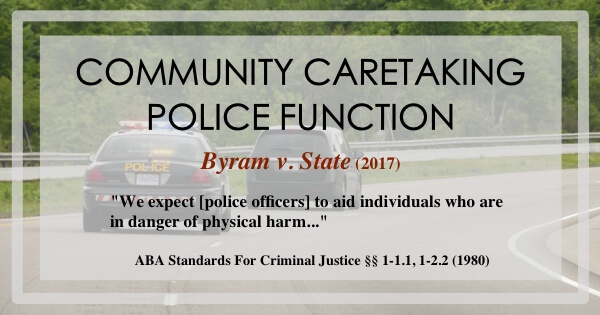
Community Caretaking Function: Police May Stop without Reasonable Suspicion

By Brandon Barnett · DWI

Community Caretaking Function TexasIn November of 2015, we wrote about State v. Byram, a DWI case out of Tarrant County. In Byram, the 2nd Court of Appeals held that a "hunched over" passenger in a vehicle was not enough to invoke the police "community caretaking" function to allow the police to initiate a traffic stop without reasonable suspicion of a violation.  The 2nd Court reversed the DWI conviction and remanded the case back to the trial court. The State appealed this decision to the Texas Court of Criminal Appeals, which issued its opinion today.

When May the Police Invoke the "Community Caretaking" Function to Make a Stop or Detention Without Reasonable Suspicion?

Byram v. State (Tex.Crim.App. 2017)

In this case, State argued that the police officer was engaged in his "community caretaking" function when he pulled the driver over. The State contends that this was a proper exercise of police authority and that the primary purpose of the stop need not be to investigate any alleged violation.

Reviewing the facts in the light most favorable to the trial court's ruling (denying the suppression motion), the CCA agreed with the State and explained its view on the Community Caretaking function:

Local police officers frequently engage in “community caretaking functions,” totally divorced from the detection, investigation, and acquisition of evidence relating to the violation of a criminal statute. Cady v. Dombrowski, 413 U.S. 433, 441 (1973). “As part of his duty to ‘serve and protect,’ a police officer may stop and assist an individual whom a reasonable person—given the totality of the circumstances—would believe is in need of help.” Wright v. State, 7 S.W.3d 148, 151 (Tex. Crim. App. 1999). However, because the reasonableness of a community-caretaking seizure sprouts from its dissociation from the competitive enterprise of ferreting out crime, “a police officer may not properly invoke his community caretaking function if he is primarily motivated by a non–community caretaking purpose.” Corbin v. State, 85 S.W.3d 272, 276-277 (Tex. Crim. App. 2002).

The Court went on to lay out a two-step test for determining whether an officer may properly invoke his community-caretaking function:

  1. whether the officer was primarily motivated by a community-caretaking purpose; and
  2. whether the officer’s belief that the individual needed help was reasonable.”*

*The standard for reasonableness is no different when the officer stops a vehicle to check the welfare of a passenger rather than the driver. Wright, 7 S.W.3d at 151.

In this particular case, the CCA held, "[the officer] saw a woman in a precarious situation, and acted reasonably to help her by first asking whether she was okay, and then conducting a traffic stop when his
question went unheeded. This is the sort of 'sound, commonsense police work that reason
commends, rather than condemns.'"

Read full article
Birchfield v. North Dakota Supreme Court Breath Test

Criminal Penalties for Refusing a Breath Test—Are They Coming to Texas?

By Brandon Barnett · DWI

Can Texas Charge a Person with a Crime for Refusing a Breath or Blood Test During a DWI Stop?

In Texas, when a person refuses to provide a breath or blood specimen when being arrested for alleged drunk driving offense, their driver’s license is typically suspended. But, can a state have a law that additionally makes it a crime to refuse a breath or blood test? In Birchfield v. North Dakota, the United States Supreme Court held that a state can attach a criminal penalty to those that refuse to submit to a warrantless breath test but they cannot for those that refuse to submit to a warrantless blood test.

In a previous blog post we discussed the oral arguments that took place in this case and briefed the three cases facing the court, Birchfield , Bernard and Beylund.  Birchfield had been criminally prosecuted for refusing a warrantless blood draw; Bernard had been criminally prosecuted for refusing a warrantless breath test; and Beylund, while not criminally prosecuted for refusing a test, submitted to a blood test after the officer told him the law required it. Birchfield v. North Dakota 579 U.S. ____ (2016).

U.S. Supreme Court Issues Opinion in Birchfield Upholding Criminal Penalty for Breath Test Refusal (But Not Blood)

SUPREME COURT DECISION - Birchfield v. North Dakota

First, the Court determined whether warrantless breath and blood tests were proper searches incident to arrest for drunk driving. The Court held that since “breath tests are significantly less intrusive than blood tests” and in most cases adequately serve law enforcement interests, the Fourth Amendment permits a warrantless breath test but not blood test as a search incident to arrest for drunk driving.

Next, the Court addressed the argument that when making the decision to drive on a public road, drivers are deemed to have given consent to submit to a blood test. Applying the Fourth Amendment reasonableness standard, the Court held that “motorists cannot be deemed to have consented to submit to a blood test on pain of committing a criminal offense.” Birchfield, 579 U.S. ____ (2016).

Finally, the Court applies these legal conclusions to the three cases.  In Birchfield, the Court held that the judgment affirming his conviction must be reversed because the warrantless blood draw was not a justified search incident to arrest and he was thus, threatened with an unlawful search. In Bernard, the Court held that Bernard had no right to refuse the breath test because it was a proper search incident to arrest. In Beylund, the Court vacated the judgment and remanded the case to the state court to reconsider Beylund’s consent given the partial inaccuracy of the officer’s statement that “the law required it.”

In conclusion, the Supreme Court held that States may enact laws that attach criminal penalties to the refusal to submit to a breath test but they may not enact such laws that will apply to refusal to submit a blood test. So what does this mean for Texas? Well, while we do not currently have laws in place that attaches a criminal penalty to refusal of a breathalyzer, the State could enact a law that makes it a crime to refuse to provide a warrantless breath test incident to arrest of drunk driving.

Read full article
Exigent Circumstances Warrantless Blood Draw

Understaffing of Police Cannot Create the “Exigency” to Justify a Warrantless Blood Draw

By Brandon Barnett · DWI

In a Warrantless DWI Blood Draw Case, State Offers "Understaffing of Police" as an Exigent Circumstance.

Exigent Circumstances Warrantless Blood DrawBonsignore v State (2nd Court of Appeals - Fort Worth, 2016)

After traveling eighty miles an hour in a forty miles per hour zone, Jeremy Bonsignore pulled into a Waffle House and started walking toward the restaurant. Unknown to Bonsignore, law enforcement had been following him for several minutes. Once the officer pulled into the parking lot, he activated his lights and began yelling at Bonsignore to stop walking. Bonsignore turned around, stumbled, and lost his balance. The officer noted the presence of a strong odor of alcohol and that Bonsignore’s eyes appeared glassy.

Bonsignore admitted to having a few drinks earlier in the day, which prompted the officer to conduct several field sobriety tests. Bonsignore failed them and then abruptly refused to do anymore tests or provide a breath or blood sample. Bonsignore was placed under arrest at 1:49 am. Dispatch informed the officer that Bonsignore had two prior DWI convictions, which could amount to Bonsignore being a repeat DWI offender, a felony offense. With this information in mind, the officer instructed a second officer to take Bonsignore to the hospital for a mandatory blood draw. The blood draw was conducted at 2:55 am. Bonsignore did not consent to the taking of his blood and the officer did not obtain a warrant.

Warrantless Blood Draw Issue at Trial

Before trial began, Bonsignore filed a motion to suppress the results of the blood draw, arguing that the blood draw was warrantless, and therefore, unconstitutional. The motion was never officially ruled upon, although the court did take the motion under advisement. During trial, when asked why he ordered the blood draw, the officer said that Bonsignore’s “two prior convictions were his only authority for obtaining the blood draw.” The officer did not attempt to obtain a search warrant, and he acknowledged that Bonsignore did not give his consent to a blood draw.

The officer testified that he relied solely on the statute, Texas Transportation Code 724.012, for authority to order the draw against Bonsignore’s will. Pleading guilty to the charges, the trial court issued Bonsignore a two-year sentence. Bonsignore appealed, arguing that his motion to suppress the evidence should have been ruled upon because the blood draw was taken without his consent and without a search warrant, violating the ruling in Missouri v. McNeely, 133 S. Ct. 1552 (2013). The State argues that (1) Bonsignore’s blood-alcohol level would dissipate over time, (2) he was a repeat felony offender, and (3) the police department was small and understaffed, and that obtaining a warrant in this case would have been overly-burdensome for the officers that night.

Is "Dissipation" an Exigent Circumstance to Justify a Warrantless Search?

In the wake of the McNeely case, the Second Court of Appeals must determine whether Bonsignore’s blood draw was constitutional, and, whether the State may rely on an exigency “emergency circumstances” argument as an exception to the Fourth Amendment.

Texas Transportation Code

Section 724.012(b)(3)(B) states that blood or breath samples may be required to be taken when the suspect is arrested for DWI and he refuses to give the specimen voluntarily, so long as the suspect has two prior DWI convictions, “although [the code] does not expressly authorize taking the specimen without a warrant.” State v. Swan, 483, S.W.3d 760, 764 (Tex. App.—Fort Worth 2016, no pet.).

However, “the explicit refusal to submit to blood testing overrides the existence of any implied consent and that implied consent that has been withdrawn by a suspect cannot serve as a substitute for the free and voluntary consent that the Fourth Amendment requires.” State v. Villarreal, 475 S.W.3d 784, 800.

Precedent Case Law: Missouri v. McNeely

“The natural metabolism of alcohol in the bloodstream [does not] present a per se exigent circumstance justifying an exception to the Fourth Amendment’s warrant requirement for nonconsensual blood testing in all drunk-driving cases.” McNeely, 133 S. Ct. at 1556, 1558.

The Second Court of Appeals Weighs In

The Second Court of Appeals agreed with Bonsignore. “The police may not create their own exigency to make a warrantless arrest or search.” Parker v. State, 206 S.W.3d 593, 598 (Tex. Crim. App. 2006). “Exigent circumstances do not meet Fourth Amendment standards if [law enforcement] deliberately creates the [circumstances].” Id.

Here, the Court held, law enforcement knew that it was not a “No Refusal Weekend” in Texas. Further, the police department knew that it only had three officers on duty the entire night Bonsignore was arrested. In fact, understaffing the department was a typical occurrence. There was nothing out of the norm about the number of officers on duty that night. “Deliberately scheduling an insufficient number of patrol officers on an evening shift does not constitute an exigent circumstance.” State v. McClendon, NO. 02-15-00019-CR, 2016 WL 742018 (Tex. App.—Forth Worth, Feb. 25, 2016, no pet.).

Additionally, the department had a protocol for obtaining warrants, even in the absence of magistrates “on call.” Also, there was no earth-shattering emergency or problem that prevented the officers from making attempts to secure a warrant for Bonsignore’s search. The Court makes a point to highlight the efficiency of fax machines for the purposes of securing warrants, “thanks to the fax machine, [law enforcement] could …request a search warrant” and “thanks again to a fax machine…once [law enforcement] had the search warrant, [they] could fax it directly to a hospital instead of driving [the warrant] there.” The argument that the police department is small was unpersuasive for the Second Court of Appeals. For these reasons, the Second Court of Appeals reversed the trial court’s ruling, and remanded the case to the trial court for a new trial.

Read full article

Speak with a Fort Worth attorney

Call (817) 993-9249 or send us a message to discuss your case.