Skip to content
Category

What to Expect When Pulled Over for DWI in Keller & Southlake, Texas

Page 4 of 10 · 48 articles

Deadly Weapon DWI Couthren v State

Is a Vehicle Always a “Deadly Weapon” in a DWI Collision Case?

By Jason H. Howard · DWI

Direct Evidence at Trial Must Reflect “Manner of Use” to Support Deadly Weapon Finding | Couthren v. State
Deadly Weapon DWI Couthren v StateOne of the common factors in any DWI case is that there must be a motor vehicle involved. Every time. When someone who is under the influence of drugs and/or alcohol chooses to drive a motor vehicle, should the car itself be considered by Texas courts to be a “deadly weapon?” When do ordinary, daily objects, such as cars, become “deadly weapons” for the purpose of charging enhancements and raising the stakes in a criminal case?

Slip Opinion: Couthren v. State (Tex. Crim. App. 2019)

Driver Hits Pedestrian after Drinking

Donald Couthren was driving on a frontage road in Bryan, Texas early one morning in 2012. He had been drinking Four Loko earlier in the evening and was impaired. Frank Elbrich was walking along the same road and stepped out in front of Couthren’s vehicle. Elbrich’s head hit the windshield and he landed on the ground. Couthren stopped his vehicle, scooped up Elbrich, and put Elbrich into his car, with the idea of taking him to the hospital. In a strange turn of events, Couthren, instead, drove to a house to exchange cars, and ended up in altercation with the people in the house. The police were called as a result. When police arrived, they noticed that Elbrich was bleeding and non-responsive. They saw that the windshield was broken, as well. The police noted that Couthren smelled of alcohol and swayed from side to side when he walked. Couthren admitted to hitting Elbrich when “[he] stepped in front of his vehicle.” Couthren did not consent to a blood draw and refused to comply with field sobriety tests. Police arrested Couthren for driving while intoxicated (DWI).

Felony DWI Trial with Deadly Weapon Enhancement

Couthren was indicted and tried for felony DWI. The State alleged a “deadly weapon” finding, claiming that the Couthren’s vehicle was a deadly weapon. A deadly weapon finding enhances the charge, increasing the term of imprisonment. Accordingly, the jury convicted Couthren and agreed with the deadly weapon finding and assessed a punishment of six years imprisonment. On appeal, Couthren argued that there was not enough evidence to support the deadly weapon finding. The lower appeals court upheld the trial court’s finding, utilizing a “two-step” approach to determine whether the evidence was sufficient. The two-step approach consisted of (1) an evaluation of the manner in which Couthren used his car during the felony and (2) an analysis of whether vehicles are capable of causing death or serious bodily injury. Couthren v. State, No. 13-16-00543-CR, 2018 WL 2057244, at 5 (Tex. App.—Corpus Christi, May 3, 2018) (mem. op., not designated for publication).

Appeal to the Texas Court of Criminal Appeals | Is a Vehicle Always a “Deadly Weapon?”

Couthren appealed the lower appeals court’s ruling, to the Court of Criminal Appeals to determine whether the first step (“manner of use”) was a proper evaluation. Specifically, Couthren argued that the lower appeals court relied on the fact that there was a collision and that he had been drinking, to uphold the deadly weapon finding. Further Couthren argued, there must be evidence of a dangerous or reckless operation to support a finding that a car was used as a deadly weapon.

The CCA examined several laws, that when applied together, could create a deadly weapon finding in a DWI collision scenario. Texas Penal Code Section 49.04(a) which prohibits a person from operating a motor vehicle in public while intoxicated. TEX. PENAL CODE §49.04(a). Further, other statutes in Texas provide for a third-degree felony enhancement if it can be proven that a defendant had to prior DWI convictions. TEX PENAL CODE §49.09(b)(2). The Texas Code of Criminal Procedure, Section 42.12 states that, “When it is proven that a defendant used or exhibited a deadly weapon, a trial court shall consider a deadly weapon finding in the judgment.” Moore v. State, 520 S.W.3d 906, 908 (Texas Crim. App. 2017).

The CCA looked to precedent cases to guide their analysis. The CCA determined that there must be evidence that the manner of driving was capable of causing death or serious bodily injury apart from the fact of a collision and a defendant’s intoxication. Brister v. State, 449 S.W.3d 490, at 495 (Tex. Crim. App 2014). Further, the CCA noted that it has “expressly rejected the argument that all felony DWI cases warrant an automatic deadly weapon finding.” Id.

Deadly Weapon Finding Reversed for Lack of “Manner of Use” Evidence to Support it

Here, the CCA noted that there was very little evidence showing the manner in which Couthren used his car during the DWI offense. For example, “we do not know if he applied his brakes…or…if there were other cars on the road.” The CCA stated that the arguments put forth by the State regarding “manner of use” on appeal were conclusions inferred from underlying facts. The CCA stated, “reasonable inferences must be supported by the evidence presented at trial.” Tate v. State, 500 S.W.3d 410 (Tex. Crim. App. 2016). In this case, “the only direct evidence of Couthren’s manner of driving before and at the time of impact was Couthren’s testimony at trial that he was driving 30 miles per hour and that he swerved to avoid hitting Elbrich.” Accordingly, the CCA determined that the facts as presented at trial did not amount to a deadly weapon finding, “in this case we lack specific testimony in the record about manner of use.” The CCA reversed the deadly weapon finding.

While the case before the CCA was decided in Couthren’s favor, it is important to note that it was not without controversy. Four justices joined in a strong dissent. Distinguishing the case at bar from the case law relied upon for the decision, Cates v. State and Brister v. State, the dissenting justices pointed out that because “the offense [in Cates] was failure to stop and render aid and the collision occurred before the offense occurred,” the collision itself could not “be the basis for a finding that a deadly weapon was used during the later offense.” The dissenting opinion states, “the collision did occur during Couthren’s DWI offense and the collision caused serious bodily injury to Mr. Elbrich.”

Read full article
Boating While Intoxicated Boating Offenses Texas

7 Common Boating Offenses in Texas | #3 Can Lead to Serious Prison Time

By Brandon Barnett · DWI

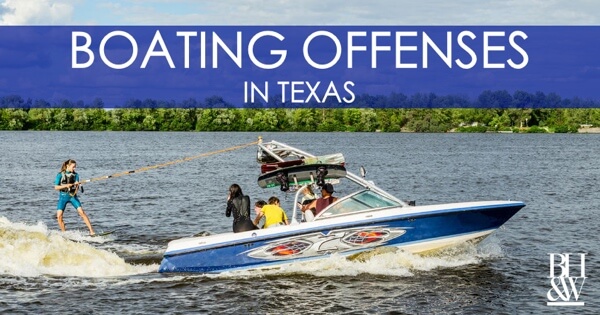
Boating While Intoxicated Boating Offenses TexasFor a lot people in Texas, the summer is filled with swimming, boating, wakeboarding, and drinking. These activities can be fun and harmless, but sometimes they can take a turn for the worse. Here’s a list of some of the most common criminal offenses that can be committed on a boat in Texas lakes and possible punishments that go along with them. Please keep these in mind to ensure that you have a fun and safe time on the water this summer.


1. Boating While Intoxicated in Texas (BWI)

There is nothing wrong with drinking on a boat, but the boat driver must be careful not to have too many. Under Texas Penal Code 49.06, a person is Boating While Intoxicated if the person is intoxicated while operating a watercraft. To be considered intoxicated, one must not having the normal use of mental or physical faculties by reason of the introduction of alcohol, a controlled substance, a drug, a dangerous drug, a combination of two or more of those substances, or any other substance into the body or have an alcohol concentration of 0.08 or more. This is the same definition of intoxication that exists under the DWI statutes in Texas.

A "watercraft," as defined in the Boating While Intoxicated law, is a vessel, one or more water skis, an aquaplane, or another device used for transporting or carrying a person on water, other than a device propelled only by the current of water.

Boating while intoxicated is a Class B misdemeanor, with a minimum term of confinement of 72 hours. It is punishable by:

  • up to 180 days in jail
  • a fine of up to $2,000, or
  • both confinement and fine

2. Underage Operation of a Boat

In Texas, according to the Parks and Wildlife Code, no person may operate a motorboat powered by a motor with a manufacturer’s rating of more than 15 horsepower on the public waters of this state unless the person is at least 13 years of age or is supervised by another person who:

  • is at least 18 years of age;
  • can lawfully operate the motorboat; and
  • is on board the motorboat when under way.

Children that are 13-17 years of age can lawfully operate a recreational vessel (like a jet ski) if they complete a boater education course.
Underage operation of a Boat is a Class C Parks and Wildlife Code misdemeanor and can be punished by a fine of $25 to $500.

3. Failure to Report a Boating Accident in Texas (Felony Offense)

The Texas Parks and Wildlife Code regulates the boating guidelines in Texas. According to Section 31.104, when involved in a boating accident, the operator is required to:

  • Render to other persons affected such assistance, as may be practicable and necessary in order to save them from or minimize any danger.
  • Give his name, address, and identification of his vessel in writing to any person injured and to the owner of any property damaged in the collision, accident, or other casualty.

Also, according to Section 31.105 the accident must be reported to the department on or before the expiration of 30 days after the incident. The report should include a full description of the collision, accident, or casualty in accordance with regulations established by the department.

It is the responsibility of each boat operator who is involved in an accident to contact TPWD or your nearest law enforcement agency if the accident:

  • Results in death; (within 48 hours) or
  • Injuries to a person requiring medical treatment beyond first aid; or
  • Causes damage to vessel(s) or property in excess of $2,000.00

Failure to report is a Parks and Wildlife Code Felony and can be punished by confinement in the Texas Department of Criminal Justice for at least 2 but less than 10 years. In addition to imprisonment, a Parks and Wildlife Code felony may be punished by a fine of $2,000 to $10,000.

4. Speeding While Boating

I’ll bet you’ve never noticed any speed limit signs on the lake. Neither have I. However, a person can still violate Texas law if they go too fast in their boat. The Texas Parks and Wildlife Code states that no person may operate any boat at a rate of speed greater than is reasonable and prudent, having due regard for the conditions and hazards, actual and potential, then existing, including weather and density of traffic, or greater than will permit him, in the exercise of reasonable care, to bring the boat to a stop within the assured clear distance ahead. So it appears that the speed limit is whatever a reasonably prudent person would say that it is. If you’re a daredevil, then ask your cautious friend if you’re going too fast.

Speeding is an offense under this section is a Class C misdemeanor and can be punished by a fine not to exceed $500.

5. Failure to Have Life Jackets on Board

Texas Parks and Wildlife Code Section 175.15 requires that there is at least one personal flotation device on board a recreational vessel for each person. Further, each child must be wearing their life jacket while on board.

Failure to have proper life jackets is a Class C misdemeanor and can be punished by a fine not to exceed $500.

6. Fishing Without a License in Texas

A valid fishing license with a freshwater or saltwater endorsement is required to take fish, mussels, clams, crayfish or other aquatic life in the public waters of Texas. However, you do not need a fishing license/package if you:

  • are under 17 years of age.
  • were born before January 1, 1931.
  • are a mentally disabled person who is engaging in recreational fishing as part of a medically approved therapy, and who is fishing under the immediate supervision of personnel approved or employed by a hospital, residence or school for mentally disabled persons.
  • are a mentally disabled person who is recreational fishing under the direct supervision of a licensed angler who is a family member or has permission from the family to take the mentally disabled person fishing

Fishing without a license is an offense under this section is a Class C misdemeanor and can be punished by a fine not to exceed $500.

7. Public Intoxication

Public Intoxication applies on the water, just as it does on land in Texas. Under the Texas Penal Code, a person commits the crime of public intoxication if the person appears in a public place while intoxicated to the degree that the person may endanger the person or another.

Public intoxication is a Class C misdemeanor and can be punished by a fine not to exceed $500.

Texas Criminal Defense Attorneys and Summer Water Enthusiasts

We enjoy the Texas lakes as much as anyone and we hope that you will too. Like we always say, we hope you never need us, either for a criminal offense or for an accident, but we are here if you do. For a free consultation about your legal matter, contact Barnett Howard & Williams PLLC at (817) 993-9249.

Read full article
DWI No Refusal Christmas Fort Worth

Twas the Night Before No Refusal Weekend in Tarrant County

By Brandon Barnett · DWI

Tarrant County No Refusal Period for the Christmas and New Year's Holidays

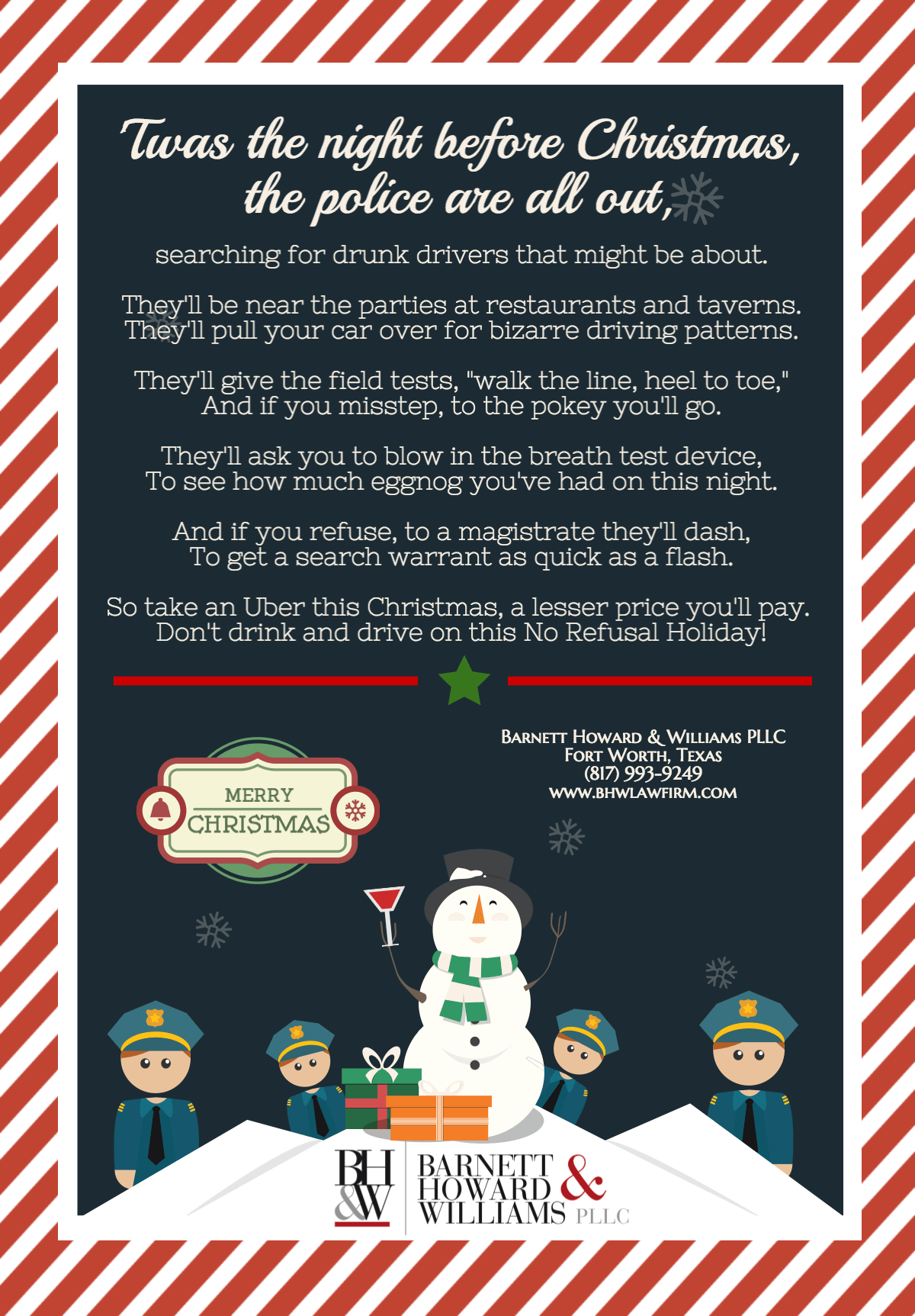
Tarrant County typically implements a No Refusal period during major holidays.  Being in the Christmas spirit, we thought that our No Refusal warning would be better if it rhymed.  Enjoy our Christmas No Refusal poem.

DWI No Refusal Christmas Fort Worth

Twas the night before Christmas, the police are all out, Searching for drunk drivers that might be about. They'll be near the parties at restaurants and taverns. They'll pull your car over for bizarre driving patterns. They'll give the field test, "walk the line, heel to toe," And if you misstep, to the pokey you'll go. They'll ask you to blow in the breath test device, To see how much eggnog you've had on this night. And if you refuse, to a magistrate they'll dash, To get a search warrant as quick as a flash. So take an Uber this Christmas, a lesser price you'll pay. Don't drink and drive on this No Refusal Holiday.

Read full article
Seal DWI Conviction Texas

Denton County’s First DWI Non-Disclosure Granted

By Brandon Barnett · DWI

Seal DWI Conviction TexasWhen Governor Abbott signed the new DWI sealing law allowing for first-time DWI convictions to be non-disclosed, we began to pull records for our past DWI clients to see if any of them were eligible to have their conviction sealed. We filed the first DWI non-disclosure petition in Denton County as soon as the law took effect in September 2017. Our client was exactly the type of person for whom this new law was written:

  • He was convicted of Class B DWI
  • He successfully completed all terms of his probation
  • More than 5 years have elapsed since he completed probation
  • He had no other arrests on his record either before or after this DWI conviction

Sealing a DWI with a BAC Exceeding 0.15

One of the wrinkles in our client’s non-disclosure petition involved his blood alcohol content. The new DWI sealing law does not allow DWI convictions to be non-disclosed if the person was convicted of having a BAC over 0.15 (Texas Penal Code Section 49.04(d)). Our client’s case involved a BAC over 0.15, but he was not convicted under Section 49.04(d), but rather under 49.04 without any finding of a particular BAC. Our client’s DWI case happened before the legislature added paragraph (d) to the DWI law in 2011. So, as we saw it, our client still qualified for the new sealing law.

The DWI Non-Disclosure Hearing

Having alleged all of the qualifying conditions in our petition, there wasn’t much to the hearing when the time came. The Denton County District Attorney did not oppose our petition and we were able to take the proposed order to the judge without the need for an evidentiary hearing. We were prepared with the offense report, clerk’s records, and criminal history for our client, but none was needed. The judge gladly signed the order for non-disclosure and our client became the very first person in Denton County to have his DWI conviction non-disclosed.

Our client, who has only had this one encounter with the criminal justice system, was thrilled that this uncharacteristic mistake can finally be put behind him. We look forward to helping more people seal their DWI convictions in both Tarrant and Denton Counties. To see if you might be eligible to have your DWI case sealed, contact our team today at (817) 993-9249.

*If you are a Texas attorney and need assistance drafting a petition or order for a DWI non-disclosure, please reach out and we will be glad to help.

Read full article
DWI Jury Instruction Alcohol Burnett

Error to Instruct DWI Jury on Drug Intoxication When Not Supported By Evidence

By Pricer · DWI

Is it Error to Provide a Jury with Instructions When the Statutory Language is not Supported by the Evidence?

DWI Jury Instruction Alcohol BurnettThe Court of Criminal Appeals recently handed down a case regarding the State’s ability to use the full statutory definition of “intoxicated” in a jury charge for DWI cases. The issue faced by the court was whether the trial court erred in providing the jury with portions of the statutory language that were not supported by evidence presented at trial.

Burnett v. State, Court of Criminal Appeals (2017)

The Facts—What Happened?

Burnett was arrested and charged with DWI after rear-ending a vehicle occupied by Bussey and Chappa. When Burnett exited his vehicle both Bussey and Chappa observed him to be intoxicated. Bussey and Chapa smelled the odor of alcohol on Burnett’s breath and noticed his speech to be slurred. Additionally, the first officer on the scene also noticed Burnett to have slurred speech and the odor of alcohol on his breath. Burnett told officers that he had not been drinking and consented to taking the standard field sobriety tests. Burnett showed signs of intoxication during the all three tests and was subsequently arrested.

In a search incident to arrest, officers found pills in Burnett’s jacket and a prescription pill bottle located in his car. The pills and prescription bottle were not photographed or admitted into evidence.

The State later charged Burnett with a Class B misdemeanor DWI and alleged that he was intoxicated “by not having the normal use of his mental and physical faculties by reason of the introduction of alcohol, a controlled substance, a drug, a dangerous drug, a combination of two or more of the substances, and any other substance into his body . . .”

Defendant’s Motion to Suppress—The Trial Court Granted Defendant’s Motion then Subsequently Admitted the Excluded Evidence as Same-Transaction Evidence.

One of the officers who saw the pills at the scene thought they were hydrocodone and was going to testify regarding such. The defendant filed a motion to suppress arguing that the officers should not be able to testify to what type of pills they found because the officers were not drug recognition experts. The trial court granted the motion to suppress.

Nonetheless, the following day at trial the pill discussion was brought up again. The state advised the Court that there was video evidence from the scene showing officer Coapland, officer Allred, and Burnett talking about the pills. Specifically, it showed that “Coapland found the pills in Burnett’s jacket, he gave them to Allred, who said that the pills looked like hydrocodone. Allred asked Burnett whether he had a prescription for the medication, and Burnett responded that he did.”

The State argued that the evidence of Burnett’s pill possession should be admitted into evidence as same-transaction contextual evidence. Over Burnett’s same objection the trial court admitted the pill evidence.

Then, when the court submitted the instructions to the jury, it included in the full statutory definition of the legal term "intoxicated," which included not only intoxication by introduction of alcohol, but also by introduction of a drug (or a combination of alcohol and drugs).  Burnett objected to this definition, arguing that the proper instruction should not include language regarding drug intoxication because there was no evidence produced at trial to indicate that he had ingested any drugs at the time of his arrest.

The Court of Appeals Agreed with the Defendant—Holding that it to be Error to Submit the Entire Statutory Language.

On appeal, Burnett argued that the trial court erred in admitting evidence that he was in possession of hydrocodone and further argued that the trial court erroneously instructed the jury that it could convict him if it found that any substance other than alcohol intoxicated him.

The court of appeals agreed and held that the charging instrument must apply the law to the facts. In support they distinguished the facts in Burnett from those in Ouellette, a 2011 court of criminal appeals case.

In Ouellette, the defendant appeared intoxicated. After her arrest, officers found a drug that she expressly identified that was known to produce the same symptoms of intoxication as alcohol. Although there was no direct evidence that she consumed the drug, there was circumstantial evidence from which a rational juror could have found that she did based on her express identification of the drug and the officer’s testimony that the drug would produce similar symptoms. Thus, the jury charge in Ouellette reflected the law as it applied to the evidence.

The Court of Criminal Appeals Affirmed the COA Judgment and Agreed that the Jury Charge was Erroneous Since it did not Apply the Law to the Facts Produced at Trial.

The State appealed the appellate court reversal and argued that the jury charge should include the entire statutory definition regardless of the evidence presented at trial. More specifically, the State argued that the focus is only on whether the defendant is intoxicated, not the intoxicant itself. In support of this argument, the State referred to Judge Cochran’s dissenting opinion in Gray v. State, 152 S.W.3d 125, 136 (Tex. Crim. App. 2004) (Cochran, J., dissenting).

In response, Burnett argued that while the State only needs to allege that the defendant was “intoxicated” and is permitted to use the language of the entire statutory definition, it would be erroneous to provide the jury with a section of statutory language that is not supported by the evidence at trial. Burnett argued that ruling for the State would allow “such guessing [that] could ensnare thousands of innocent Texans, such as fatigued drivers and those with naturally bad balance, even though they never ingested any substance as required to prove intoxication.” Burnett also claimed that the State misinterpreted Judge Cochran’s dissent and would not apply.

The Court of Criminal Appeals agreed that the State misinterpreted Judge Cochran’s dissent; the dissent discussed pleadings rather than jury charges and thus, was not applicable. Furthermore, the Court declined to follow the State’s argument that in every case the full statutory language should be allowed regardless of evidence. The court reasoned that the trial court is responsible for ensuring the jury instructions set forth the law applicable to the evidence in the case. As such, the jury charge must be tailored to the facts presented during the trial.

The court also noted that a jury will still be permitted to consider whether the defendant is intoxicated by “any other substance” if there is evidence that the defendant ingested a substance that caused intoxication or there is circumstantial evidence for a rational juror to make an inference, like Ouellette.

Here, the Court determined that Burnett only showed signs of intoxication by alcohol—nothing else. The odor of alcohol was present on his breath, he had slurred speech and he failed the field sobriety tests. The fact that police later found pills that may have been hydrocodone was irrelevant because “there was no evidence as to what kind of drug hydrocodone is, whether it can cause intoxicating effects, or whether the symptoms of intoxication Burnett was experiencing were also indicative of intoxication by hydrocodone.” These criteria were the critical elements that were present in Ouellette but not in Burnett’s case. Accordingly, the court held the jury charge in Burnett’s case to be erroneous because it did not apply the law to the evidence presented at trial and it constituted harmful error.

Takeaways...

In any DWI case, if there is no evidence presented at trial that would suggest intoxication by drugs or vice versa by alcohol, then the defense should ask for the statutory language in the jury charge to be limited to only facts produced. Additionally, the mere fact that drugs are found is not enough, by itself, to have such language in the jury charge. If Burnett had not objected to the full statutory definition of intoxication, he could have been finally convicted based on evidence never presented at trial. (In Judge Richardson’s concurring opinion he also notes that there were no objections made to the evidence in Ouellette).

Judge Richardson Concurring Opinion

Presiding Judge Keller Dissenting Opinion

Judge Yeary Dissenting Opinion

Read full article

Speak with a Fort Worth attorney

Call (817) 993-9249 or send us a message to discuss your case.