Skip to content
Category

Criminal Defense

Page 4 of 10 · 49 articles

Christmastime Arrests Texas

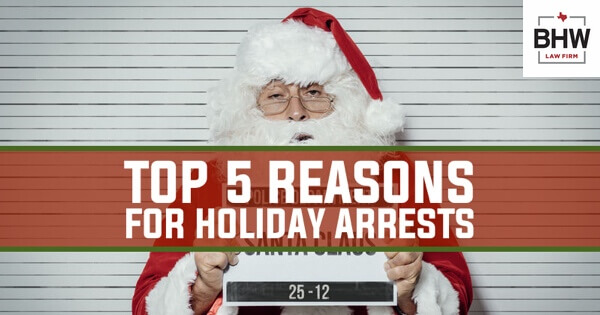
Top 5 Reasons for Arrests During the Christmas Holiday Season

By Brandon Barnett · Criminal Defense

Christmastime Arrests TexasWhen you think about the Christmas season, you probably think about family time, presents, good food, and celebration. We think about those things too, but as criminal defense attorneys, we also think about the reasons that some of our clients get arrested during the holiday season. For this article, we took a look at the last 8 years of holiday season arrests (for clients that we represented) and compiled an (anecdotal) list of the top 5 reasons that folks get arrested during the Christmas/New Year's season. Our goal is that this list will serve as a warning, so that your holiday season can be filled with the good stuff, rather than jail, bail, and calls to our office. Here goes:

5. Shoplifting

Many retailers slash their prices and offer steep discounts in the weeks leading up to Christmas and even bigger discounts after Christmas, but we have yet to see any retailer offer the "five finger discount" for their merchandise. Regardless, we see plenty of shoplifting cases during the Christmas season, making it our #5 reasons that people get arrested during Christmas. Depending on the regular price value of the item (not the discounted price), shoplifting theft charges can range from misdemeanors to felonies. Learn more about Theft law in Texas here.

4. Package Theft

In a similar vein to shoplifting, our #4 reason for holiday arrests is package theft. Many shoppers choose the convenience of online shopping and have their Christmas purchases delivered right to their front door. Some people see this as an easy target, following behind UPS or FedEx trucks to steal those would-be Christmas gifts from the front porch. However, with the increase in doorbell cameras, it is getting easier to catch the porch pirates in the act. Further, some law enforcement agencies have begun using dummy packages to bait thieves into getting caught. Package theft can range from a misdemeanor to a felony depending on what unknown treasure lay inside the brown box.

3. Air Travleing Trouble (Guns, Drugs, and Intoxication)

Going to visit grandma can require air travel for many families. This means that thousands more people than usual flood through DFW Airport between Thanksgiving and New Year's. It matters not from where these travelers hail. From Maryland to Oregon to France, if a person is arrested at DFW Airport, their case will be filed in Tarrant County, Texas and they will have to travel back to DFW to attend court. During the holidays, we see a surge in airport arrests when people bring items into the airport that are not allowed or when folks over indulge during a layover. Specifically, we see the following airport arrests:

Even if the state from which a traveler is coming has legalized marijuana and the state to which they are traveling has legalized marijuana, if they are caught possessing marijuana in the airport, they will be arrested and charged. The combination of airport gun arrests, airport drug arrests, and airport public intox arrests make these types of cases our #3 reason for holiday arrests.

2. Assault Family Violence

In the movie Christmas Vacation, Clark Griswold showed an enormous amount of restraint when his extended family pushed him to the limit (especially Cousin Eddie), but not everyone is blessed with such a cool head. Christmas time brings added stressors into the family environment that can sometimes lead to verbal or physical altercations between family members, so much so, that these arrests rank at #2 in our book. Depending on the nature of the assault, a domestic violence arrest can be charged as a misdemeanor or a felony. Learn more about Family Violence under Texas law.

1. Driving While Intoxicated

With all of the Christmas and New Year's parties and the increase in No Refusal Weekends, it is not hard to guess that DWI arrests are #1 on our list. Driving While Intoxicated in Texas can range from a misdemeanor (if it is a first or second offense) to a felony (if there is a child in the car or if the person arrested has been convicted of DWI twice in the past). Our advice is to plan ahead and do not even take your car to a Christmas party when you plan to drink. Catch a ride from a friend or take an Uber or Lyft. That would be a lot cheaper than hiring an attorney and a lot less hassle too. Learn more about Texas DWI law here.

We Hope You Never Need Us, But We're Here if Your Do.

We wish you a very merry Christmas and a happy New Year. As always, we hope you never need us to represent you or one of your loved ones for a criminal offense. This is even more true during the Christmas season. Hopefully this list will help you avoid trouble that looms during the holiday season. If you do happen to need us, we are only a phone call away at (817) 993-9249.


Read full article
Fireworks Laws in Texas2

Fireworks Laws in Texas | Could a Sparkler Really Cost You $2,000?

By Luke A. Williams · Criminal Defense

Do Not Lose Your Liberty on Independence Day

Fireworks Laws in TexasIndependence Day is right around the corner. You will probably start seeing the notices spread across social media from local police departments, warning that setting off fireworks (including sparklers) is illegal inside of city limits. We know that you're probably going to do it anyway (so are we), but we wanted to let you know what Texas law provides regarding fireworks on the 4th of July.
Texas Fireworks Law | Are Sparklers Illegal Inside of City Limits?

While state law in Texas permits possessing and using fireworks, it’s important to note that where and when a person can possess them is still highly regulated. There are State laws that limit the use and display of fireworks but use is predominantly regulated by way of city ordinances.

Specifically, under state law, a person may not:

  1. Explode or ignite fireworks within 600 feet of any church, a hospital other than a veterinary hospital, an asylum, a licensed child care center, or a public or private primary or secondary school or institution of higher education unless the person receives authorization in writing from that organization;
  2. Sell at retail, explode, or ignite fireworks within 100 feet of a place where flammable liquids or flammable compressed gasses are stored and dispensed;
  3. Explode or ignite fireworks within 100 feet of a place where fireworks are stored or sold;
  4. Ignite or discharge fireworks in or from a motor vehicle;
  5. Place ignited fireworks in, or throw ignited fireworks at, a motor vehicle;
  6. Conduct a public fireworks display that includes Fireworks 1.3G unless the person is a licensed pyrotechnic operator;
  7. Conduct a proximate display of fireworks that includes Fireworks 1.3G or Fireworks 1.4G as defined in NFPA 1126 Standards for the Use of Pyrotechnics Before a Proximate Audience unless the person is a licensed pyrotechnic special effects operator and has the approval of the local fire prevention officer; or
  8. Sell, store, manufacture, distribute, or display fireworks except as provided by this chapter or rules adopted by the commissioner under this chapter.

Texas Occupations Code, Subchapter F, Sec. 2154.251

These violations are Class C Misdemeanors, which can be punishable by a fine up to $500.

Fireworks licensing violations are Class B Misdemeanors which can result in a jail term up to 180 days and a fine not to exceed $2,000.

Fireworks City Ordinances | Local Fireworks Rules in Fort Worth, Keller, and Southlake

In addition to State law, most cities in Texas regulate the use and display of fireworks by way of specific city ordinances. For example, Fort Worth, Texas has enacted an ordinance making the sale, discharge or possession of fireworks within the incorporated city limits a Class C misdemeanor punishable by up to a $2,000.00 fine. Similar ordinances exist in Keller and Southlake, and most other Texas cities.

Before your celebrations, it’s always best to review the above regulations under the Texas Occupations Code and check your local city ordinances online to ensure that you're legally possessing, using and displaying fireworks.

Read full article
Recording Conversations Texas Wiretapping

Can I Record a Conversation Without the Other Party's Consent in Texas?

By Brandon Barnett · Criminal Defense

Recording Conversations Without Consent in Texas | Wiretapping Laws

Recording Conversations Texas WiretappingWith roadway cameras at nearly every street corner, video surveillance in businesses, doorbell cameras on homes, web cams on computers, and recording capabilities on mobile phones – we must navigate carefully in a digital world. We’ve seen titillating news reports exposing a secret audio tape of a public figure having scandalous phone conversations, or video surveillance of questionable traffic stops that escalate in shocking fashion. You may have had a suspicious feeling that you were being recorded, or on the other hand, felt as if you needed to record a conversation with another for your own protection.

With privacy seemingly harder to come by as compared with days long past—what does Texas law say about recording conversations? Is it illegal to record a phone conversation with another person? What about in person?

The short answer is: YES, you can record a conversation with another person without that person's consent. But this answer requires more explanation.

Recording Phone Calls in Texas | Texas is a One-Party Consent State

Under Texas Law, it is a crime intercept or record any wire, oral or electronic communication without the consent of at least one party. The good news is that you count as one party and if you're recording then you have probably given yourself consent to record the conversation. Generally speaking, state wiretapping laws turn on whether the state is a one-party consent state. While some states require the consent of all of the parties to a conversation prior to recording, Texas permits the recording of telephone calls, so long as the consent of one of the parties is obtained. As stated, if you are one of the parties on the phone call, then you may consent to having your own conversation recorded—you need not alert the other party. Additionally, a parent may give vicarious consent to the recording of a child’s conversation if the parent has a good faith objectively reasonable belief that the recording is necessary for the welfare of the child.

However, if during a phone call there are multiple parties who are in different states, then be aware that other state laws may require pre-recording consent of all of the parties. In this scenario, if the recording party obtains consent from the other parties before the recording begins, then the recorder is not in violation of wiretapping laws.

See this link to learn more about the various state wiretapping laws.

Recording In-Person Conversations in Texas | Can I Record Someone Else's Public Conversation?

Texas law (Penal Code §16.02) does not permit you to record in-person communications when the parties have an expectation that such communication is not subject to interception (i.e. If there is a reasonable expectation of privacy). If you wish to record a conversation to which you are not a party, all of the parties must give consent before the recording device is turned on or there must be no reasonable expectation of privacy (e.g. If the recording is taken from your doorbell camera and the parties are standing on you doorstep). If you are a party to the conversation, record away.

Further, you are able to record in-person communication at a public place, like a mall food court or at a football game for example, where parties do not have the expectation of privacy. Remember—if you say it in a public place, within earshot of others who may overhear, you do not have an expectation of privacy in those statements. Generally, such statements may be recorded without violating that state’s wiretapping laws.

A Word of Caution of Recording Conversations in Texas

Please be aware that there are both federal and state wiretapping laws that may limit your ability to making recordings of telephone calls or in person conversations. This article addresses state wiretapping laws in Texas only. Additionally, if a person has violated a state or federal wiretapping statute, he may be both charged criminally and be sued civilly by the damaged party.

Further, while a person may have successfully recorded a conversation under state and federal wiretapping laws, the act of disclosing the recording to other third parties could be, in and of itself, punishable criminally or civilly under other legal theories (such as slander, for example).

If you are faced with a wiretapping charge, or have questions about wiretapping, please contact an attorney who will address both the state and federal regulations as they are related to the facts of your specific case. Wiretapping charges are potentially serious felonies that could land a person in jail or prison, with fines ranging from $200 to $10,000. If you are faced with charges related to wiretapping in Texas, please contact our offices at (817) 993-9249 for a consultation.

Summary on Texas Wiretapping

  • A person can record a conversation to which you are a party in Texas without violating wiretapping laws, so long as the other party is in a “one party consent” state.
  • A person can record a conversation (to which he is not a party) if one of the participants gives him permission.
  • A person can record a conversation when, in a public setting, the participants do not have a reasonable expectation of privacy.
  • It is almost always illegal to record a phone call or private conversation to which one is not a party, does not have consent from at least one of the parties, and could not naturally overhear the conversation.

This article is for educational purposes only and should never be substituted for legal advice.

Read full article
SBA Loans Criminal History

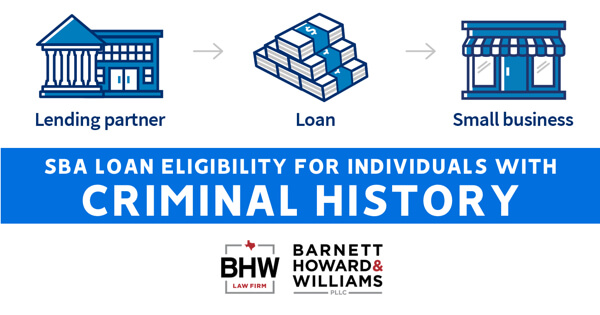
SBA Loans Limitations Based on Criminal History

By Brandon Barnett · Criminal Defense

Can I apply for an SBA Loan if I have a criminal history?

SBA Loans Criminal HistoryCountless small businesses have been impacted by the COVID-19 pandemic. The US Government has several different loan programs offered through the Small Business Administration aimed at helping small business get through the crisis and maintain jobs for their employees. Many of the SBA loan programs for the COVID-19 crisis can be found on the SBA website COVID-19 section.
One of the questions that we have received during the last couple of weeks is whether a person with a criminal history can apply for an SBA loan. The answer is...it depends. It depends on the nature of the criminal offense.

What will disqualify me from applying for an SBA loan?

When it comes to criminal history, the following will disqualify a company and make it ineligible for SBA assistance.

If an owner of the company (who owns 20% or more) answers YES to any of the following questions taken from the SBA application, then the company is NOT eligible to apply for SBA assistance:

  • Are you currently incarcerated?
  • Have you been adjudicated for a felony in the preceding 5 years? This includes
    • Felony conviction;
    • Plea of guilty to a felony offense;
    • Plea of nolo contendere (no contest) to a felony;
    • Participating in a pre-trial diversion program for a felony offense;
    • Probation or Deferred Adjudication for a felony offense.

  • Are you currently on probation for a felony or a misdemeanor?
  • Are you currently on parole?
  • Are there pending criminal charges against you that have not yet been adjudicated (felony or misdemeanor)?

*NOTE: There is also a question on the Economic Injury Disaster Loan that asks whether an applicant has been arrested (even if the charge was dismissed) for any criminal offense (other than a minor motor vehicle violation). It is unclear whether an arrest by itself is a disqualifier or just a point of inquiry.

If a 20% (or more) owner answers YES to any of those questions, then the company will not even be able to complete its application for SBA assistance.

In the past, it seemed that the SBA was only concerned with felony criminal history (see 13 CFR 120.110), but the new applications for the COVID relief do not distinguish between felonies and misdemeanors when it comes to either active probationers or individuals with pending charges.  This is especially difficult for individuals that have a pending criminal charge to which they have pleaded not guilty and not yet received their day in court. To sink their business while at the same time presuming them innocent is not in keeping with the spirit of the presumption itself.

Please be reminded that it is a federal offense to falsify a loan application, so please don't do that.

Paycheck Protection Loan Application

Economic Injury Disaster Loan

Read full article
COVID-19 State Orders Texas

What Happens if I Refuse to Obey the COVID-19 Orders?

By Luke A. Williams · Criminal Defense

Texas Legal Consequences During the Coronavirus Pandemic

COVID-19 State Orders Texas
With the declaration of a state of disaster in Texas by Governor Greg Abbott on March 13,2020 comes some new consequences that Texas citizens need to be aware of.

We previously posted a blog addressing enhancements that have gone into place for certain criminal offenses. But, there are also new laws activated as a result of state, local and interjurisdictional emergency management plans.

Broadly speaking, Texas Government Code (TGC) 418.173 establishes a penalty for citizens failing to comply with emergency management plans.

Specifically, TGC 418.173 states:

(a)  A state, local, or interjurisdictional emergency management plan may provide that failure to comply with the plan or with a rule, order, or ordinance adopted under the plan is an offense.
(b)  The plan may prescribe a punishment for the offense but may not prescribe a fine that exceeds $1,000 or confinement in jail for a term that exceeds 180 days.

Most local Texas governments have already established emergency management plans. County Judges in Dallas and Austin, for example, have published their Orders regarding these plans on their local websites and are regularly amending them.

The Emergency Order for Tarrant County can be found here.

It’s important that citizens know that with the disaster declaration in effect, violation of these Orders can result in a person being arrested. For practical purposes, that means that if local government is limiting community gatherings and business closures, a violation of those Orders could result in an arrest.

Information coming from our local government is changing on almost a daily basis now. Check with your local jurisdiction for their emergency management plans and be aware of the consequences of violating those plans.

There are a number of special powers and provisions established with the declaration of a statewide emergency effecting many different areas of law. The full text of the extent of those can be found in Chapter 418 of the Texas Government Code.

Read full article

Speak with a Fort Worth attorney

Call (817) 993-9249 or send us a message to discuss your case.