
Skip to content
Tag

Trial Advocacy

Page 2 of 2 · 9 articles

Military Defendants in Texas Military Veteran Attorney

3 Things To Avoid When Representing a Military Defendant

By Brandon Barnett · Veterans

Criminal Defense Attorneys Defending a Military Defendant Must Be Careful Not to Make These Mistakes

Military Defendants in Texas Military Veteran AttorneyTexas has its fair share of military bases and military servicemembers. Sometimes those servicemembers get into trouble, be it for DWI, Domestic Violence, or other criminal offenses. The military defendant, who usually has no criminal history, is not savvy with the Texas criminal justice system and must rely solely on the criminal defense attorney he selects to represent them. Below are some of the mistakes that I’ve seen when a non-military criminal defense attorney represents a military defendant. These are my opinions and should not be attributable to the United States Marine Corps or any government agency.

Mistake #1 – Allowing Your Client to Wear His Uniform to Court

You should not ask or allow your military criminal client to wear his service uniform to court. I understand that you may think his uniform will win him favor with the judge or the prosecutor, but it doesn’t. Anecdotally, I’ve spoken with several judges and prosecutors on this issue and it never inures to your client’s benefit. Whether you believe it or not, the general public (including judge and prosecutors) holds our military to a higher standard than the average defendant. Rightly or wrongly, they expect more from them and don’t like to see them as a criminal defendant. By allowing your client to wear his uniform, you skyline him and lower our Armed Forces in public esteem in the process. Unless it is an absolute emergency and his uniform is the only thing keeping your client from appearing in court naked, please ask him to wear the same thing your other clients wear to court. A court setting for a criminal case is the last place your client wants to be noticed in his dress uniform.

Mistake #2 – Not Considering the Military Consequences of a Disposition

When representing military servicemember, you need to ask and learn about the military consequences of the criminal case. Some criminal case dispositions trigger mandatory reporting to the member’s chain of command, which could (and often does) result in negative consequences in the military. Other types of cases (e.g. Domestic Violence) can result in your client losing the right to possess a firearm, which makes them non-deployable and virtually useless to their command. If your client does not know what his obligations are to his Service, seek out another attorney with military experience and ask them. DO NOT CALL YOUR CLIENT’S COMMAND OR THE BASE LEGAL COUNSEL. There is no privilege with base personnel and they will often be required to report your call to your client’s commander.

Mistake #3 – Not Requesting Your Client’s Military Record (OMPF)

Every servicemember has an OMPF or Official Military Personnel File. The OMPF will tell you everything you need to know about your client’s service. It will show you awards, deployments, performance ratings, disciplinary actions, and more. If you plan on using your client’s service as a positive mark in his favor, you should do your research to make sure that his service has indeed been positive. Your client may have below average ratings, several minor disciplinary infractions, and a Letters of Reprimand in his file. Or he may have combat awards, Letter of Appreciation, and early promotion recommendations. A savvy prosecutor will know all of this. The military shares information with the DA when requested. So before you drape yourself and your client in the flag, you should probably learn a little more about how “honorable” his service has been.

Military Veteran Representing Military Defendants in Texas State Courts

Brandon Barnett is a criminal defense attorney in Fort Worth, Texas with Barnett Howard & Williams PLLC. He is a veteran of the US Marine Corps and Operation Iraqi Freedom. He currently serves a reserve Military Judge for special and general courts-martial. Mr. Barnett teaches Military Justice at Texas A&M University School of Law in Fort Worth. For a free consultation of your Texas criminal case or to consult with Mr. Barnett about the potential military consequences of a criminal disposition, contact him at (817) 993-9249.

Read full article
Federal Prosecutor Tips

5 Things I Wish Defense Attorneys Knew in Federal Criminal Cases

By Brandon Barnett · Criminal Defense

Guest Blog Post: Former Federal Prosecutor Offers Tips for Defense Attorneys in Federal Criminal Cases

Former Assistant United States Attorney and long-time U.S. Marine prosecutor Glen Hines provides some tips regarding Federal criminal cases from his time as an AUSA in Arkansas.  The views contained in this post are his own and not those of the Department of Justice, the United States Marine Corps or any other government organization.

Below are the top five unsolicited practice points for defense attorneys practicing in the Federal justice system:

Read up on the U.S. Attorneys' Manual.

Although this is non-binding guidance to AUSAs, they rarely deviate from it. Be aware of the Principles of Federal Prosecution, at Section 9-27.000, because you can use these to get your client a better outcome in some cases. This will give you a good idea of DOJ policy on issues like charging decisions, non-criminal alternatives to prosecution, plea agreements and their provisions, and cooperation issues. These policies form the AUSA's mindset to any federal case. If the AUSA on your case deviates from the USAM to the detriment of your client, ask him or her why they are doing it.

Get out ahead of the government's case.

This is easier said than done in practice; unfortunately, by the time most of your clients get around to retaining you, they have likely already been indicted. But in the rare event one hires you beforehand, it's an opportunity for you to shape the case before it even gets started. Don't be afraid to proffer your client. If you think he has something to offer the government that might help them get a bigger fish, most offices have a standard use immunity agreement to cover whatever your client tells them during the proffer. Moreover, as stated above, if you can get in touch with the AUSA on your case, you might be able to obtain a non-criminal alternative to prosecution; for instance in financial cases you could offer the government that your client agree to a civil, financial forfeiture and "pretrial diversion" (Section 9-22.000) in lieu of indictment.

Know the Federal Sentencing Guidelines.

They drive everything. For some reason, a lot of defense attorneys avoid federal cases because they are afraid of having to deal with the guidelines, but it really isn't rocket science. This is very important because almost every case I did as an AUSA, I pulled up the guidelines first to see what the case was going to be worth, the idea being, why should the government spend the resources to indict a case if the punishment was going to be very minimal? Know generally how to calculate the range, know about enhancements and deductions, and especially know that your client gets 3 points off the applicable range for timely pleading and "acceptance of responsibility." See section 3E1.1.  Your client is going to want to know how much time he is going to have to do if he pleads as opposed to going to trial and getting convicted, so you need to be able to calculate that number. A helpful calculator (not affiliated with any governmental entity) is on the internet HERE. Always check your numbers against what the AUSA comes up with.

"The squeaky wheel gets the grease"/Return my phone calls.

This goes along with #2 above. The defense attorney who calls or emails me about his case will get their call or email returned. If I know you are paying attention to your client's case and hearing from you, it's more likely I will view you as a straight-shooter and try to work with you on a potential deal. If I never hear from you and you never return my calls or emails, I will assume you want to go to trial and I'll start preparing to do so.

The AUSA is not going to deal your case out at the last minute.

Do not turn down a plea offer because you think the AUSA is going to knuckle under at the last minute and give you a sweetheart deal as the jury is walking in for voir dire. I know this happens on the state level, but as said before, the AUSA does not have the discretion to fashion some kind of sentence deal; the guidelines drive sentencing. If you wait that long, expect to go to trial. AUSAs typically don't have the huge caseload state deputy district attorneys do, so they try fewer cases and are only more than willing to roll the case out to the jury when the time comes.


Glen Hines Former Federal ProsecutorGlen. R. Hines (LinkedIn) is a former Assistant U.S. Attorney and a reserve Marine Corps Lieutenant Colonel and judge advocate. The majority of his 18-year, active-duty and reserve military career has been served as a prosecutor and Military Judge. He is a graduate of George Washington University (LLM-Highest Honors) and the University of Arkansas, Fayetteville (JD). He has written on national security, federal and military criminal law, and gun control issues.  See his past article at Task & Purpose.

Read full article
Vincent Bugliosi

Vincent Bugliosi's Advice on Cross-Examination and Asking "Why"

By Brandon Barnett · Trial Advocacy

Renowned Trial Lawyer, Vincent Bugliosi, Explains One of His Theories About Cross-Examination

Vincent BugliosiIn 2011, I had the privilege of escorting the late Mr. Vincent Bugliosi around Marine Corps Base Camp Pendleton, as he was the guest speaker at a trial advocacy conference my office organized.  Mr. Bugliosi, 76 years old, was best known as the prosecutor that put Charles Manson away.  He was also a renowned true crime author, writing such books as Helter Skelter, And the Sea Will Tell, 'Till Death Us Do Part, and Outrage.  He would tell you, however, that his proudest moment was his victory over Gerry Spence in the mock trial of Lee Harvey Oswald for the assassination of President John F. Kennedy.  Other than this mock trial, Gerry Spence boasts a perfect trial record.

One of the things about which Mr. Bugliosi spoke was cross-examination.  He noted that many of the best-selling books on cross-examination caution lawyers from asking a witness WHY they took a certain action.  Lawyers are warned that they should never allow a witness to explain themselves on cross.  Well, Mr. Bugliosi did not exactly agree with that maxim.  Here's what he had to say on the subject:

Even if I do not ask "why," the lawyer who called the witness, if alert, will do so on redirect.  The witness has then often had a court recess or perhaps overnight to think up the very best answer to the "why" question.  I would much rather force the witness to answer on cross, not giving him extra time to fabricate.

Although both lawyers can avoid asking the "why" question and, as in some other situations, "save for final argument" the implications of the witness' testimony, by that late point in the trial the witness' reason for his improbable act is a matter of competing speculations by the lawyers, not the court record.

The "why" question, of course, can be a dangerous one, but I feel this is so only if the lawyer hasn't first blocked off possible and anticipated escape hatches.  Admittedly, real witnesses, unlike their fictional counterparts in novels and on the screen who cave under pressure of the first or second good question, are as doughty and elusive as all hell.  When all but trapped, and at the brink of a public, courtroom humiliation, human beings seem to secrete a type of mental adrenaline that gets their minds working extremely fast, and well.  So the witness a lawyer faces on the stand, for some curious reason, is almost inherently formidable.  But a witness can't go somewhere when he has nowhere to go.

If I feel a witness if lying, a technique I frequently employ is to first elicit answers from him on preliminary matters (blocking off all escape hatches), answers which, when totaled up, show he would be expected to take a certain course of action.  The witness having committed himself by his answers, I then ask him what course he in fact took (which is not the course he would be expected to take), and follow this up with the "why" question.  If time after time a witness is unable to satisfactorily justify conduct which is incompatible with what would be expected of a reasonable person, the jury will usually conclude that his testimony is suspect.

Mr. Bugliosi made sure to caveat that we should never ask the "why" question unless all possible escape hatches have been blocked off.  He was truly an outstanding speaker on this and many more topics.  His true crime books are excellent and are highly recommended for all criminal trial lawyers out there.  Vincent Bugliosi passed away on June 6, 2015.

Read full article
Voir Dire in Texas

A Proper Voir Dire Question

By Brandon Barnett · Trial Advocacy

Voir Dire in Texas
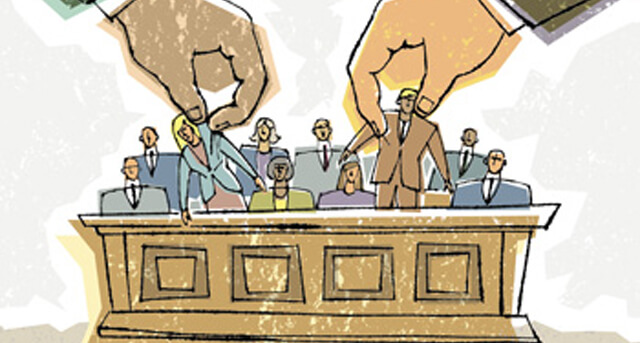
When conducting voir dire of prospective jurors (the venire panel), Texas law says that a lawyer cannot ask a “commitment question.” The Texas Court of Criminal Appeals defines a “commitment question” as
a question that commits a prospective juror to resolve or to refrain from resolving an issue a certain way after learning of a particular fact. Commitment questions are impermissible unless the law requires a commitment, and the law does not require a commitment on what facts a juror will consider during sentencing.

The CCA also cautions, however, that “a trial court abuses its discretion if it disallows a proper voir dire question.”

In Davis v. State, a case decided by the CCA last month, the defense counsel asked the venire panel the follow question:

Let’s talk about factors in [assessing] the sentence in a case of aggravated robbery with a deadly weapon, what factors do y’all think are important?

Despite counsel’s fine use of the word “y’all,” and without any objection to the question by the State, the trial judge interjected, saying, “that’s a commitment question. You can’t ask that question.” On appeal, the 14th District Court of Appeal (Houston) agreed.

The CCA now reverses, holding that

appellant’s counsel asked “what factors…are important” in sentencing. This did not ask the jurors how particular facts would influence their deliberations. This was an inquiry into the jurors’ general philosophies.

There you have it. Cases regarding commitment questions are always very fact dependant, but for now, we can add one more to the list. Counsel may properly ask: "What factors are important in assessing the sentence in a [name your offense] case."

Presiding Judge Keller penned the lone dissent.  She deems the question an improper commitment question.

Read full article

Speak with a Fort Worth attorney

Call (817) 993-9249 or send us a message to discuss your case.