
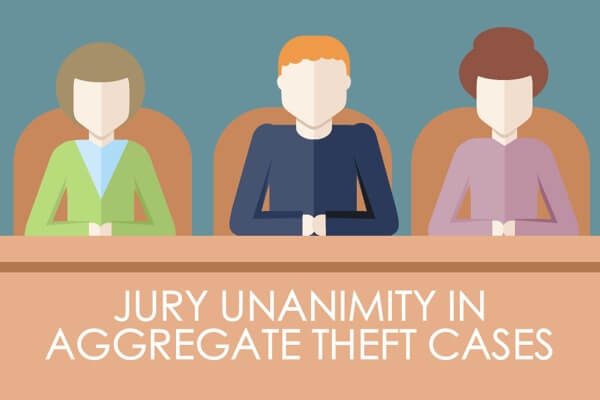
What is Jury Unanimity for Aggregate Theft Cases?
By Brandon Barnett · Jury Trial, Theft
 Jury unanimity is required in every jury trial, whether it be felony or misdemeanor. This means that the jury must unanimously agree that the State has proven or failed to prove all elements of an offense beyond a reasonable doubt. If a jury cannot reach a unanimous verdict of guilty or not guilty, then the judge will declare a mistrial. With some offenses, however, it can be a little unclear as to what jury unanimity actually requires. This is specifically so with aggregated theft cases.
What Is Aggregate Theft?
Aggregate theft is an offense where two or more thefts were committed “pursuant to one scheme or continuing course of conduct” and the amounts combined determine the grade of the offense. Tex. Penal Code §31.09. Under Section 31.09, aggregate theft may be and often is considered as one offense. Even though it is considered one offense, each individual underlying theft act (where the amounts are aggregated) is considered an element. The Court of Criminal Appeals of Texas has held that for evidence to be sufficient the state must prove beyond a reasonable doubt that the defendant unlawfully appropriated “enough property to meet the aggregated value alleged.” The state is not required to prove each underlying appropriation. However, the Court, until recently has left one question unanswered: Does the jury have to unanimously agree on all underlying theft transactions? Meaning, if the defendant is alleged to have committed 10 separate theft acts (pursuant to a common scheme), do the jury have to agree on each, or some, or none?
Kent v. State—What is the Jury Unanimity requirement in Aggregate Theft cases?
Until recently there had been no holding by the Court of Criminal Appeals of Texas on whether jurors are required to unanimously agree on each underlying transaction that is used to comprise an aggregated theft charge. In Kent v. State the Court finally addressed this exact question.
See the full CCA opinion in Kent..
Kent was a mortgage broker indicted for theft from four complainants in an amount exceeding $200,000. The thefts were alleged to have occurred over a period of time and pursuant to one scheme or continuing course of conduct. At trial, the defense requested a paragraph in the jury instructions that outlined each individual theft allegation and called for a unanimous verdict on each. The trial judge denied the defense request to include this paragraph. The jury found Kent guilty of aggregate theft. On appeal, the Kent complained that the trial judge erred by refusing to include his requested paragraph in the jury instructions. The appellate court reversed and remanded the case for a new trial, holding that the jury should have been instructed that they must unanimously agree beyond a reasonable doubt on each underlying transaction used to comprise an aggregate theft charge.
The State appealed to the Court of Criminal Appeals of Texas to determine whether this was correct. Reversing the lower courts holding, the CCA held that for an aggregated-theft case,
unanimity requires that the jurors agree that the threshold amount has been reached and that all the elements are proven for each specific instance of theft that the individual juror believes to have occurred. Every instance of theft need not be unanimously agreed upon by the jury.
In other words, it is only required that the jurors unanimously agree that two or more thefts pursuant to a common scheme, when combined, exceeded the threshold amount beyond a reasonable doubt, not that they unanimously agree on exactly which thefts were comprised to reach that amount.
Takeaway: When facing aggregated theft charges it is important to know that the jury does not have to unanimously agree that each underlying theft alleged in the indictment has been proven beyond a reasonable doubt. Bottom line, it’s the aggregated amount that matters. This is only a brief explanation of how the jury unanimity requirement plays a role in a case and if you should have any more questions contact our Fort Worth criminal defense team.
 Gone are the days of flipping through your local newspaper’s classified section and circling your favorite ads. These days, Craigslist is the new classifieds of Fort Worth and Dallas. It is the one stop shop source to find a new car, truck, job, furniture, garage sale, or even a love interest. With the rise of Craigslist (and other online forums), there has also been an increase in criminal activity ranging from online scams to fraud and theft. Police stings based on advertisements from Craigslist are also common. Police have seen such a meteoric rise in these “Craigslist related crimes”, that many departments have established “safe exchange locations where transactions can occur under the watchful eye of local law enforcement.