Skip to content
Tag

Terry Stops & Court Cases: Understanding Reasonable Suspicion

Page 1 of 2 · 7 articles

Terry Stop Officer Pat Down Search

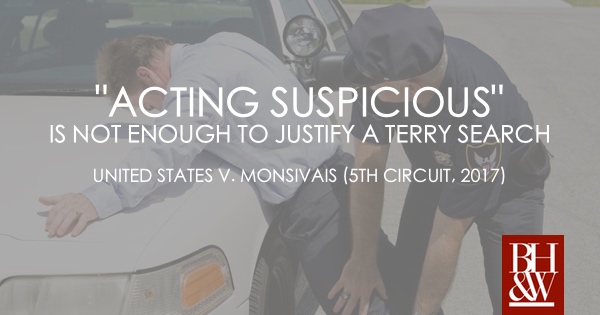
“Acting Suspicious” is Not Enough to Justify a Pat Down Search

By Pricer · Search & Seizure

Does an Officer’s Testimony That a Person was “Acting Suspicious” Establish Reasonable Suspicion to Support a Terry Stop?
Terry Stop Officer Pat Down SearchThe Fifth Circuit Court of Appeals recently handed down an opinion concerning the reasonable suspicion standard required for law enforcement officers to conduct a Terry stop—an exception to the warrant requirement. The issue facing the Court was whether merely “acting suspicious” is enough to establish reasonable suspicion to justify a law enforcement officer to initiate a Terry stop.

United States v. Monsivais, 848 F.3d 353 (5th Cir. 2017)

The Facts — District Court Found the Terry Stop to be Lawful Based On the Defendant's Demeanor, Remarks, and for Officer-safety Reasons

While on patrol in a marked police car, two officers observed Monsivais walking down the side of the I-20 interstate away from an apparently disabled truck. The officers stopped in front of Monsivais and activated the car’s emergency lights in order to ask Monsivais if he needed roadside assistance. As Monsivais approached, he ignored the officers and walked past their patrol car. At this point, the officers exited their vehicle, and asked Monsivais where he was going and if he needed any help. Monsivais told the officers he was heading to Fort Worth (even though his vehicle was pointed towards Abilene). During questioning, Monsivais appeared nervous and repeatedly placed his hands in his pockets; however upon the officer’s request, Monsivais removed his hands. Additionally, Monsivais responded politely to all of the officers’ questions. After approximately four minutes, one of the officers advised Monsivais that he was going to pat Monsivais down for weapons because of his behavior, inconsistent statements and for officer safety reasons. Shortly thereafter, Monsivais told the officer that he had a firearm in his waistband. The officer seized the firearm and Monsivais was later charged with possession of a firearm while being unlawfully present in the United States.

Monsivais filed a motion to suppress the firearm and other evidence, arguing that the officer violated the Fourth Amendment because he did not have reasonable suspicion to believe Monsivais was involved in criminal activity when he detained him. The district court denied Monsivais' motion to suppress, holding only that the “consensual encounter was transformed into a lawful Terry frisk due to the Defendant's demeanor, remarks, and for officer-safety reasons.”

The Court of Appeals Reversed the District Court’s Decision—Holding the Officers Lacked a Basis to Reasonably Suspect Monsivais of a Criminal Act

The Court first determined that the officer seized Monsivais for Fourth Amendment purposes when he told Monsivais that he was going to pat him down. At this point, the officer converted the roadside assistance “welfare check” into an investigative detention—otherwise known as a Terry stop.

“The Fourth Amendment generally requires officers to obtain a warrant before searching or seizing an individual.” However, pursuant to a narrow exception announced in Terry v. Ohio, 392 U.S. 1, 88 (1968), police officers may briefly detain a person for investigative purposes if under the totality of relevant circumstance they can point to “specific and articulable facts” that give rise to reasonable suspicion that a particular person has committed, is committing, or is about to commit a crime. United States v. Hill, 752 F.3d 1029, 1033 (5th Cir. 2014).

Here, the Court found that while Monsivais’ behavior might not have been typical of all stranded motorists, the officers could not point to any specific and articulable facts that Monsivais had committed, was committing, or was about to commit a crime before seizing him.

The court explained that Monsivais’ nervous demeanor alone was insufficient to create reasonable suspicion of criminal activity in order to justify a Terry stop. In fact, the Court gives little or no weight to an officer's statement that a suspect appeared nervous. United States v. Portillo–Aguirre, 311 F.3d 647, 656 (5th Cir. 2002). Moreover, the Court held that evidence of Monsivais placing his hands in his pocket is of little significance. The Court noted that any number of people walking down the street might have their hands in their pockets. Additionally, the Court determined there were no inconsistencies in Monsivais’ story; and, even if there were, the inconsistencies would not connect Monsivais with any reasonably suspected unlawful conduct. Moreover, Monsivais’ choice to ignore the officers’ presence by merely walking past them, not fleeing, did not give rise to criminal activity.

In conclusion, the officer testified that he never suspected Monsivais was involved in any criminal activity, but rather that Monsivais was just acting “suspicious.” As such, the court found that the officer seized Monsivais without reasonable suspicion and that the evidence obtained from the unlawful seizure should have been suppressed.


Read full article
Stop and Frisk Furr v. State 2016

Reasonable Suspicion to Stop and Frisk Upheld | Furr v. State (2016)

By Luke A. Williams · Reasonable Suspicion, Search & Seizure

Texas Court of Criminal Appeals Upholds a Stop and Frisk Case

Stop and Frisk Furr v. State 2016Furr v. State (Tex. Crim. App. 2016)

On September 21st the Criminal Court of Appeals decided Furr v. State. In Furr, the Court held that an anonymous tip was sufficiently corroborated to establish reasonable suspicion to stop and frisk Appellant Furr. To support the stop and frisk, the court noted that Appellant:

  • watched the officer as he drove by,
  • repeatedly looked at the officer as he walked away,
  • was nervous, anxious and sort of out of it,
  • appeared under the influence of drugs, and
  • did not initially respond as to whether he was armed.

Further, the Court stated it is not per se objectively reasonable for a police officer to execute a pat down of a suspect for weapons simply because they are accused of drug possession.

The Facts of Furr v. State

Corpus Christi Police Department received an anonymous tip that two men were doing drugs on a particular street corner, one dressed in all black and the other in a black shirt carrying a brown backpack. In response, an officer drove past the street corner. He observed two men that fit the description from the tip and noticed in his rearview mirror that the men were watching him as he drove by. The officer then approached the two men but one of the men, Furr, walked away into the nearby shelter, repeatedly looking over his shoulder at the officer. The officer described Furr's actions as furtive, “like he was trying to get away.”

When another officer arrived, the officers made contact with Furr. Furr was described as nervous, anxious, evasive, and was sweating excessively. Furr did not respond when the officers initially asked if he had any weapons on him. Officers said he appeared “kind of out of it” and “like he was under the influence of a drug. As a result, for safety reasons, officers frisked Furr for weapons and found a glass crack pipe in Furr’s front pocket. When removing the pipe, the officer also found two syringes, and after arrest, two small balloons of heroin.

Furr was charged with possession of a controlled substance. He pled guilty, reserving his right to appeal after his motion to suppress was denied. Furr argued on Appeal that officers did not have reasonable suspicion to stop and frisk him and that the trial court erred by not granting the Motion to Suppress the search.

The Court of Appeals Affirmed the Trial Courts Decision

The court of appeals held that Furr’s nervousness coupled with the observation that he seemed to be under the influence of a drug sufficiently corroborated the tip to support the investigative detention and that Furr’s failure to initially respond about being armed coupled with the other circumstances justified the frisk.

The Criminal Court of Appeals Concluded that there Was Reasonable Suspicion to Detain and Frisk Furr.

1. The Analysis of the Detention

In order to detain a person, the police officer must have reasonable suspicion based on “specific articulable facts, when combined with rational inferences from those facts, would lead him to reasonably conclude that the person detained is, has been, or soon will be engaged in criminal activity.” Wade v. State, 422 S.W.3d 661, 668 (Tex. Crim. App. 2013). Anything that happens or that is observed before the detention will be considered in determining whether the officer indeed had reasonable suspicion to detain Furr.

Furr argued that the anonymous tip alone was not enough.  The Court, however, explains that if there had only been the anonymous tip, it would not have established reasonable suspicion, but here there was more. The Court identifies several independent observations:

  • Furr and the other man were at the specified location and matched the informant’s description.
  • The area was a “high drug, high crime” area.
  • Furr and the other man watched the officer as he drove past
  • When the officer approached the two, Furr walked away “furtively.”
  • When the officers came upon Furr in the shelter he was sweaty, nervous, anxious, and appeared out of it as if he was under the influence of a drug.

Thus, the reasonable suspicion here was not solely based on the informant’s tip, but instead that tip was corroborated by independent observations made by the police officers. Looking at the totality of these circumstances, the Court held that the officers had reasonable suspicion to stop Furr and investigate the information from the anonymous tip that Furr and the other man were using and possessing a drug.

2. The Terry Frisk

The Court rejected the State’s request to adopt a rule that it is, “per se, objectively reasonable for the police to pat down a suspect for weapons if they are accused of possessing drugs,” because reasonable suspicion to frisk a suspect cannot be established by accusations of drug possession alone.

The Court further rejects the State’s argument that the officer was objectively justified in patting Furr down for weapons because this was outside of a homeless shelter for two reasons: 1) Nothing in the record shows that the shelter was a homeless shelter; and 2) Even if it was a homeless shelter, the Court does not see a correlation between being armed and dangerous and being at a homeless shelter.

Even so, the Court ultimately agrees with the court of appeals that reasonable suspicion was established here because the anonymous tip was corroborated by all of the circumstances surrounding the officers’ interactions with Furr. Specifically, the Court noted the tip, personal observations by the officers and the high drug, high crime area would warrant a belief that the safety of officers and others was in danger.

DISSENT - Stop and Frisk Should Have Been Held Unlawful

Judge Meyers dissented from the majority and opined that the stop and frisk of Furr was unlawful and that the motion to suppress should have been granted. Judge Meyers concluded that neither Furr’s action of looking over his shoulder or the anonymous tip, alone or combined, were sufficient to establish reasonable suspicion. Thus, there was no need to analyze the legality of the frisk. Judge Meyers believes that the majority made its decision “not based on law but on the feeling that Furr should not get relief.”

Read full article
Reasonable Suspicion Brodnex Texas 2016

Turns Out That Walking Late at Night in a High-Crime Area Is Not Criminal Activity

By Brandon Barnett · Reasonable Suspicion, Search & Seizure

Reasonable Suspicion Brodnex Texas 2016Frequently the public’s perception as to what officers can and cannot do during encounters is convoluted and even wrong. Many people are unaware of what their 4th Amendment rights actually afford them when it comes to contact with police officers. First, it’s important to know that an officer is completely free to approach whomever he wants and have a consensual encounter with someone whether or not he has a specific reason. However, an officer cannot detain you on a simple hunch, the police officer must have reasonable suspicion of criminal activity. Then comes the question of what exactly is reasonable suspicion.

What is Reasonable Suspicion?

According to Fourth Amendment law, reasonable suspicion exists when there are specific articulable facts that, when combined with rational inferences from the facts, would lead a reasonable officer to believe crime was afoot. The police officer must have more than a hunch that a crime was in progress. If a police officer detains, frisks, or searches someone without reasonable suspicion that officer has violated the 4th Amendment and evidence coming from that unlawful detention must be suppressed.

The 4th Amendment in Action - Brodnex v State of Texas (2016)

In a case just decided by the Court of Criminal Appeals of Texas, the Court overturned a conviction because it found the officer did not have reasonable suspicion to detain the defendant, thus, violating the 4th Amendment.

In Brodnex v. State, the defendant was arrested and convicted of possession of a controlled substance. The arresting officer observed Brodnex and a female walking in an area known for narcotic activity around 2 a.m.. The officer approached the two individuals, asked them their names and what they were doing. When Brodnex identified himself, the officer asked him “Didn’t you just get picked up?” and Brodnex replied “Hell no.” The Officer then searched Brodnex and found a cigar tube with crack cocaine.

The Officer’s reasons for detaining Brodnex were:

  • The time of day;
  • The area’s known narcotic activity, and
  • His belief, based on what other officers had told him, that Brodnex was a “known criminal.”

Brodnex filed a motion to suppress challenging both the stop and search. The trial court denied the motion and the appellate court affirmed.

The CCA Overturns the Conviction for Lack of Reasonable Suspicion

The Court of Criminal Appeals of Texas held that Brodnex was illegally detained because at the time of detention, under the totality of the circumstances, the facts apparent to the officer “did not provide him with a reasonable suspicion for the detention.” Therefore, the crack cocaine should have been suppressed. The court's holding relied on the fact that the officer had simply seen Brodnex walking, not doing anything that would suggest he was engaged or about to engage in criminal activity. Additionally, the court found that the officer’s limited personal knowledge of Brodnex’s criminal history was not enough to support the belief that Brodnex was lying about not being picked up.

Know Your Rights

This case explains that the officer must have sufficient information that links the suspect to a particular crime before reasonable suspicion exists. While the time of day and high-crime area are factors that Texas courts consider, those alone are insufficient to develop reasonable suspicion. Since reasonable suspicion is based on the totality of the circumstances, it is often not completely clear as to whether a particular set of facts rises to the level of reasonable suspicion.

If you are facing criminal charges that resulted from a detention or search that might not have been supported by reasonable suspicion, any evidence found from might be able to be suppressed. Contact our criminal defense team today to discuss your case and determine whether a reasonable suspicion issue is present.

*To know your rights on the go, download our FREE Mobile App.

Read full article

Border Patrol Agents Violate Fourth Amendment in Terry Stop But Conviction Upheld

By Brandon Barnett · Warrantless Search

United States v. Hernandez-Mandujano, (5th Circuit June 27, 2013)

Border Patrol agents stopped Appellant as he was driving on Interstate 10, approximately 450 miles from the nearest United States-Mexico border crossing. The agents believed Appellant was transporting illegal aliens because he was driving an SUV; had both hands on the steering wheel, and he was not exhibiting the relaxed nature of most drivers. In addition, Appellant's speed dropped from 70 miles per hour to 60 miles per hours as the agents followed him, and when the agents pulled alongside Appellant, he stopped talking to the person in the passenger's seat.

The agents learned the car was registered to a woman; however, it had not been reported stolen, had no outstanding warrants or criminal activity associated with it, and had not recently crossed the border. During the stop, Appellant told the agents he was a Mexican national in the United States illegally. The government indicted Appellant for reentry without permission by an alien deported after conviction for an aggravated felony, in violation of 18 U.S.C. § 1326(a) and (b)(2).

At trial, Appellant moved to suppress his statements to the agents, arguing the stop could not be considered an extended border search and the agents lacked reasonable suspicion to conduct a Terry stop. The district court agreed the stop was not an extended border search, but held the agents had reasonable suspicion of illegal activity to support a Terry stop.

The 5th Circuit Court of Appeals held the agents did not have reasonable suspicion to stop Appellant. First, the stop occurred 450 miles from the nearest border crossing and there was no reason to believe Appellant had come from the border. Second, Appellant's driving posture speed change and the fact the SUV was registered to a woman was not indicative of criminal activity. Third, the SUV had not been reported stolen, had no outstanding warrants or criminal activity associated with it, and had not recently been documented as crossing the border. Finally, the agents could not identify anything about the SUV that rendered it more likely than other SUVs to be transporting illegal aliens.

Even though the agents violated the Fourth Amendment in stopping Appellant, the court still denied Appellant's motion to suppress. The court noted previous Fifth Circuit case law held an alien's INS file and identity are not subject to suppression when law enforcement officers learn of a deported alien's unlawful reentry after an allegedly unconstitutional stop.

Read full article

"There They Are Right There!" - A Defective Terry Stop

By Brandon Barnett · Investigative Detention

The propriety of a Terry stop (a.k.a. investigative detention) can be, and often is, a hotly contested issue during pre-trial suppression hearings and on appeal.  I've written about the legal standard required for a Terry stop many times, but one can never get enough Terry law, so here it is again, complete with case citations, as recited by the 2nd District Court of Appeals (Fort Worth):

A temporary or investigative detention is a seizure.  Francis v. State, 922 S.W.2d 176, 178 (Tex. Crim. App. 1996); Josey v. State, 981 S.W.2d 831, 838 (Tex. App.—Houston [14th Dist.] 1988, pet. ref‘d).  An investigative detention occurs when an individual is encountered by a police officer, yields to the officer‘s display of authority, and is temporarily detained for purposes of an investigation.  Johnson v. State, 912 S.W.2d 227, 235 (Tex. Crim. App. 1995).  Because an investigative detention is a seizure, reasonable suspicion must be shown by the officer to justify the seizure.  State v. Larue, 28 S.W.3d 549, 553 n.8 (Tex. Crim. App. 2000).

An officer conducts a lawful temporary detention when he has reasonable suspicion to believe that an individual is violating the law. Ford, 158 S.W.3d at 492.  "[T]he police officer must be able to point to specific and articulable facts which, taken together with rational inferences from those facts, reasonably warrant that intrusion."  Davis v. State, 947 S.W.2d 240, 242 (Tex. Crim. App. 1997) (quoting Terry v. Ohio, 392 U.S. 1, 21, 88 S. Ct. 1868, 1880 (1968)).  The articulable facts must show unusual activity, some evidence that connects the detainee to the unusual activity, and some indication that the unusual activity is related to a crime. Martinez, 2011 WL 2555712, at *2.  Articulable facts must amount to more than a mere inarticulate hunch, suspicion, or good faith suspicion that a crime was in progress. Crain v. State, 315 S.W.3d 43, 52 (Tex. Crim. App. 2010).

In State v. Kerwick, a recent case designated for publication by the 2nd COA, the Court was called upon to consider whether the trial court abused its discretion when it suppressed the evidence of a defendant's warrantless arrest.  The arresting officer had been dispatched to the Stockyards after a brawl was reported outside a bar.  When he arrived, an unidentified person pointed at a group of people in a car and said "There they are right there."  The car was pulling away when the officer approached on foot and ordered the driver to stop.  The driver was later arrested for DWI.

The Court of Appeals agreed with the trial court (or at least found that the ruling was not outside the reasonable zone of disagreement) that the officer did not have "reasonable suspicion" to justify the Terry stop when the only facts he had were that a brawl was reported and an unidentified person said "There they are."

While I agree that the officer did not have reasonable suspicion to justify the stop in this case, I think this case really hinged on the trial court's initial ruling.  The standard of review (abuse of discretion - outside the zone of reasonable disagreement) is very deferential and had the trial court ruled for the State, it would not be hard to imagine the appellate court upholding that ruling as well (with the exact same facts).  Perhaps an obvious observation on my part.

Read full article

Speak with a Fort Worth attorney

Call (817) 993-9249 or send us a message to discuss your case.