Skip to content
Tag

Sex Offender

Page 2 of 4 · 16 articles

Fort Worth Criminal Defense Personal Injury Attorneys

Indecent Exposure: From Class B Misdemeanor to Sex Offender

By Brandon Barnett · Sex Crimes

Sex Offender Registration for the Offense of Indecent Exposure

Most “sex offenses” in Texas are felonies. Most sex offenses involve some sort of physical contact or an indecent act with a minor. However, there is one offense that is classified as a low-level Class B misdemeanor, than can result in sex offender registration.

Indecent Exposure under Section 21.08 of the Texas Penal Code is a Class B misdemeanor, which means it only carries a range of punishment of 0-180 days in county jail and a fine up to $2,000. Indecent Exposure can range from urinating on a public golf course, to having intercourse in a parked car in a public parking lot, to flashing someone. A person convicted or sentenced to Deferred Adjudication for Indecent Exposure does not typically have to register as a sex offender. If the offense is the first time that person has been charged or convicted with Indecent Exposure, then there is no registration requirement.

10-Year Sex Offender Registration for the 2nd Indecent Exposure Conviction

Under Section 62.005(5)(F) of the Texas Penal Code, a person is required to register as a sex offender for a period of 10 years for “the second violation of Section 21.08 (Indecent exposure), Penal Code.” However, “if the second violation results in a deferred adjudication,” then the person is not required to register. Because the statute uses the term “violation,” instead of “conviction,” a first charge of Indecent Exposure that results in a deferred adjudication still counts toward the total, even if the defendant ultimately has their case dismissed. So it is imperative that a defense attorney negotiate for a deferred adjudication if their client has a previous conviction or deferred for Indecent Exposure.

See what other crimes require Sex Offender Registration in Texas.

Read full article
Juvenile Sex Offender Registration Texas

Juvenile Sex Offender Registration in Texas

By Christy Dunn · Juvenile, Sex Crimes

Juvenile Sex Offender Registration TexasIn Texas, the law governing sex offender registration contains several provisions that apply specifically to juveniles. This means that sex offender registration works differently in juvenile cases than it does in adult cases. This article will highlight how sex offender registration works in the Texas juvenile justice system and why this is an appropriate approach to take in these cases. This article will not discuss exemptions to the sex offender registration law for certain young adult offenders.

Sex Offender Registration in Juvenile Cases

The two biggest differences between sex offender registration in adult and juvenile cases involves how long the duty to register lasts and exemptions or deferrals for certain juvenile cases.

Expiration of the Duty to Register

Sex offender registration in Texas is contained in Chapter 62 of the Texas Code of Criminal Procedure. Under Section 62.101, the duty to register in adult cases is for life. However, in juvenile cases, the duty to register ends ten years after the end of the sentence. This ten-year provision also applies to juvenile cases that are certified and transferred to adult court.

Exemptions for Certain Juvenile Cases

According to Section 62.351 of the Code of Criminal Procedure, either during or after the dispositional hearing in a case in which a juvenile has been adjudicated for a registrable offense, the court can hold a hearing to determine whether the interests of the public require this particular juvenile to register under Chapter 62. This hearing will only be held if, prior to the hearing, the attorney for the juvenile has filed a motion asking the court to consider exempting him from the registration requirements.

During this hearing, which does not involve a jury, the juvenile must prove by a preponderance of the evidence that the protection of the public would not be increased by the registration or that any increase in the protection of the public is clearly outweighed by the anticipated substantial harm to the juvenile and his family caused by registration. After the hearing, the court, under Section 62.352, can make one of several rulings. If the court determines that the juvenile has met his burden of proof, the court must exempt the child from the duty to register. If the juvenile has not met his burden, the judge can either make the child register, make the registration nonpublic, or defer the decision on registration until after the juvenile has completed treatment.

Deferral of the Registration Requirement Certain Juvenile Cases

If the court decides to defer the registration, the juvenile is not required to register during the deferral period. This deferral will automatically turn into an exemption if the juvenile successfully completes treatment, unless the prosecuting attorney files a motion requesting a hearing to reconsider the issue of registration.

Other Scenarios

Under Sections 62.353 and 62.354, juveniles who are already registering under Chapter 62, or those who are required to register due to an out-of-state adjudication, may also petition the court to have their registration either deferred or waived. These provisions require a hearing similar to that discussed above with exemptions.

Tarrant County's Approach to Juvenile Sex Offender Registration

No one can guarantee a particular outcome in a specific case. Every case, and every set of facts, is different and unique. However, many times, in Tarrant County, if a motion is filed by the juvenile’s attorney, the court will consider deferring the registration requirement until the end of probation to see if the juvenile can successfully complete treatment.

Other States' Approaches to Juvenile Sex Offender Registration

It is important to note that not all states have a provision for exempting or deferring a juvenile’s sex offender registration requirements. This means that if a child is adjudicated of a sex offense requiring registration in Texas and then moves out of state, he may be required to register under the new state’s laws.

Why is This an Appropriate Approach to Juvenile Sex Offender Registration?

At first blush, exempting juveniles from registering after they have been adjudicated of a sex offense seems wrong. However, it is important to remember that sex offender registration is a far-reaching consequence that can have profound effects on the life of the person subject to registration. These effects can be even more profound when the person who must register is an 11 or 12-year-old child. It is also important to note that research has shown repeatedly that juveniles who successfully complete treatment are less likely to reoffend than adults. Many juveniles who commit sexual offenses are not pedophiles, but instead, are curious, experimenting, or have not yet developed an acceptable level of impulse control.

While these behaviors are wrong, serious, and need to be addressed, sex offender registration is not the appropriate vehicle to do that. By allowing the exemption or deferral of registration in juvenile cases, Chapter 62 allows judges to evaluate each of these very different cases on their merits and apply the law in the most appropriate way for that case. It also allows juveniles to have a chance at rehabilitation before imposing drastic and long-lasting consequences on them that may devastate their lives before they ever really begin.

Conclusion

Sex offender registration is applied differently in adult cases than it is in juvenile cases. This is due to a few provisions in the law that apply specifically to juveniles. The biggest difference in the two systems is that, in juvenile cases, the judge has discretion over the issue of registration. The court can, if it chooses, defer that registration to see how the juvenile does in treatment. This allows courts to tailor a disposition and consequences to better suit a particular juvenile’s situation while still providing for the protection of the public.

This article is not intended to provide legal advice about any particular case. It is only intended to be a general overview of the sex offender registration law in juvenile cases. For legal advice, please consult an attorney about your case.

Read full article
sexting laws texas

When Is "Sexting" a Crime in Texas?

By Christy Dunn · Sex Crimes

sexting laws texas"Sexting" has become a very popular activity amongst teenagers and young adults in the last several years. This generation sees it as just another ordinary part of life with cell phones. For parents, prosecutors, and law enforcement officers, however, sexting is a dangerous habit that has wide-ranging effects. While sexting has the potential to severely damage lives and reputations, the very nature of it makes it difficult for authorities to adequately address the problems it causes. This article will explore what sexting is, how common it is, the applicable laws, and the practical implications of applying those laws to common instances of sexting.

What Is Sexting?

Sexting is derived from the words “sex” and “texting.” It means the sending of nude or sexually explicit photos or sexually suggestive text messages by text, email, or instant messenger using a mobile device. Many times, the person depicted in the photographs has either consented to the photo being taken or has taken the pictures of themselves. Typically, the person in the photograph, either on their own initiative or at the request of another, takes the photo and then voluntarily sends it to a significant other or a person they are attracted to. The intent is generally for the picture to be kept private by the initial recipient.

The problem with sexting arises when the photograph is either posted on the internet, usually through a social media platform, or is shared with others through text or email. In many cases, this posting or sharing is not consented to by the person depicted in the picture.

How Common is Sexting?

A study done by Drexel University in 2015 found that over 80% of adults surveyed admitted to sexting within the last year. The study was presented during the American Psychological Association’s 2015 convention. According to GuardChild.com, 20% of all teenagers have sent or posted nude or semi-nude photos or videos of themselves and 39% of teenagers have sent sexually suggestive messages through either email, text, or instant messaging.

Criminal Laws Applicable to Texting in Texas

In the State of Texas, there are several laws which could be used to prosecute instances of sexting, especially if it involves a minor. These laws can range from a Class C misdemeanor to a first-degree felony.

Unlawful Disclosure or Promotion of Intimate Visual Material

Texas law makes it unlawful for a person to intentionally disclose photographs or videos of a person engaged in sexual conduct or with their intimate parts exposed without the consent of the person depicted if the person in the photo/video had a reasonable expectation that the material would remain private, the person depicted is harmed and the identity of the person in the photo/video is revealed through the disclosure. This is a Class A misdemeanor.

Sale, Distribution, or Display of Harmful Material to a Minor

A person who sells, distributes, or shows “harmful material” to a minor, knowing that the material is harmful and the person is a minor, or displays harmful material and is reckless about whether a minor is present who would be offended is guilty of this offense in Texas. This is a Class A misdemeanor unless the person uses a minor to commit the offense, and then it is a third-degree felony.

Sexual Performance by a Child

The offense of sexual performance of a child is committed when a person employs, authorizes, or induces a child under the age of 18 to engage in sexual conduct. In this context, “sexual conduct” includes the lewd exhibition of the genitals, anus or breast. This offense is a third-degree felony, but if the victim was under the age of 14 at the time of the offense, then it is enhanced to a second-degree felony.

Possession or Promotion of Child Pornography

A person commits the offense of possession or promotion of child pornography if he intentionally or knowingly promotes or possesses with the intent to promote material that depicts a child engaged in sexual conduct knowing that the material depicts a child. This is a third-degree felony, but it can be enhanced to a second or first-degree felony.

The Sexting Law - Electronic Transmission of Certain Visual Material Depicting Minor

This is Texas’ “sexting” statute. Under it, a person under the age of 18 commits an offense if he intentionally or knowingly possesses or promotes to another minor visual material that depicts a minor engaged in sexual conduct by electronic means if he produced the material or knows that another minor produced it. This is a Class C misdemeanor, but it can be enhanced to either a Class B or Class A misdemeanor in certain situations.

Practical Implications

An instance of sexting in Texas can be prosecuted under any of the above laws. However, there are problems with each of these statutes that makes it difficult to prosecute sexting cases under them. These problems are what led the Texas legislature to create the sexting law several years ago.

Problems with the Sexting Law

However, there are two major problems with this law. First, the sexting statute only applies to persons under the age of 18. This means that an 18-year-old high school student who shares sexting photos with others in his high school cannot be prosecuted under this law. The second problem with it is that it creates a defense to prosecution if the person in possession of the visual material destroys it. So, the law that makes sexting illegal also allows those who break the law to get away with it by destroying the evidence. Because of these problems, it is almost impossible to prosecute someone under this law.

Problems with Using the Other Laws to Prosecute Sexting

The main issue with using the other laws laid out above to prosecute sexting cases is that they were not created to address this specific behavior. So, it becomes a situation where prosecutors are having to shove a square peg into a round hole to make it work in many cases. For instance, the Unlawful Disclosure or Promotion of Intimate Visual Material law requires that the person in the pictures had a reasonable expectation that the photos would remain private. GuardChild.com found in their compilation of sexting statistics that 44% of teenagers believe it is common for sexually suggestive text messages to be shared with others, and 35-40% of them feel that it is common for nude or semi-nude photos to be shared with others beyond the intended recipient. These beliefs undermine the “reasonable expectation of privacy” prong of the law.

Similarly, the Possession or Promotion of Child Pornography statute is problematic when used in sexting cases because it does not include any protections from prosecution for the victim. This means that when a teen age girl takes a nude photo of herself and sends it to her boyfriend, who then shares it with other students, the girl who took the photo of herself is as guilty of promotion of child pornography as the boy who shared it with others. Most people would agree that the victim shouldn’t face charges for child pornography. Yet, prosecutors must either prosecute both of them or do nothing.

Sex Offender Registration for a Sexting Conviction

Another major practical ramification of sexting is that if a person is convicted or adjudicated for sexting under the possession or promotion of child pornography law, he will be required to register as a sex offender for life if the person is prosecuted in the adult system or for ten years past the end of his sentence if he is adjudicated as a juvenile. Depending on the facts of the case, this can be a very harsh consequence for a behavior that is so common in this modern world we live in. But it is important for anyone who engages in sexting, and their parents, to realize that sex offender registration for life is a very real possibility if prosecuted.

Conclusion

While many parents may not know that sexting even exists, the fact remains that it is much more common than we would like to think. It can have devastating consequences for the person depicted in the photos, and for anyone who shares or possesses these photos. Many teenagers engage in this behavior without realizing what the ramifications can be.

This is one area where the law hasn’t caught up to technology yet. So, the job of protecting our children from the harms associated with sexting still falls primarily to parents. It is important for parents to educate themselves about the practice and then talk to their teenagers and pre-teens about the dangers of sexting.


Fort Worth Sexual Crimes Defense Attorney
Rating: ★★★★★ 5 / 5 stars
Rated By Google User “This firm was a Godsend in handling our case!”

 

Read full article
Texas Sex Offender Registration

Which Crimes Require Sex Offender Registration in Texas?

By Brandon Barnett · Sex Crimes

Texas Sex Offender Registration
It’s no secret that there are certain offenses that require individuals to register themselves on the sex offender registry. However, what are those offenses? How long is a person required to register?

What Offenses Require Sex Offender Registration in Texas?

In Texas there are over 20 offenses that require registration as a sex offender. Additionally, registration could be required as a condition of parole, release to mandatory supervision, or community supervision. Further, even if a person was convicted for a crime outside of Texas you might be required to register as a sex offender if the elements of that offense are substantially similar to an offense under Texas law that requires registration.

Under the Texas Code of Criminal Procedure these are called “reportable convictions or adjudications.” Article 62.001(5) of the Code defines these to be a conviction or adjudication, which includes deferred adjudication, that is based on various offenses outlined in the section.

How Long Does a Person’s Duty to Register as a Sex Offender Last?

Many of the offenses requiring registration as a sex offender have a lifetime registration requirement but some have a “10-year” requirement. The 10-year requirement depends not only on the alleged offense but also on how the case is disposed. If the duty was based on an adjudication of delinquent conduct (defined by Tex. Fam. Code §51.03) then the duty to register ends on the 10th anniversary of the date on which the disposition was made or the date of completion of the terms of the disposition, whichever is later. If the duty is based on a conviction or deferred adjudication, then the duty to register ends on the 10th anniversary of the date the person is released from a penal institution, or is discharged from community supervision, or the court dismisses the criminal proceedings, whichever date is later.

Additionally, there is a 10-year requirement for persons, who would otherwise be subject to lifetime registration requirements, who were a juvenile at the time and their case was transferred to a criminal district court pursuant to Section 54.02 of the Texas Family Code. Tex. Code Crim. Proc. Art. 62.101(b). Under this requirement the duty to register ends 10th anniversary of the date the person is released from a penal institution, completed probation, or the date the court dismisses the charges against them, whichever date is later. Id.

Below is a chart that lists offenses requiring registration and the applicable time period the law requires a person to register.

Sex Offender Registration Requirements in Texas

LENGTH OF REGISTRATION SEXUAL OFFENSES

Lifetime Registration

See Tex. Code of Crim. Proc. Art. 62.101(a), 62.001(5), (6)

  • Continuous sexual abuse of a young child or children. TPC 21.02
  • Indecency with a young child under. TPC 21.11(a)(1)
  • Sexual assault. TPC 22.011
  • Aggravated sexual assault. TPC 22.021
  • Aggravated kidnapping under TPC 20.02(a)(4) with intent to violate or abuse the victim sexually
  • Burglary under TPC 30.02(d) if offense was committed with the intent to commit one of the above listed felonies
  • Sexual performance by a child. TPC 43.25
  • An offense under the laws of another state, federal law, the laws of a foreign country, or the Uniform Code of Military Justice if the offense’s elements are substantially similar to the above felonies.
  • Trafficking of a person under TPC 20A.02(a)(3), (4), (7), or (8)
  • Prohibited sexual conduct. TPC 25.02
  • Compelling prostitution under 43.05(a)(2)
  • Possession or promotion of child porn. TPC 43.26
  • Indecency with a young child under TPC 21.11(a)(2) if the person received another conviction or adjudication that requires registration
  • Unlawful restraint, Kidnapping, or Aggravated kidnapping if there was an affirmative finding that the victim or intended victim was younger than 17 and the person receives or has received another conviction or adjudication that requires registration. TPC 20.02, 20.03, 20.04
  • Obscenity under TPC 43.23(h)

10-Year Registration


See Tex. Code of Crim. Proc. Art. 62.101(c), 62.001(5)

  • Indecency with a young child in a manner not listed under lifetime registration. TPC 21.11
  • Unlawful restraint, Kidnapping, or Aggravated kidnapping if there was a finding that the victim or intended victim was younger than 17. TPC 20.02, 20.03, 20.04
  • An attempt, conspiracy, or solicitation to commit one of the above listed offenses in this chart
  • Online solicitation of a minor. TPC 33.021
  • Prostitution under TPC 43.02(c)(3)
  • Second indecent exposure under TPC 21.08 or an offense with substantially similar elements under the laws of another state, federal law, the laws of a foreign country or the Uniform Code of Military Justice but not if the second resulted in deferred adjudication.
  • An offense of the laws of another state, federal law, the laws of a foreign country or the Uniform Code of Military Justice that contains elements that are substantially similar to the elements of the offenses described above, but not if the offense resulted in deferred adjudication.

What Exactly Does the Duty to Register Require?

A person required to register must register with the municipality or county where they reside or intent to reside for more than seven days. Among other things the registration must contain the type of offense the person was convicted of, the age of the victim, and a recent color photograph of the person. Tex. Code Crim. Proc. Art. 62.051. If the person spends more than 48 hours in a different municipality or county three or more times in a month they must provide the local authority with certain information. Art. 62.059. In addition to registering, the person must comply with a request for a specimen of their DNA. Tex. Code Crim. Proc. Art. 62.061; Government Code §411.1473. Also, if the Department of Public Safety has assigned a person a numeric risk level of 3, public notice must be given of where that person intends to live. Art. 62.056. Further, there are restrictions on type of employment for certain registrants. Art. 62.063.*

As you can see there are many consequences that come with a conviction, deferred adjudication or adjudication for delinquent conduct for one of the above listed offenses and there are additional requirements that could be imposed depending on the particular alleged offense. These very specific requirements provided under the Texas Code of Criminal Procedure must be followed so that a person does not violate the registration requirements and face additional criminal consequences ranging from a state jail felony to a first degree felony. Art. 62.102. If it has been alleged that you committed one of these offenses, it can be extremely overwhelming but also important to understand what lies ahead for you. Contact our criminal defense attorneys today to ensure that you fully comprehend what is being alleged, what consequences could be attached, and what your options are in your specific situation. Additionally, contact us if you are currently required to register and have questions about what duties are required of you.

*Note this blog does not provide all requirements and additional requirements for certain offenses. To find all requirements see Article 62 of the Texas Code of Criminal Procedure.

Read full article
United States Age of Consent Map

What is the Age of Consent in the United States?

By Brandon Barnett · Sex Crimes

Is There a Uniform Age of Consent for all 50 States in the United States?

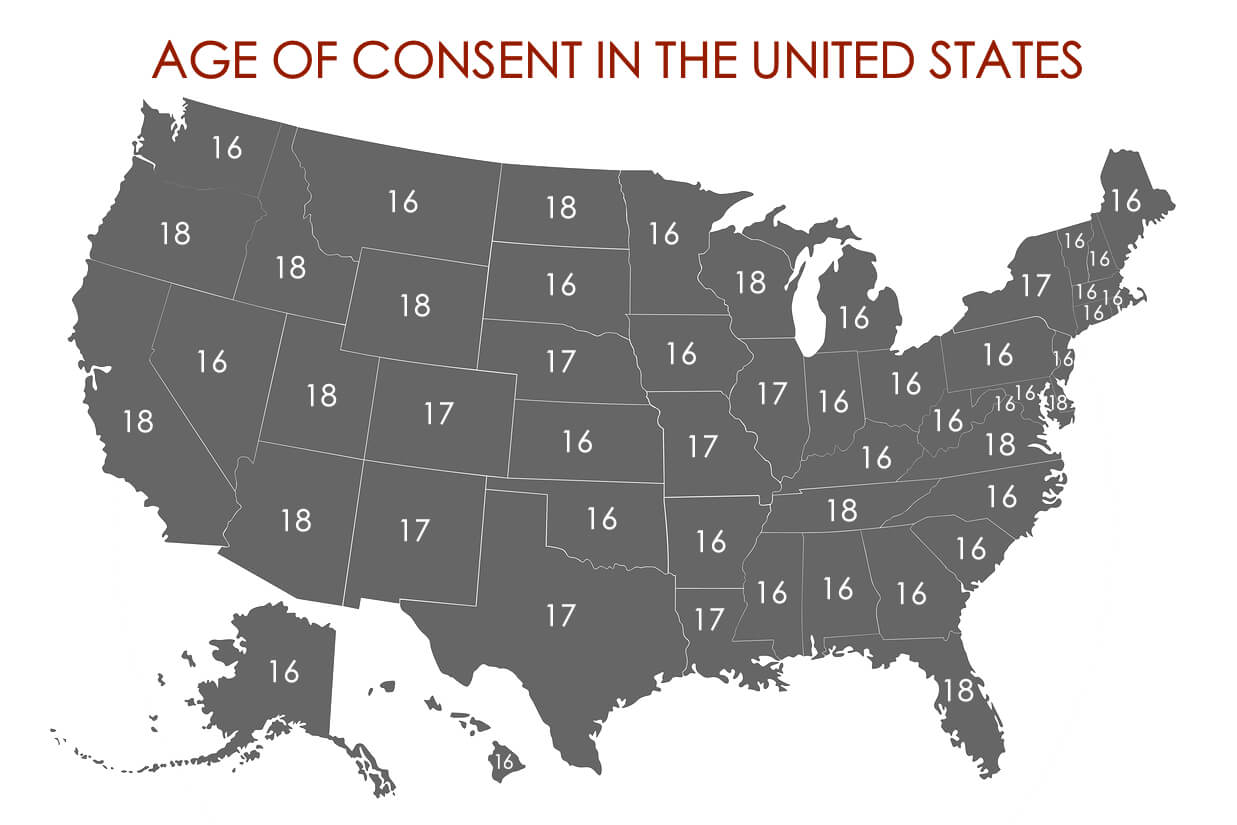
No, there is not a uniform age of consent. The "Age of Consent" is the minimum age at which a person may consent to participation in sexual intercourse. A person younger than the legal age of consent cannot legally consent to sexual activity. The age of consent in the United States ranges from 16 to 18 years old depending on the state, meaning that a person 15 years of age or younger cannot legally consent to sexual contact. Each state enacts its owns laws which set the age of consent.  If someone engages in sexual activity with a person younger than the age of consent in that state, the person could be charged with Statutory Rape or other offenses depending on the nature of the contact.

What follows is a map depicting the age of consent for all 50 states and a chart outlining the same.

*Note: This chart was current as of 2016, but could be subject to change over the years. Please do not rely on this chart to make any decisions that could impact your life. Check your own state's age of consent laws to make sure you are fully informed, because ignorance of the law will not be a defense for you if charged with a child sexual offense.

United States Age of Consent Map

United States Age of Consent Map

United States Age of Consent Chart

STATE LEGAL AGE OF CONSENT
Alabama 16
Alaska 16
Arizona 18
Arkansas 16
California 18
Colorado 17
Connecticut 16
D.C. 16
Delaware 18
Florida 18
Georgia 16
Hawaii 16
Idaho 18
Illinois 17
Indiana 16
Iowa 16
Kansas 16
Kentucky 16
Louisiana 17
Maine 16
Maryland 16
Massachusetts 16
Michigan 16
Minnesota 16
Mississippi 16
Missouri 17
Montana 16
Nebraska 17
Nevada 16
New Hampshire 16
New Jersey 16
New Mexico 17
New York 17
North Carolina 16
North Dakota 18
Ohio 16
Oklahoma 16
Oregon 18
Pennsylvania 16
Rhode Island 16
South Carolina 16
South Dakota 16
Tennessee 18
Texas 17
Utah 18
Vermont 16
Virginia 18
Washington 16
West Virginia 16
Wisconsin 18
Wyoming 18


"Romeo and Juliet Law" in Texas | An Exception to the Age of Consent in Texas

As mentioned in the chart above, the age of consent in Texas is 17. Texas, as well as many other states, has created a so-called "Romeo and Juliet" law, an exception to the statutory rape and age of consent law. Romeo and Juliet laws are targeted toward teenagers and young adults who engage in sexual relations with someone under the age of consent (17 in Texas), but who are still close in age to the sexual partner. The Romeo and Juliet provision creates a close in age exemption and keeps these would-be offenders from being classified as sex offenders.

Under Texas law, if a person over the age of 17 has consensual sexual intercourse with someone under the age of 17, but there is also no more than a three-year age difference between the two partners, the Texas Romeo and Juliet law will not allow the older person to be charged with statutory rape or be classified as a sex offender.

Read full article

Speak with a Fort Worth attorney

Call (817) 993-9249 or send us a message to discuss your case.