
Skip to content
Tag

Reasonable Suspicion

Page 2 of 3 · 13 articles

Failure to Maintain a Single Lane of Traffic DWI Attorney Fort Worth

Failure to Maintain a Single Lane of Traffic Leads to a DWI Conviction

By Brandon Barnett · Reasonable Suspicion

Does an Officer have "Reasonable Suspicion" to Make a Traffic Stop When Vehicle Weaves Inside a Traffic Lane?
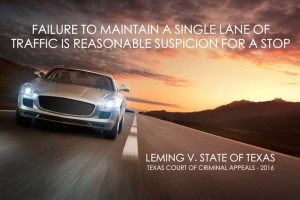
Failure to Maintain a Single Lane of Traffic DWI Attorney Fort WorthJames Leming was convicted of DWI after erratic driving alarmed fellow motorists to call police. On January 20, 2012, a citizen filed a report of a “swerving Jeep” and Officer Manfred Gilow responded. As the dashboard camera confirmed, the Jeep traveled thirteen miles under the speed limit; Gilow followed the Jeep for several miles. Officer Gilow observed the Jeep, “drifting [within the] lane to the left [with] tires on the stripes… back to the right, almost hit[ting] the curb twice.”

Officer Gilow said he did not stop the Jeep immediately because the heavy traffic made a traffic stop unsafe at the time. He wanted to wait until the Jeep approached “the 3000 block because I knew there’s parking lots where he could pull over [safely].” Gilow justified the warrantless stop under the Community Caretaking Exception, “due to the …[low] speed…and…swerving, it was an indication that the driver [was] somehow either distracted or physically not able to operate [his] motor vehicle carefully.”

Eventually, the officer pulled Leming over, noting on the police report, the smell of liquor. Though Leming denied drinking, he said he had taken some prescription pills. Officer Gilow conducted field sobriety tests and placed Leming under arrest for DWI.

Read the full opinion in Leming v. State.

Leming's DWI Trial and Motion to Suppress the Stop

Before the trial began, Leming filed a motion to suppress the traffic stop, which was denied. At trial, Leming pled guilty to and was convicted of DWI. Because Leming had two prior DWI convictions (a felony under Texas law), the court assessed punishment at ten years’ imprisonment. Tex. Penal Code § 49.09(b)(2).

The Sixth Circuit Court of Appeals reversed the trial court’s ruling, holding that the trial court should have granted the motion to suppress. Leming v. State, 454 S.W.3d 78 (Tex. App.—Texarkana 2014). The Sixth Circuit concluded that Gilow lacked reasonable suspicion to detain Leming for the offense of failure to maintain a single lane under Section 545.0600(a) of the Texas Transportation Code. The court reasoned “in order for it to have been unlawful, the encroachment must have been made unsafely; [here,] there was no real danger of his colliding with another vehicle in an adjacent lane.” The State’s Prosecuting Attorney petitioned the Court of Criminal Appeals for discretionary review, arguing that the citizen’s report coupled with Officer Gilow’s observations were sufficient for reasonable suspicion that Leming was driving the Jeep under the influence.

The Issue Before the Texas Court of Criminal Appeals Regarding the Traffic Stop

The Court of Criminal Appeals had to determine whether a driver must BOTH fail to maintain a single lane AND not change lanes without checking to assure the maneuver can be accomplished safely, before it may be said that a driver has committed an offense. Such an offense would rise to the level of reasonable suspicion for a constitutionally-sound traffic stop.

What Does the Texas Transportation Code Say About Driving Within a Single Lane?

Section 545.060(a) states that “an operator on a roadway divided into two or more clearly marked lanes for traffic (1) shall drive as nearly as practical entirely within a single lane; and (2) may not move from the lane unless that movement can be made safely.”

The CCA Holds that a Driver Must Maintain a Single Lane AND Must not Leave the Lane Unless it is Safe.

The CCA explains that the fact that both the requirement to stay within a single lane as for as practical and the prohibition to not leave that lane unless it is safe to do so, originally appeared in the same subsection of the statute, does not indicate that the Legislature intended that both must be violated before an offense has occurred. Rather, the CCA believes that the Legislature intended a violation of EITHER part of the statute constitutes separately actionable offenses.

The CCA says that Officer Gilow knew from personal observations, as well as from the citizen’s report, that Leming had some sort of trouble maintaining a steady driving pattern while traveling under the speed limit. “That was sufficient information to justify a temporary detention to investigate whether Leming had actually failed at some point to remain in his dedicated lane of traffic as far as it was practical to do so under the circumstances—it matters not whether that failure was unsafe.” Further, Officer Gilow had an objectively reasonable basis to suspect Leming of driving under the influence.

As a matter of principle, the CCA notes, “it [would be] counterproductive and contrary to common sense to set the reasonable suspicion bar for DWI so high that law enforcement must hesitate to investigate such hazardous driving for fear that the stop will later be invalidated.” In a Concurring Opinion, Judge Richardson adds, “I believe [the community caretaking exception] provided justification for the officer’s stop, where, a reasonable police officer—given the totality of the circumstances-would believe [someone] is in need of help.” Dissenting, Judge Keasler stated, “this is a close case…the majority reaches the wrong result by misconstruing the statute and finds reasonable suspicion on the basis of a single insufficient articulable fact.” Judge Newell also dissented in this case.
Read full article
Passing in Left Lane in Texas

Warrantless Traffic Stop Upheld for Driving in "Passing Only" Lane

By Brandon Barnett · Drug Crimes, Reasonable Suspicion

Driving in the “Passing Only” Left Lane for Forty-Five Seconds Creates Reasonable Suspicion for Warrantless Traffic Stop in Texas

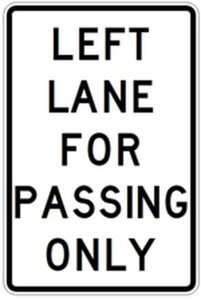
Passing in Left Lane in TexasJaganathan v. State: Francheska Jaganathan was driving in the left lane of a three-lane Texas highway, just ahead of a police cruiser. Mounted with a dashboard camera, the cruiser accelerated and changed lanes, but stayed behind Jaganathan’s car. A few seconds later, Jaganathan’s car passed a “Left Lane for Passing Only Sign,” yet her vehicle continued in the left lane despite the middle lane being clear of traffic. About forty-five seconds later, the trooper turned on his overhead lights, and conducted a traffic stop of Jaganathan’s car. During the traffic stop, the trooper smelled marijuana, prompting a search of the vehicle. The trooper found marijuana in the trunk, and as a result, Jaganathan was charged with possession of marijuana.

At trial, Jaganathan filed a motion to suppress the evidence, but the court denied the motion. Jaganathan chose a plea agreement where she pled guilty and was placed on deferred adjudication. On appeal, Jaganathan argued that the trooper lacked reasonable suspicion to conduct the traffic stop in the first place. The court of appeals agreed with her, stating that Jaganathan likely stayed in the left lane for safety reasons, that seeing the cruiser may have influenced her decision to stay out of the trooper’s way, and that a few seconds were an insufficient amount of time “to conclude that [Jaganathan] committed a [traffic] violation.”

The Court of Criminal Appeals of Texas disagrees with the court of appeals, citing the reasonable suspicion standard in Texas, and the Texas Transportation Code. The Court of Criminal Appeals also clarifies the issue at hand.

The issue is not whether Jaganathan committed a traffic offense, but whether the trooper had reasonable suspicion to stop the vehicle.

First, “A trooper may make a warrantless traffic stop if the reasonable suspicion standard is satisfied.” Guerra v. State, 432 S.W.3d 905, 911 (Tex. Crim. App. 2014). “Reasonable suspicion exists if the trooper has specific and articulable facts that, when combined with rational inferences from those facts, would lead him to reasonably suspect that a particular person has engaged …in criminal activity.” Abney v. State, 394 S.W.3d 542, 548 (Tex. Crim. App. 2013).

Second, “an operator of a motor vehicle [must] comply with an applicable official traffic-control device, including a sign.” TEX. TRANSP. CODE § 544.004(a); § 541.304(1). “Before a trooper can have reasonable suspicion to believe that a defendant committed the traffic offense of failing to obey a “Left Lane for Passing Only” sign, the trooper must be aware of facts that support a reasonable inference that the defendant drove past the sign before being pulled over.” Abney, 394 S.W.3d at 549.

Here, Jaganathan was driving in the left lane without passing other cars, after driving past a sign that prohibited that conduct. The dashboard camera captured the sign and all of the movements of the car. According to the Court of Criminal Appeals, even if Jaganathan had a defense of necessity—she HAD to be in the left lane for a medical or traffic emergency—the trooper still had reasonable suspicion to conduct a traffic stop. The Court of Criminal Appeals states, “these were only possibilities, and so it was reasonable for [the trooper] to suspect the appellant had violated the law.” Further, the reasonable suspicion standard “accepts the risk that officers may stop innocent people.” Illinois v. Wardlow, 528 U.S. 119, 125 (2000). As a result of the forty-five second traffic violation, the trooper had reasonable suspicion to pull Jaganathan’s car over; and, as a result of smelling marijuana, the trooper was able to search the car without a warrant, resulting in charges against Jaganathan. The Court of Criminal Appeals reversed the judgment of the court of appeals and affirmed the judgment of the trial court.

It is important to note, however, that the ruling has a dissenting opinion. Justice Meyers is adamant that the sign and the Transportation Code supporting it are problematic for the following reasons:

• The Code is unclear on how to comply or not comply with the sign.
• The Code does not state a specific amount of time a driver has to pass and merge back into the non-passing lane.
• The Code does not address passing a string of cars, in the middle lane.
• The Code does not address the need to accelerate to be able to pass, whether intended or unintended (for example if the car being passed speeds up, making passing difficult).
• Proving a driver’s intent to pass another car is difficult.

If you or a loved one are facing traffic violations or drug charges, please contact our office for a free consultation at (817) 993-9249.

Read full article

Purposeless Pacing Not Evidence of Prostitution

By Brandon Barnett · Prostitution

Prostitution Case Overturned for Lack of Reasonable Suspicion or Probable Cause | Fort Worth Prostitution Defense Attorneys

- San Antonio 4th Court of Appeals (2015)
At approximately 9:00 p.m., San Antonio police officer Christopher Connelly and his partner observed Shamar Johnson "pacing" on the sidewalk in a dimly lit area near two gay clubs. Officer Connelly's testimony differs from Johnson's in some respects, but there is general agreement on the relevant facts. The area was known for gay prostitution. Based on their belief that Johnson had no reason to be loitering in the area, Officer Connelly and his partner pulled up to Johnson in their car, exited the vehicle and began questioning Johnson.

When Johnson saw the car, he stopped. According to Officer Connelly, Johnson appeared to be nervous and put his hands in his pockets. Johnson said that the presence of the officers on either side of him was intimidating. Officer Connelly instructed Johnson to put his hands on the patrol car and asked Johnson if he had anything illegal in his possession. Again, Johnson said that he did not believe he could leave and had to do exactly what the officers said. Johnson told the officers they could search him. The officers found a plastic bag containing cocaine and arrested Johnson.

Johnson moved to suppress the evidence the officers found because the detention and search were unlawful. The trial court found Officer Connelly's testimony "credible" and denied the motion to suppress. Johnson subsequently struck a plea bargain and pled no contest to the charge of possession of a controlled substance.

Johnson appealed the trial court's decision. Consistent with the standard for reviewing a trial court's action on a motion to suppress, the Court of Appeals deferred almost entirely to the trial judge, who was in the best position to assess credibility of witnesses, regarding the facts of the case, but made its own determination regarding how the law applied to the facts.

In a four-step analysis, the Court of Appeals found the officers' encounter with Johnson constituted an unlawful seizure and the motion to suppress should have been granted.

(1) Both sides agreed that the officers' encounter with Johnson was not consensual. The State admitted there was no support to argue the search was consensual.

(2) The state argued the officers' detention of Johnson was based upon reasonable suspicion, which requires the existing of specific facts leading an officer to conclude that a person has committed or is about to commit a crime. The State cited the facts that Johnson was in a dimly lit area known for male prostitution and Johnson's "loitering" looked like someone who was engaged in prostitution. The Court of Appeals disagreed, concluding that being present in a dimly lit area, even an area known for prostitution, does not provide reasonable suspicion that an individual is a prostitute. Because the officers had no reasonable suspicion to detain Johnson, Johnson's detention was a violation of the Fourth Amendment.

(3) The Court considered whether Johnson's consent to search was an act of free will. The court noted the consent occurred shortly after Johnson was told to place his hands on the car and there were no intervening circumstances to lessen the "taint" of the improper detention. Although nothing indicated the officers intended to commit an unlawful detention, the Court found Johnson's consent was not an exercise of his free will and therefore did not remove the taint of the unlawful detention.

(4) After determining the trial court should have granted the motion to suppress, the Court of Appeals considered whether that error made any difference in Johnson's punishment. Although Johnson accepted a plea bargain rather than go to trial, the Court of Appeals believed the denial of the motion to suppress gave the State leverage in the process and may have contributed to Johnson's giving up his right to a trial in order to obtain a favorable punishment recommendation.

Many people believe they are required to cooperate in any encounter with police until the police officers terminate the encounter. However, Johnson v. Texas makes it clear police officers do not have unlimited authority to detain an individual unless they have a reasonable suspicion that a crime has been or is about to be committed. While police officers may see reasonable suspicion where others would not and trial courts may agree, higher court decisions have set a standard for reasonable suspicion which limits police ability to detain citizens who, like Shamar Johnson, just appear to be in the wrong place at the wrong time.

Read full article

DWI: Is Passing on the Shoulder Evidence of a Traffic Offense?

By Brandon Barnett · DWI

DWI Conviction Overturned | Passing on the Shoulder Permitted in Certain Circumstances

In many ways, Texas Court of Criminal Appeals also acts the State's highest traffic court. What follows is a synopsis of Lothrop v. State, wherein the CCA opines on the legality of using the right shoulder of a road to pass a slower vehicle.

In Lothrop, the police stopped Appellant after observing him use the right shoulder of the road to pass a vehicle that was slowing down.  Appellant was later arrested for Driving While Intoxicated (DWI). At trial, he filed a motion to suppress the evidence gained from the stop, arguing that the police officer did not have reasonable suspicion to make the stop. Appellant pointed to Section 545.058(a) of the Texas Transportation Code, which provides:

(a) An operator may drive on an improved shoulder to the right of the main traveled portion of a roadway of that operation is necessary and may be done safely, but only:

(1) to stop, stand, or park;

(2) to accelerate before entering the main traveled lane of traffic;

(3) to decelerate before making a right turn;

(4) to pass another vehicle that is slowing or stopped on the main traveled portion of the highway, disabled, or preparing to make a left turn;

(5) to allow another vehicle traveling faster to pass;

(6) as permitted or required by an official traffic-control device; or

(7) to avoid a collision.

The trial court denied the motion and Appellant pled guilty to DWI. The 2nd Court of Appeals (Fort Worth) affirmed the conviction, holding that "driving on an improved shoulder, regardless of circumstance, is prima facie evidence of an offense, and that Section 545.058(a) merely establishes defenses that a defendant may raise at trial."

Think again, said the Traffic Court (a.k.a. CCA):

[T]he offense of illegally driving on an improved shoulder can be proved in one of two ways: either driving on the improved shoulder was not a necessary part of achieving one of the seven approved purposes, or driving on an improved shoulder could not have been done safely. Merely driving on an improved shoulder is not prima facie evidence of an offense. Thus if an officer sees a driver driving on an improved shoulder, and it appears that driving on the improved shoulder was necessary to achieving one of the seven approved purposes, and it is done safely, that officer does not have reasonable suspicion that an offense occurred.

With that, the CCA reversed the Court of Appeals and remanded the case back to the trial court.   So there you have it - your traffic lesson for today from the CCA. You are free to drive on the improved shoulder of the road (without worrying that you will be pulled over) IF you are doing it safely and for one of the seven listed purposes.

Read full article

Being Left of Center: Reasonable Suspicion for a DWI Stop?

By Brandon Barnett · DWI

You can't believe anything he says. He tries to sound intelligent and reliable, but falls far short. Did you think I was writing about a political candidate? Nope. A police officer.

The Second District Court of Appeals (Fort Worth) just released State v. Houghton, a Driving While Intoxicated (DWI) case that centered around the testimony of the arresting officer.  In this case, the defendant moved to suppress the DWI stop for lack of reasonable suspicion.  At the suppression hearing, the police officer testified that he couldn't remember why the car initially caught his attention. Perhaps it was for speeding, but he couldn't say for sure.  He further testified that the car was driving left of center in a lane, but that it never actually crossed over the line.

Granting the motion to suppress, the trial court commented that the officer lacked any credibility. Affirming the trial court's suppression ruling, the Court of Appeals, held:

To establish reasonable suspicion, the state must show that, at the time of the detention, the officer had specific, articulable facts that established reasonable suspicion.  Terry, 392 U.S. at 21-22, 88 S. Ct. 1868, 1880... Generally, law enforcement action can only be supported by facts the officer was "actually aware of at the time of that action." State v. Ruelas, 327 S.W.3d 321, 326-27 (Tex. App.―El Paso 2010, pet. ref'd). As stated by the court in Ruelas, "The preference for objective standards, however, does not apply to the facts on which officers act." Id. at 326 (holding officer lacked reasonable suspicion where it was not until suppression hearing when state was questioning motorist defendant that officer learned of facts suggesting he violated traffic code by making left turn into right-hand lane).

Here, because the officer failed to offer any justifiable reason for the traffic stop (a reason that was in his mind at the time of the stop, vice at the suppression hearing), the Court of Appeals affirmed the trial court's suppression of the traffic stop.  A police officer can't just follow the prosecutor's lead to justify the stop.  He has to be able to articulate what was going through his mind at the time of the stop.  If is doesn't amount to reasonable suspicion, the case needs to get kicked.

Read full article

Speak with a Fort Worth attorney

Call (817) 993-9249 or send us a message to discuss your case.