Skip to content
Tag

Jury Trials Archive | Howard Lotspeich Alexander & Williams

Page 2 of 5 · 22 articles

Hernandez Racial Slur Error 2016

Murder Conviction Reversed for Prosecutor's Use of Racial Slur

By Brandon Barnett · Jury Trial, Trial Advocacy

Texas Prosecutor Uses the "N" Word During Closing Argument. Court of Appeals Reverses the Conviction.
Hernandez Racial Slur Error 2016In December of 2014, Appellant Luis Miguel Hernandez was convicted of the murder of Devin Toler, an African-American man. During the trial, Appellant claimed self-defense, arguing that Toler attacked him and that by killing him, he was defending himself from the attack. The prosecution, however, presented evidence that Appellant provoked Toler by his words, some of them racial slurs. The actual words of the alleged racial slurs were never presented to the jury in the testimony of any witness or otherwise. However, during closing argument, the prosecutor said the following:

"What were the words of provocation? I’ll tell you what the words of provocation were. [Appellant] called Devin and his family 'niggas.' That’s what it was."

The defense attorney promptly objected to the prosecutor's use of the racial slur as it was inflammatory and outside the evidence in the case. Ultimately, (after a heated bench conference) the judge sustained the objection and instructed the jury to disregard the counsel's comment, but did not specify which counsel or what comment the jury was to disregard. The defense did not move for a mistrial. The jury returned a verdict of guilty and sentenced Appellant to 14 years in prison.

See the majority opinion in Hernandez v. State (2nd Court of Appeals - Fort Worth, 2016)

What is a Proper Jury Argument?

On appeal to the Second Court of Appeals (Fort Worth), the Appellant challenged the judge's failure to declare a mistrial after the prosecutor's use of the "N" word. The court explained:

Proper jury argument falls into one of four areas: (1) summation of the evidence; (2) reasonable deduction from the evidence; (3) an answer to the argument of opposing counsel; and (4) a plea for law enforcement. Generally, error resulting from improper jury argument is subject to a harm analysis.

The appellate court held that not only were the prosecutor's comments in using the "N" word error, but that the prosecutor's comments constituted an "incurably prejudicial argument;" one that required a mistrial.

Is the "Incurably Prejudicial Argument" Waived if the Defendant Does Not Move for a Mistrial?

Texas courts have consistently held that to preserve error for an improper argument, the defendant must do 3 things:

  1. Make a timely and specific objection;
  2. Request and instruction to disregard if the objection is sustained; and
  3. Move for a mistrial if the instruction to disregard is granted.

Cockrell v. State, 933 S.W.2d 73, 89 (Tex. Crim. App. 1996), cert. denied, 520 U.S. 1173 (1997)

In this case, the defense satisfied 1 and 2, but did not move for a mistrial. The appellate court was then presented with the issue of whether the improper jury argument objection is waived if the defense does not move for a mistrial.  Texas precedent says the issue can be waived for failure to move for a mistrial. But the court does not find this to be wise.

"Logically, this position makes no sense. An incurably prejudicial argument requires a mistrial. If the trial court does not grant the mistrial, the court has committed error that requires setting aside the conviction and re-trying the case. Respectfully, if the argument is so prejudicial that it has deprived the defendant of a fair trial, the injury is fundamental."

The court provides further reasoning to depart from precedent, citing the tenuous political atmosphere surrounding race relations in America at the time of the trial.

The impact of the improper statement by the prosecuting attorney must be viewed in the context of the political atmosphere at the time of trial. The trial took place in early December 2014. On February 26, 2012, George Zimmerman, whose mother was from Peru, killed Trayvon Martin. Emotional discussions of Zimmerman’s ethnicity filled news commentary. Other killings made headlines. Among them was the death of Eric Garner while he was selling loose cigarettes in New York on July 17, 2014. The officer who killed him was Daniel Pantaleo. On August 9, 2014, Michael Brown was killed in Ferguson, Missouri. On August 11, 2014, Ezell Ford was killed in Los Angeles by two police officers, one of whom was Hispanic. And on November 23, 2014, twelve-year-old Tamir Rice was killed in Cincinnati, Ohio. Additionally, the Black Lives Matter organization was formed in 2013 in response to the acquittal of George Zimmerman in his trial for the murder of Trayvon Martin and was actively involved in protests nationwide.

With that, the Second Court held that the improper jury argument was not cured (and could not have been cured) by the judge's "perfunctory" instruction to disregard and that the error was preserved for appeal. The court then reversed the case and remanded back to the trial court.

Dissent Agrees that the Error Was Prejudicial, But Would Not Depart From Precedent

Justice Sudderth dissented. She is not willing to depart from Court of Criminal Appeals' precedent regarding the formal requirement to move for a mistrial. She writes:

Of all of the words in modern American English usage, including the slang and the vulgar, the “n-word” is of such infamy that it is generally referenced and understood only by its first letter. And with very few exceptions, such racially charged inflammatory language has no place in jury argument.

This is certainly the case when a prosecutor, using that language to secure a conviction, goes outside of the record to introduce it. Therefore, I agree with the majority that the prosecutor’s behavior was improper. It was inexcusable. It cannot be condoned. And the trial judge committed error in permitting it. Nevertheless, because we are constrained by precedent of the court of criminal appeals requiring preservation of this type of error, I am compelled to dissent.

It will be interesting to see whether the Court of Criminal Appeals will stick to their previous precedent or take this opportunity to change the law when it comes to an "incurably prejudicial argument" involving racial slurs.

Read full article
Husband Wife Privilege Texas Rule 504

Can One Spouse be Forced to Testify Against the Other?

By Luke A. Williams · Criminal Defense, Jury Trial

Can My Spouse be Forced to Testify Against Me in a Criminal Trial in Texas?

Husband Wife Privilege Texas Rule 504Everyone knows (or should know) of the attorney-client privilege which prohibits the calling of an attorney to testify as a witness against his client and protects the attorney-client relationship. But what about the husband-wife relationship? Are spouses afforded any protection from having their spouse testify against them in a criminal trial?

Yes. In Texas there are two "Husband-Wife" privileges that apply to the marital relationship: spousal immunity and the marital communication privilege. Many people are aware that certain privileges arise but often do not know exactly what protections these privileges provide. The following article discusses both of the matrimonial privileges in Texas.

See the full text of Texas Rule of Evidence 504 - Spousal Privileges

What is Spousal Immunity? How does Spousal Immunity work in Texas?

Spousal immunity is the privilege that exists in a criminal trial for the defendant’s spouse not to be called as a witness in certain situations.  Tex. R. Evid. 504(b). This privilege applies to spouses that are married to the defendant during trial and are asked to testify as to matters that occurred during the spouse's marriage to the defendant. The non-defendant spouse holds this privilege; meaning he or she is the one who may invoke the privilege not to testify and it is ultimately his or her decision. Tex. R. Evid. 504(b)(3). Thus, if the spouse wants to voluntarily testify for the State, she may do so regardless of whether the defendant objects to the spouse's testimony.

Spousal immunity does not stop the defendant from calling their current spouse as a witness. If a defendant chooses to do so the spouse cannot assert this privilege and will be required to testify. With that, if the defendant does not call the spouse and surrounding evidence suggests the spouse could testify to relevant matters the State is allowed to comment about that. 504(b)(2).

Exceptions to Spousal Immunity in Texas

There are two exceptions to spousal immunity in Texas.

  • First, the privilege does not apply in a criminal proceeding in which the defendant has committed against the spouse (e.g. Domestic Violence) or prosecution for bigamy.
  • Second, the privilege does not apply when the spouse is called to testify about matters that occurred before they were married to the defendant.

What is the Texas Marital Communication Privilege?

Under Texas Rule of Evidence 504(a), spouses have the privilege to prevent testimony of certain communications made during the marriage from one spouse to the other spouse.  Unlike the spousal immunity privilege, the marital communication privilege may be invoked by either the defendant or the spouse being called as a witness. Additionally, this privilege survives divorce; meaning it applies whether or not the defendant and the spouse are still married as long as the communications were made while they were married. Tex. R. Evid. 504(a)(2).

This privilege only applies to communications that were intended to be confidential, that is, they were made privately with no intent to disclose to anyone other than the spouse. A communication will still be confidential if someone overheard the conversation if the defendant spouse made the statement without knowledge or intent that the other person would hear the conversation. Basically, the requirement is that the communication made was intended for the spouse’s ears only.

Exceptions to the Marital Communications Privilege in Texas

There are two exceptions to the confidential communications privilege.

  • First, if the communication was made in whole or in part to aid in the commission of a crime the privilege does not apply.
  • Second, the marital communication privilege does not apply in prosecutions for crimes against the defendant’s spouse, any minor child, or a member of the defendant or defendant spouse’s household.

In conclusion, there are certain situations where matters occurring between spouses are kept within the sanctity of the marriage and will not come out in court. However, as you can see these privileges are very specific and it is important to be aware of what exactly is privileged and when such privileges apply.

See the full text of Texas Rule of Evidence 504 - Spousal Privileges

Read full article
Making a Murderer | Fort Worth Criminal Defense Attorney

Making a Murderer: The Power of the Jury

By Ashley Gilmore · Jury Trial

Can a Single Juror Make a Difference? Ask Steven Avery.

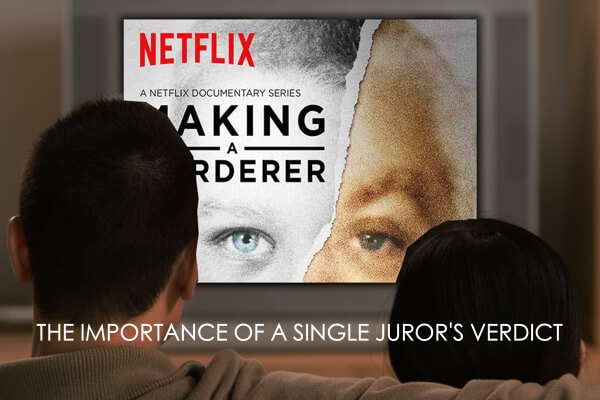
Making a Murderer | Fort Worth Criminal Defense AttorneyWe, like many of you, have been sucked into the sad, frustrating, and very real tale of the murder trial of Steven Avery in Manitowoc County, Wisconsin brought forth in the Netflix documentary “Making a Murderer." While much has been made of Steven Avery’s guilt or innocence, the coerced confession from his nephew Brandon Dassey (see full confession transcript HERE), and the possible foul play of the law enforcement in Manitowoc County, one major key to the case has been largely overlooked - the power of the jury. Without a guilty verdict from the jury, there is no frenzy over a viral documentary and certainly Steven Avery is a free man.

Recently, the filmmakers have reported to the press that a member of the jury now admits that he or she believed Avery was not guilty. This juror, wishing to remain anonymous, claims to have changed their vote to “guilty” after succumbing to fear and pressure. In reality, the juror believed, and still believes, that Avery was framed for murder. Speaking to the filmmakers, the juror said “I’m the reason the justice system failed.” Is the juror right?

Criminal Verdicts in Texas Must Be Unanimous. Every Juror Vote Counts.

Jury deliberations are secret, so only the jurors themselves could ever say for sure exactly why they arrive at a certain verdict for a case. In a criminal case, a jury verdict must be unanimous, which ensures that each juror’s vote is important and not diluted in a simple majority. If this one juror had summoned the courage to stay true to their “not guilty” vote, it would have caused a mistrial. A mistrial forces authorities to make the difficult decision of whether or not to retry the accused. Who knows what would have happened in a hypothetical second trial of Steven Avery.

For years, this juror has shouldered guilt from this trial, proving that the decisions juries are asked to make are indeed difficult ones. The next time you are on a jury, take a lesson from this case. Stand up for what you believe in and refuse to cave to pressure or fear. Do not be overpowered by the person with the loudest voice in the jury room. Remember, your vote holds the power of incarceration or freedom.

I hope we didn't spoil the documentary for you, but if you haven't watched it, this post does not even scratch the surface of the things you will see in this series.  We suggest you watch it and consider the case for yourself.  If nothing else, you'll see that there are two sides to every story and you'll understand to importance of having a fair and conscientious jury in a criminal trial.

Read full article
Vincent Bugliosi

Vincent Bugliosi's Advice on Cross-Examination and Asking "Why"

By Brandon Barnett · Trial Advocacy

Renowned Trial Lawyer, Vincent Bugliosi, Explains One of His Theories About Cross-Examination

Vincent BugliosiIn 2011, I had the privilege of escorting the late Mr. Vincent Bugliosi around Marine Corps Base Camp Pendleton, as he was the guest speaker at a trial advocacy conference my office organized.  Mr. Bugliosi, 76 years old, was best known as the prosecutor that put Charles Manson away.  He was also a renowned true crime author, writing such books as Helter Skelter, And the Sea Will Tell, 'Till Death Us Do Part, and Outrage.  He would tell you, however, that his proudest moment was his victory over Gerry Spence in the mock trial of Lee Harvey Oswald for the assassination of President John F. Kennedy.  Other than this mock trial, Gerry Spence boasts a perfect trial record.

One of the things about which Mr. Bugliosi spoke was cross-examination.  He noted that many of the best-selling books on cross-examination caution lawyers from asking a witness WHY they took a certain action.  Lawyers are warned that they should never allow a witness to explain themselves on cross.  Well, Mr. Bugliosi did not exactly agree with that maxim.  Here's what he had to say on the subject:

Even if I do not ask "why," the lawyer who called the witness, if alert, will do so on redirect.  The witness has then often had a court recess or perhaps overnight to think up the very best answer to the "why" question.  I would much rather force the witness to answer on cross, not giving him extra time to fabricate.

Although both lawyers can avoid asking the "why" question and, as in some other situations, "save for final argument" the implications of the witness' testimony, by that late point in the trial the witness' reason for his improbable act is a matter of competing speculations by the lawyers, not the court record.

The "why" question, of course, can be a dangerous one, but I feel this is so only if the lawyer hasn't first blocked off possible and anticipated escape hatches.  Admittedly, real witnesses, unlike their fictional counterparts in novels and on the screen who cave under pressure of the first or second good question, are as doughty and elusive as all hell.  When all but trapped, and at the brink of a public, courtroom humiliation, human beings seem to secrete a type of mental adrenaline that gets their minds working extremely fast, and well.  So the witness a lawyer faces on the stand, for some curious reason, is almost inherently formidable.  But a witness can't go somewhere when he has nowhere to go.

If I feel a witness if lying, a technique I frequently employ is to first elicit answers from him on preliminary matters (blocking off all escape hatches), answers which, when totaled up, show he would be expected to take a certain course of action.  The witness having committed himself by his answers, I then ask him what course he in fact took (which is not the course he would be expected to take), and follow this up with the "why" question.  If time after time a witness is unable to satisfactorily justify conduct which is incompatible with what would be expected of a reasonable person, the jury will usually conclude that his testimony is suspect.

Mr. Bugliosi made sure to caveat that we should never ask the "why" question unless all possible escape hatches have been blocked off.  He was truly an outstanding speaker on this and many more topics.  His true crime books are excellent and are highly recommended for all criminal trial lawyers out there.  Vincent Bugliosi passed away on June 6, 2015.

Read full article

Winning By Losing in a Jury Trial

By Brandon Barnett · Jury Trial

Let me make an admission...sometimes we lose at trial. There, I said it. We don't win every case. Sometimes the evidence is not in our favor. Sometimes the State is able to prove every element of the alleged offense. And we typically know that going into it.

It begs the question, "Why take the case to a jury trial if you suspect you are going to lose?" Here's why...because in many situations, going to trial is the only way to get a good result.

For instance, we had a client that was charged with a low level misdemeanor offense. The State was offering a plea bargain of 18 months probation, a $1,250 fine, and numerous classes in exchange for a guilty plea. We considered this offer to be too steep in relation to the alleged offense. Our client agreed. But the State was not willing to budge on the offer. So we set it for trial.

After a hard fought trial, the jury came back with a guilty verdict, which is what we suspected all along. Then we went to the judge for punishment. The State continued to recommend 18 months probation and a $1250 fine. The judge, however, awarded our client 2 days of labor detail and a $750 fine. Two short days later, the entire ordeal was but a fleeting memory for our client. No probation. No monthly reporting. No random drug tests. No classes.

We would have never received such a low punishment offer from the State. We also would have never received such a low sentence from the judge if we hadn't gone to trial and filled her in on the extenuating and mitigating circumstances of the case and our client.

In criminal defense, a moral victory is still a victory and sometimes you win by losing.

Read full article

Speak with a Fort Worth attorney

Call (817) 993-9249 or send us a message to discuss your case.