Skip to content
Tag

Fort Worth DWI Attorneys

Page 6 of 8 · 40 articles

Stopped at Canada border for DWI conviction

Crossing the Canadian Border with a Texas DWI Conviction

By Brandon Barnett · DWI

Traveling to Canada, Eh?  Travel Plans for Some Americans May Be Foiled as Canada Cracks Down on DWI Arrests and Convictions

Stopped at Canada border for DWI convictionDo you have a DWI conviction in Texas (or anywhere in the United States)? Are you traveling to Canada any time soon? If you answered “Yes” to both of these questions, you may be in for a surprise at the border. Even if you have recently been acquitted of a DWI charge, you may still be turned away and deemed “criminally inadmissible for entry.” This article will explain the law and provide some solutions if you find yourself in this dilemma.

Canada’s Immigration Laws Create Anxiety for Americans with DWI Charges

Recently, Canada enacted strict immigration laws making entry into the country by car, plane, train or boat more difficult for United States passport holders who have a DWI arrest or conviction on their record. Regardless of whether the arrest or conviction was a misdemeanor charge, whether you plan to drive while in Canada, or whether the charge happened when you were a juvenile, any DWI charge at all could cause you to be turned away at the border, further damaging chances for success in all Canadian immigration programs for life. Bottom line: travelers with any type of DWI arrest or conviction will face enhanced scrutiny by the border patrol and must comply with additional legal requirements set forth by the Canadian government for entry. It is a better strategy to be proactive and prepared before traveling, instead of reactive and defensive once “caught” at the border.

Unlike the division between federal and state powers in the United States with regard to law enforcement, Canadian criminal law is solely a federal responsibility. As a result, criminal laws are uniformly interpreted and enforced throughout all of the Canadian provinces. Traveling to a different province in the hope of more leniency because of different criminal laws will not be helpful.

The federal Canadian Immigration and Refugee Protection Act (“IRPA”) governs immigration admissibility into Canada. Section 36(b)-(c) of IRPA states, “a permanent resident or a foreign national is inadmissible on grounds of serious criminality for having been convicted of an offense [or committing an act] outside Canada that, if committed in Canada, would constitute an offense under an Act of Parliament punishable by a maximum term of imprisonment of at least ten years.” Basically, IRPA converts any DWI charge or conviction from the United States into a “serious criminal offense” in Canada and allows Canadian authorities to deny entry into the country at border checkpoints on roads, railways, airports, and maritime ports.

Generally speaking, Canada views DWI offenses—even minor offenses—very seriously. However, there are a few options available for travelers who have a DWI on their record. If a traveler wishes to apply for relief, Canadian officials will assess the following: number and type of offense(s), when the sentencing for the offense(s) was completed, and the severity of the offense(s). The three solutions below are the most popular options for relief for travelers with DWI history, however, they are not an exhaustive list of all of the application and appeals procedures, so please consult an attorney for specific details on your particular case.

Solutions For Gaining Permission to Enter Canada with a DWI

Option 1: The Temporary Resident Permit (“TRP”)

The TRP allows a traveler with a DWI to gain entry Canada on a temporary basis. The permit can be issued for any length of stay, up to a period of three years, and the traveler must state the reason for the visit (for example, family or school). Travelers should apply for the TRP if their most recent offense occurred within the last five years. According to the Canadian Immigration Newsletter, this type of permit may take six months to a year to process.

Option 2: Criminal Rehabilitation

Travelers seeking to permanently resolve their inadmissibility issues can apply for Criminal Rehabilitation. Essentially, the traveler with a DWI charge or conviction is asking the Canadian government to forgive their DWI history. In order to be eligible, more than 5 years must have passed since the completion of one’s most recent sentence (which may have included alcohol classes, counseling, fines, jail or prison time, community service, community supervision, driving courses, probation, etc.). Rehabilitation applications can take a year or more to process. It is possible to have a TRP while one is applying for Permanent Criminal Rehabilitation, so that one has the ability to travel to Canada in the interim while waiting on the resolution of the Criminal Rehabilitation application.

Option 3: Deemed Rehabilitation

If a traveler has only one single DWI conviction where more than 10 years have passed from completion of the full sentence (for example jail or prison time, fines paid, reinstatement of driver’s license, etc), an individual may be deemed rehabilitated by virtue of the time that has elapsed. However, even if you fit this category, it is probably still a good idea to have prepared an affidavit or letter explaining the incident to Canadian border officials because full disclosure is critical to overcoming the barriers to entry. Trying to hide a conviction or denying altogether that you have one are sure fire ways to be denied entry permanently into the country.

Getting into Canada with a DWI is not as easy as showing up to the border checkpoint with a valid passport and a smile. Don’t be caught by surprise at the border! To increase your chances of admissibility into Canada, it is a good idea to talk with an attorney who will help you take the proactive steps before your trip so that you have the greatest possible chance of gaining approval for entry.


Read full article
Tarrant County DWI Court Nekhom

Tarrant County Starts New Misdemeanor DWI Court Program

By Brandon Barnett · DWI

Judge Deborah Nekhom to preside over Tarrant County's new DWI Court Program for Misdemeanor DWI Cases

Tarrant County DWI Court NekhomTarrant County has many specialty court programs for various types of criminal cases, but for DWI cases, the only specialty program available was limited to felony-level cases - the Felony Alcohol Intervention Program (FAIP). Not anymore. After much debate, Tarrant County started a new specialty court designed for misdemeanor DWI cases (it is not currently listed on the county's website). The program officially began on March 30, 2016.  Judge Deborah Nekhom in County Criminal Court 4 is the presiding judge over the new DWI Court and she is dedicated to making it a success.

DWI Court is Designed for High-Risk / High-Need Offenders

The goal of the new DWI Court is to identify high-risk DWI defendants and intervene so that they do not end up with a felony DWI down the road. With the help of defense attorneys and clinical specialists, the program seeks to identify defendants with significant substance abuse issues, who are in need of serious help. While the specifics of the program are still being ironed out, our firm has been told that there will be strict oversight and accountability for all participants so that they can have the best chance of successfully completing the program and their DWI probation.

What are the benefits of the Tarrant County DWI Court?

The main benefit of participating in the new DWI Court is that participants will receive the counseling and support they need to overcome their addiction and live a health, productive, alcohol-free and drug-free lifestyle. In addition, some of the following benefits have been discussed and are being implemented:

  • Probation time is reduced after completion of the program, allowing participants to enter into a non-reporting status;
  • Waiver of DWI fines (up to $4,000)
  • No program fees
  • *Dismissal of the underlying DWI charge and allowance for a Non-Disclosure (*this expires on 1/1/17 with changes to the Texas Government Code)

Several other benefits are being considered and are not ripe for public discussion at this point.

How Do I Get a Client into the DWI Court?

If you have a client that would be a good candidate for misdemeanor DWI Court, you should get him or her an assessment ASAP to determine whether they are classified as high-risk / high-need. You should then discuss the option of DWI court with the presiding judge of your client's DWI case. If, after seeing the assessment, the judge agrees that DWI court is a good option, he or she will transfer the case to CCC4 after your clients enters a plea of guilty to the DWI.

Contact Us for More Information About DWI Court

I realize that this article does not provide a lot in the way of specifics about the new program, but it only started yesterday and there are not a lot of specifics to publish at this point. If you have some questions, our DWI defense attorneys would be happy to answer them if we can. Contact our office at (817) 993-9249.

Read full article
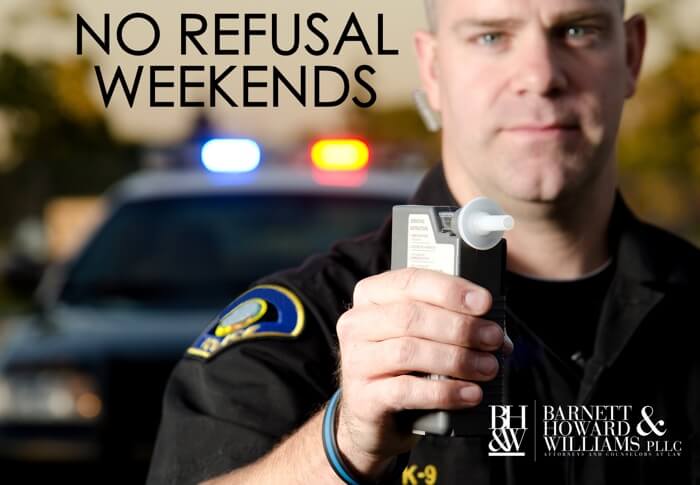
No Refusal Weekends for DWI in Fort Worth, Texas

No Refusal Weekends in Texas | DWI Blood Search Warrant

By Brandon Barnett · DWI

What you need to know about No Refusal Weekends in Texas | Fort Worth DWI Attorneys

No Refusal Weekends for DWI in Fort Worth, TexasThroughout the year, as various holidays approach (Christmas, New Year's, Super Bowl weekend, 4th of July, etc.), we receive questions about "No Refusal Weekends," in which police agencies crack down on driving while intoxicated or DWI. It is important that Texas motorists understand the rules of the road, so that every holiday season remains merry and bright. Many have seen the “No Refusal” notices on electronic road signs, heard the “No Refusal” advertisements on the radio, or watched stories on the news related to “No Refusal" for suspected drunk driving. What is “No Refusal” and how does the law impact your holiday travel? Understanding a few basic things about the law could help you in the event of a traffic stop or a detention by a law enforcement officer.

What is No Refusal Weekend?

No Refusal Weekend refers to a short period of time, typically a holiday weekend or the weekend of a special event, such as the Super Bowl, where law enforcement advertises the ability to conduct routine traffic stops, detaining motorists for suspected DWI. During the stop, law enforcement requests a blood or breath sample, and, if the motorist refuses to comply, law enforcement immediately contacts a judge or magistrate who is designated “on call” during the No Refusal time frame. If the law enforcement officer conveys to the judge that (1) there was reasonable suspicion to detain the motorist for a traffic or criminal offense, and, (2) there is probable cause to believe the motorist is driving under the influence of drugs or alcohol, then the judge quickly issues a search warrant for the sample. Tex. Transp. Code §§ 724.011(a), 724.012(b), 724. At that point, law enforcement may call for a phlebotomist to take the sample on site, or may transport a motorist to a facility to obtain the sample. If all goes according to plan, “no refusal” speeds up the process by which law enforcement obtain samples used for DWI/DUI arrests. Further, the sample becomes evidence for trial.

What is the purpose of No Refusal Weekend?

The entire No Refusal process from detention to arrest is faster in theory, the goal being to catch motorists who are driving under the influence quickly, and to capture the highest blood alcohol content (“BAC”) possible. In Texas, a BAC level of .08 is considered legally intoxicated. No Refusal Weekend differs from a DWI stop on regular days by it’s speed — the quick phone call to an “on call” judge who is waiting by the phone to issue warrants — and it’s deference to law enforcement in the moment. So what does this mean for you, the Texas motorist?

You have the right to refuse blood and breath tests initially.

The term No Refusal sometimes confuses motorists. Many believe they cannot refuse a law enforcement officer’s request for a sample during a No Refusal period. Not true. On No Refusal Weekend motorists still have the right to refuse to provide blood and breath during a traffic stop. However, if law enforcement obtains a search warrant for blood, the motorist must comply; failure to comply may result in additional charges. Once the officer has a warrant in hand, the rules change. But before the officer obtains a warrant, you can refuse to provide breath or blood and you may refuse to submit to field sobriety tests. For notifications about when No Refusal Weekends begin in the Dallas Fort Worth area, and to know your rights if you are stopped by an officer, download our free App from the App Store or Google Play — know your rights before you go out!

*Note: Refusal of a breath or blood test may result in temporary loss of driving privileges, even if the officer later obtains a warrant to conduct the search.  The courts will typically grant an occupational driver's license to work and household tasks.

Warrantless searches for blood alcohol content in DWI cases violate the Fourth Amendment.

The No Refusal law comes from an “implied consent” provision in the Texas Transportation Code. The 2007 law states, “if a person is arrested for...operating a motor vehicle in a public place…while intoxicated…the person is deemed to have consented…to submit to the taking of one or more specimens of the person's breath or blood for analysis to determine the alcohol concentration or the presence in the person's body of a controlled substance, drug, dangerous drug, or other substance.” Tex. Transp. Code §§ 724.011(a), 724.012(b), 724. However, in 2014, the Texas Court of Criminal Appeals held that “warrantless, nonconsensual testing of a DWI suspect's blood does not…fall within any recognized exception to the Fourth Amendment's warrant requirement, nor can it be justified under a…Fourth Amendment balancing test.” State v. Villareal, PD-0306-14 (Tex. Crim. App. 2014).  See also, the US Supreme Court's opinion in Missouri v. McNeely. In summary, a motorist may refuse a blood or breath test upon an initial request by law enforcement, but after a warrant is obtained from a judge, a motorist may not refuse at that point because it is mandatory—hence the name No Refusal.

Please take the time to know your responsibilities and rights before heading out on No Refusal Weekends in Texas. Download our App on the App Store or on Google Play for the latest information on No Refusal Weekends. Have a safe and happy holiday season! This article is for educational purposes only and does not take the place of legal advice. If you are in need of a DWI attorney, please contact our office for a free consultation at (817) 993-9249.

Read full article
Public Intoxication Charges in Texas

What is the Punishment for Public Intoxication in Texas?

By Brandon Barnett · DWI

Is a Texas Public Intoxication charge a serious offense? What is the Possible Punishment for a PI in Tarrant County?

Public Intoxication Charges in TexasWe often receive calls or emails from people in Tarrant County who have been arrested for or cited with Public Intoxication (PI) in Fort Worth. Typically, they contact us to determine how serious a PI charge is in Texas and what the possible punishment might be. They want to know whether this is something they should handle on their own or whether they need a criminal defense attorney to help.


Generally, Public Intoxication in Texas is a Class C misdemeanor. Some might tell you that a Class C misdemeanor is the same as a traffic ticket and that is somewhat true. However, some Class C convictions can have a much larger impact on your future than a simple speeding violation. So when someone asks me whether they need an attorney to help them handle a PI, I tell them yes. You won't need to pay an arm and a leg, but a criminal defense attorney can help ensure that your rights are protected throughout the process and can, hopefully, set your case up for a dismissal and an expunction down the road.

Public Intoxication Punishment When the Offender is 21 Years of Age or Older

Section 49.02(c) of the Texas Penal Code provides that Public Intoxication in Texas is a Class C Misdemeanor, which is punishable by a fine not to exceed $500.00. However, if a person has two prior Public Intoxication convictions on their record, a third PI can be enhanced to a Class B misdemeanor, which has a range of punishment of up to 180 days in the Tarrant County jail and a fine up to $2,000. This enhancement provision is one of the big reasons that it pays to hire an attorney for each and every Public Intoxication violation in Texas.

Should You Plead Guilty to a Public Intoxication Charge in Texas?

Sure it is easy to just plead guilty, pay the fine, and get on with life. However, a conviction for a PI, even though it is only a Class C offense, can have a lasting negative impact on your job prospects, military or college admissions, and more. As stated above, a PI conviction can also count toward a future enhancement charge or possible even evidence during sentencing in a DWI trial. If you do plead guilty, please do so after consultation with a criminal defense attorney in your area.

Public Intoxication Punishment When the Offender is Under 21 Years Old

There are different rules for persons under 21 in Texas. As you probably know, person under 21 are not allowed to consume any amount of alcohol, so the legislators drafted special rules for them. Section 49.02(e) of the Texas Penal Code Section relates to minors and states that minors would face the same punishment as if they committed an offense under Section 106.071 of the Texas Alcoholic Beverage Code. Here are the highlights for you:

  • A person under 21 can be enhanced to a Class B misdemeanor for a 3rd PI, just like a person over 21 can
  • A first time conviction for Public Intoxication can result in a driver’s license suspension.
  • The fine for PI for a person under 21 is between $250 and $500.
  • Mandatory community service.
  • Alcohol education course or alcohol awareness program.

Fort Worth Public Intoxication Defense Attorneys

If you have been arrested in Tarrant County for Public Intoxication, contact our Fort Worth public intoxication defense attorneys today for a free consultation of your case. We can help you get your PI dismissed and then help you get the entire thing expunged from your record.  Call us today at (817) 993-9249.

Read full article
Impersonating a Public Servant in Texas

Man Pretends to be a Dallas District Attorney and Receives 2 Years in Prison

By Brandon Barnett · Criminal Defense

Impersonating a Public Servant in TexasWhen I think of someone impersonating an attorney, my mind goes to Joe Pesci and My Cousin Vinny.  In the movie Vincent Gambino only impersonated a criminal defense lawyer (not a public servant) so nobody seemed to care (except the judge), but in Texas, Impersonating Public Servant (including a district attorney) is a serious matter.  Robert Cornwell found this out after he pretended to be a Dallas County Assistant District Attorney in hopes of helping his friend with a DWI case.

In May of 2012, Robert Cornwell called Montgomery County Assistant District Attorney Kourtney Teaff, identifying himself as an assistant district attorney from Dallas County, attempting to “resolve [his friend’s] [DWI] case.” Cornwell claimed access to criminal histories, case files, and fingerprint cards. He mentioned speaking with governmental offices, and prosecuting his nephew for drug possession. Cornwell insisted on using his personal cell phone number because he and Teaff “were on the same team.” Becoming suspicious of the “highly unusual” requests coming from another district attorney, Teaff recorded the conversations. According to the trial court, Cornwell always used his real name, he had never been an attorney in Texas, he never attempted to claim official authority over Teaff, and he intended that “Teaff should consider the requests a personal favor.” Cornwell was sentenced to two years imprisonment for impersonating a public servant.

See the opinion in Cornwell v. State

What does "Impersonating a Public Servant" mean in Texas?

Impersonating a Public Servant is a Third Degree Felony with a punishment range of 2-10 years in prison and up to a $10,000 fine.  A person violates Section 37.11(a)(1) of the Texas Penal Code when the person impersonates a public servant in combination with the requisite intent...[which] can be satisfied with either the submission theory (“with intent to induce another to submit to his pretended official authority”) or the reliance theory (“with the intent to induce another…to rely on his pretended official acts.”).

Cornwell appealed to the Court of Appeals, arguing that the evidence was insufficient to show either theory of intent—submission or reliance—because he did not persuade Teaff to submit to any asserted authority he might have over her. The Court of Appeals rejected Cornwell’s argument, “concluding that the evidence was…sufficient to support a jury finding that he had impersonated a public official with intent to induce another to rely on his pretended official acts—the reliance theory.” Cornwell then petitioned the Court of Criminal Appeals (“CCA”) for discretionary review.

Here, the CCA determines whether the Court of Appeals was incorrect in misconstruing the meaning of the Section 37.11(a)(1) of the Texas Penal Code, as only “a few Texas appellate courts have directly addressed the reliance theory of intent, and specifically, the meaning of pretended official acts.” See Ex Parte Niswanger, 335 S.W.3d at 617 & n.11; Tiller v. State, 362 S.W.3d 125, 128 (Tex. App.—San Antonio 2011, pet. ref’d.); Tovar v. State, 777 S.W.2d 481,489 (Tex. App.—Corpus Christi 1989, pet. ref’d.).

The CCA Clarifies what "Impersonating" means (and doesn't mean).

The CCA explained that Section 37.11(a)(1) can be broken down into two parts: the culpable act (actus reus, the bad act) and a culpable mental state (mens rea, the guilty mind). To violate the statute, the State must prove:

  1. that the impersonation happened and
  2. that the impersonator had the specific intent to induce another to submit or to rely upon.

“An accused may not be convicted on a simple showing that he falsely held himself out to be a public servant.”

Because it was undisputed that Cornwell did impersonate a public servant—an assistant district attorney from Dallas County—satisfying the first part of the statute, the CCA focused on Cornwell’s mental state, specifically the reliance theory—the evidence that shows Cornwell’s intent to induce another to rely upon his pretended official acts. The CCA explained that Cornwell attempted to persuade Teaff he was “an experienced assistant district attorney by relating various claims of conduct he had undertaken as an assistant district attorney” namely, “putting his nephew in jail, reviewing case files, and investigating matters in the capacity of assistant district attorney.” The CCA is adamant that, “the only reason [Cornwell] could have had for relaying these pretended official acts to Teaff was to enhance the credibility of his claim to be an assistant district attorney.” “By calling and speaking to an assistant district attorney as a member of the same team, [Cornwell]…hoped to gain [Teaff’s] trust and goodwill.” Further, Cornwell did not ask for favor[s] in his capacity as a private citizen or concerned friend, rather, he asked under the guise of being an assistant district attorney. The CCA states, such “purported actions exceed mere false identification as a public servant.” The CCA agreed with the Court of Appeals, affirming Cornwell’s conviction and sentence.

There are no shortcuts to due process. The Texas Penal Code prescribes strict punishment for those impersonating officers of the court. There is no doubt that criminal charges and allegations can make the accused feel panicked and overwhelmed, however, the old adage “desperate times call for desperate measures,” will not hold water in court where impersonation is concerned. If you or a loved one are facing criminal charges, contact an actual Texas attorney who will explain the proper steps in dealing with the legal system. Contact our office today for a free consultation at (817) 993-9249.

Read full article

Speak with a Fort Worth attorney

Call (817) 993-9249 or send us a message to discuss your case.