
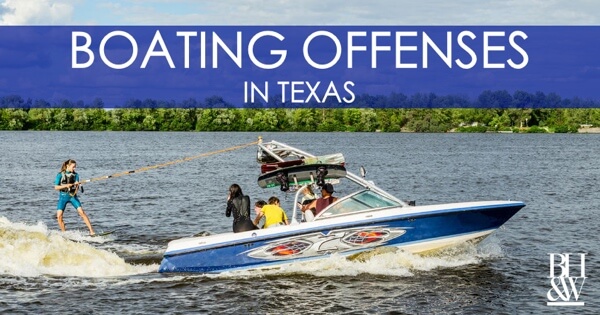
7 Common Boating Offenses in Texas | #3 Can Lead to Serious Prison Time
By Brandon Barnett · DWI
 For a lot people in Texas, the summer is filled with swimming, boating, wakeboarding, and drinking. These activities can be fun and harmless, but sometimes they can take a turn for the worse. Here’s a list of some of the most common criminal offenses that can be committed on a boat in Texas lakes and possible punishments that go along with them. Please keep these in mind to ensure that you have a fun and safe time on the water this summer.
1. Boating While Intoxicated in Texas (BWI)
There is nothing wrong with drinking on a boat, but the boat driver must be careful not to have too many. Under Texas Penal Code 49.06, a person is Boating While Intoxicated if the person is intoxicated while operating a watercraft. To be considered intoxicated, one must not having the normal use of mental or physical faculties by reason of the introduction of alcohol, a controlled substance, a drug, a dangerous drug, a combination of two or more of those substances, or any other substance into the body or have an alcohol concentration of 0.08 or more. This is the same definition of intoxication that exists under the DWI statutes in Texas.
A "watercraft," as defined in the Boating While Intoxicated law, is a vessel, one or more water skis, an aquaplane, or another device used for transporting or carrying a person on water, other than a device propelled only by the current of water.
Boating while intoxicated is a Class B misdemeanor, with a minimum term of confinement of 72 hours. It is punishable by:
- up to 180 days in jail
- a fine of up to $2,000, or
- both confinement and fine
2. Underage Operation of a Boat
In Texas, according to the Parks and Wildlife Code, no person may operate a motorboat powered by a motor with a manufacturer’s rating of more than 15 horsepower on the public waters of this state unless the person is at least 13 years of age or is supervised by another person who:
- is at least 18 years of age;
- can lawfully operate the motorboat; and
- is on board the motorboat when under way.
Children that are 13-17 years of age can lawfully operate a recreational vessel (like a jet ski) if they complete a boater education course.
Underage operation of a Boat is a Class C Parks and Wildlife Code misdemeanor and can be punished by a fine of $25 to $500.
3. Failure to Report a Boating Accident in Texas (Felony Offense)
The Texas Parks and Wildlife Code regulates the boating guidelines in Texas. According to Section 31.104, when involved in a boating accident, the operator is required to:
- Render to other persons affected such assistance, as may be practicable and necessary in order to save them from or minimize any danger.
- Give his name, address, and identification of his vessel in writing to any person injured and to the owner of any property damaged in the collision, accident, or other casualty.
Also, according to Section 31.105 the accident must be reported to the department on or before the expiration of 30 days after the incident. The report should include a full description of the collision, accident, or casualty in accordance with regulations established by the department.
It is the responsibility of each boat operator who is involved in an accident to contact TPWD or your nearest law enforcement agency if the accident:
- Results in death; (within 48 hours) or
- Injuries to a person requiring medical treatment beyond first aid; or
- Causes damage to vessel(s) or property in excess of $2,000.00
Failure to report is a Parks and Wildlife Code Felony and can be punished by confinement in the Texas Department of Criminal Justice for at least 2 but less than 10 years. In addition to imprisonment, a Parks and Wildlife Code felony may be punished by a fine of $2,000 to $10,000.
4. Speeding While Boating
I’ll bet you’ve never noticed any speed limit signs on the lake. Neither have I. However, a person can still violate Texas law if they go too fast in their boat. The Texas Parks and Wildlife Code states that no person may operate any boat at a rate of speed greater than is reasonable and prudent, having due regard for the conditions and hazards, actual and potential, then existing, including weather and density of traffic, or greater than will permit him, in the exercise of reasonable care, to bring the boat to a stop within the assured clear distance ahead. So it appears that the speed limit is whatever a reasonably prudent person would say that it is. If you’re a daredevil, then ask your cautious friend if you’re going too fast.
Speeding is an offense under this section is a Class C misdemeanor and can be punished by a fine not to exceed $500.
5. Failure to Have Life Jackets on Board
Texas Parks and Wildlife Code Section 175.15 requires that there is at least one personal flotation device on board a recreational vessel for each person. Further, each child must be wearing their life jacket while on board.
Failure to have proper life jackets is a Class C misdemeanor and can be punished by a fine not to exceed $500.
6. Fishing Without a License in Texas
A valid fishing license with a freshwater or saltwater endorsement is required to take fish, mussels, clams, crayfish or other aquatic life in the public waters of Texas. However, you do not need a fishing license/package if you:
- are under 17 years of age.
- were born before January 1, 1931.
- are a mentally disabled person who is engaging in recreational fishing as part of a medically approved therapy, and who is fishing under the immediate supervision of personnel approved or employed by a hospital, residence or school for mentally disabled persons.
- are a mentally disabled person who is recreational fishing under the direct supervision of a licensed angler who is a family member or has permission from the family to take the mentally disabled person fishing
Fishing without a license is an offense under this section is a Class C misdemeanor and can be punished by a fine not to exceed $500.
7. Public Intoxication
Public Intoxication applies on the water, just as it does on land in Texas. Under the Texas Penal Code, a person commits the crime of public intoxication if the person appears in a public place while intoxicated to the degree that the person may endanger the person or another.
Public intoxication is a Class C misdemeanor and can be punished by a fine not to exceed $500.
Texas Criminal Defense Attorneys and Summer Water Enthusiasts
We enjoy the Texas lakes as much as anyone and we hope that you will too. Like we always say, we hope you never need us, either for a criminal offense or for an accident, but we are here if you do. For a free consultation about your legal matter, contact Barnett Howard & Williams PLLC at (817) 993-9249.

 When Governor Abbott signed the
 The Court of Criminal Appeals recently handed down a case regarding the State’s ability to use the full statutory definition of “intoxicated” in a jury charge for DWI cases. The issue faced by the court was whether the trial court erred in providing the jury with portions of the statutory language that were not supported by evidence presented at trial.
 Let's face it, a criminal record is not a good thing when it comes to employment opportunities and other things that require a background search. Even when the criminal offense is non-violent and unintentional, like DWI, it can negatively impact a person's future. Our Texas lawmakers recognized this stigma and did something about it. This past legislative session (2017),
 If you’ve received an occupational license related to a DWI ALR suspension (blood or breath test refusal or failure) in Texas, the judge who granted you that license likely included several restrictions and requirements you must follow. Those requirements can be found in the order granting your occupational license. You should have that order handy because Texas Transportation Code Section 521.250 requires you to possess a certified copy of the order when you drive. In fact, it’s a criminal offense not to possess a certified copy (we’ll revisit that below.)