
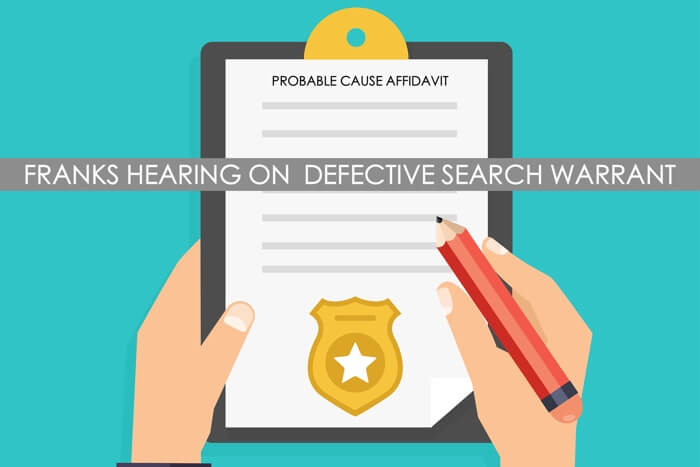
Challenging the Probable Cause Affidavit | Franks Hearing Requirements
By Brandon Barnett · Fraud
Problems with Probable Cause: Law Enforcement Allegedly Used Conflicting Third Party Statements as the basis for a Search Warrant
 Evidence obtained by a valid search warrant can be used at trial. But what if the search warrant was based on information provided by a third party who later recants the information he provided? Further, what if law enforcement mischaracterized the evidence when presenting it to the magistrate in the application for the warrant? What legal remedy, if any, exists to support defendants who find themselves in this situation? The Fifth Circuit heard United States v. Minor in August, this article summarizes the Court’s surprising holding.
See the full text of the 5th Circuit's decision in United States v. Minor (USCA 5th Cir. 2016)
US v. Minor - Rogue Bank Employee Hatches Identity Theft Scheme
Anthony Minor and his friend Katrina Thomas, a Fannie Mae employee, hatched a plan to steal the identities of numerous Fannie Mae clients with the intention of using the personal information to obtain entry into checking and savings accounts. Thomas created a list of client names and personal information while at work, and then provided Minor with the information. Minor was successful in using the data to steal money from those individuals’ bank accounts by contacting banks, pretending to be the individual, and transferring funds to Minor’s personal account.
During the time of these crimes, Minor was frequenting a hotel. Eventually, law enforcement began investigating Minor; the lead investigator assigned to the case was Albert Moore. In a warrant affidavit, Moore states that Will Crain, the director of security at the hotel, reported to law enforcement that he had seen Minor with expensive merchandise. That statement was used to establish probable cause for obtaining a search warrant. Law enforcement used the search warrant to search Minor’s dwellings, and the search rendered evidence of the crimes. Minor was arrested on numerous bank fraud charges.
Minor Goes to Trial on Federal Fraud Charges
At trial, a jury found Minor guilty of bank fraud, aiding and abetting bank fraud, conspiracy to commit bank fraud, using or trafficking in an unauthorized access device, aggravated identity theft, and aiding and abetting aggravated identity theft. Minor was sentenced to 192 months’ imprisonment, a sentence that incorporated a six-level enhancement, but was set well below the federal Sentencing Guidelines recommendation at the trial judge’s discretion.
Minor appealed to the Fifth Circuit Court of Appeals, arguing that the search warrant contained false information and that he is entitled to a Franks Hearing to establish the facts surrounding the statements used to support the finding of probable cause for the search warrant.
Minor Appeals to the Fifth Circuit Arguing Agents Lacked Probable Cause for Search Warrant
Minor appealed to the Fifth Circuit Court of Appeals, arguing:
- that the trial court should have held a Franks Hearing to determine whether law enforcement improperly obtained a search warrant for his car,
- that even if Minor’s case does not meet the requirement for a Franks Hearing, that an exception be carved out specifically for his case, and
- that his sentence should not have included a six-level enhancement (more prison time).
Minor alleged that Crain, the hotel’s security guard, testified at trial that he did not see Minor carrying merchandise and therefore, law enforcement did not have probable cause to secure a search warrant.
Franks Hearing Requirements—A Supreme Court Precedent
In Franks v. Delaware, 438 U.S. 154 (1978), the Supreme Court held that
“where the defendant makes a substantial preliminary showing that a false statement knowingly and intentionally, or with reckless disregard for the truth, was included by the affiant in the warrant affidavit, and if the allegedly false statement is necessary to the finding of probable cause, the Fourth Amendment requires that a hearing be held at the defendant’s request.”... [Further, if the] “allegation of perjury or reckless disregard is established by…a preponderance of the evidence…the search warrant must be voided and the fruits of the search excluded to the same extent as if probable cause was lacking on the face of the affidavit.”
Id. at 155-56.
Federal Sentencing Guidelines for Bank Fraud Crimes
“U.S.S.G. § 2B1.1 (2014), provides that “if the defendant’s offense involved 250 or more victims, then § 2B1.1(b)(2)(C) requires the court to increase the defendant’s offense level by 6 levels. U.S.S.G. §2.B1.1(b)(2)(C).
The Fifth Circuit Weighs In; Holds that the Affiant’s statements were not "deliberately false or made with reckless disregard for the truth."
The Fifth Circuit relied heavily on Supreme Court precedent with regard to the evidentiary appeal and deferred to the reasoning of the trial court with regard to sentencing.
As “Minor concedes that Agent Moore did not intentionally insert false information into the affidavit, or act with reckless disregard for the truth…and because Minor failed to make the requisite substantial preliminary showing, [Minor] is not entitled to a Franks hearing.” Secondly, “[Minor] asks us to hold that in a case where a law enforcement affiant is relying upon information….from other[s]…the challenger should not be required to meet the intentional or reckless requirement to proceed a Franks hearing.” Here, “Minor’s argument is meritless under any standard…[and he] has not cited any authority recognizing his proposed exception to Franks…we decline…to create a new exception to well-established Supreme Court precedent.
Further, the Fifth Circuit said, “we agree with the district court that Minor…actively employed the means of identification of over 250 victims in furtherance of their bank fraud scheme…with the object of unlawfully accessing those customers’ bank accounts without their consent.” Accordingly, the Fifth Circuit affirms the holding and sentence of the trial court.
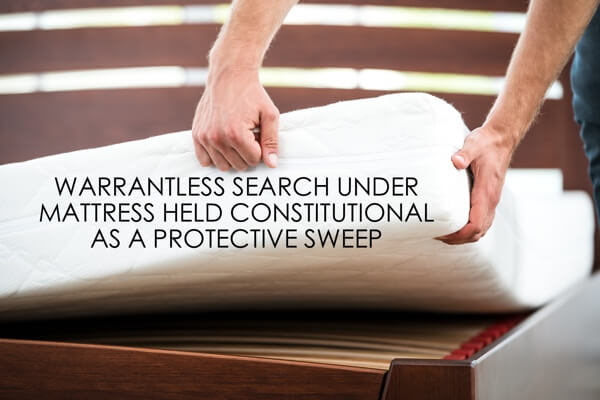
 FACTS: On February 5, 2014, the Wharton County Deputy Sheriff’s Department served a felony arrest warrant on Yonari Garcia at his father’s trailer home. Yonari’s father told law enforcement that Yonari was not home, however, consented to a search of the trailer. Upon entry, Garcia-Lopez, Yonari’s brother, made a beeline for a bedroom, closing and locking the door. Law enforcement followed Garcia-Lopez and demanded that the door be unlocked. Garcia-Lopez opened the door and the police entered, continuing the search for Yonari. Garcia-Lopez asked if he could sit on his bed and eat his dinner while police searched the room. The police obliged the odd request. A minute later, law enforcement discovered two sets of bullet-proof vests in plain sight, prompting a background check. Garcia-Lopez was a convicted felon and having the body armor was a violation for being a felon in possession of body armor, U.S.C. § 922(g)(1). The police arrested Garcia-Lopez after being in the home a total of three minutes. After the arrest, police continued searching the Garcia-Lopez’s room. Concerned Yonari might be sheltered in a hollowed-out mattress, the police lifted the bed up, discovering ammunition and three handguns sandwiched between the mattress and box springs. After a total of seven minutes inside the trailer, the police left with Garcia-Lopez under arrest.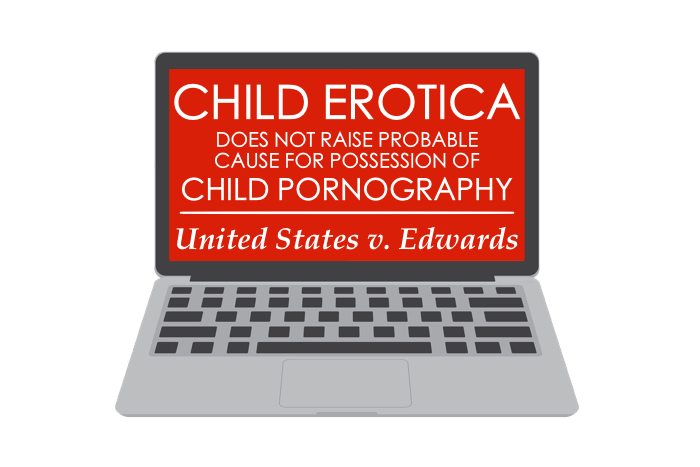
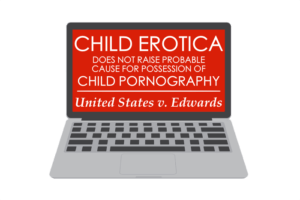 Paul Edwards was charged with
 Glen. R. Hines (
 A district court convicted Renee Pratt, a prominent Louisiana politician, of conspiracy to violate the federal Racketeer Influenced and Corrupt Organizations Act (“RICO”). 18 U.S.C. § 1962(d). Pratt’s conviction resulted from a thorough investigation of her long-time friend, Mose Jefferson, a well-known Louisiana community organizer and politician, as well as his family. United States v. Pratt, 728 F.3d 463 (5th Cir. 2013), cert. denied, 134 S. Ct. 1328 (2014). The Jefferson family and Pratt were accused of obtaining community-service grants, and using the money for personal gain. Id. Pratt timely appealed, citing new evidence that several prosecutors from the U.S. Attorney’s Office (“USAO”), made negative and persuasive online comments in public forums, including a local newspaper’s website, regarding her case around the time of trial. Pratt claims that the jury rendered a guilty verdict because of the disparaging and prejudicial comments.