Skip to content
Tag

Class C Misdemeanors in Texas: Assault & Related Topics

Page 1 of 2 · 6 articles

Assault as Lesser Included

Assault By Contact NOT an LIO of Assault Bodily Injury

By Brandon Barnett · Assault

Is the Class C charge of Assault (Offensive Contact) a lesser-included offense of the Class A charge of Assault (Bodily Injury)?

In short, the answer is most likely No.
Assault as Lesser IncludedAn offensive-contact assault not a lesser-included offense of a bodily-injury assault because the offenses have different elements.

The Court of Criminal Appeals, whose opinions are controlling in Texas, held that an offensive-contact assault is not a lesser-included offense (“LIO”) of a bodily-injury assault because what the state was required to prove for one offense differed from what the state had to prove for the other (McKithan v. State, 324 S.W.3d 582, 583, 591 (Tex. Crim. App. 2010)). For a Class A misdemeanor bodily-injury assault, the state must prove that bodily injury (or pain) occurred; the statute does not require the state to prove that the contact was offensive or provocative (Tex. Penal Code § 22.01(a)(1), (a)(3)). An offense is not an LIO if the state must prove different elements for each offense (McKithan, 324 S.W.3d at 583, 591). It is not enough that “proof of the charged [] offense may also” show the other offense; the State must be “required to prove these offenses in establishing the charged offenses” (Id. at 593).

Granted, seven years before McKithan, the Court of Criminal Appeals stated that an offensive-contact assault is an LIO “of (a)(1), because [it is] proved by less than all the facts required to prove (a)(1), specifically, physical injury” (Reed v. State, 117 S.W.3d 260, 267 (Tex. Crim. App. 2003)). However, the Court of Criminal Appeals seemed to move away from this categorical view in McKithan.

Additionally, the appeals court presiding over cases in Tarrant County, the Second Court of Appeals, held that an offensive-contact assault “is not, under the circumstances of this case, a lesser-included offense of assault causing bodily injury” (Welsh v. State, 2009 Tex. App. LEXIS 3592, *4-5 (Tex. App—Fort Worth May 21, 2009)). Other courts echo this sentiment. For example, in Norman v. State, the appeals court held that the trial court did not make a mistake when it refused to instruct the jury on offensive-contact assaults as a LIO of bodily-injury assaults because offensive-contact assaults have a unique element (2019 Tex. App. LEXIS 6690, *16-17 (Tex. App—Amarillo August 1, 2019). And one Houston court stated that “[b]ecause offensive-contact assault is not within the proof necessary to establish bodily-injury assault, it is not a lesser-included offense” (Washington v. State, 2019 Tex. App. LEXIS 5409, *12 (Tex. App—Houston June 27, 2019)).

Thus, offensive-contact assaults are not considered LIOs of assaults causing bodily. An assault under § 22.01(a)(3) has elements unique to it, so one cannot prove an assault under § 22.01(a)(1) by establishing the elements of assault under § 22.01(a)(3).

Read full article
Left Lane Passing Texas Law

Why Driving Slowly in the Left Lane Can Cause Accidents

By Jesse Lotspeich · Car Wreck

We've all been there...stuck on the highway while the driver in the left lane (i.e. the "fast" lane) is going slower or the same speed as the cars on the right. This can cause congestion and considerable frustration to drivers wanting to pass. Texas Transportation Code Section 545.051 actually requires slower drivers to use the right hand lane. However, it would appear that many drivers are unaware of this requirement.

Does Driving Slowly in the Left Lane Cause Accidents?

As personal injury attorneys, we have seen many car accidents that happened on the highway due to unsafe passing. This typically happens when the faster driver weaves in and out of lanes trying to pass the slower drivers. Vox published a helpful video that does a fair job explaining the danger of driving slowly in the left lane.


Texas is Cracking Down on Driving in the Left Lane

Texas DPS has ramped up its enforcement of left-lane citations in the last several years. DPS officials have noted that driving slowly in the left lane is a hazard and requires enforcement.

Whether it was a car wreck, a truck accident, or a wrongful death, if you or a loved one have been seriously injured on a Texas highway, contact our experienced Personal Injury Attorneys today for a free consultation and case evaluation.

Read full article
Paxton Fantasy Football Illegal

Texas Attorney General Says Fantasy Football Constitutes Illegal Gambling in Texas

By Luke A. Williams · Gambling

Is Fantasy Football Illegal in Texas? AG Paxton Says "Yes."

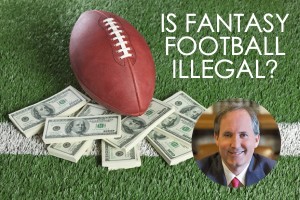
Paxton Fantasy Football IllegalYesterday, Texas Attorney General Ken Paxton issued an opinion stating that participating in daily fantasy football websites is illegal gambling in Texas. The opinion specifically states that participating in daily fantasy sports leagues is illegal gambling under section 47.02 of the Texas Penal Code.
Section 47.02 of the Texas Penal Code states that a person commits an offense if he or she makes a bet on the partial or final result of a game or contest or on the performance of a participant in a game or contest.

The key term that the Attorney General focused on in the opinion is the term “bet.” A “bet” is defined as an agreement to win or lose something of value solely or partially by chance. Texas Penal Code 47.01(1). Attorney General Paxton specifically stated that because the outcome of games in daily fantasy sports leagues depends partially on chance, an individual’s payment of a fee to participate in such activities is a “bet.”

Under 47.02 of the Texas Penal Code, gambling is a Class C misdemeanor offense, wherein offenders could face a fine of up to $500.00. Gambling under Section 47.02 of the Texas Penal Code is a fine-only offense that does not involve jail time as a punishment.

Can I keep playing daily fantasy sports?

It's up to you. If you continue to play daily fantasy sports in Texas, you would be participating in illegal gambling as the law is interpreted by Attorney General Ken Paxton. Again, according to the attorney general, participating in daily fantasy football league sites constitutes a Class c misdemeanor.

Opponents of the AG's opinion argue that daily fantasy sports involves skill to really win.  Mark Cuban, owner of the Dallas Mavericks, is one of the outspoken people who disagrees with the Paxton opinion.  He believes that just about everything in life and business involves chance and could be considered gambling as Paxton defines it.

What is important to remember though is that the attorney general cannot and will not be responsible for the actual investigation or prosecution of these cases. Local law enforcement and local district attorneys would be the responsible agencies for enforcing this law. Investigation of these cases would have to be tedious and would require a significant amount of resources in order to prosecute the lowest level of offense under Texas law. Whether the State would go to the extent needed to prove these types of gambling charges beyond a reasonable doubt is yet to be seen.

The law does allow a defense to prosecution for gambling if the person engages in gambling in a private place, no person receives any economic benefit other than personal winnings; and except for the advantage of skill or luck, the risks of losing and the chances of winning are the same for all participants.

What does this Fantasy Sports AG opinion mean for the average Texan?

The opinion means that, according to the State’s highest-ranking attorney, participating in daily fantasy sports leagues is illegal gambling. Now, it’s up to each local jurisdiction’s law enforcement agencies, prosecutors and courts to decide if prosecuting these cases is a priority or not. Law enforcement uses discretion on a daily basis as to what crimes and actions they should focus the bulk of their enforcement actions on. It’s unknown at this time if or whether law enforcement will spend the resources necessary to prosecute these cases.

Hopefully, if you choose to continue to play daily fantasy football, you are good at it and can cover your potential fines. We'll have to wait and see which, if any, jurisdictions choose to enforce this opinion. Based on the resources it would take, I seriously doubt that we'll see any citations written for this. Good luck out there!

Read the Texas AG Paxton Fantasy Football Opinion

Read full article
Texas front license plate law

License Plate Law in Texas | Front License Plate | Two Plate Rule

By Brandon Barnett · Traffic Offenses

One License Plate or Two: Does Your Car Need a Front License Plate In Texas?

Texas front license plate lawHow many license plates does your vehicle need in order to comply with Texas law? Do you need one or is there a two plate rule? Should you drill holes into the front bumper of your car to install a front license plate, or will you be alright with a rear plate only? If you are reading this article, perhaps you have exhaustively Google-searched license plate laws out of frustration. Find out what the Texas Transportation code says about license plates and what the implications are for you, the Texas motorist.

Do I need a Front License Plate in Texas? Yes. Texas law requires that every vehicle maintain a license plate in the front and rear of the vehicle.  The current fine for failing to display a front license plate in Texas is $200.00.

Do I need a Front License Plate in Texas? | An Error In the Texas Transportation Code Created a License Plate Loophole

Since 1934, Texas law has required that Texas motorists display a front and a rear license plate. In 2011, House Bill 2357 modified the statutory language making driving a vehicle without displaying a front and a rear license place both illegal and punishable by a fine. In January of 2012, Texas lawmakers revised the transportation code, once again, to include several new provisions. However, in the process of making revisions, the provision mandating a penalty for vehicles not in compliance with the “two plate rule” was accidentally stricken from the Texas Transportation Code. From January 2012 to September of 2013, law enforcement could not lawfully issue citations for failure to display a front license plate. Unfortunately, this brief period of time also created a lot of confusion around the “two plate rule” that reverberates to the present day.

Texas Lawmakers Amend the Code to Close the Loophole | Front License Plate Now Required in Texas

The two plate rule was originally created for the purpose of making identification of vehicles and their owners more efficient for automatic plate readers and law enforcement agencies. In 2012, the Texas A&M Transportation Institute (“TTI”) issued a report, citing overall effectiveness of the two plate rule, unlike states that only required one rear license plate on a vehicle. TTI found that front license plates were (1) easier to read in the daylight; (2) helpful in toll billing; (3) aided law enforcement in tracking down violators of the transportation code by way of automatic plate readers; and (4) allowed Homeland Security and U.S. Customs and Border Protection to process and screen vehicles more effectively and quickly. Thus, the front license plate requirement in Texas.

Aware of the inadvertent loophole created by omission of the penalty provision, lawmakers amended the transportation code in September of 2013 to mandate punishment for Texas motorists who do not display both the front and the rear license plates. Motorists who do not have a front license plate risk incurring a Class C misdemeanor charge, punishable by fine not to exceed $500.

Implications For the Texas Motorist | Texas Front License Plate Law | Penalty for Front License Plate Violation

Currently, the penalty for operating a vehicle without a front license plate is $200.00 - subject to change with subsequent legislation. However, there may be more to this than meets the eye. Generally speaking, when a vehicle is out of compliance with mandatory safety and administrative regulations (such as only having a rear license plate), by statute, Texas law enforcement has “probable cause” to conduct a traffic stop. At minimum, such a traffic stop could include pulling the vehicle over, running a check of the license plate, researching the driver’s license and registration of the motorist, and issuing a citation for violating the two plate rule.

In sum, a Texas motorist who drives without both plates risks being pulled over for a lawful traffic stop and fined at least $200.00 for a misdemeanor traffic offense.

References:

Read full article

How Jerry Seinfeld Violated Texas Theft Law

By Brandon Barnett · Theft

Obscure Texas Laws | Fort Worth Criminal Defense Attorneys

No, I'm not talking about a Good Samaritan Law, but Texas does have some obscure laws on the books that you might not suspect.  We are hoping to bring some of them to your attention.  For the first obscure Texas law, we look to one of the most successful television shows in history.

For all of the Seinfeld fans out there, you probably remember the episode where Kramer tries to entice Jerry to have cable illegally installed by two Russians.  Well, Jerry's actions would be a Class C misdemeanor Theft offense here in Texas punishable by a fine up to $500.

Section 31.12 - Theft of or Tampering With Multichannel Video or Information

Under this law:

[a] person commits an offense if, without the authorization of the multichannel video or information services provider, the person intentionally or knowingly makes or maintains a connection, whether physically, electrically, electronically, or inductively, to a television set, videotape recorder, or other receiver attached to a multichannel video or information system.

Based on his actions (or inability to stop Kramer), Jerry could be arrested and issued a Class C criminal citation.  Like all penal statutes, there is much more to it than that.  If you're curious about whether you may have violated this one in the past (long before the statute of limitations ran out, of course), see the full text of the Texas Theft Statute and look for Section 31.12.

Contact Fort Worth Theft Attorneys

If you or a loved one are charged with any theft offense in Texas, don't call Jacky Chiles.  Contact the experienced (and non-fictional) criminal defense attorneys at Barnett Howard & Williams PLLC by calling (817) 993-9249.

Read full article

Speak with a Fort Worth attorney

Call (817) 993-9249 or send us a message to discuss your case.