Skip to content

Tag

Child Sexual Assault

Page 2 of 2 · 18 articles

Statutory Rape Texas

The Statutory Rape Dilemma in Texas

By Luke A. Williams · Sex Crimes

Statutory Rape TexasOf the various types of criminal cases we defend in Fort Worth, Texas, Statutory Rape can be one of the more frustrating. First, a word of clarification; the term “Statutory Rape” does not actually appear in the Texas Penal Code. What I refer to as Statutory Rape is actually Sexual Assault of a person under 17 years of age (and over 14 years of age) under Section 22.011(a)(2). To understand what I mean about our frustration, consider this example (based on a true story).

The Story of Sam | A Common Statutory Rape Example

A 22 year-old attractive young man, let’s call him Sam, is filling up his car (a BMW) at a gas station when an attractive young woman (Nadia) approaches him and tells him how she admires his car. Nadia then tells Sam that she thinks he is cute and gives Sam her phone number. Nadia is younger than Sam, but he’s not exactly sure how much younger. She is fully developed and is dressed in mature clothing. Over the next few days Nadia and Sam send each other text messages. The messages are flirty at first and then Nadia turns the conversation toward sexual things. Sam is a bit surprised by how forward Nadia is, but he welcomes the banter. Sam then asks Nadia how old she is because he’s always heard the old adage “16’ll get ya 20.” Nadia tells Sam that she is 18 and says that she’ll show him an ID indicating the same when they get together. She then asks Sam to come pick her up in his BMW and take her to a park near her house. Sam agrees.

At the park, Nadia shows Sam her Texas ID, which says that she is indeed 18 years old. Sam and Nadia then engage in consensual sex, after which Sam takes Nadia home. Sometime during the next few days, Nadia’s mother gets ahold of her cell phone and notices the messages between her and Sam. When she confronts Nadia, Nadia admits that she and Sam had sex. Nadia’s mother is furious and calls the police to report Sam for child sexual assault. The police conduct a quick investigation wherein Sam admits to having sex with Nadia. After all, he thought he was doing nothing wrong since she was 18. The police then arrest Sam for statutory rape for having consensual sex with a 16 year-old. Nadia is only 16.

Statutory Rape is a Strict-Liability Offense

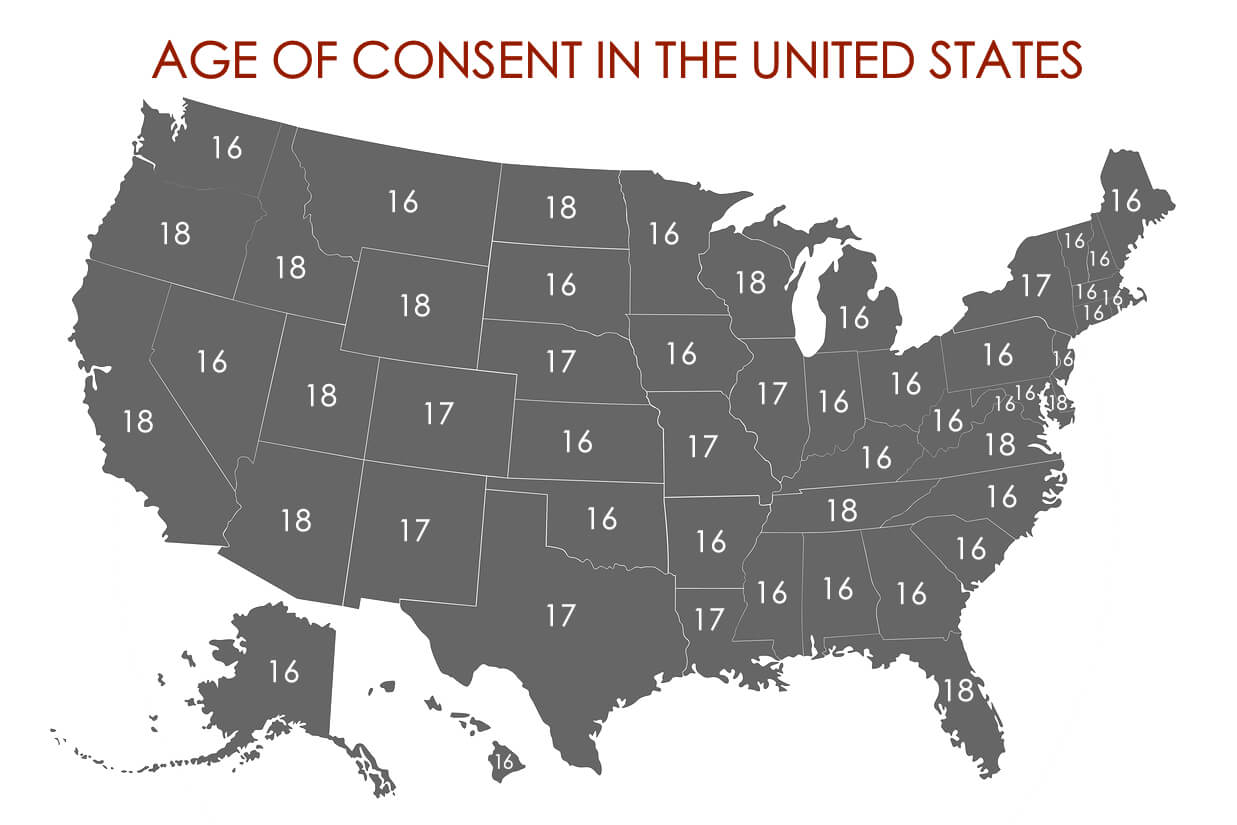
Statutory rape (Sexual Assault under Texas Penal Code Section 22.011(a)(2)) is a strict liability offense in Texas. What does this mean? It means that a person is guilty if:

  1. The person is older than 18 years of age; and
  2. The person intentionally or knowingly has sex with someone younger than 17 years of age.

*There is an exception to the law is the actors are less than 3 years apart in age, meaning that if the minor is 16 and the partner is 19 (but not more than 3 years older) then he will not be charged.

Other than the 3-year age gap exception, there are no other exceptions to statutory rape in Texas, hence strict liability. There is no Consent defense; consent is irrelevant for this offense. There is not Mistake of Fact defense when the minor lies about her age and no Mistake of Law defense for when the actors don’t know what the age of consent is in Texas. That is why we call this one of the more frustrating offenses in the Texas Penal Code.

Let’s take Sam’s case. Sam genuinely had no idea that Nadia was only 16. In fact, short of asking for her birth certificate, he showed due diligence in finding out her age before they had sex. He asked about her age and even saw her identification, which we now know was a fake ID. How can the state punish Sam when he tried to do everything right (fornication arguments aside)?

We often encounter this scenario or one like it. Our Fort Worth sexual assault defense attorneys have been able to get charges reduced under these circumstances. Many times, if we are hired before the grand jury considers the case, we will request to make a presentation to the grand jury and highlight these facts, urging the grand jury to no-bill the case and dismiss it. When we are negotiating with prosecutors on these types of cases, we do everything we can to get the charge amended to a different offense that doesn’t require sex offender registration (e.g. Injury to a Child). We have had considerable success in doing this, but it can be fact dependent (and personality dependent).

Sex Offender Registration for Consensual Sex with a Minor

Make no mistake; a conviction for statutory rape requires the offender to register as a sex offender in Texas. In fact, Statutory Rape is a lifetime registration offense. So although it may seem like a minor offense based on an age technicality, it is terribly serious. Further, even if your attorney is able to get your case reduced to a non-sex offense and you do not have to register as a sex offender, the court might still require you to undergo sex offender caseload on probation. You should fight this requirement as the sex offender caseload can be extremely difficult (and frustrating), especially when you never had the intent to commit a crime in the first place.

Free Consultation with a Fort Worth Statutory Rape Defense Attorney

If you are under investigation or have been charged with a Statutory Rape offense, contact our team of Tarrant County criminal defense attorneys. Our attorneys have the knowledge and experience to defend your future and your name with care and compassion. Contact us today at (817) 993-9249.

Read full article
Sex Offender Passport Law

New Law Requires Certain Sex Offenders to Have Identifying Mark on Their Passports

By BWB · Sex Crimes

Sex Offender Passport LawOn February 8, 2016, President Obama signed International Megan’s Law after it unanimously passed in Congress. International Megan’s Law has been put into place to prevent child exploitation and other sexual crimes through advanced notification of traveling sex offenders. The law will implement new notification requirements for sex offenders as well as require unique identifying marks on sex offender’s passports.

Read the language of the bill here.

Who is Required to Have an Identifying Mark on Their Passport under the International Megan's Law?

The new law provides two categories of "covered" sexual offenders that will have to have this mark on their passport:

  1. Sex offenders convicted of a sex offense against a minor; and
  2. Any individual that is required to register in the sex offender registry of any jurisdiction in the National Sex Offender Registry because of an offense against a minor.

What Are the New Requirements for Sex Offenders Traveling Abroad?

Covered sex offenders must now provide to the appropriate official any information relating to their intended travel outside of the United States, including anticipated dates and all flight information, address or other contact information while outside of the U.S., purpose for travel, and any other travel-related information. The sex offender must update any changes to this information. If a sex offender knowingly fails to provide such information they shall be fined, imprisoned for not more than 10 years, or both.

What Will Occur When Sex Offenders Decide to Travel Abroad?

The Angel Watch Center will be established to perform activities required by the law to gain information on sex offenders traveling abroad. The Center, not later than 48 hours before scheduled departure, will use all relevant databases, systems and sources of information to:

  • Determine if individuals traveling abroad are listed on the National Sex Offender Registry
  • Review lists of individuals who have provided advanced notice of international travel, and
  • Provide a list of those individuals to the United States Marshals Service’s National Sex Offender Targeting Center (Targeting Center) not in the system to determine compliance with sex offender registration requirements.

When Will Advanced Notice Be Given to Destination Countries?

The Center may give relevant information to an individual’s destination country if the individual was identified as having provided advanced notice of international travel, or if after completing the Center’s activities described above, the Center receives information pertaining to a sex offender from the Targeting Center.

Additionally, the Center may immediately give relevant information to the destination country if the Center becomes aware of a sex offender traveling outside of the U.S. within 24 hours of their intended travel and simultaneously completes the Center’s activities, or if within 24 hours of intended travel, the Center has not yet received the information pertaining to the sex offender from the Targeting Center.

What is the Process for Issuing Passports to Sex Offenders?

The Secretary of State cannot issue a passport to a covered sex offender unless the passport contains a unique identifier. Further, a passport previously issued without an identifier may be revoked. The unique identifier has not been determined yet.

The Secretary of State may reissue a passport without a unique identifier if an individual reapplies for a passport and the Angel Watch Center provides written determination that the individual is no longer required to register as a covered sex offender.

What About Sex Offenders Entering Into the United States?

Upon receiving notification that an individual who has committed an offense of a sexual nature is attempting to enter the United States, the Center will immediately share all of the information on the individual with the Department of Justice and other Federal, State, and local entities as appropriate.

Conclusion

Under this new law, sex offenders who have committed offenses pertaining to a minor child will now be required to give notification of any intended international travel and will likely have to have a passport with a unique identifying mark. Sex offenders who already have passports should be prepared for reissuance of one with the identifying mark. This mark will alert officials that this individual has committed an offense against a child. Further, destination countries will be notified of any relevant information on the sex offender. It is important to stay up to date on the requirements and implications set forth by International Megan’s Law to avoid any unintentional violations of the new requirements.

The law is still new and right now there are more questions than answers.  Interested parties should be diligent to stay informed as the implementation of this law is rolled out.

Read full article
Texas Sex Trafficking Statute

Is Texas' Sex Trafficking Statute Overbroad?

By BWB · Sex Crimes

Appellate Court Raises a Constitutional Eyebrow at Texas' Sex Trafficking Statute

Texas Sex Trafficking StatuteRobert Francis Ritz met a young girl on an online dating website. She was fourteen years old at the time while Ritz was Forty-four. The two began to meet up in person and began to have a sexual relationship. Ritz would pick the girl up from her parents’ house, drive her back to his house, have sex, and then drop her back off at her house. For this conduct, a jury found appellant Ritz guilty of continuous sex trafficking and assessed punishment at life in prison. Ritz appealed to the 3rd District Court of Appeals in Austin.

See the court's opinion in Ritz v. State

How Does the Texas Penal Code Define Sex Trafficking?

The Texas Penal Code provides that a person commits continuous trafficking of persons “if, during a period that is 30 or more days in duration, the person engages two or more times in conduct that constitutes an offense under Section 20A.02 [trafficking of persons] against one or more victims.” Tex. Penal Code § 20A.03(a). A person commits trafficking of persons “if the person knowingly . . . traffics a child and by any means causes the trafficked child to engage in, or become the victim of, conduct prohibited by” an enumerated section of the Penal Code. Id. § 20A.02(a)(7). The Penal Code also provides that “‘[t]raffic’ means to transport, entice, recruit, harbor, provide, or otherwise obtain another person by any means.” Id. § 20A.01(4).

Under this broad language, Ritz falls into this category. Ritz argues, however, that he did not traffic this girl and should not be found guilty of human sex trafficking. He argues that the legislature surely did not intend this anti-human-trafficking statute to apply to cases like this where there is no “illegal trade of human beings for profit or for sex trafficking.” Further, he argues that this outcome would lead to “absurd consequences” and increase the punishment range for all sexual offenses involving a minor.

Essentially, Ritz is argued on appeal that this statute was intended for people trading other humans, not for a person driving a girl around so they can have sex together. The Court of Appeals concedes that although this act is “reprehensible,” it is not what is normally thought of as human trafficking because there was no organized crime, prostitution, or forced labor. The court also concedes that the language in the statute may be so broad that nearly every adult who has sex with a minor will be considered a human trafficker.

Nonetheless, the court concludes that as long as this statute is constitutional, then they must enforce it as it was written and not how it should have been written. The court also offers that it could have been possible that the legislature did want to increase the penalties for persons who commit sexual crimes with minors under the “trafficking” umbrella.

Effectively after this case, most every person who has committed a sexual crime with a minor will be eligible to be punished under the trafficking umbrella which faces harsh penalties as seen here. The court noted that Ritz did not challenge the constitutionality of the statute so the court did not look into it. Attorneys facing this same dilemma might raise this constitutional argument to have a better chance on appeal.

Read full article
Child Sexual Assault Grooming Texas

CCA Recognizes "Grooming" as a Legitimate Subject of Expert Testimony

By BWB · Sex Crimes

Child Sexual Assault Grooming TexasToday, in Morris v. State, a 6-3 opinion authored by Presiding Judge Keller, the Texas Court of Criminal Appeals held (by taking judicial notice) that "'grooming' of children for sexual molestation is a legitimate subject of expert testimony."  The opinion, which reads like a law review article at times, goes into great detail about the state and federal courts that have long recognized "grooming" as an appropriate (and helpful) area for expert testimony. (If you don't know what "grooming" is, HERE is the Wikipedia definition.)

Judge Price's Dissent is highly critical:

After doing the vast bulk of the research for the State, the Court now essentially holds (despite the absence of any actual litigation on the subject below) that case law from other jurisdictions demonstrates that grooming is such a well-established psychological concept that the State, as proponent of the grooming-based testimony here, need not have been required to prove it at all.

Believing the trial record too bare for the Court to take judicial notice of the reliability of grooming-based testimony, Judge Price dissents.  Judges Meyers and Womack joined the dissent.

Judge Meyers also dissented, stating:

Irrespective of whether the study of “grooming” behavior is a legitimate field of expertise, I do not think [the expert in this case] was qualified to be an expert on this issue. He had no degree in any field of study involving human behavior, no specialized training in “grooming” behavior, and he did not show that the training and experience he did have enabled him to distinguish such behavior.

Judges Womack and Price joined the dissent.

Judge Cochran concurred in the judgment and would hold that grooming is an experiential field rather than a "soft science":

This is not rocket science. It does not depend upon any scientific, technical, or psychological principles or methodology. This type of testimony does not depend upon educational expertise, any calculable rate of error, learned treatises, peer review, or any other esoteric skill. This is not even “soft science.” It is just “horse sense” expertise developed over many years of personal experience and observation.

While they all seem to agree that "grooming" is an appropriate area for expert testimony, the lingering question (at least for me) is - What does it take to qualify someone to be an expert witness on child grooming?  A question for a later day I suppose.

Read full article

Videotaped Testimony of Child Sexual Abuse Victims Held Unconstitutional

By BWB · Sex Crimes

Last week, the Texas Court of Criminal Appeals issued its opinion in Coronado v. State.

[The CCA] granted review of the case to determine whether the videotape procedures set out in [the Texas Code of Criminal Procedure] Article 38.071, Section 2, including the use of written interrogatories in lieu of live testimony and cross-examination, satisfy the Sixth Amendment rights of confrontation...

The case involved a six year-old child sexual abuse victim (who was three years-old when the abuse began) that the trial court determined was "unavailable" to testify in court because of the likelihood that she would suffer severe emotional trauma upon seeing the defendant.  Accordingly, the trial court allowed a neutral child interviewer to videotape an interview pursuant to Article 38.071, Section 2.  The defense counsel agreed to this procedure and propounded numerous questions for the interviewer to ask.  The defense counsel also agreed to allow the interviewer to ask follow-up questions that she deemed appropriate.  At trial, the videotaped testimony of the child was played to the jury in lieu of any live testimony by the victim.

The videotape procedures of Article 38.071, Section 2, were enacted prior to the Supreme Court's decision in Crawford v. Washington.  Since that time, there has been a marked shift in confrontation clause jurisprudence in favor of a strict requirement of face-to-face live confrontation.  The lower appellate court, however, failed to cite (or even mention) the Crawford line of cases in its analysis.  The CCA, on the other hand, explained:

We are unable to find any post-Crawford precedent from any jurisdiction that states, or even suggests, that a list of written interrogatories, posed by a forensic examiner to a child in an ex parte interview, is a constitutional substitute for live cross-examination and confrontation...There was no "rigorous adversarial testing" of [the child victim's] testimonial statements by that greatest legal engine for uncovering the truth: contemporaneous cross-examination.  The written-interrogatories procedure used in this case does not pass muster under our English common-law adversarial system or our United States Constitution.

The CCA's reluctance to overturn this case was apparent.  On page 2 of the opinion, Judge Cochran writes, "On federal constitutional matters, we are obliged to follow the dictates of the United States Supreme Court regardless of our own notions."

Judge Hervey concurred.  While she agreed with the majority that the procedure used in this case was unconstitutional, she wrote separately to express her opinion that the defendant's right to confrontation should be balanced with the societal interest in protecting child sexual abuse victims.  She would not foreclose the possibility of allowing testimony via closed circuit television where the witness would testify in a separate room, but where the victim could still see the defendant and the jury.

Presiding Judge Keller dissented.  In a well-reasoned opinion, she explains why she believes that the confrontation clause was not violated in this case.  She calls this a "close case," but she would have affirmed.

Read full article

An Improper Jury Instruction Matters Not

By BWB · Jury Trial

Texas Jury InstructionIt seems like all I write about anymore is the Court of Criminal Appeals reversing a Court of Appeals case and siding with the State. Well, this post is no different.

In Taylor v. State, the appellant was convicted of aggravated sexual assault and sentenced to 70 years confinement and a $10,000 fine for each offense. Much of the testimony at trial, however, related to acts appellant committed while he was a minor. The evidence showed that appellant began sexually abusing a young girl when he was 13 years old and she was 8. The abuse continued for several years, the final occurrence happening when appellant was 20 years old and the victim was 15.

Texas Penal Code Section 8.07(b) provides that unless a juvenile court waives (or has previously waived) jurisdiction and certifies an individual for criminal prosecution, "a person may not be prosecuted for or convicted of any offense committed before reaching 17 years of age."  Accordingly, while evidence was admitted at trial regarding appellant’s acts before he turned 17, he can only be convicted of those acts that occurred after he was 17.

The trial court failed to instruct the jury of this requirement and the jury returned a guilty verdict. On appeal, appellant argued that the jury charges were erroneous because they did not limit the jury’s consideration to evidence of acts committed after he turned 17. The 1st Court of Appeals (Houston) held that the Court was required to instruct the jury that appellant could not be convicted of criminal acts committed before he turned 17, and that appellant was denied a fair and impartial trial as a result. The Court of Appeals reversed the case.

The CCA now reverses the Court of Appeals. It agrees with the Court of Appeals that the instruction should have been given to the jury, even if neither party requested the instruction. But the CCA held, nonetheless, that the error did not deprive appellant of a fair and impartial trial. The CCA states:

Here, the error was the omission of an instruction, rather than the presentation to the jury of an erroneous instruction…[T]he jury in this case could have convicted Appellant based upon evidence presented, even if the proper instruction had been given and Appellant’s pre-seventeen acts were disregarded by the jury. The evidence showed an eight-year pattern of escalating sexual abuse of J.G. by Appellant. Appellant turned 17 years old midway through the abusive period, meaning that he is subject to prosecution for his conduct beginning on that birthday…and evidence of molestation that occurred after that date was introduced at trial.

So, basically the CCA is saying – “We don’t know from the face of the record exactly which instances of abuse the jury believed, and we can’t say with 100% certainty that they believed any of the instances after appellant was 17, but we know they definitely believed something happened at some time.”

The CCA ultimately concludes that Appellant was not denied a fair and impartial trial. My question is – “How do we know that?” I realize that appellant said he didn’t commit any of the alleged acts and I also realize that the jury, by their verdict, believed that he did.  But how do we know that the jury didn’t conclude that the appellant was guilty of only those acts that occurred when he was a minor?  We don’t.

Read full article

Speak with a Fort Worth attorney

Call (817) 993-9249 or send us a message to discuss your case.