Skip to content

News and Insights

Page 34 of 102 · 510 articles

Additonal Notice for Suppression Hearing

No Additional Notice Required for Suppression Hearing on Trial Date

By Brandon Barnett · Trial Advocacy

Texas Court of Criminal Appeals Determines That There Needs to be No Additional Notice Provided to the State When Holding a Suppression Hearing On the Day of a Trial

Additonal Notice for Suppression HearingThe Court of Criminal Appeals recently handed down a decision affirming a trial court judge's decision to hold a suppression hearing on the day the trial was set, but before voir dire or any trial proceedings occurred. State v. Velasquez, 2018 Tex. Crim. App. LEXIS 52. After a prior motion for continuance by the State was granted, the defense submitted 16 pretrial motions, including a motion to suppress evidence. On the day of the trial, both sides announced ready, and the judge chose to hold the suppression hearing before jury selection. The State objected because they were not provided with proper notice of the hearing (and because their witnesses were not present to testify for the motions hearing before jury selection), but the objection was overruled and the judge ruled in favor of the defendant. The Fourth Court of Appeals reversed the trial judge's decision, but that was overturned by the Court of Criminal Appeals, affirming the trial court ruling on the motion.

Texas Code of Criminal Procedure Article 28.01

The State based its appeal on Article 28.01 of the Texas Code of Criminal Procedure. This statute enables the judge to schedule pretrial hearings (Section 1), requires notice of these hearings to be provided to the defense (Section 2), and gives the required means of providing notice (Section 3). The State claimed that it was not provided adequate notice of the pretrial suppression hearing under this statute, and therefore, should have been given an opportunity to delay the hearing and trial.

Section 1

Article 28.01(1) allows for the court to set a pretrial hearing before it is set for a trial upon the merits. The Court of Criminal Appeals recognized that this creates two separate settings and that the court must provide adequate notice for any new and separate hearing. Included in this list of settings is a suppression hearing in Section 1(6). The court also acknowledges that many suppression hearings are done as a part of trial, and that parties should be capable of arguing for or against suppression at the time of the trial. In this case, the State was not prepared for the suppression hearing and refused to argue, forcing the court to rule in favor of the defendant.

Section 2

Article 28.01(2) requires the court to provide notice of at least 10 days to the defendant in order to allow the defendant enough time to respond and raise any additional preliminary matters. The State argues that it is entitled to notice, however, the Court points out that the statute only provides for notice given to the defendant. The Court decided that the State has no right to additional notice for a pretrial motion that will be handled on the day of the trial, so long as notice of the trial day setting was given to the State.

Section 3

Article 28.01(3) establishes the acceptable methods for providing notice to the defendant. Notice can be given through an announcement in open court in front of the defendant and his/her attorney, personal service to defendant, or by mail.

Court of Criminal Appeals' Conclusion

Ultimately, the CCA held that it was appropriate for the trial court to hold a suppression hearing on the same day as trial, despite not giving additional notice to the State. The notice of the trial setting was sufficient to make the State aware of the possibility of a suppression hearing, and the State should have been ready for that hearing. The court sees a distinction between a pretrial setting and handling a matter just before the trial begins. Because suppression hearings are often held in conjunction with trials, this action was proper. Article 28.01 does not apply in this instance because there was no new, separate setting, and the party complaining about notice was the State. The Court understands that there could be improvements to the notice requirements, but as a member of the judicial branch, they are not empowered to make those changes.
Read full article
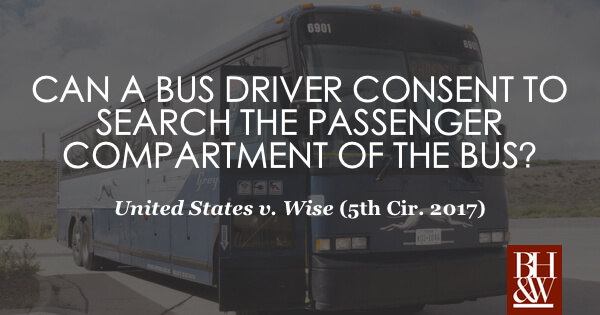
Bus Driver Consent Search Wise 2017

Can a Bus Driver Give Consent to Search the Passenger Compartment?

By Brandon Barnett · Search & Seizure

The Case of the Not Too "Wise" Bus Passenger

United States v. Wise, 877 F.3d 209 (5th Cir. TX 2017)

Bus Driver Consent Search Wise 2017FACTS: In this case, police officers were conducting bus interdictions at a Greyhound bus stop. After a certain bus stopped, the driver got off the bus and the officers approached him requesting consent to search the passenger cabin of the bus. The bus driver consented to a search and two experienced narcotics officers in plain clothes boarded the bus. The officers did not block the exit or otherwise obstruct any of the passengers from departing the bus. One officer walked to the back of the bus while the other officer remained at the front.

The officer at the front of the bus noticed a man who was pretending to be asleep. The officer found this suspicious, because in his experience, criminals on buses often pretended to be asleep to avoid police contact. The officer walked past the "sleeping" man and turned around. The sleeping man (named Morris Wise) then turned to look back at officer, revealing that he was not asleep after all. The officer then approached Wise (now awake) and asked to see his bus ticket. Wise gave the officer a bus ticket, bearing the name "James Smith." The officer had a hunch that James Smith was a fake name. The officer then asked Wise if he had any luggage with him on the bus. Wise said yes and motioned to the luggage rack directly above his head.

Wise then gave the officers consent to search the duffle bag in the overhead compartment. The officers did not find any contraband in the duffle bag. The officers also noticed a backpack near Wise and asked if the backpack belonged to him. Wise denied ownership of the backpack. The officers then asked the other passengers about the backpack and no one claimed it, so the officers removed the backpack at the bus driver's request.

Outside the bus, a trained police canine alerted to the backpack. The officers then cut a small lock off the backpack, searched it, and found seven brick-type packages that appeared to contain cocaine.

The officers then went back onto the bus and asked Wise if he would mind getting off the bus to speak to the officers. Wise complied with the officers' request and got off the bus. The officers asked Wise if he had any weapons, which he denied that he had any weapons, and then they asked him to empty his pockets.

From his pockets, Wise gave the officers his ID card with bearing the name "Morris Wise" and a lanyard with several keys attached to it. Not surprisingly, one of the key opened the lock that the officers had to cut off of the backpack (that Wise said was not his). The officer then arrested Wise, and the government charged him with several drug-related offenses.

Motion to Suppress the Search as the Fruits on an Illegal "Checkpoint Stop"

Wise filed a motion to suppress the evidence as a violation of his 4th amendment right against unreasonable searched and seizures. The district court held that the officers' conduct in searching the bus constituted an unconstitutional checkpoint stop. In addition, the district court held that the bus driver did not voluntarily consent to the officers' search of the luggage compartment where the backpack was located. As a result, the district court suppressed all evidence the officers seized after the stop.

The government appealed to the Fifth Circuit Court of Appeals.

First, the court held that the district court incorrectly characterized the officers' bus interdiction as an unconstitutional checkpoint. The court noted that the Supreme Court's cases involving checkpoints involve roadblocks or other types of conduct where the government initiates a stop to interact with motorists. In this case, the officers did not require the bus driver to stop at the station. Instead, the driver made the scheduled stop as required by his employer, Greyhound. In addition, the officers only approached the driver after he had disembarked from the bus, and the driver voluntarily agreed to speak with them. The court concluded that the interaction between the officers and the driver was better characterized as a "bus interdiction."

Second, although Wise had a reasonable expectation of privacy in his luggage, the court held that as a passenger, Wise did not have a reasonable expectation of privacy in the luggage compartment of the commercial bus. As a result, the court concluded that Wise had no standing to challenge the officers' search of that compartment, to which the bus driver consented.

Third, the court held that the officers did not seize Wise, within the meaning of the Fourth Amendment, when they approached him, asked to see his identification, and requested his consent to search his luggage. Instead, the court concluded that Wise's interaction with the officers was a consensual encounter because a reasonable person in Wise's position would have felt free to decline the officers' requests or otherwise terminate the encounter.

Finally, the court held that Wise voluntarily answered the officer's questions, voluntarily emptied his pockets, and voluntarily gave the officer his identification and keys.

Read full article
Can Police Stop You for Driving on the Improved Shoulder of the Road?

Can Police Stop You for Driving on the Improved Shoulder of the Road?

By Brandon Barnett · Drug Crimes

State v. Cortez (Tex. Crim. App. 2018)

Jose Cortez was stopped because a Texas State Trooper allegedly observed him driving on an "improved shoulder" in violation of Texas Transportation Code § 545.058. The officer testified that Cortez touched the white "fog" line of the road and crossed it twice. During the ensuing stop, the trooper searched Cortez's vehicle and found drugs. Cortez moved to suppress the stop (and the search) arguing that the officer lacked probable cause to initiate the stop.

What is Driving on the Improved Shoulder?

The Texas Transportation Code also defines "improved shoulder" as a "paved shoulder" with the "shoulder" being the "portion of the highway that is:

  •  adjacent to the roadway;
  • designed or ordinarily used for parking;
  • distinguished from the roadway by different design, construction, or marking; and
  • not intended for normal vehicular travel."

The Texas Transportation Code §545.058 prohibits drivers from driving on the shoulder unless it is necessary and done safely, "but only:

  1. to stop, stand, or park;
  2. to accelerate before entering the main traveled lane of traffic;
  3. to decelerate before making a right turn;
  4. to pass another vehicle that is slowing or stopped on the main traveled portion of the highway, disabled, or preparing to make a left turn;
  5. to allow another vehicle traveling faster to pass;
  6. as permitted or required by an official traffic-control device; or
  7. to avoid a collision."

Court Suppressed the Traffic Stop Because Driving on the Shoulder Did Not Violate Any Laws

In this case, the trial court determined, after careful review of dashcam footage and officer testimony, that Cortez did not appear to touch the fog line, and that even if he did, that was not a violation of the law. The courts also reasoned that if Cortez did cross the line, he was doing so to let the officer pass and to exit the highway, both reasons justified by the statute. The court of appeals affirmed the trial court's suppression of the stop. The Texas Court of Criminal Appeals agreed and affirmed the lower court's ruling.

What Does This Mean for Texas Drivers?

First, it is not illegal to touch the white line of the shoulder under Texas Transportation Code § 545.058. If you are pulled over for this, the courts have determined this is not a violation of the law and does not provide a reasonable basis for an officer to pull you over and search your vehicle.

Second, if you do cross the white line, that is not necessarily a violation. If one of the acceptable reasons above is present, then it is permissible to cross the shoulder line and the police will not have a reasonable basis for stopping you and should not stop you or search your vehicle.

Overall, you should pay close attention when you are driving. But the courts have acknowledged that it is nearly impossible to drive in a perfectly straight line. The police do not automatically have a reasonable basis to stop you if you cross the white line, and they have NO basis for stopping you if you merely touch it. However, as we have always said, if you are stopped, be polite, be courteous, and do not consent to any searches.

NOTE: Presiding Judge Keller dissented in this case and would hold that driving on the white fog line does constitute driving on the improved shoulder in violation of the transportation code.

Read full article
Megans Law Sex Offender Passport

Passports Revoked for Sex Offenders Pursuant to New Law

By Luke A. Williams · Sex Crimes

Megan's Law and the Implications for Passports of Registered Sex Offenders

Sex Offender Passport Law
In February of 2016, we wrote about President Obama signing Megan's Law and the implications that the law would have on passports.

Effective January 11, 2018, in accordance with Megan’s Law, the U.S. State Department has started to revoke passports issued to registered sex offenders. The law was passed October 31, 2017 but is now in effect. This law prevents the Department of State from issuing passports to sex offenders without a unique identifier printed on the person’s passport and authorizes the State Department to immediately revoke all passports currently held by registered sex offenders that do not contain this identifier.

Required Endorsement for Sex Offender Passports

Passports re-issued to registered sex offenders will now bear an endorsement on the passport, which will read:

“The bearer was convicted of a sex offense against a minor, and is a covered sex offender pursuant to 22 United States Code Section 212b(c)(l).”

According to federal law, endorsements cannot be printed on passport cards, so qualifying individuals will not be issued passport cards.

This new procedure by the State Department does not prohibit registered sex offenders from leaving the country. But, it certainly leads to the presumption that this identifying marker on these passports could very likely lead to these individuals being denied entry into other countries.

In the coming weeks, the Department of State will be sending letters to those individuals covered under this law notifying them that their passports are now revoked.

There are a wide number of crimes that can lead to a person being on the sex offender registry. These crimes can include sexual assault of a child, indecency with a child, online solicitation of a minor and viewing or sharing child pornography (either inadvertently or on purpose).

For more information, visit the Department of State website.


Read full article
Drone Laws TX Drone Registration

Rules for Drones | Drone Registration and Penalties for Failure

By Brandon Barnett · Criminal Defense

Drone Laws TX Drone RegistrationDrones or Quadcopters were a popular Christmas gift this year. While many new drone owners are probably preoccupied with learning to fly without getting the propellers stuck in trees or crashing them over their neighbor’s fence, they need to take a moment to learn about the federal registration rules for unmanned aircraft.

*Federal drone registration had been struck down by an appeals court in May of 2017, but the National Defense Authorization Act that was passed in December 2017 reinstated drone registration.

Do I Have to Register My Drone?

Maybe. Any unmanned aircraft system (“drone”) that weighs more than .55 pounds must be registered with the FAA. Depending on the size of the drone, it can be registered under:

  • Part 107, Small UAS Rule,
  • Section 336, the Special Rule for Model Aircraft, or
  • 14 CFR Part 47, the Traditional Aircraft Registration

Registration Under The Special Rule for Model Aircraft

Most people register their drone under this provision. The Special Rule for Model Aircraft allows for registration of a drone between 0.55 lbs and 55 lbs for recreational use only. Under this registration:

  • A person is allowed to fly their drone within their line of sight,
  • A person is required to follow the community-based and nationwide guidelines,
  • A person is not allowed to fly their drone over an airport or to interfere with emergency response units, and
  • A person must notify an airport when they are flying within five miles of an airport.

In order to register under the Special Rule for Model Aircraft, you must:

  • Register as a “modeler” with the FAA,
  • Be at least 13 years’ old,
  • Be a legal United States citizen or legal permanent resident, and
  • Label your drone with the registration number in case it is lost or stolen.

This registration, which can be completed online costs $5 and lasts for 3 years.

Registration of Drones Between 0.55 lbs and 55 lbs Under the Smalls UAs Rule

The Small UAS Rule allows for registration of a drone between 0.55lbs and 55lbs for recreational and commercial use. Registration is REQUIRED by the FAA. Under the Small UAs Rule a person may:

  • Fly their drone at or below 400 feet (Class “G” airspace)
  • Fly during daylight or civil twilight
  • Fly at or below 100 miles per hour.

With a drone registered under Part 107, the pilot:

  • Must yield to manned aircraft
  • Cannot fly directly over people,
  • Cannot fly from a moving vehicle unless you are in a sparsely populated area.

In order to obtain your registration under the Small UAs Rule, you must:

  • Be at least 16 years old,
  • Have a valid credit card, email address, and physical/mailing address,
  • Pass an aeronautical knowledge test at an FAA-approved testing center,
  • Undergo a Transportation Safety Administration security screening, and
  • Denote the make and model of your aircraft when applying for registration.

The Small UAS Rule registration, which can be completed online costs $5 and lasts for 3 years.

Traditional Aircraft Registration for Drones Greater Than 55 Lbs

Traditional Aircraft Registration must be completed for any unmanned aircraft weighing over 55 pounds. The paperwork for drones greater than 55 pounds can be found on the FAA website and must be turned in via regular mail. Drones over 55 lbs will require an N-number that you have to submit to the FAA. The FAA website lays out the necessary information for an application.

This registration costs $5 and lasts for 3 years.

What is the Penalty for Flying a Drone Without Registering it?

Failure to register an unmanned aircraft can result in regulatory penalties up to $27,500 and criminal penalties up to $250,000 and/or imprisonment for up to 3 years. Penalties are determined on a case by case basis and will vary based on the judge.

The FAA provides on its website:

“There is no one-size-fits-all enforcement action for violations. All aspects of a violation will be considered, along with mitigating and aggravating circumstances surrounding the violation. In general, the FAA will attempt to educate operators who fail to comply with registration requirements. However, fines will remain an option when egregious circumstances are present.”

Do you have to register your drone if you only fly over your own property?

Even if flying over your own property, the FAA still requires registration of your drone. The penalties for failure to register an unmanned aircraft will apply even if the drone does not leave your property.

What Other Drone Rules Should I Be Aware of?

Every registration allows for different flight regulations, so pay close attention to what you register for and what that particular registration allows you to do. The FAA has developed an app called “B4UFLY” which gives you important information about your location and the flight restrictions in that area. This app is recommended by the FAA to help avoid violations of the registration limitations. For any additional questions/concerns, visit the FAA website.

Read full article

Speak with a Fort Worth attorney

Call (817) 993-9249 or send us a message to discuss your case.