Skip to content

News and Insights

Page 24 of 102 · 510 articles

Uber Lyft Accident Claim Liability Texas

Suing Uber and Lyft for the Accidents of their Drivers

By Jesse Lotspeich · Car Wreck
Uber Lyft Accident Claim Liability TexasRideshare companies like Lyft and Uber have risen to prominence over the last several years, grabbing a sizable market share from traditional taxi cab and town car companies. Additionally, there has been a surge in food delivery services (like DoorDash) and contract delivery drivers for Amazon. With more and more of these companies offering rides and deliveries from their part-time drivers, we are also seeing accidents involving the drivers for these companies. These accidents can sometimes have confusing liability issues that accompany them. It is important to know how to proceed and what you are entitled to if you are involved in an accident with a rideshare driver, as a passenger or another driver.

Can You Sue the Rideshare company? Who is Liable in a Lyft or Uber Accident?

As with most legal questions, the answer is, it depends. Liability for an Uber or Lyft accident will depend upon whether the driver is logged on to his rideshare company's app, and if so, whether the driver is waiting for a ride request or actively giving a ride or making a delivery. The Texas Insurance Code Chapter 1954 requires rideshare drivers to carry specific insurance policies that provide coverage regardless of their activity, so you will need to ascertain a few facts before you determine your course of action.

Was the Driver Logged on to the Rideshare App?

If the driver was NOT logged onto the ridesharing app, then the driver's personal insurance will be responsible for covering the driver in the event of an accident. There generally will not be any ramifications for the rideshare company, and no real reason to pursue any claims against them. Of course, we would need many more facts to determine the exact course of action. If the driver is logged on to the rideshare app, you will need to determine whether they are in-between rides, or actively participating in a ride.

Was the Driver in-between Rides When the Accident Happened?

This is the largest gray area in the new insurance law. While coverage is required, there is no requirement regarding who must cover the driver. Many insurance companies exclude coverage on drivers using their personal vehicles for ridesharing purposes, and rideshare companies are hesitant to provide the additional coverage since they are not required to by law. Ridesharedashboard.com lays out the coverage options in Texas, pointing out that currently, only GEICO and Farmer's offer coverage to both Uber and Lyft drivers, while MetLife will cover Lyft drivers only, and Allstate is currently working on their rideshare policy.

Nonetheless, the Texas Insurance Code Sec. 1954.052 requires rideshare drivers to be covered by a 50/100/25 policy. This means that they must be covered up to $50,000 for bodily injury or death of each person in an incident, $100,000 for bodily injury or death of a person per incident, and $25,000 for damage or destruction of property of others. This is a higher level of coverage than the standard 30/60/25 policy required for Texas drivers. This should not be an issue as drivers are required to notify their insurance provider if they are driving for a rideshare company. However, it will be very important to determine who is covering the driver in the event of an accident. Fortunately, there is a safeguard in Sec. 1954.054 that requires the rideshare company to cover claims in the event the driver's policy has lapsed or does not cover the claim. If you find yourself in this situation, please get as much information from the driver as possible and contact an attorney immediately.

For driver's logged onto the rideshare app but currently in-between rides:

  • Uber Provides: 50/100/25 coverage for its drivers and can supplement the personal policy
  • Lyft Provides: 50/100/25 coverage in the event a driver's personal policy does not cover this much.

Was the Lyft or Uber Driver Engaged in a Ride?

The term "engaged in a ride" can mean two things: either the driver was on his way to pick up a passenger, or the driver currently had a passenger in the car. If the driver involved in the accident was currently engaged in a ride, that driver MUST be covered by a $1 million coverage policy according to Texas law. Recent legislative action in many states has pushed for this coverage, influencing these companies to adopt these insurance policies. Should you be involved in an accident with an engaged rideshare driver, whether as passenger or third party, this insurance should provide coverage for damages caused by the driver.

For drivers "engaged in a ride:"

  • Uber Provides:
    • $1 million coverage for damages caused by driver
    • $1 million coverage for damage done by an under/uninsured motorist
    • Supplemental coverage for collision and comprehensive personal policies
    • These will cover the rider if a rider is in the car with the Uber driver

  • Lyft Provides:
    • Lyft will take over as primary provider
    • $1 million coverage for damages caused by driver
    • $1 million coverage for damage done by an under/uninsured motorist
    • Supplemental coverage for collision and comprehensive personal policies

What Should You Do if You are Involved in an Accident with a Rideshare Driver?

  1. Get to a safe place and call 911. Safety and health are the first priority.
  2. Take pictures of the accident and surroundings.
  3. Get the names, phone numbers, addresses of everyone involved and any witnesses.
  4. Get the name of the rideshare driver, determine whether they were logged on to the rideshare app, whether he/she was engaged in a ride, and get a picture of the insurance policy
    • Under Sec. 1954.056b, the drivers are required to provide this information in the case of an accident
    • If you are the passenger of a rideshare when the accident occurs, screenshot the app on your phone

  5. Call your attorney.


To review companies' insurance policies, click on their Logo below:

Uber Accident Coverage TexasLyft Driver Liability in Texas

Read full article
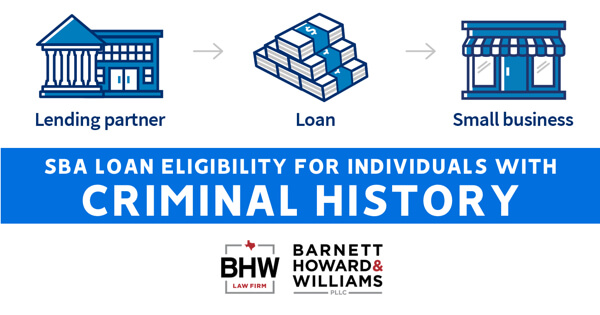
SBA Loans Criminal History

SBA Loans Limitations Based on Criminal History

By Brandon Barnett · Criminal Defense

Can I apply for an SBA Loan if I have a criminal history?

SBA Loans Criminal HistoryCountless small businesses have been impacted by the COVID-19 pandemic. The US Government has several different loan programs offered through the Small Business Administration aimed at helping small business get through the crisis and maintain jobs for their employees. Many of the SBA loan programs for the COVID-19 crisis can be found on the SBA website COVID-19 section.
One of the questions that we have received during the last couple of weeks is whether a person with a criminal history can apply for an SBA loan. The answer is...it depends. It depends on the nature of the criminal offense.

What will disqualify me from applying for an SBA loan?

When it comes to criminal history, the following will disqualify a company and make it ineligible for SBA assistance.

If an owner of the company (who owns 20% or more) answers YES to any of the following questions taken from the SBA application, then the company is NOT eligible to apply for SBA assistance:

  • Are you currently incarcerated?
  • Have you been adjudicated for a felony in the preceding 5 years? This includes
    • Felony conviction;
    • Plea of guilty to a felony offense;
    • Plea of nolo contendere (no contest) to a felony;
    • Participating in a pre-trial diversion program for a felony offense;
    • Probation or Deferred Adjudication for a felony offense.

  • Are you currently on probation for a felony or a misdemeanor?
  • Are you currently on parole?
  • Are there pending criminal charges against you that have not yet been adjudicated (felony or misdemeanor)?

*NOTE: There is also a question on the Economic Injury Disaster Loan that asks whether an applicant has been arrested (even if the charge was dismissed) for any criminal offense (other than a minor motor vehicle violation). It is unclear whether an arrest by itself is a disqualifier or just a point of inquiry.

If a 20% (or more) owner answers YES to any of those questions, then the company will not even be able to complete its application for SBA assistance.

In the past, it seemed that the SBA was only concerned with felony criminal history (see 13 CFR 120.110), but the new applications for the COVID relief do not distinguish between felonies and misdemeanors when it comes to either active probationers or individuals with pending charges.  This is especially difficult for individuals that have a pending criminal charge to which they have pleaded not guilty and not yet received their day in court. To sink their business while at the same time presuming them innocent is not in keeping with the spirit of the presumption itself.

Please be reminded that it is a federal offense to falsify a loan application, so please don't do that.

Paycheck Protection Loan Application

Economic Injury Disaster Loan

Read full article
COVID-19 State Orders Texas

What Happens if I Refuse to Obey the COVID-19 Orders?

By Luke A. Williams · Criminal Defense

Texas Legal Consequences During the Coronavirus Pandemic

COVID-19 State Orders Texas
With the declaration of a state of disaster in Texas by Governor Greg Abbott on March 13,2020 comes some new consequences that Texas citizens need to be aware of.

We previously posted a blog addressing enhancements that have gone into place for certain criminal offenses. But, there are also new laws activated as a result of state, local and interjurisdictional emergency management plans.

Broadly speaking, Texas Government Code (TGC) 418.173 establishes a penalty for citizens failing to comply with emergency management plans.

Specifically, TGC 418.173 states:

(a)  A state, local, or interjurisdictional emergency management plan may provide that failure to comply with the plan or with a rule, order, or ordinance adopted under the plan is an offense.
(b)  The plan may prescribe a punishment for the offense but may not prescribe a fine that exceeds $1,000 or confinement in jail for a term that exceeds 180 days.

Most local Texas governments have already established emergency management plans. County Judges in Dallas and Austin, for example, have published their Orders regarding these plans on their local websites and are regularly amending them.

The Emergency Order for Tarrant County can be found here.

It’s important that citizens know that with the disaster declaration in effect, violation of these Orders can result in a person being arrested. For practical purposes, that means that if local government is limiting community gatherings and business closures, a violation of those Orders could result in an arrest.

Information coming from our local government is changing on almost a daily basis now. Check with your local jurisdiction for their emergency management plans and be aware of the consequences of violating those plans.

There are a number of special powers and provisions established with the declaration of a statewide emergency effecting many different areas of law. The full text of the extent of those can be found in Chapter 418 of the Texas Government Code.

Read full article
Disaster Declaration Texas Criminal Law

Criminal Law Enhancements During a State of Disaster

By Luke A. Williams · Criminal Defense

Disaster Declaration Texas Criminal Law
On March 13, 2020, Governor Greg Abbott declared a state of disaster in Texas in response to the COVID-19 pandemic. For the purposes of criminal law in Texas, that disaster declaration triggered the provisions of Texas Penal Code (TPC) 12.50.

What are the Criminal Law Implications During a State of Disaster?

In general, TPC 12.50 states that for the offenses listed below, if committed during the declaration of a state of disaster, the punishment level for these offenses is increased to the next higher category for that offense. For example, if a Theft charge would normally be punished as a Class B misdemeanor (0 - 180 days in jail and up to $2,000 fine) then it would be increased to a Class A misdemeanor (0 - 365 days in jail and up to $4,000 fine) if it is committed during the time of the declared disaster.

Specifically, 12.50 applies to the following offenses:

  • Assault and Domestic Violence (TPC 22.01);
  • Arson (TPC 28.02);
  • Robbery (TPC 29.02);
  • Burglary (TPC 30.02);
  • Burglary of Coin-operated or Coin Collection Machines (TPC 30.03)
  • Burglary of Vehicles (TPC 30.04);
  • Criminal Trespass (TPC 30.05); and
  • Theft (TPC 31.03)

TPC 12.50 is limited by the following provisions:

For the offenses of Assault, Burglary of Coin-operated/Coin Collection Machines, Burglary of Vehicles, Criminal Trespass or Theft, if the offense committed would normally punished as a Class A misdemeanor, then during the emergency declaration the minimum term of confinement is increased from 0 to 180 days in a county jail.

For the offenses of Arson, Burglary, and Criminal Trespass, if the offense committed would normally be punished as a First Degree Felony, then there is no enhancement.

Read full article
Reckless Texas Penal Code

What does Recklessness Mean in Texas Criminal Law?

By Brandon Barnett · Criminal Defense

Defining “Recklessness” Under the Texas Penal Code

Reckless Texas Penal CodeThere are some criminal offenses that require the state the prove that the defendant acted “recklessly” or with “criminal recklessness.” In a colloquial sense, we (including prosecutors) often think of recklessness as another word for carelessness, but it actually has a specific definition in the Texas Penal Code.

Defining “Recklessness,” Tex. Penal Code Section 6.03(c) states that “a person acts recklessly, or is reckless, with respect to circumstances surrounding his conduct or the result of his conduct when he is aware of but consciously disregards a substantial and unjustifiable risk that the circumstances exist, or the result will occur. The risk must be of such a nature and degree that its disregard constitutes a gross deviation from the standard of care that an ordinary person would exercise under all the circumstances as viewed from the actor’s standpoint."

What Does the Texas Court of Criminal Appeals Say About Recklessness?

Unpacking the legal standard of recklessness, The Texas Court of Criminal Appeals reasons that...

“Criminal recklessness must not be confused with (or blended into) criminal negligence, a lesser culpable mental state.” Williams v. State, 235 S.W.3d 742, 751 (Tex. Crim. App. 2007). “Criminal negligence depends upon a morally blameworthy failure to appreciate a substantial and unjustifiable risk while recklessness depends upon a more serious moral blameworthiness – the actual disregard of a known substantial and unjustifiable risk.” Id.

Criminal negligence and recklessness differ from one another only in terms of mental state:

  • Criminally negligent defendant “ought to be aware” of a substantial and unjustifiable risk;
  • Reckless defendant is subjectively aware of an identical risk but disregards it

The two prongs of gross negligence or recklessness are:

  • Subjectively, the defendant must have actual awareness of the extreme risk created by his or her conduct.
  • Objectively, the defendant’s conduct must involve an extreme degree of risk (the “extreme risk” prong is not satisfied by a remote possibility of injury or high probability of minor harm, but the likelihood of serious injury to the plaintiff).

Reckless conduct...

  • Is the conscious disregard of the risk created by the actor’s conduct;
  • Mere lack of foresight, stupidity, irresponsibility, thoughtlessness, ordinary carelessness, however, serious the consequences may be, do not suffice to constitute criminal recklessness;
  • Criminal recklessness is of a gross and flagrant character, evincing reckless disregard of human life, or of the safety of persons exposed to its dangerous effects; or that entire want of care which would raise the presumption of a conscious indifference to consequences; or which shows such wantonness or recklessness or a grossly careless disregard of the safety and welfare of the public, or that reckless indifference to the rights of others, which is equivalent to an intentional violation of them.

Recklessness: Texas Case Law Examples

Williams v. State, 235 S.W.3d 742 (Tex. Crim. App. 2007): The defendant was convicted after her children died in an accidental house fire while her boyfriend was babysitting. The defendant took the children to a house without working utilities and left them under her boyfriend’s care with a candle lit in their bedroom. The court held that there was legally insufficient evidence that defendant consciously disregarded a substantial and unjustifiable risk that the children would suffer serious bodily injury in a house fire. The court also said that the defendant’s stupidity did not constitute reckless disregard. The defendant was not criminally responsible for the result

Mills v. State, 742 S.W.2d 831, 1987 Tex. App. LEXIS 9214 (Tex. App. Dallas Dec. 18. 1987, no writ): The defendant’s conviction was upheld where circumstantial evidence supported the conclusion that defendant placed a child in a tub of hot water. The Court found that the jury could reasonably have found defendant acted recklessly with regard to that child’s care in violation of Tex. Penal Code § 6.03(c).

Ehrhardt v. State, No. 06-02-00208-CR, 2003 Tex. App. LEXIS 7248 (Tex. App. Texarkana Aug. 26, 2003): Where the evidence in an assault trial showed defendant struck the victim in the face, the court found that the defendant was reckless as to whether her conduct would result in bodily injury.

Read full article

Speak with a Fort Worth attorney

Call (817) 993-9249 or send us a message to discuss your case.