Skip to content
Category

Guide to Texas Theft Charges by Howard Lotspeich Alexander & Williams

Page 2 of 4 · 17 articles

Jury Unanimity Aggregate Theft Texas

What is Jury Unanimity for Aggregate Theft Cases?

By Brandon Barnett · Jury Trial, Theft

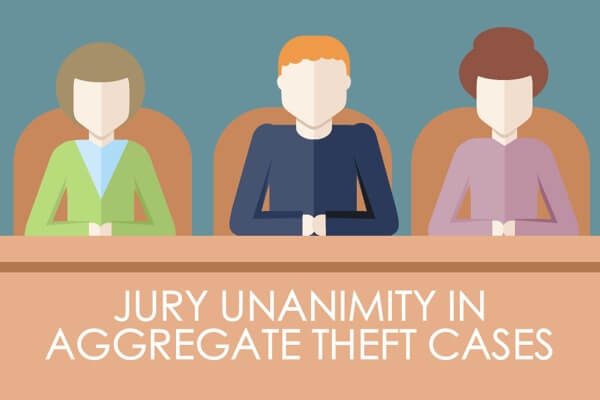
Jury Unanimity Aggregate Theft TexasJury unanimity is required in every jury trial, whether it be felony or misdemeanor. This means that the jury must unanimously agree that the State has proven or failed to prove all elements of an offense beyond a reasonable doubt. If a jury cannot reach a unanimous verdict of guilty or not guilty, then the judge will declare a mistrial. With some offenses, however, it can be a little unclear as to what jury unanimity actually requires. This is specifically so with aggregated theft cases.

What Is Aggregate Theft?

Aggregate theft is an offense where two or more thefts were committed “pursuant to one scheme or continuing course of conduct” and the amounts combined determine the grade of the offense. Tex. Penal Code §31.09. Under Section 31.09, aggregate theft may be and often is considered as one offense. Even though it is considered one offense, each individual underlying theft act (where the amounts are aggregated) is considered an element. The Court of Criminal Appeals of Texas has held that for evidence to be sufficient the state must prove beyond a reasonable doubt that the defendant unlawfully appropriated “enough property to meet the aggregated value alleged.” The state is not required to prove each underlying appropriation. However, the Court, until recently has left one question unanswered: Does the jury have to unanimously agree on all underlying theft transactions?  Meaning, if the defendant is alleged to have committed 10 separate theft acts (pursuant to a common scheme), do the jury have to agree on each, or some, or none?

Kent v. State—What is the Jury Unanimity requirement in Aggregate Theft cases?

Until recently there had been no holding by the Court of Criminal Appeals of Texas on whether jurors are required to unanimously agree on each underlying transaction that is used to comprise an aggregated theft charge. In Kent v. State the Court finally addressed this exact question.

See the full CCA opinion in Kent..

Kent was a mortgage broker indicted for theft from four complainants in an amount exceeding $200,000. The thefts were alleged to have occurred over a period of time and pursuant to one scheme or continuing course of conduct. At trial, the defense requested a paragraph in the jury instructions that outlined each individual theft allegation and called for a unanimous verdict on each. The trial judge denied the defense request to include this paragraph.  The jury found Kent guilty of aggregate theft. On appeal, the Kent complained that the trial judge erred by refusing to include his requested paragraph in the jury instructions.  The appellate court reversed and remanded the case for a new trial, holding that the jury should have been instructed that they must unanimously agree beyond a reasonable doubt on each underlying transaction used to comprise an aggregate theft charge.

The State appealed to the Court of Criminal Appeals of Texas to determine whether this was correct. Reversing the lower courts holding, the CCA held that for an aggregated-theft case,

unanimity requires that the jurors agree that the threshold amount has been reached and that all the elements are proven for each specific instance of theft that the individual juror believes to have occurred. Every instance of theft need not be unanimously agreed upon by the jury.

In other words, it is only required that the jurors unanimously agree that two or more thefts pursuant to a common scheme, when combined, exceeded the threshold amount beyond a reasonable doubt, not that they unanimously agree on exactly which thefts were comprised to reach that amount.

Takeaway: When facing aggregated theft charges it is important to know that the jury does not have to unanimously agree that each underlying theft alleged in the indictment has been proven beyond a reasonable doubt. Bottom line, it’s the aggregated amount that matters. This is only a brief explanation of how the jury unanimity requirement plays a role in a case and if you should have any more questions contact our Fort Worth criminal defense team.
Read full article
Craigslist Crimes in Texas

Texas’ Online Crime Marketplace: Craigslist Crimes, Craigslist Stings, and Craigslist Thefts

By Brandon Barnett · Computer Crimes, Theft

Craigslist-Related Crimes | New Crimes in the Digital Age

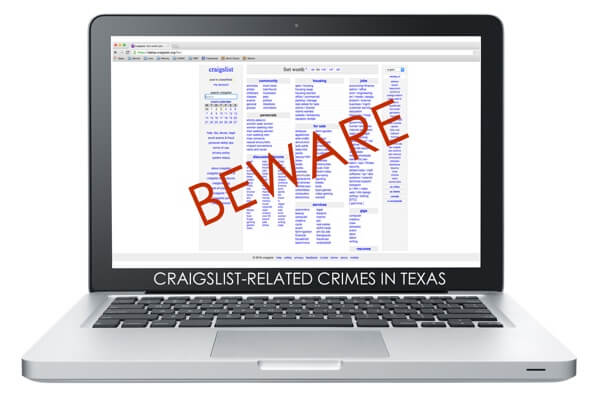
Craigslist Crimes in TexasGone are the days of flipping through your local newspaper’s classified section and circling your favorite ads. These days, Craigslist is the new classifieds of Fort Worth and Dallas. It is the one stop shop source to find a new car, truck, job, furniture, garage sale, or even a love interest. With the rise of Craigslist (and other online forums), there has also been an increase in criminal activity ranging from online scams to fraud and theft. Police stings based on advertisements from Craigslist are also common. Police have seen such a meteoric rise in these “Craigslist related crimes”, that many departments have established “safe exchange locations where transactions can occur under the watchful eye of local law enforcement.



Whenever people meet to engage in a transaction, crime can occur. These crimes can take place anywhere, whether you are in an urban or rural area, in the parking lot of the local shopping center, or even on your own front porch. Craigslist is easily accessible, and is increasingly used to create opportunities for one party to take advantage of another. It is essential to be vigilant whenever meeting up with anyone from the Internet.

Craigslist Criminal Investigations | Fort Worth, Texas

With the advent of Craigslist, law enforcement agencies have seen a few specific areas of criminal activity increase rapidly. These investigations into alleged crimes often facilitated by Craigslist include:

  • Craigslist Robbery: Increasingly, people will post ads on craigslist looking to buy or sell an expensive item, such as a cell phone, and when the other party arrives take either the item or the money by force. Avoid being a target by meeting buyers or sellers at a “safe exchange” location set up by the police department.
  • Craigslist Prostitution: Craigslist is full of ads looking for love, and both men and woman can get caught up in activity they may not have even realized was criminal until too late. Craigslist is used to source potential targets, and can result in charges from soliciting sex with a minor to soliciting sex for pay. Police departments are increasingly using Craigslist to set up sting operations to catch people trying to engage in prostitution.
  • Craigslist Drug Charges: Police are seeing an increase in advertisements for illegal drugs posted on Craigslist using code words. Engaging in a dialogue with someone posting one of these ads could lead police to believe you are involved in drug dealing or drug trafficking through ads placed on Craigslist.

Defending Craigslist-Related Criminal Cases

Defense of Craigslist-related criminal charges can be a very complex proposition, requiring legal counsel experienced in these types of matters and the technology it involves. Forensic Computer Specialists and other experts may be necessary to the investigation and protecting your constitutional rights. Seek counsel from experienced criminal defense attorneys at Barnett Howard & Williams PLLC, former prosecutors with an in-depth understanding of the criminal justice system and its applications in today’s Internet-oriented society.

Contact Our Fort Worth Craigslist Crimes Defense Attorneys Today!

At Barnett Howard & Williams PLLC, our attorneys understand how to investigate and defend against complex computer-related criminal charges, including Craigslist-related charges. To schedule a free consultation, contact us at our offices in Fort Worth, Texas, at 817-993-9249.

Barnett Howard & Williams PLLC Rated 5.0 out of 5 based on 30 Google+ Reviews.
Read full article
Bait Cars Backpage Entrapment Texas

Bait Cars, Backpage, and the Entrapment Defense

By Brandon Barnett · Prostitution, Theft

Bait Cars Backpage Entrapment Texas
Our firm has represented many defendants in Fort Worth with cases stemming from a bait car or a Backpage ad. For those of you not familiar with either, let me explain Bait Cars and Backpage.

What is a Bait Car?

A Bait Car is vehicle owned by the police department and equipped with GPS devices and cameras. But, the car looks like any regular car on the street. The police typically place something valuable inside the Bait Car, such as a paint spray rig, and then they park the car (with the keys inside) on the side of the street in a low-income part of town. If someone tries to steal the bait car or the valuables inside, the GPS is triggered, the camera is activated, and the police are alerted. In most cases, the person does not get very far before a patrol car arrives to arrest them for theft.

What is Backpage?

I doubt I can fully explain what Backpage is or how it is used, but in the cases that we see, Backpage is a website (akin to Craigslist) where escorts and ladies of the night advertise their services. Potential Johns can browse the Backpage website to arrange an interlude of momentary love. The police have been using Backpage and arranging for a female officer to meet men at a local motel room posing as a prostitute. With backup officers waiting in the bathroom, the John is arrested for Solicitation of a Prostitute when they arrive to meet the woman/officer they contacted on Backpage.

Is it Entrapment for the Police to Use a Bait Car or to Advertise on Backpage?

We get this question in every Bait Car or Backpage case. To answer the question, we typically explain that fairness and equity are not the same as the legal defense of entrapment. Just because the police conduct doesn’t seem fair or because we think the police are “creating the crimes,” does not mean that it is entrapment.

Section 8.06 of the Texas Penal Code defines the affirmative defense of Entrapment:

“It is a defense to prosecution that the actor engaged in the conduct charged because he was induced to do so by a law enforcement agent using persuasion or other means likely to cause persons to commit the offense."

The Penal Code goes on to explain that: “Conduct merely affording a person an opportunity to commit an offense does not constitute entrapment.”

Therein lies the rub. By using a Bait Car and by advertising escort services on Backpage, the Fort Worth police are “merely affording a person an opportunity to commit an offense,” so under the law, entrapment would not apply to these situations. Don’t get me wrong, we hate Bait Cars and Backpage. We wish the police would use their time and resources toward real crimes, rather than “creating opportunities” for people to commit crimes. Why in the world would we want to create opportunities for people to commit crimes in the first place? That is similar to setting up a keg right outside the AA meeting with a sign for free beer.

Whether we like it or not, entrapment does not apply as an affirmative defense in these cases. Regardless, our attorneys still fight hard to get bait car and Backpage cases dismissed, reduced, or mitigated any way we can. Anecdotally, we’ve seen that a lot of prosecutors don’t like these cases any more than we do. Hopefully, we will see bait cars and Backpage go away soon, but until then, know that Entrapment won’t help you if you choose the wrong car or the wrong escort.

Barnett Howard & Williams PLLC Rated 5.0 out of 5 based on 30 Google+ Reviews.
Read full article
Theft By Deception Texas

Justice of the Peace Convicted of Theft By Deception for Use of Airline Voucher

By Brandon Barnett · Theft

Theft By Deception?  County Official Uses Airline Flight Voucher (Purchased with Government Charge Card) to Buy a Plane Ticket for his Son.

Theft By Deception TexasIn Fernandez v. State, the Texas Court of Criminal Appeals considered the case of a Val Verde County Justice of the Peace who used an airline voucher for a flight that was unrelated to a government purpose.  The CCA discusses the offense of Theft by Deception in Texas, explaining what it means and what it doesn't mean.  It is an interesting case because it seems so petty - the amount was only 300 dollars and some change.  Why didn't the JP simply purchase a new ticket for his son?  Read more.

Travel Plans Arranged

James Fernandez was charged with “theft by deception” in 2012. Fernandez, serving as a Justice of the Peace in Val Verde County, wanted to travel to Orlando, Florida for a work-related conference in June of that year. After obtaining permission to travel to the conference and to use his government-issued credit card for airfare, Fernandez asked his office clerk to book the flight. The clerk made flight arrangements with Southwest Airlines.

Travel Plans Cancelled

Just before the conference, Fernandez became ill and cancelled his flight itinerary. Per Southwest Airlines’ refund policy, the airline issued a “refund-voucher” to Fernandez, in his name, valid for travel until February 2013. The refund-voucher was valued at $381.60, a dollar-for-dollar match to the amount originally paid for the ticket to Orlando.

In August, Fernandez asked his office clerk for the flight information from the cancelled Orlando trip. Once the clerk located the information, Fernandez told the clerk to give the flight reservation number to his son, Fernandez Jr.. The clerk complied.

Routine Audit Leads to an Investigation

During a routine review of the County’s flight budget, the County Auditor contacted Southwest, attempting to get a full refund of the flight. At that time the Auditor learned that the refund-voucher from the Orlando ticket had been used by Fernandez for a flight to Phoenix, Arizona in August. The auditor also learned that Phoenix flight incurred additional fees, fees that were not paid for by the county. Relying on Val Verde County’s policy that prohibits the use of county property for personal use, the auditor reported the transaction, triggering an investigation by the Attorney General.

Too Late to Repay, Fernandez Goes to Court

Soon after, Fernandez tried to pay for the airline voucher, but the auditor refused to accept his payment. Fernandez was charged with “theft by a public servant by way of deception.” At trial, Fernandez Jr. testified that his father had intended to repay the county, nevertheless, Fernandez was convicted—a conviction upheld by the Fourth Court of Appeals. Fernandez appealed to the Court of Criminal Appeals (“CCA”) for relief, arguing that State failed to prove he induced consent by way of deception at the time he misappropriated the government’s refund-voucher. The CCA must determine whether Fernandez committed “theft by deception” when he purchased online airfare for government-related travel with a government credit card, but canceled, using the refund-voucher for personal travel without “correcting the impression” that the refund-voucher would be used for future government-related travel.

What is Theft by Deception Under Texas Law?

Texas law defines theft as, “the unlawful appropriation of property with the intent to deprive the owner of the property.” Tex. Penal Code § 31.03(a). “Appropriation is unlawful if it is without the owner [of the property’s] effective consent.” Id. § 31.03(b)(1). Consent is defined as, “assent in fact, whether express or apparent,” and is “not effective if it is induced by deception or coercion.” Id. § 1.07(a)(11); §31.01(3)(A). Deception means, “failing to correct a false impression…fact that is likely to affect the judgment of another in the transaction, that the actor previously created…by words or conduct, and that the actor does not now believe to be true.” Id. § 31.01(1)(B). The burden of proof is on the State to prove “that the owner of the misappropriated property was induced to consent to its transfer because of a deceptive act of the defendant.” Geick v. State, 349 S.W.3d 542, 548 (Tex. Crim. App. 2011); Daugherty v. State, 387 S.W.3d 654, 659 (Tex. Crim. App. 2013).

The CCA Decides

Here, the CCA explains that “consent” is a key issue—that the initial consent Fernandez received from his office to use the government credit card to make the flight reservation was not the consent that is the basis of the conviction. Rather, it was the consent Fernandez obtained when he asked his clerk to send the information to his son, “because without the voucher number, Fernandez would have been unable to access the [information]” to book the flight to Phoenix. Further, the county, by way of its agent [the clerk], assented to the refund-voucher’s use because the agent gave the cancelled flight information to Fernandez and his son in August.

Moreover, the CCA says that the consent was obtained through deception. Fernandez established with his office that he would be attending a work-related conference in June, thus creating the impression that county funds were being used for a work-related purpose. Once the flight was cancelled, the refund-voucher that was issued is to be considered the county’s property, “just as the ticket to Orlando had been [considered county property].” Fernandez failed to correct the impression that he was using the ticket/refund-voucher for work-related travel, instead using the refund-voucher for personal travel without telling anyone in the Val Verde County’s business office. “By remaining silent, [Fernandez] left intact the impression he created…that the [refund-voucher] would be used for county-approved travel.” The CCA affirmed the decisions rendered by the trial and appeals courts.

Judge Johnson filed a concurring opinion that simplified the majority’s opinion. “When [Fernandez] failed to…tell the county….that he had not used the original ticket…and [did not] surrender the voucher, [Fernandez] failed to correct the impression of appropriate travel on county business that he had previously created.” This alone was the deception that is required to support the conviction.

_______

Barnett Howard & Williams PLLC is a criminal defense law firm in Fort Worth, Texas.  Our criminal defense attorneys handle all felony and misdemeanor offenses in Tarrant County and surrounding areas.  For more information about our attorneys, visit our Firm Profile page.

Read full article

How Jerry Seinfeld Violated Texas Theft Law

By Brandon Barnett · Theft

Obscure Texas Laws | Fort Worth Criminal Defense Attorneys

No, I'm not talking about a Good Samaritan Law, but Texas does have some obscure laws on the books that you might not suspect.  We are hoping to bring some of them to your attention.  For the first obscure Texas law, we look to one of the most successful television shows in history.

For all of the Seinfeld fans out there, you probably remember the episode where Kramer tries to entice Jerry to have cable illegally installed by two Russians.  Well, Jerry's actions would be a Class C misdemeanor Theft offense here in Texas punishable by a fine up to $500.

Section 31.12 - Theft of or Tampering With Multichannel Video or Information

Under this law:

[a] person commits an offense if, without the authorization of the multichannel video or information services provider, the person intentionally or knowingly makes or maintains a connection, whether physically, electrically, electronically, or inductively, to a television set, videotape recorder, or other receiver attached to a multichannel video or information system.

Based on his actions (or inability to stop Kramer), Jerry could be arrested and issued a Class C criminal citation.  Like all penal statutes, there is much more to it than that.  If you're curious about whether you may have violated this one in the past (long before the statute of limitations ran out, of course), see the full text of the Texas Theft Statute and look for Section 31.12.

Contact Fort Worth Theft Attorneys

If you or a loved one are charged with any theft offense in Texas, don't call Jacky Chiles.  Contact the experienced (and non-fictional) criminal defense attorneys at Barnett Howard & Williams PLLC by calling (817) 993-9249.

Read full article

Speak with a Fort Worth attorney

Call (817) 993-9249 or send us a message to discuss your case.