Skip to content
Category

Texas Personal Injury Articles & Resources – HLAW

Page 5 of 10 · 47 articles

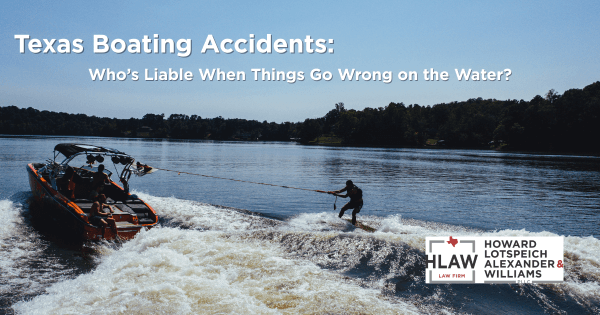
Speedboat towing a wakeboarder on a Texas lake, representing boating accident liability cases handled by Howard Lotspeich Alexander & Williams, PLLC.

Texas Boating Accidents: Who’s Liable When Things Go Wrong on the Water?

By Jesse Lotspeich · Personal Injury

Speedboat towing a wakeboarder on a Texas lake, representing boating accident liability cases handled by Howard Lotspeich Alexander & Williams, PLLC.
Boating accidents on Texas lakes and rivers can lead to serious injuries. Our attorneys explain who may be liable and how to protect your rights.

Boating is a favorite pastime across Texas — from the shores of Eagle Mountain Lake and Possum Kingdom Lake to the Gulf Coast. But when fun on the water turns into tragedy, victims and their families often face serious injuries, costly medical bills, and tough legal questions about who is responsible.

Under Texas law, boating accident liability can be complex, involving state boating regulations, general negligence principles, and in some cases, criminal statutes for intoxicated operation. Here’s what you need to know if you’ve been involved in a recreational accident on Texas lakes, rivers, or coastal waters.

Texas Boating Laws at a Glance

The Texas Parks and Wildlife Department (TPWD) enforces state boating laws found primarily in Texas Parks & Wildlife Code, Chapter 31. These laws govern everything from boat registration to safety equipment requirements. For accident liability, key provisions include:

  • Operating a Vessel in a Negligent or Reckless Manner - Under Tex. Parks & Wild. Code § 31.099, it is an offense to operate a boat in a way that endangers the life, limb, or property of another person. This includes excessive speed, unsafe turns, or creating hazardous wakes.
  • Boating While Intoxicated (BWI) - Similar to driving a car, operating a boat while intoxicated is prohibited under Tex. Penal Code § 49.06. A person is considered intoxicated if they have a blood alcohol concentration (BAC) of 0.08% or more, or if they lack the normal use of mental or physical faculties due to alcohol or drugs. BWI is a criminal offense that can also form the basis for civil liability.
  • Duty to Render Aid and Report Accidents - Under Tex. Parks & Wild. Code § 31.104, boat operators involved in an accident must stop, render aid, and exchange information. § 31.105 requires reporting any accident involving death, disappearance, or injury requiring more than first aid to TPWD within 48 hours, and property damage over $2,000 within 30 days.

Civil Liability for Boating Accidents

When a boating accident occurs, victims may bring a personal injury or wrongful death claim under Texas negligence law. To establish liability, you must generally prove:

  1. Duty of Care – The boat operator owed passengers and others on the water a duty to operate safely.
  2. Breach of Duty – The operator violated that duty, for example by speeding, failing to maintain a proper lookout, or boating while intoxicated.
  3. Causation – The breach directly caused the accident and resulting injuries.
  4. Damages – You suffered measurable harm (medical expenses, lost wages, pain and suffering, etc.).

Who Can Be Held Liable?

Boating accident claims often involve multiple responsible parties:

  1. The Boat Operator - If the operator acted negligently or recklessly, they may be directly liable.
  2. The Boat Owner - Even if they weren’t driving, an owner who negligently entrusted the vessel to an incompetent or intoxicated operator can be held liable under the doctrine of negligent entrustment.
  3. Marinas, Rental Companies, or Tour Operators - Businesses that rent or charter boats can be liable for negligent maintenance, failure to provide safety instructions, or renting to unqualified or intoxicated individuals.
  4. Other Negligent Parties - Liability may extend to other boaters whose actions contributed to the collision or to manufacturers of defective equipment under Texas product liability law (Tex. Civ. Prac. & Rem. Code Chapter 82).

Boating While Intoxicated: Civil and Criminal Consequences

BWI is not only a criminal offense but strong evidence of negligence in a civil claim. A conviction can support a finding of negligence per se, meaning the violation of the statute is presumed to be negligent if it caused the injuries.

In cases involving gross negligence—conduct showing conscious indifference to the rights or safety of others—Texas law allows for exemplary damages under Tex. Civ. Prac. & Rem. Code § 41.003.

Common Boating Accident Scenarios in Texas

  • Collisions between two vessels
  • Boat striking a dock, swimmer, or fixed object
  • Falls overboard leading to drowning
  • Water skiing or tubing accidents
  • Mechanical failure due to poor maintenance
  • Accidents caused by intoxicated or inexperienced operators

Steps to Take After a Boating Accident

  1. Seek Medical Attention Immediately – Even minor injuries can worsen if untreated.
  2. Report the Accident – Follow the reporting requirements under Texas law.
  3. Gather Evidence – Take photos, collect witness statements, and preserve any available video (including GoPro or cell phone footage).
  4. Avoid Giving Recorded Statements to Insurers – Consult a lawyer first.
  5. Contact a Texas Boating Accident Attorney – An attorney can investigate, identify liable parties, and pursue full compensation.

Bottom Line

Texas boating accident cases blend elements of personal injury law, maritime safety regulations, and sometimes criminal law. Whether your accident happened on Lake Texoma, the Brazos River, or along the Gulf Coast, identifying the responsible parties and proving negligence is key to recovery.

If you or a loved one has been injured in a boating accident, Howard, Lotspeich, Alexander & Williams, PLLC can help you navigate the legal waters and fight for the compensation you deserve. We offer free consultations and case evaluations and we don't get paid unless you do. If you or a friend or family member has been seriously injured in a boating accident, contact us for a free consultation.
Read full article
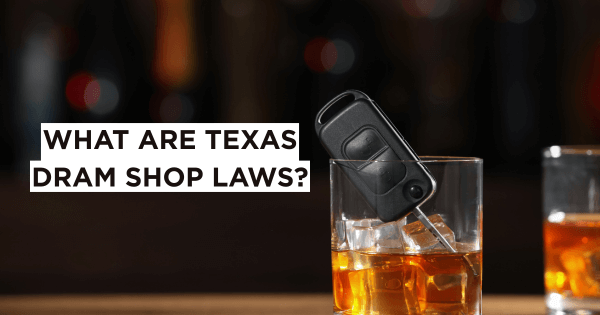
Glass of whiskey with car key inside on a bar counter, symbolizing the dangers of drunk driving and Texas dram shop liability for overserving alcohol.

What You Need to Know About Texas Dram Shop Laws After a Drunk Driving Crash

By Jesse Lotspeich · Personal Injury

Glass of whiskey with car key inside on a bar counter, symbolizing the dangers of drunk driving and Texas dram shop liability for overserving alcohol.
When a night out turns tragic, accountability matters. Under Texas Dram Shop Laws, bars and restaurants may be held liable for over-serving intoxicated patrons who cause drunk driving crashes. Know your rights—and the law.

Drunk driving crashes can shatter lives in seconds—and while the intoxicated driver is the most obvious party at fault, Texas law recognizes that others may share responsibility too. In some cases, bars, restaurants, or other alcohol-serving establishments can be held liable for over-serving someone who later causes a wreck.

This is where Texas dram shop laws come in. If you or a loved one has been injured by a drunk driver, understanding how these laws work may open the door to additional compensation and accountability.

Below, we break down when and how bars can be held liable for drunk driving accidents in Texas, what the law requires to prove liability, and what victims should do after a crash.

What Is a “Dram Shop” in Texas?

The term “dram shop” comes from an old British term for establishments that sold alcohol by the dram (a small unit of liquid). In modern Texas law, a dram shop refers to any business licensed or permitted to sell or serve alcohol—such as a bar, nightclub, or restaurant.

The Texas Dram Shop Act – Key Statute

Texas dram shop liability is governed by the Texas Alcoholic Beverage Code § 2.01–2.03. The most important provision is § 2.02, which lays out the circumstances under which an alcohol provider can be held liable for the actions of a drunk patron.

📜 Texas Alcoholic Beverage Code § 2.02(b):

A provider of alcoholic beverages may be liable if:

  1. It was apparent to the provider that the individual was obviously intoxicated to the extent that he presented a clear danger to himself and others, and
  2. The intoxication was a proximate cause of the damages suffered.

In simpler terms: if a bar over-serves a customer who is clearly drunk, and that customer causes a crash, the bar could be on the hook.

What Is “Obvious Intoxication”?

This is the central question in most dram shop cases.

The statute requires that the signs of intoxication be visible and apparent to a reasonable person. That might include:

  • Slurred speech
  • Staggering or stumbling
  • Aggression or impaired motor skills
  • Inability to pay or communicate clearly
  • Drinking multiple shots or rounds in a short period

If the server or bartender continues to serve alcohol despite those warning signs, the business can be found liable under the Dram Shop Act.

Can Social Hosts Be Liable Too?

No, not usually. Texas law draws a sharp distinction between licensed alcohol providers and private individuals.

Under § 2.02(c) of the Alcoholic Beverage Code, social hosts are not liable unless they provide alcohol to a minor under 18, and they are not the minor’s parent, guardian, or spouse.

What About “Safe Harbor” Protections for Bars?

Texas law also includes a “safe harbor” defense under Alcoholic Beverage Code § 106.14. An establishment may avoid liability if it can show that:

  1. It required its employees to attend a Texas Alcoholic Beverage Commission (TABC)-approved training program,
  2. The employee actually attended that training, and
  3. The employer did not encourage or pressure the employee to violate the law.

However, this defense does not apply if the bar did not follow proper policies, failed to train its staff, or actively encouraged overserving.

How Dram Shop Claims Help Drunk Driving Victims

A drunk driver may be uninsured, underinsured, or financially unable to pay for the full extent of a victim’s injuries. A dram shop claim can provide another source of financial recovery.

Victims may be able to recover compensation for:

  • Medical expenses
  • Lost wages or earning capacity
  • Pain and suffering
  • Punitive damages (in some cases)

Importantly, a dram shop case can also highlight unsafe practices and force establishments to improve their policies to protect the public.

Real-World Example

Imagine a man is served 10 drinks over the course of two hours at a local bar. He’s slurring, stumbling, and knocks over a barstool—but the bartender keeps serving him. On the way home, he crashes into a family’s vehicle, severely injuring the driver.

In this case, the bar may be found partially or fully liable for those injuries under the Texas Dram Shop Act. An experienced personal injury attorney can help gather surveillance footage, witness testimony, and receipts to prove the case.

How Long Do You Have to File a Dram Shop Claim?

Dram shop cases are subject to the Texas personal injury statute of limitations—generally two years from the date of the crash (Texas Civil Practice & Remedies Code § 16.003).

But early investigation is critical. Evidence like video footage, employee schedules, and receipts may disappear quickly. If you believe a bar may have contributed to a drunk driving crash, speak with a qualified attorney as soon as possible.

Final Thoughts

Texas takes drunk driving seriously—and that includes holding alcohol providers accountable when they put profits over public safety. If you’ve been injured by a drunk driver, a dram shop claim may help you find justice and financial relief.

At HLAW, our attorneys understand the emotional and financial toll of a serious crash. We know how to investigate dram shop liability and build strong cases that hold negligent bars and restaurants accountable.

📞 Injured by a Drunk Driver? Call Us Today.

We offer free consultations and handle personal injury cases on a contingency fee basis. Contact us today to see how we can help.

Read full article
Person using smartphone with text overlay: “Social Media Mistakes That Can Ruin Your Texas Personal Injury Case”

Social Media Mistakes That Can Ruin Your Texas Personal Injury Case

By Jesse Lotspeich · Personal Injury

Person using smartphone with text overlay: “Social Media Mistakes That Can Ruin Your Texas Personal Injury Case”
Posting on social media during your injury case can cost you—learn the biggest mistakes to avoid.

Real-World Examples, Legal Pitfalls, and How to Protect Your Claim

In today’s connected world, social media is second nature. Whether it’s a quick photo on Instagram, a status update on Facebook, or a short video on TikTok, we often share snippets of our lives without a second thought. But if you’ve been injured in an accident in Texas and are pursuing a personal injury claim, social media can be your worst enemy.

What you post—intentionally or not—can severely damage your case. Insurance adjusters, defense attorneys, and investigators are scouring public profiles to find anything they can use to deny or reduce your compensation.

In this blog, we’ll share real-world examples of social media backfires, explain how Texas law treats social media evidence, and offer practical legal tips to avoid sabotaging your case.

How Social Media Can Harm a Personal Injury Claim

When you file a personal injury claim in Texas—whether it’s for a car crash, slip and fall, or other injury—you’re essentially stating that you’ve suffered physical, emotional, and financial harm. Any social media activity that appears to contradict those claims can be used against you.

Real Example #1: The “Weekend Warrior” Post

A Fort Worth man filed a claim after a motorcycle accident, citing serious back pain and limited mobility. However, he posted a photo on Facebook just weeks later of himself hiking with the caption, “Back at it!” Defense attorneys used the photo in court to undermine his credibility, and the jury awarded significantly less than what he sought.

Lesson: Even if your pain is manageable or the activity was staged, optics matter. A single photo can shift the entire narrative of your injury.

Relevant Law: Social Media as Admissible Evidence in Texas

Texas courts have consistently recognized social media posts as admissible evidence when relevant to a case. Under the Texas Rules of Evidence (TRE) 401 and 402, evidence is admissible if it makes a fact more or less probable than it would be without the evidence.

Furthermore, under Texas Rule of Civil Procedure 192.3, parties may obtain discovery regarding any matter that is relevant to the subject matter of the lawsuit—including digital content like social media posts.

This means if your post is even arguably related to your physical or emotional state, the opposing side can likely demand it in discovery. Courts have compelled plaintiffs to turn over private content in many Texas cases if it relates to:

  • Physical condition or activities
  • Mental or emotional state
  • Statements about the accident or injury
  • Posts about settlement or legal proceedings

Real Example #2: “Check-In” Gone Wrong

A Dallas woman claimed she was unable to return to work due to debilitating anxiety following a workplace injury. Yet she checked in on Facebook at a local comedy club and posted selfies laughing with friends. The defense used this to challenge her emotional distress claim, arguing she was socially active and enjoying life.

Her settlement offer dropped by nearly 40%.

Lesson: Check-ins, tagged photos, or casual posts can be deceptively damaging—especially when they paint a picture of normalcy or happiness inconsistent with your claims.

Legal Tip: Avoid These Common Social Media Mistakes

If you’re pursuing a personal injury claim in Texas, here are concrete ways to protect yourself online:

✅ Avoid Posting About Your Injury or Accident

Don’t share photos, updates, or opinions about your accident. Anything you say can be interpreted in a way that benefits the defense.

✅ Don’t Accept New Friend Requests

Insurance companies and defense investigators may try to access your private content by posing as someone else. Be cautious of unknown contacts.

✅ Set Your Accounts to Private—But Don’t Delete Posts

Adjust your privacy settings, but do not delete any posts after your accident. Deleting social media content during litigation could be considered destruction of evidence (spoliation) and may subject you to sanctions under Texas Rule of Civil Procedure 215.2.

✅ Tell Friends and Family Not to Post About You

Tagged photos or comments from loved ones can be just as harmful. Ask them to avoid mentioning your injury or activities.

Real Example #3: TikTok Dance Disaster

A teenager in Houston suffered a concussion after a sports-related accident and sued the school for inadequate supervision. A few weeks later, she posted a TikTok dance trend video. The school district’s attorneys cited the video to argue that she was not experiencing symptoms of dizziness or cognitive delays.

While she explained that she was “just trying to push through,” the judge found the evidence persuasive enough to reduce the award.

Protecting Your Case: What Your Attorney Needs to Know

Your attorney should be informed about your social media activity from the start. At our firm, we routinely advise clients on digital behavior and will work to protect your case from potential pitfalls.

If you’re unsure whether something could be problematic, it’s always better to ask than to post.

Final Thoughts: Your Case Is a Legal Matter, Not a Social One

In Texas personal injury cases, your words—and pictures—can absolutely come back to haunt you. What seems like a harmless post may be twisted to paint you as dishonest, exaggerating, or even fraudulent.

The best practice? Go quiet on social media until your case is resolved.

If you have been seriously injured in an accident, contact the HLAW firm today for a free case evaluation.

Read full article
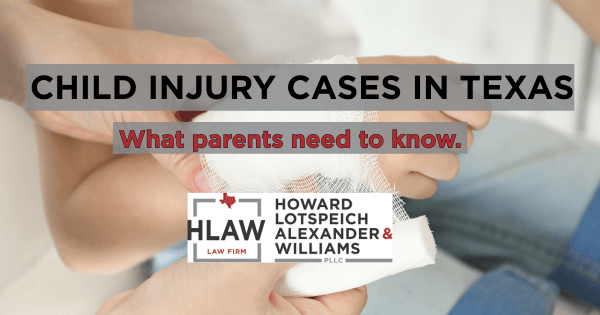
Concerned parent holding child’s hand after injury, symbolizing support during a Texas personal injury claim for minors

Personal Injury Claims for Children in Texas: What Parents Need to Know

By Jesse Lotspeich · Personal Injury

Concerned parent holding child’s hand after injury, symbolizing support during a Texas personal injury claim for minors
When your child is injured, understanding your legal options is crucial. Learn how HLAW helps families navigate child injury claims in Texas.

When a child is injured due to another’s negligence, parents are thrust into a world of emotional stress, medical decisions, and legal confusion. In Texas, personal injury claims involving children differ significantly from those involving adults—and understanding these nuances is critical to protecting your child’s rights and future.

At the HLAW law firm, we’ve represented children and families across Texas in personal injury cases. Our team understands the delicate balance between legal complexity and the care families need after a traumatic event. Below, we explain everything Texas parents should know about pursuing a child injury claim, including deadlines, guardianship requirements, settlement procedures, and court oversight.

Children Have a Right to Compensation—But Cannot File Their Own Lawsuit

In Texas, minors (individuals under age 18) lack legal capacity to file lawsuits or enter into binding legal contracts. However, Texas law does not prohibit a minor from recovering compensation for injuries caused by another person’s negligence.

Who Can File on the Child’s Behalf?

Under Texas Rule of Civil Procedure 44, a next friend (usually a parent or legal guardian) may file suit on behalf of the child. The court will also typically appoint a guardian ad litem or formal legal guardian under certain circumstances to ensure the child’s interests are fully protected.

Statute of Limitations: Special Rules for Minors

For most adult personal injury claims, the statute of limitations in Texas is two years from the date of the incident, per Texas Civil Practice & Remedies Code § 16.003(a). However, when the injured party is a minor, the timeline is different.

Tolling for Minors

Under § 16.001(a)(1) and (b), a person is under a legal disability if they are under 18. The limitations period is tolled (paused) until the minor reaches their 18th birthday.

This means the child generally has until their 20th birthday to file their claim.

BUT: Parental Claims Are Still Limited

Parents, however, are entitled to bring separate claims for:

These parental claims are not tolled and must be brought within two years of the incident.

Settlement of a Minor’s Personal Injury Claim Requires Court Approval

Texas law is particularly protective of minors’ rights, especially when it comes to settlements. Even if all parties agree to settle, a Texas court must approve the settlement before it becomes enforceable.

Tex. Estates Code § 1351.001 allows for court approval of a minor’s settlement and details when court-created accounts or guardianships of the estate are required.

The Court Approval Process:

  1. File a Petition for Approval of Minor’s Settlement
  2. Appointment of a Guardian Ad Litem (if required)
  3. Conduct a Prove-Up Hearing
  4. Court evaluates:

  • Whether the settlement is fair and reasonable
  • Whether proceeds are being protected for the child’s benefit
  • Judge enters an order approving the settlement and disbursing funds appropriately

Courts routinely use Tex. R. Civ. P. 173 to appoint a Guardian Ad Litem when necessary.

The Role of a Guardian Ad Litem

When court approval is needed, the judge may appoint a Guardian Ad Litem—an independent attorney tasked with evaluating whether the proposed settlement is in the child’s best interest.

Tex. R. Civ. P. 173.4(c): “The guardian ad litem may participate in mediation or negotiation, and may testify or submit a report and recommendations to the court concerning the settlement.”

Their report may influence the judge’s decision significantly. This neutral third party ensures that no conflict of interest exists between the child and the parent or attorney, especially in cases involving large settlements or parental claims for reimbursement.

Important: The Guardian Ad Litem’s fees are usually paid from the settlement, and the court must also approve this fee.

Where Does the Money Go? Distributing a Minor’s Settlement

Texas law mandates protections for how a minor’s injury settlement is handled. The funds cannot simply be handed over to the parents.

Acceptable Methods of Disbursement:

  • Court Registry (Estates Code § 1351.003): The funds are deposited with the court and released when the child turns 18.
  • Structured Settlement Annuities: Payments begin at age 18 (or another age specified by the court) and continue periodically.
  • Trust Accounts: In some cases, a special needs trust or guardianship of the estate may be necessary to preserve eligibility for benefits.

If the net recovery is over $100,000, courts often require appointment of a guardian of the child’s estate under Tex. Estates Code § 1104.001.

Medical Expenses and Insurance Subrogation

In Texas, medical bills for a minor are generally considered the legal responsibility of the parents until the child turns 18. These bills form the basis of the parents’ own personal injury claim, which is subject to the standard 2-year statute of limitations.

Also, beware of health insurance subrogation claims. Under Tex. Civ. Prac. & Rem. Code § 140.005, insurers may seek reimbursement from settlement funds for amounts they paid toward the child’s treatment, but parents may have negotiation rights to reduce this lien. An experienced Texas personal injury attorney can be crucial in the success of this process as well.

Why You Need an Experienced Attorney for a Child Injury Claim

Navigating a child injury case is not simply about negotiating with insurance companies. It requires:

  • Managing dual claims for both parent and child
  • Understanding court approval procedures
  • Navigating guardian ad litem investigations
  • Handling structured settlements and trusts
  • Coordinating with insurance subrogation departments

At the HLAW law firm, our attorneys bring over years of experience handling minors’ personal injury settlements across Texas. We understand how to protect your child’s legal and financial future, and how to advocate for your family at every step.

Final Thoughts: Don’t Wait to Act

While the statute of limitations may be tolled for a child’s injury, critical evidence—such as witness statements, photographs, and medical records—can fade over time. Early legal action helps ensure the strongest possible claim and maximizes your child’s recovery.

Contact HLAW Today

If your child has suffered a serious injury, contact HLAW to speak with an experienced Texas child injury attorney and a free case evaluation. We’ll walk you through every step of the process—from investigating the claim to finalizing a court-approved settlement that protects your child’s future.


Read full article
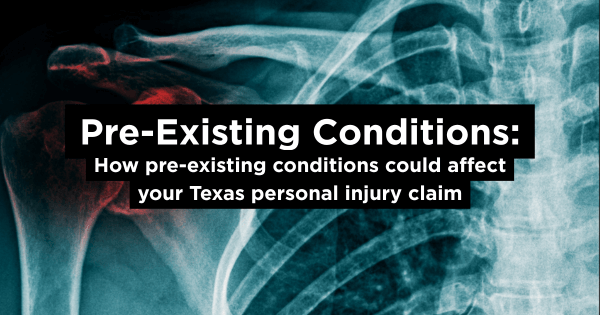
X-ray of shoulder and ribcage highlighting pre-existing conditions in Texas personal injury claims

How Pre-Existing Conditions Affect Your Texas Personal Injury Claim

By Jesse Lotspeich · Personal Injury

X-ray of shoulder and ribcage highlighting pre-existing conditions in Texas personal injury claims
Understanding how pre-existing injuries impact personal injury cases under Texas law, including the eggshell plaintiff rule.

When you suffer an injury in Texas due to someone else’s negligence, you have the right to seek compensation, even if you had a pre-existing condition. However, insurance companies often use your prior medical history to limit or deny your claim. This is where Texas law and the "eggshell plaintiff" rule come into play.

Understanding Pre-Existing Conditions in Personal Injury Claims

A pre-existing condition refers to any medical issue or injury you had before the accident. Common examples include:

  • Back or neck problems
  • Arthritis
  • Previous surgeries
  • Degenerative disc disease
  • Old fractures or soft tissue injuries

When a new accident aggravates or exacerbates these conditions, questions often arise about how much of your current injury is due to the new incident versus your prior health issues.

The Eggshell Plaintiff Rule in Texas

Under Texas law, the "eggshell plaintiff" rule protects injured victims who have pre-existing conditions. This rule is derived from common law principles and is routinely recognized by Texas courts.

The Texas Pattern Jury Charge (PJC 28.6) includes specific language on pre-existing conditions:  "If a pre-existing injury or condition was aggravated by the occurrence in question, you are to determine the amount of damages that resulted from the aggravation."

Simply put, under the eggshell plaintiff rule, a defendant takes the plaintiff as they find them. If the defendant’s negligence causes additional harm to someone who is more susceptible to injury due to a pre-existing condition, they are still fully responsible for the entire extent of the harm caused.

Insurance Companies' Tactics

Despite the eggshell plaintiff rule, insurance companies routinely argue that your injuries were not caused by the accident but were instead due to your pre-existing conditions. Their tactics often include:

  • Requesting extensive medical records
  • Hiring defense medical experts
  • Arguing that only a minor aggravation occurred
  • Blaming natural degeneration or aging

These arguments can significantly reduce your settlement offer if you don’t have strong legal advocacy.

Texas Law: Proximate Cause and Apportionment of Damages

In Texas, the legal concept of "proximate cause" is crucial (Texas Pattern Jury Charge PJC 2.4). The defendant is liable for injuries that are the foreseeable result of their negligence, even if the plaintiff's pre-existing condition made the injuries worse.

However, if part of your injury was truly unrelated to the accident, the jury may apportion damages. Texas Civil Practice and Remedies Code §33.003 allows for proportionate responsibility, though this typically applies to multiple defendants rather than distinguishing between pre-existing and new injuries.

In Leitch v. Hornsby, 935 S.W.2d 114 (Tex. 1996), the Texas Supreme Court reaffirmed that defendants are liable for the full extent of harm caused by their negligence, even when pre-existing conditions make the injury worse.

Key Takeaways for Injured Texans

  •  You are entitled to compensation for the full extent of your injuries, even if you had a pre-existing condition.
  • The defendant cannot escape liability by arguing you were already vulnerable.
  • Insurance companies will likely try to minimize your claim by focusing on your medical history.
  • Having thorough medical documentation and an experienced personal injury attorney can make a significant difference.

Protecting Your Rights

If you have suffered a pre-existing injury accident in Texas, don’t let insurance companies take advantage of you. An experienced personal injury attorney can:

  • Gather and present your medical evidence effectively.
  • Retain medical experts to support your case.
  • Ensure the jury understands how the accident aggravated your pre-existing condition.
  •  Maximize your compensation under Texas law.

At the HLAW Firm, we have extensive experience dealing with complex cases involving pre-existing injuries. Contact us for a free consultation if you or a loved one has been injured.

Read full article

Speak with a Fort Worth attorney

Call (817) 993-9249 or send us a message to discuss your case.