
Skip to content
Category

Howard Lotspeich Alexander & Williams: Jury Trial Cases & Analysis

Page 2 of 4 · 20 articles

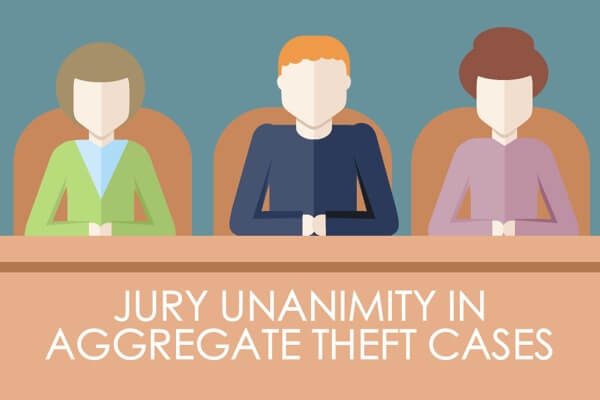
Jury Unanimity Aggregate Theft Texas

What is Jury Unanimity for Aggregate Theft Cases?

By Brandon Barnett · Jury Trial, Theft

Jury Unanimity Aggregate Theft TexasJury unanimity is required in every jury trial, whether it be felony or misdemeanor. This means that the jury must unanimously agree that the State has proven or failed to prove all elements of an offense beyond a reasonable doubt. If a jury cannot reach a unanimous verdict of guilty or not guilty, then the judge will declare a mistrial. With some offenses, however, it can be a little unclear as to what jury unanimity actually requires. This is specifically so with aggregated theft cases.

What Is Aggregate Theft?

Aggregate theft is an offense where two or more thefts were committed “pursuant to one scheme or continuing course of conduct” and the amounts combined determine the grade of the offense. Tex. Penal Code §31.09. Under Section 31.09, aggregate theft may be and often is considered as one offense. Even though it is considered one offense, each individual underlying theft act (where the amounts are aggregated) is considered an element. The Court of Criminal Appeals of Texas has held that for evidence to be sufficient the state must prove beyond a reasonable doubt that the defendant unlawfully appropriated “enough property to meet the aggregated value alleged.” The state is not required to prove each underlying appropriation. However, the Court, until recently has left one question unanswered: Does the jury have to unanimously agree on all underlying theft transactions?  Meaning, if the defendant is alleged to have committed 10 separate theft acts (pursuant to a common scheme), do the jury have to agree on each, or some, or none?

Kent v. State—What is the Jury Unanimity requirement in Aggregate Theft cases?

Until recently there had been no holding by the Court of Criminal Appeals of Texas on whether jurors are required to unanimously agree on each underlying transaction that is used to comprise an aggregated theft charge. In Kent v. State the Court finally addressed this exact question.

See the full CCA opinion in Kent..

Kent was a mortgage broker indicted for theft from four complainants in an amount exceeding $200,000. The thefts were alleged to have occurred over a period of time and pursuant to one scheme or continuing course of conduct. At trial, the defense requested a paragraph in the jury instructions that outlined each individual theft allegation and called for a unanimous verdict on each. The trial judge denied the defense request to include this paragraph.  The jury found Kent guilty of aggregate theft. On appeal, the Kent complained that the trial judge erred by refusing to include his requested paragraph in the jury instructions.  The appellate court reversed and remanded the case for a new trial, holding that the jury should have been instructed that they must unanimously agree beyond a reasonable doubt on each underlying transaction used to comprise an aggregate theft charge.

The State appealed to the Court of Criminal Appeals of Texas to determine whether this was correct. Reversing the lower courts holding, the CCA held that for an aggregated-theft case,

unanimity requires that the jurors agree that the threshold amount has been reached and that all the elements are proven for each specific instance of theft that the individual juror believes to have occurred. Every instance of theft need not be unanimously agreed upon by the jury.

In other words, it is only required that the jurors unanimously agree that two or more thefts pursuant to a common scheme, when combined, exceeded the threshold amount beyond a reasonable doubt, not that they unanimously agree on exactly which thefts were comprised to reach that amount.

Takeaway: When facing aggregated theft charges it is important to know that the jury does not have to unanimously agree that each underlying theft alleged in the indictment has been proven beyond a reasonable doubt. Bottom line, it’s the aggregated amount that matters. This is only a brief explanation of how the jury unanimity requirement plays a role in a case and if you should have any more questions contact our Fort Worth criminal defense team.
Read full article
Judge Reform Unauthorized Verdict

When the Jury Verdict is Not Authorized by Law

By Brandon Barnett · Jury Trial

What Should the Trial Judge Do When the Jury Returns an Unauthorized Verdict?

Judge Reform Unauthorized VerdictAt the trial of Reginald Nixon for burglary of a habitation and evading arrest, the jury returned a guilty verdict and sentence of 7 years for the burglary and 9 years for the evading. However, the verdict form contained a handwritten note that read: “*To be served consecutively, not concurrently.” A consecutive sentence would mean that the two verdicts are added together to make the actual prison term 16 years. The jury had previously asked the judge whether the sentences would run concurrently and the judge refused to answer them, advising them to simply continue with their deliberations. Without an answer to their question, the jury took the matter into their own hands.


The problem with the jury’s verdict of 7 years and 9 years to run consecutively is that it is not an authorized sentence. Under Texas law, the sentences in Nixon’s case were required to run concurrently rather than consecutively. As a result, the trial judge refused to accept the sentences and reform them to run concurrently (as he was urged to do by Nixon’s counsel). Instead, the judge sent the jury back with a note advising them that the sentences cannot run consecutively. The jury soon returned with new verdicts of 16 years confinement for each offense, which the judge accepted.

Nixon appealed, again urging that the trial judge erred by failing to accept and reform the original jury verdicts. The 2nd Court of Appeals (Fort Worth) affirmed the trial court’s judgments and “reasoned that while the judge may have had the authority to reform the verdict under Article 37.10, he also had the authority to refuse the verdict and return the jury to their deliberations pursuant to this Court’s opinion in Muniz v. State [573, S.W.2d 792 (Tex. Crim. App. 1978)].”

The Texas Court of Criminal Appeals granted review and now reverses the holding of the 2nd Court of Appeals. The CCA highlighted the changes that were made in 1985 when the legislature enacted Section 37.10(b) of the Texas Code of Criminal Procedure. This change distinguished between “informal” and “unauthorized” verdicts. For unauthorized verdicts, Section 37.10(b) provides:

If the jury assesses punishment in a case and in the verdict assesses both punishment that is authorized by law for the offense and punishment that is not authorized by law for the offense, the court shall reform the verdict to show the punishment authorized by law and to omit the punishment not authorized by law.

CCA explained that the lower court’s reliance on Muniz was misplaced since Section 37.10(b) was not enacted at the time Muniz was decided. Further, the verdict form in Muniz was incomplete, unlike the verdict in this case, which was complete but contained an unauthorized portion.

The CCA concluded by holding:

Although the terms of confinement were 45 authorized punishments, the attempted cumulation was punishment unauthorized by law. Article 37.10(b)’s plain language is clear that, when the jury assesses punishment and returns a verdict assessing punishment that is both authorized and unauthorized by law, “the court shall reform the verdict to show the punishment authorized by law and to omit the punishment not authorized by law.” Accordingly, we hold that the judge erred in failing to accept the initial punishment verdicts and omit the jury’s unauthorized attempt to stack the terms of confinement.

Judge Alcala and Judge Yeary dissented.

Read full article
Making a Murderer | Fort Worth Criminal Defense Attorney

Making a Murderer: The Power of the Jury

By Ashley Gilmore · Jury Trial

Can a Single Juror Make a Difference? Ask Steven Avery.

Making a Murderer | Fort Worth Criminal Defense AttorneyWe, like many of you, have been sucked into the sad, frustrating, and very real tale of the murder trial of Steven Avery in Manitowoc County, Wisconsin brought forth in the Netflix documentary “Making a Murderer." While much has been made of Steven Avery’s guilt or innocence, the coerced confession from his nephew Brandon Dassey (see full confession transcript HERE), and the possible foul play of the law enforcement in Manitowoc County, one major key to the case has been largely overlooked - the power of the jury. Without a guilty verdict from the jury, there is no frenzy over a viral documentary and certainly Steven Avery is a free man.

Recently, the filmmakers have reported to the press that a member of the jury now admits that he or she believed Avery was not guilty. This juror, wishing to remain anonymous, claims to have changed their vote to “guilty” after succumbing to fear and pressure. In reality, the juror believed, and still believes, that Avery was framed for murder. Speaking to the filmmakers, the juror said “I’m the reason the justice system failed.” Is the juror right?

Criminal Verdicts in Texas Must Be Unanimous. Every Juror Vote Counts.

Jury deliberations are secret, so only the jurors themselves could ever say for sure exactly why they arrive at a certain verdict for a case. In a criminal case, a jury verdict must be unanimous, which ensures that each juror’s vote is important and not diluted in a simple majority. If this one juror had summoned the courage to stay true to their “not guilty” vote, it would have caused a mistrial. A mistrial forces authorities to make the difficult decision of whether or not to retry the accused. Who knows what would have happened in a hypothetical second trial of Steven Avery.

For years, this juror has shouldered guilt from this trial, proving that the decisions juries are asked to make are indeed difficult ones. The next time you are on a jury, take a lesson from this case. Stand up for what you believe in and refuse to cave to pressure or fear. Do not be overpowered by the person with the loudest voice in the jury room. Remember, your vote holds the power of incarceration or freedom.

I hope we didn't spoil the documentary for you, but if you haven't watched it, this post does not even scratch the surface of the things you will see in this series.  We suggest you watch it and consider the case for yourself.  If nothing else, you'll see that there are two sides to every story and you'll understand to importance of having a fair and conscientious jury in a criminal trial.

Read full article

Winning By Losing in a Jury Trial

By Brandon Barnett · Jury Trial

Let me make an admission...sometimes we lose at trial. There, I said it. We don't win every case. Sometimes the evidence is not in our favor. Sometimes the State is able to prove every element of the alleged offense. And we typically know that going into it.

It begs the question, "Why take the case to a jury trial if you suspect you are going to lose?" Here's why...because in many situations, going to trial is the only way to get a good result.

For instance, we had a client that was charged with a low level misdemeanor offense. The State was offering a plea bargain of 18 months probation, a $1,250 fine, and numerous classes in exchange for a guilty plea. We considered this offer to be too steep in relation to the alleged offense. Our client agreed. But the State was not willing to budge on the offer. So we set it for trial.

After a hard fought trial, the jury came back with a guilty verdict, which is what we suspected all along. Then we went to the judge for punishment. The State continued to recommend 18 months probation and a $1250 fine. The judge, however, awarded our client 2 days of labor detail and a $750 fine. Two short days later, the entire ordeal was but a fleeting memory for our client. No probation. No monthly reporting. No random drug tests. No classes.

We would have never received such a low punishment offer from the State. We also would have never received such a low sentence from the judge if we hadn't gone to trial and filled her in on the extenuating and mitigating circumstances of the case and our client.

In criminal defense, a moral victory is still a victory and sometimes you win by losing.

Read full article

Appeals Court Reverses Conviction in 11 Person Jury Trial

By Brandon Barnett · Jury Trial

12 Persons Required to Serve on Texas Felony Jury Trial - Fort Worth Trial Lawyers

A felony jury trial in Texas requires 12 jurors (with limited exceptions). The defense can waive that requirement under certain circumstances, and jurors can be excused under certain circumstances. But generally, a felony jury panel must have 12. Below, we discuss a case in Denton County where the jury started with 12 and then went to 11 because a juror could not understand the English language well enough to serve.

Stillwell v. State - Opinion issued by the 2nd District Court of Appeals (Fort Worth) on May 28, 2015

Appellant, Eben Stilwell was convicted in the 367th District Court in Denton County by an 11-person jury of indecency with a child and sentenced to 12 years in prison. A jury of 12 was originally empaneled but after three days of testimony, one of the jurors came forward and informed the court that he was having difficulty understanding the proceedings. The juror primarily spoke Spanish and was having difficulty following the proceedings because they were in English.

During the conversation between the judge and the juror, the juror repeatedly said "I understand a little bit" or "I don't understand." Both the defense and state agreed that the juror did not adequately understand the English language and was not completely following what was going on in the courtroom.

The prosecution and defense disagreed, however, as to the legal basis for the juror's removal. The state urged that juror be deemed "disabled" under Tex.Code Crim. Proc. Ann. art. 36.29(a), which would allow the trial to proceed with 11 jurors over defense objection. The defense argued that because the juror was never able to serve, he was disqualified and a trial using 11 jurors could only proceed with the defendant's consent. The defendant did not consent to continuing the trial with only 11 jurors. The trial court followed that state's recommendation and dismissed the juror as disabled, continuing the trial with only 11 jurors.

The 2nd District Court of Appeals (Fort Worth), Justice Sudderth writing the opinion for the court, held that the court could have allowed the juror to remain on the jury because the right to have him excluded due to his inability to understand English had been forfeited. It is always the attorneys' duty to determine that capability and fitness of the jurors during voir dire. Neither party inquired as to ability to understand the English language.

But, once the court determined that the juror should be dismissed, consent of the defendant was required to proceed with 11 jurors. Because appellant did not agree to proceed with 11 jurors, a mistrial was required. The lower court was reversed.

Fort Worth Criminal Trial Lawyers

If you or a loved one have a criminal case in Fort Worth, you need to seek the best criminal defense lawyer to represent you and protect your rights at trial. Call our attorneys today for a Free Consultation of your case.

Read full article

Speak with a Fort Worth attorney

Call (817) 993-9249 or send us a message to discuss your case.