Skip to content
Category

Criminal Defense

Page 9 of 10 · 49 articles

Accomplice Wtiness Rule Texas

Texas' Accomplice Witness Rule

By Brandon Barnett · Criminal Defense
Accomplice Wtiness Rule TexasCriminal law disfavors the testimony of an accomplice, for good reason.  The policy behind this is clear - factfinders should be leary of trusting those who have a substantial stake in the litigation, especially those with a direct liberty interest.  A few years back, the 2nd District Court of Appeals (Fort Worth) provided a good synopsis of the Accomplice Witness Rule, which I felt was worth sharing.  The following excerpt is taken from Clark v. State (June 17, 2010).

What is the Accomplice Witness Rule in Texas criminal law?

The accomplice-witness rule is a statutorily imposed sufficiency review andis not derived from federal or state constitutional principles that define the legal andfactual sufficiency standards.  An accomplice is a person who participates before, during, or after the commission of the crime and can be prosecuted for the same offense as the defendant or for a lesser-included offense.  Article 38.14 of the code of criminal procedure provides that “[a] conviction cannot be had upon the testimony of anaccomplice unless corroborated by other evidence tending to connect the defendant with the offense committed; and the corroboration is not sufficient if it merely shows the commission of the offense.”

When evaluating the sufficiency of corroboration evidence under the accomplice-witness rule, we “eliminate the accomplice testimony from consideration and then examine the remaining portions of the record to see if there is any evidencethat tends to connect the accused with the commission of the crime.”  The corroborating evidence need not prove the defendant’s guilt beyond a reasonable doubt by itself.  Nor is it necessary for the corroborating evidence to directly link the accused to the commission of the offense.  Rather, the evidence must simply link the accused insome way to the commission of the crime and show that “rational jurors could conclude that this evidence sufficiently tended to connect [the accused] to theoffense.”  Additionally, “[p]roof that the accused was at or near the scene of the crime at orabout the time of its commission, when coupled with other suspicious circumstances, may tend to connect the accused to the crime so as to furnish sufficient corroboration to support a conviction.”  But “mere presence alone of a defendant at the scene of a crime is insufficient to corroborate accomplice testimony.”

I omitted the citations, so you should click on the link above and go to page 15 of the opinion if you wants the various cites for the law above.
Read full article
Impersonating a Public Servant in Texas

Man Pretends to be a Dallas District Attorney and Receives 2 Years in Prison

By Brandon Barnett · Criminal Defense

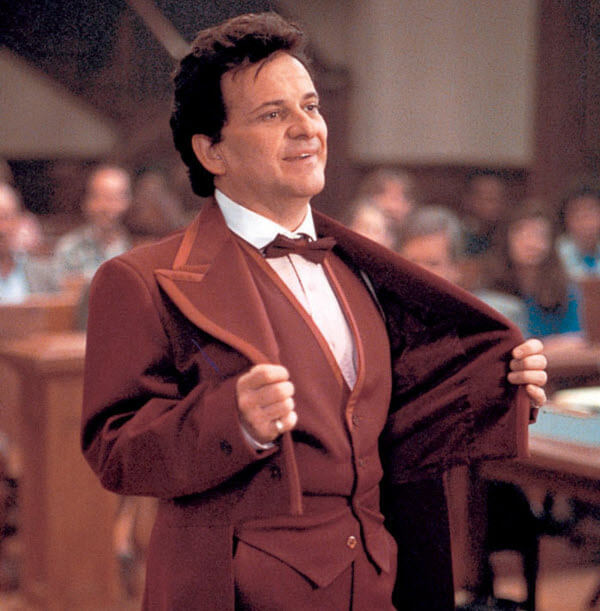
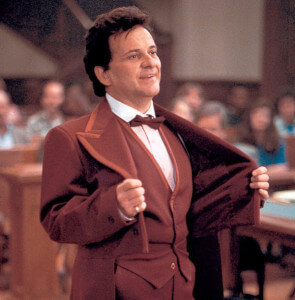
Impersonating a Public Servant in TexasWhen I think of someone impersonating an attorney, my mind goes to Joe Pesci and My Cousin Vinny.  In the movie Vincent Gambino only impersonated a criminal defense lawyer (not a public servant) so nobody seemed to care (except the judge), but in Texas, Impersonating Public Servant (including a district attorney) is a serious matter.  Robert Cornwell found this out after he pretended to be a Dallas County Assistant District Attorney in hopes of helping his friend with a DWI case.


In May of 2012, Robert Cornwell called Montgomery County Assistant District Attorney Kourtney Teaff, identifying himself as an assistant district attorney from Dallas County, attempting to “resolve [his friend’s] [DWI] case.” Cornwell claimed access to criminal histories, case files, and fingerprint cards. He mentioned speaking with governmental offices, and prosecuting his nephew for drug possession. Cornwell insisted on using his personal cell phone number because he and Teaff “were on the same team.” Becoming suspicious of the “highly unusual” requests coming from another district attorney, Teaff recorded the conversations. According to the trial court, Cornwell always used his real name, he had never been an attorney in Texas, he never attempted to claim official authority over Teaff, and he intended that “Teaff should consider the requests a personal favor.” Cornwell was sentenced to two years imprisonment for impersonating a public servant.

See the opinion in Cornwell v. State

What does "Impersonating a Public Servant" mean in Texas?

Impersonating a Public Servant is a Third Degree Felony with a punishment range of 2-10 years in prison and up to a $10,000 fine.  A person violates Section 37.11(a)(1) of the Texas Penal Code when the person impersonates a public servant in combination with the requisite intent...[which] can be satisfied with either the submission theory (“with intent to induce another to submit to his pretended official authority”) or the reliance theory (“with the intent to induce another…to rely on his pretended official acts.”).

Cornwell appealed to the Court of Appeals, arguing that the evidence was insufficient to show either theory of intent—submission or reliance—because he did not persuade Teaff to submit to any asserted authority he might have over her. The Court of Appeals rejected Cornwell’s argument, “concluding that the evidence was…sufficient to support a jury finding that he had impersonated a public official with intent to induce another to rely on his pretended official acts—the reliance theory.” Cornwell then petitioned the Court of Criminal Appeals (“CCA”) for discretionary review.

Here, the CCA determines whether the Court of Appeals was incorrect in misconstruing the meaning of the Section 37.11(a)(1) of the Texas Penal Code, as only “a few Texas appellate courts have directly addressed the reliance theory of intent, and specifically, the meaning of pretended official acts.” See Ex Parte Niswanger, 335 S.W.3d at 617 & n.11; Tiller v. State, 362 S.W.3d 125, 128 (Tex. App.—San Antonio 2011, pet. ref’d.); Tovar v. State, 777 S.W.2d 481,489 (Tex. App.—Corpus Christi 1989, pet. ref’d.).

The CCA Clarifies what "Impersonating" means (and doesn't mean).

The CCA explained that Section 37.11(a)(1) can be broken down into two parts: the culpable act (actus reus, the bad act) and a culpable mental state (mens rea, the guilty mind). To violate the statute, the State must prove:

  1. that the impersonation happened and
  2. that the impersonator had the specific intent to induce another to submit or to rely upon.

“An accused may not be convicted on a simple showing that he falsely held himself out to be a public servant.”

Because it was undisputed that Cornwell did impersonate a public servant—an assistant district attorney from Dallas County—satisfying the first part of the statute, the CCA focused on Cornwell’s mental state, specifically the reliance theory—the evidence that shows Cornwell’s intent to induce another to rely upon his pretended official acts. The CCA explained that Cornwell attempted to persuade Teaff he was “an experienced assistant district attorney by relating various claims of conduct he had undertaken as an assistant district attorney” namely, “putting his nephew in jail, reviewing case files, and investigating matters in the capacity of assistant district attorney.” The CCA is adamant that, “the only reason [Cornwell] could have had for relaying these pretended official acts to Teaff was to enhance the credibility of his claim to be an assistant district attorney.” “By calling and speaking to an assistant district attorney as a member of the same team, [Cornwell]…hoped to gain [Teaff’s] trust and goodwill.” Further, Cornwell did not ask for favor[s] in his capacity as a private citizen or concerned friend, rather, he asked under the guise of being an assistant district attorney. The CCA states, such “purported actions exceed mere false identification as a public servant.” The CCA agreed with the Court of Appeals, affirming Cornwell’s conviction and sentence.

There are no shortcuts to due process. The Texas Penal Code prescribes strict punishment for those impersonating officers of the court. There is no doubt that criminal charges and allegations can make the accused feel panicked and overwhelmed, however, the old adage “desperate times call for desperate measures,” will not hold water in court where impersonation is concerned. If you or a loved one are facing criminal charges, contact an actual Texas attorney who will explain the proper steps in dealing with the legal system. Contact our office today for a free consultation at (817) 993-9249.

Read full article
Community Caretaking Fort Worth

“Hunched Over” Passenger Not Enough Distress to Invoke the Community Caretaking Exception

By Brandon Barnett · Criminal Defense, DWI

Community Caretaking Fort WorthWhile conducting a preventative patrol on the Fourth of July in 2013, a Fort Worth police officer stopped at a red light beside Cameron Byram’s vehicle. Both vehicles had the windows rolled down. The officer testified at trial that he noticed a female passenger in Byram’s car “hunched over…[and that he]…didn’t see any movement at all [from] the female.” The officer smelled alcohol coming from Byram’s car, and felt Byram was “not attending to the female passenger.” The officer shouted over to Byram, asking if she was alright, but Byram faced forward and drove away when the light turned green. Believing the female passenger needed medical attention, coupled with Byram’s actions “as an attempt to avoid contact with the police,” the officer stopped Byram’s car to conduct traffic stop. The officer checked on the passenger and called for medical attention, which she later refused. Next, the officer investigated and arrested Byram for driving while intoxicated (DWI). The officer testified that Byram had not committed a traffic offense, nor were there any technical violations on Byram’s car—he only stopped the car to perform a safety check.

Byram v. State (2nd Court of Appeals - Fort Worth, 2015)

***UPDATE - This case was REVERSED by the Texas Court of Criminal Appeals in 2017. See opinion.

After his motion to suppress the evidence for the DWI charge was denied, Byram entered a guilty plea. The trial court assessed punishment at ninety days in jail and a $750 fine, but suspended the sentence, placing him on community supervision for eighteen months. Byram appealed.

The issue before the Fort Worth Court of Appeals is whether the community caretaking exception to the Fourth Amendment applies to the facts of the case, or, whether the police officer had reasonable suspicion to stop Byram.

The Fourth Amendment provides a safeguard against unreasonable searches and seizures. U.S. Const. amend. IV; Wiede v. State, 214 S.W.3d 17, 24 (Tex. Crim. App. 2007). A warrantless arrest is considered unreasonable unless it fits into an exception, such as the community caretaking exception. Minnesota v. Dickerson, 508 U.S. 366, 113 S. Ct. 2130, 2135 (1993); Torres, 182 S.W.3d at 901. A search or seizure “is not unreasonable” when community caretaking is the goal, however, the exception is “narrowly applied” in the “most unusual of circumstances.” Wright, 7 S.W.3d at 152.

“Courts consider four non-exclusive factors in determining whether the officer’s belief that the defendant needed help was reasonable: (1) the nature and level of the distress exhibited by the individual; (2) the location of the individual; (3) whether or not the individual was alone or had access to assistance other than that offered by the officer; and (4) to what extent the individual, if not assisted, presented a danger to himself or others.” Corbin v. State, 85 S.W.3d 272, 277 (Tex. Crim. App. 2002).

First, the Court of Appeals concludes that the passenger did not exhibit distress. “The passenger did not appear to be in any great distress, she was located in a busy area of town where there were nearby hospitals, she was not alone [in the car], she was in public, and she did not appear to be a danger to herself or others.” Further, the Court of Appeals states, “We…cannot conclude that the…community caretaking exception, when applied to a hunched over passenger…indicates that the passenger presented a danger to herself or others.”

Second, the Court of Appeals determines that the officer lacked reasonable suspicion to be able to perform a safety check. “[While] we do not question the good faith of [the officer’s] subjective suspicion that Byram might have been involved in an alcohol-based offense…so long as consumption of alcohol is not illegal…permitting…investigation of persons for alcohol-based offenses solely on whether the odor of alcohol is present invites unwarranted police intrusions.” Byram’s traffic stop violated his Fourth Amendment rights.

Justice Sue Walker dissents, stating the passenger was exhibiting signs of distress because she “was not moving and appeared unconscious.” The passenger was also in a vehicle driven by a man “who appeared unconcerned about her well-being.” The passenger’s access to assistance was doubtful because Byram did not respond to the police officer’s question about her condition. Lastly, the passenger was a danger to herself because she appeared unresponsive and unable to ask for help. “Thus, all four factors…support the reasonableness of the officer’s belief that she needed assistance.”

Law enforcement officers must abide by local, state and federal procedural and substantive laws when conducting traffic stops and arrests. If you or a loved one is facing DWI charges or traffic violations, please contact our office today for a free consultation at (817) 993-9249.

Read full article
Sharen Wilson Tarrant County District Attorney

Tarrant County District Attorney Sharen Wilson Oversees all Fort Worth Prosecutors

By Brandon Barnett · Criminal Defense

Tarrant County District Attorney Sharen Wilson

Sharen Wilson Tarrant County District Attorney

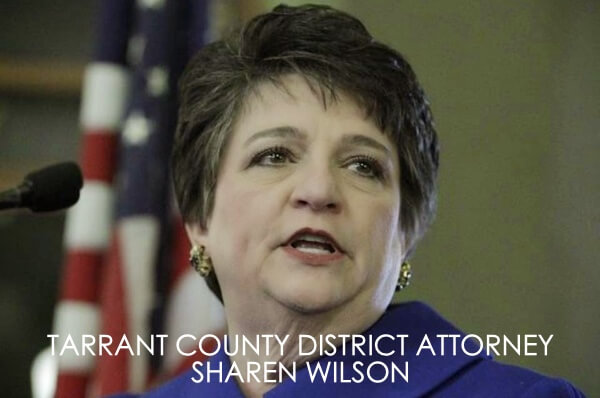
Sharen Wilson, who took office in 2015, is the elected Tarrant County District Attorney. She is the top of all Fort Worth prosecutors, managing a large office of Assistant District Attorneys, investigators, support staff, and even a therapy dog.  Prior to assuming her new role as the Tarrant County District Attorney, Sharen Wilson presided over Criminal District Court Number 1 as a District Judge.  Her office receives cases from the various police departments across Tarrant County, investigates the cases, and files misdemeanor or felony criminal cases.  The Assistant District Attorneys under Sharen Wilson present cases to grand juries and manage dockets in the 20 Tarrant County criminal courts and the Courts of Appeals.  If you are interested in observing a criminal trial in Tarrant County, check out the Tarrant County Trial Board for a list of cases each week.

Fort Worth Prosecutors | Tarrant County DA

The Tarrant County District Attorney office has over 150 Fort Worth prosecutors and over 50 investigators. The office has a budget of $38 million dedicated to criminal prosecutions and investigations in Tarrant County.  Colloquially, every Assistant District Attorney is referred to as a "Tarrant County DA" or "prosecutor," but the ultimate authority over criminal prosecutions is retained by Sharen Wilson.  Fort Worth prosecutors are known across the state as fair and collegial attorneys.  They have a reputation for taking a fair look at each case and providing all available information to the defense bar in a timely manner.  Although the Tarrant County District Attorney office is one of the largest in the state, in one of the largest counties in the state, the office and its staff carry themselves with small-town values.  While each criminal case is different and may have its own challenges, our criminal defense attorneys have always been satisfied with the professionalism of the Tarrant County DA office.

Free Consultation of Tarrant County Criminal Cases

Our Fort Worth criminal defense attorneys square off every day with the Tarrant County DA office. We have a proven track record of favorable results for our clients. We understand that every case and every client are different. We take a personal approach to every client and pursue every option to address our clients' individual needs. For a FREE consultation of your Tarrant County criminal case, contact our team at (817) 993-9249.

Read full article
Fort Worth criminal investigation

Private Investigator: An Indispensable Criminal Defense Asset

By Brandon Barnett · Criminal Defense

Investigating Every Case to Uncover the Real Truth | Fort Worth Criminal Defense Lawyers

Fort Worth criminal investigationEvery criminal allegation exists in a gray area. If one were to focus solely on the police report, a criminal case might seem black and white. But it's not. There are secrets, personalities, motivations, half-truths, unnamed witnesses, and much more lurking in the shadows of every case. One of the keys to a successful defense is to uncover those facts not articulated in the police report and give the case a context. This is why we use a private investigator as part of our defense team.

A good private investigator is indispensable to a full and complete criminal defense. You would be surprised to hear what people will tell an investigator (while being recorded). Perhaps it's because people like to feel important, or maybe some folks just aren't completely aware of what they are saying, but a good private investigator can blow a case wide open simply by hitting the streets to interview witnesses and others connected to the case.

Our investigator is a retired police officer that spent over 30 years on the force in the Dallas Fort Worth Metroplex, including many years as an undercover narcotics officer. He can look at a police report and spot errors in the investigation at the drop of a hat.

If you have been charged with a criminal offense in Tarrant County, Texas and you know that there is more to your case than what is contained in the police report, give us a call and we will coordinate with our investigator to get started uncovering "the rest of the story." Contact us today for a free consultation.

Read full article

Speak with a Fort Worth attorney

Call (817) 993-9249 or send us a message to discuss your case.