
Skip to content

October 2016

Page 2 of 2 · 8 articles

HL Hunt Mansion Dallas Hill v State

Dallas Oil Family's Dismissal for Vindictive Prosecution Upheld on Appeal

By Brandon Barnett · Criminal Defense, White Collar

How Far Does the Trial Courts Discretion Go in Determining Whether to Hold a Pretrial Evidentiary Hearing?
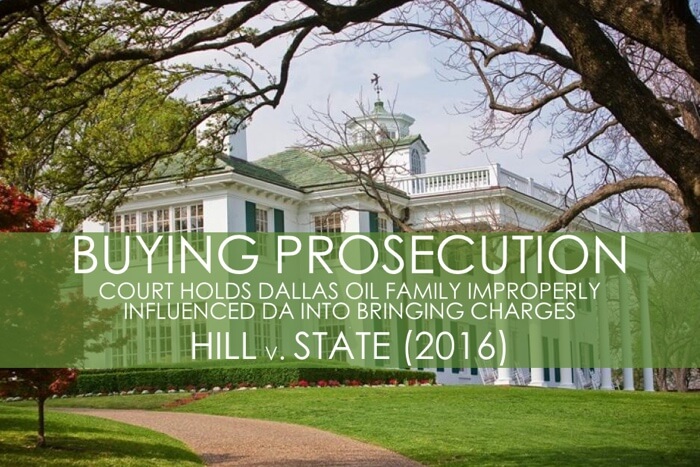
HL Hunt Mansion Dallas Hill v StateOn September 21st the Texas Court of Criminal Appeals issued a decision on the oil tycoon heir Albert Hill III’s criminal appeal. The question the Court faced was whether it was in the trial court’s discretion to conduct a pretrial evidentiary hearing on Hill’s motions to quash and dismiss based on prosecutorial vindictiveness. The Court determined that it was within the trial court’s discretion to conduct such a pretrial evidentiary hearing and that discretion was not limited by the defendant meeting “a certain threshold evidentiary requirement.”

Court Opinion: State of Texas v. Albert Hill (Tex. Crim. App. 2016)

The Facts | Trial Court Finds Dallas DA's Actions Improper

Appellant Hill is the great-grandson of legendary Dallas oil billionaire H.L. Hunt and the events surrounding the indictment dealt with a multi-million dollar trust litigation between Hill and his father. Hill and his wife Erin were indicted in 2011 for making false and misleading statements in order to obtain a $500,000 mortgage from Omni American Bank. The indictment came shortly after Hill won in the trust litigation against his father. Prior to the indictment (but after Albert Hill's victory in the trust litigation) Hill’s father’s attorney, Michael Lynn delivered a memo to the Dallas County District Attorney’s Office which alleged various offenses committed by Hill and his wife. Hill challenged these charges by filing a motion to quash the indictment and a motion to dismiss. Hill argued that the District Attorney, Craig Watkins, was under the influence of his disgruntled father as well as Lisa Blue Baron, one of Hill’s attorneys in the trust litigation case that had just filed a lawsuit against Hill seeking several million dollars in legal fees.

Some items of interest that the court noted were:

  • Lisa Blue Baron exchanged several phone calls and text messages with Watkins leading up to the indictment;
  • Michael Lynn’s law partner donated $48,500 to Watkins’ campaign prior to the indictment;
  • Lisa Blue Baron made a $100,000 donation to SMU LAW in Watkins’ honor after the indictment;
  • Lisa Blue Baron also held a fundraising event for Watkins’ campaign at her house and made a $5,000 donation to the campaign.

The trial court held an evidentiary hearing on Hill’s motions and granted both the motion to quash and the motion to dismiss.

The Court of Appeals Reversed the Trial Court's Decision

The Fifth Court of Appeals reversed the trial court's dismissals holding that the trial court “erred in conducting a hearing on Hill’s motion to dismiss.” The State argued that the trial court should not have held a pretrial evidentiary hearing because Hill failed to prove, with evidence, a prima facie case of prosecutorial misconduct and vindictiveness. The Court of Appeals stated that before a pretrial evidentiary can be held for a defendant claiming a violation of his constitutional rights, the defendant must “present facts sufficient to create a reasonable doubt about the constitutionality of his prosecution.” The Court of Appeals found that Hill did not sufficiently meet this standard.

The Court of Criminal Appeals Disagrees with the Court of Appeals, holds that Trial Courts Have Sound Discretion to Conduct a Pretrial Evidentiary Hearing

1. Article 28.01 - The CCA points to Article 28.01 in determining that the trial court had the discretion to hold a pretrial hearing on Hill’s motions to quash and suppress. Article 28.01 §1 provides that a trial court “may set any criminal case for a pre-trial hearing” and that some of things that the pre-trial hearing shall be to determine is the “pleadings of the defendant,’ ‘exceptions to the form or substance of the indictment,’ or discovery.’” Article 28.01 §1(1), (2), (4), (8). Additionally, while Article 28.01 does not expressly provide for an evidentiary hearing on a motion to dismiss like it does for a motion to suppress, the Court determined that it would be a misapplication of the rules of statutory construction to decide that oral testimony cannot be used in a pretrial hearing to resolve any other issue raised.

2. Case Law - The Court supported its Article 28.01 decision with the Court’s decision in Neal v. State which held that a defendant is required to “preserve a complaint of vindictive prosecution by filing a pretrial motion to quash and dismiss.” 150 S.W.3d 169. With that decision in mind the Court said “it would make no sense to limit the trial court’s discretion to hold an evidentiary hearing on such motion.”

The State pointed to federal case law that provided defendant must make a prima facie case that raised a reasonable doubt. However, these cases dealt with the issue of whether the trial court erred by denying a pretrial hearing. Thus, the Court stated that this case law is not on point in Hill’s case and thus are not controlling on this issue, and do not persuade the Court to hold otherwise.

Decision of the Criminal Court of Appeals | The Trial Court’s Discretion is Not Limited

The CCA determined that Article 28.01 has no limiting factor on the judge’s discretion to hold a pretrial evidentiary hearing based on any threshold evidentiary standard. Accordingly, the trial court did not err in conducting the pretrial evidentiary hearing in Hill’s case but instead acted within its bounds of sound discretion.


Read full article
Evil Clown Scare Texas

Hold Your Fire...Don't Shoot the Clowns! Yet.

By Luke A. Williams · Self-Defense

Evil Clown Scare TexasRecently, a friend asked me if it was legal for individuals to dress as clowns and scare the public. He also wanted to know what would happen if he were frightened by one of these clowns and shot the clown. While not asking the latter in complete seriousness, these questions do bring up potential criminal law issues.

Is it Legal to Dress as a Clown in Public?

There’s no state law that we’re aware of that makes dressing up like a clown in public per se illegal.

The only potential laws that may be applicable to these situations would be individual city ordinances. A search of city codes in a handful of Texas towns around the Metroplex reveals no ordinance specifically prohibiting dressing like a clown in public. The only codes we are able to find related to costumes primarily had to do with a prohibition on costumes which fail to cover private areas in regards to sexually oriented businesses.

While dressing like a clown doesn’t appear to be per se prohibited, there is certainly the risk of breaking other laws while dressed as a clown. In addition, dressing like a clown in public and creating unnecessary alarm or panic could be deemed as disorderly conduct.

Texas Penal Code, Chapter 42 lays out a list of behaviors that could constitute up to a Class B misdemeanor. Class B misdemeanors can carry a penalty of up to 6 months in jail and up to a $2,000 fine. Sec. 42.01 (a)(2) states that a person commits an offense [of disorderly conduct] if he intentionally or knowingly makes an offensive gesture or display in a public place, and the gesture or display tends to incite an immediate breach of the peace. An offense of this nature is a Class C misdemeanor and carries the possibility of up to a $500.00 fine.

Can I use Deadly Force Against the Clown?

Let’s start with the simple answer of “NO”. While individuals may be suffering from coulrophobia (the fear of clowns), this condition does not give you a right to use deadly force – or any force for that matter – against an individual simply because he or she is standing in public dressed as a clown.

The more complex answer of “maybe” would have to do with the use of force for self-defense purposes. Section 9.31 of the Texas Penal Code provides for a justifiable defense at the time of trial for self-defense, so long as the type of force used is reasonable and necessary in the moment to protect against an attacker. Under this law, the actor must reasonably believe that the force is reasonably necessary to protect against the other’s use or attempted use of unlawful force. Simply observing a clown, with no weapon or threat to use a weapon, provides no grounds to use force – much less deadly force – against that clown.

In addition, the Penal Code does establish that force may be used to protect one’s own property. A person in “lawful possession” of real property or personal property is justified in using force if “the actor reasonably believes the force is reasonably necessary to prevent or terminate the other’s trespass on the land…” However, the use of deadly force to protect one’s own property is limited. “A person is justified in using deadly force against another to protect land or property if (1) he is justified under TPC §9.41; (2) he reasonably believes using the force is immediately necessary to prevent commission of arson, burglary, or robbery; and, (3) the actor reasonably believes that the land or property cannot be protected or recovered by any other means [such as by calling law enforcement]. Tex. Penal Code Section 9.42.

Using force for self-defense purposes is a serious response to dangerous and threatening situations – but certainly not an appropriate response to being “creeped” out.

Bottom Line | Do Not Shoot the Clown (Yet)

Dressing up as a clown and causing fear amongst the public is a stupid (and perhaps even illegal) idea. Our attorneys would advise you strongly against it. You certainly place yourself in the position of having your behavior scrutinized by law enforcement for any potential illegal activity. And, if you’re simply afraid of clowns, do your defense attorney a favor and please do not shoot them.  BUT...If the clown lays a hand on you or chases you through a park, all bets are off. You may use force against the clown to avoid an assault.

Read full article
Juvenile Certification Process in Texas

Juvenile or Adult? The Juvenile Certification Process in Texas

By Christy Dunn · Juvenile

The Nuts and Bolts of the Juvenile Certification Process

Juvenile Certification Process in TexasThe juvenile court has exclusive jurisdiction over offenses committed by juveniles (children ages 10-17)  in Texas. The only exception to this, according to Texas Family Code Section 54.02, is when the court waives its jurisdiction and transfers a juvenile to an adult district court to face the adult criminal justice process. This is what is called certifying a juvenile as an adult. The Family Code lays out a process for when and how a juvenile may be certified.

The Process of Certification

Family Code Section 54.02 actually lays out two different processes for certification. One process is for cases in which the charged person is still a juvenile. The other one is for cold cases where the person accused was a juvenile at the time of the offense, but became an adult prior to the time the case went to court. This latter process is commonly referred to as a post-18 certification.

In all cases, per Section 54.02(a), the juvenile court may certify someone as an adult ONLY if the following factors are met:

  1. the alleged offense is a felony
  2. the child was 14 or older at the time of the offense if the alleged offense was a first degree felony, a capital felony, or an aggravated controlled substance felony or the child was 15 or older for any other felony
  3. no adjudication hearing has taken place for that offense, and
  4. during a hearing, the court finds that there is probable cause to believe the juvenile committed the offense.

Additionally, in all cases, the court must order, prior to the hearing, a complete diagnostic study to be done on the juvenile, which is to include information about his circumstances and the circumstances of the crime. This study must then be given to the court, prosecutor, and defense attorney prior to the hearing. This is required by Section 54.02(d) and (e).

The “Normal” Certification Process in Texas

If the person who is the subject of a certification proceeding is under the age of 18 at the time of court, under Section 54.02(a), the court must determine whether the welfare of the community requires the child to be certified as an adult due to either the seriousness of the offense or the background of the child. In making this determination, the court must take into account, along with other things, whether the crime was committed against a person or property, the sophistication and maturity of the child, the record and previous history of the child, the potential of adequate protection of the public, and the likelihood of appropriate rehabilitation of the child using the resources and services available in the juvenile system. These factors are laid out in Section 54.02(f).

Post-18 Certification in Texas

For cold cases, in which a person was a juvenile at the time of the offense, but is now an adult, the process is a little bit different. For these cases, the certification process is the only avenue available for prosecution. According to Section 54.02(j), in addition to the factors listed above regarding age and probable cause, which must be met in every certification case, the court must also find that either:

  • because of a reason beyond the control of the State, it was not practicable to proceed prior to the person’s 18th birthday or
  • after due diligence on the part of the State, it was not practicable to proceed with the case prior to the person’s 18th birthday because the State did not have probable cause and new evidence has been discovered since the 18th birthday.

Who Decides on Certification?

Initially, the District Attorney’s Office makes the decision whether to seek certification. If they decide to seek certification, then a hearing will be held. At the hearing, the juvenile court judge will be the person to determine whether the juvenile will be certified. There is no jury at a certification hearing. In Tarrant County, the juvenile prosecutor who is assigned to the case is the person who decides whether to pursue certification.

Across the state of Texas, certifications make up only a small percentage of juvenile cases. Most cases are kept in the juvenile system. In Tarrant County, there are only a handful of certification hearings held each year. Most of those are post-18 certifications on sex cases where the victim did not outcry about the offense until after the juvenile charged was 18 or older. On average, there are less than 5 certifications of juveniles who are still under the age of 18 per year in Tarrant County.

Possible Defenses to Juvenile Certification

Because the State must only prove by probable cause that the charged juvenile committed the offense, it is unlikely that defenses to the offense itself will be successful at a certification hearing. However, there are some other areas where a defense attorney can attack. In cases of a post-18 certification, the best possible avenues for the defense would be to attack the age of the juvenile at the time of the offense or the due diligence of law enforcement to investigate the case.

For normal certifications, a defense attorney should look to areas such as the maturity of the juvenile, and the likelihood of rehabilitation of the juvenile through the resources available in the juvenile system. A defense attorney should also highlight the positive aspects of the juvenile’s background, including responsible adults who could provide appropriate support and supervision for that child, positive educational and extra-curricular activities, and any treatment or mentoring that the child has had in the past which showed positive results. An attorney should also be pointing out things such as a low IQ, any mental health diagnosis, a lack of treatment for those problems, and how available resources within the juvenile system would be the best approach to address those things.

Legal Ramifications of Certification

If the juvenile court waives its jurisdiction and certifies a juvenile as an adult, the case will be transferred to adult court. From there, it will be treated as an adult case for all intents and purposes. The prosecutors must present the case to a grand jury for indictment. Adult punishment ranges will apply.
If, however, the juvenile court denies certification on an accused person who is still a juvenile, the case can still be pursued by the prosecution in juvenile court. In those post-18 certifications, if the court denies the certification, then the case is dead because the court will no longer, at that point, have jurisdiction over the person accused due to their age.

Certifying a juvenile as an adult is something that does not happen a lot in the State of Texas. It is even more rare in Tarrant County. However, when it does happen, there is a specific procedure laid out in Family Code Section 54.02 which must be followed in order for the certification to happen. The prosecutor gets to decide whether to seek certification, but it is up to the juvenile court judge to determine whether it will be granted. If granted, from that point on, the case and the juvenile will be treated as an adult and will be prosecuted in the adult system.

About the Author

Christy Dunn is a writer and attorney licensed to practice in Texas. She was a prosecutor for 15 years. The last five years of her prosecutorial career was spent in the Juvenile Division of the Tarrant County District Attorney’s Office. She has tried over 20 juvenile cases in Texas and multiple certification hearings. She was part of the multidisciplinary team that created a Project SAFeR.

Read full article

Speak with a Fort Worth attorney

Call (817) 993-9249 or send us a message to discuss your case.