Skip to content

February 2016

Page 2 of 2 · 10 articles

Statutory Rape Texas

The Statutory Rape Dilemma in Texas

By Luke A. Williams · Sex Crimes
Statutory Rape TexasOf the various types of criminal cases we defend in Fort Worth, Texas, Statutory Rape can be one of the more frustrating. First, a word of clarification; the term “Statutory Rape” does not actually appear in the Texas Penal Code. What I refer to as Statutory Rape is actually Sexual Assault of a person under 17 years of age (and over 14 years of age) under Section 22.011(a)(2). To understand what I mean about our frustration, consider this example (based on a true story).

The Story of Sam | A Common Statutory Rape Example

A 22 year-old attractive young man, let’s call him Sam, is filling up his car (a BMW) at a gas station when an attractive young woman (Nadia) approaches him and tells him how she admires his car. Nadia then tells Sam that she thinks he is cute and gives Sam her phone number. Nadia is younger than Sam, but he’s not exactly sure how much younger. She is fully developed and is dressed in mature clothing. Over the next few days Nadia and Sam send each other text messages. The messages are flirty at first and then Nadia turns the conversation toward sexual things. Sam is a bit surprised by how forward Nadia is, but he welcomes the banter. Sam then asks Nadia how old she is because he’s always heard the old adage “16’ll get ya 20.” Nadia tells Sam that she is 18 and says that she’ll show him an ID indicating the same when they get together. She then asks Sam to come pick her up in his BMW and take her to a park near her house. Sam agrees.

At the park, Nadia shows Sam her Texas ID, which says that she is indeed 18 years old. Sam and Nadia then engage in consensual sex, after which Sam takes Nadia home. Sometime during the next few days, Nadia’s mother gets ahold of her cell phone and notices the messages between her and Sam. When she confronts Nadia, Nadia admits that she and Sam had sex. Nadia’s mother is furious and calls the police to report Sam for child sexual assault. The police conduct a quick investigation wherein Sam admits to having sex with Nadia. After all, he thought he was doing nothing wrong since she was 18. The police then arrest Sam for statutory rape for having consensual sex with a 16 year-old. Nadia is only 16.

Statutory Rape is a Strict-Liability Offense

Statutory rape (Sexual Assault under Texas Penal Code Section 22.011(a)(2)) is a strict liability offense in Texas. What does this mean? It means that a person is guilty if:

  1. The person is older than 18 years of age; and
  2. The person intentionally or knowingly has sex with someone younger than 17 years of age.

*There is an exception to the law is the actors are less than 3 years apart in age, meaning that if the minor is 16 and the partner is 19 (but not more than 3 years older) then he will not be charged.

Other than the 3-year age gap exception, there are no other exceptions to statutory rape in Texas, hence strict liability. There is no Consent defense; consent is irrelevant for this offense. There is not Mistake of Fact defense when the minor lies about her age and no Mistake of Law defense for when the actors don’t know what the age of consent is in Texas. That is why we call this one of the more frustrating offenses in the Texas Penal Code.

Let’s take Sam’s case. Sam genuinely had no idea that Nadia was only 16. In fact, short of asking for her birth certificate, he showed due diligence in finding out her age before they had sex. He asked about her age and even saw her identification, which we now know was a fake ID. How can the state punish Sam when he tried to do everything right (fornication arguments aside)?

We often encounter this scenario or one like it. Our Fort Worth sexual assault defense attorneys have been able to get charges reduced under these circumstances. Many times, if we are hired before the grand jury considers the case, we will request to make a presentation to the grand jury and highlight these facts, urging the grand jury to no-bill the case and dismiss it. When we are negotiating with prosecutors on these types of cases, we do everything we can to get the charge amended to a different offense that doesn’t require sex offender registration (e.g. Injury to a Child). We have had considerable success in doing this, but it can be fact dependent (and personality dependent).

Sex Offender Registration for Consensual Sex with a Minor

Make no mistake; a conviction for statutory rape requires the offender to register as a sex offender in Texas. In fact, Statutory Rape is a lifetime registration offense. So although it may seem like a minor offense based on an age technicality, it is terribly serious. Further, even if your attorney is able to get your case reduced to a non-sex offense and you do not have to register as a sex offender, the court might still require you to undergo sex offender caseload on probation. You should fight this requirement as the sex offender caseload can be extremely difficult (and frustrating), especially when you never had the intent to commit a crime in the first place.

Free Consultation with a Fort Worth Statutory Rape Defense Attorney

If you are under investigation or have been charged with a Statutory Rape offense, contact our team of Tarrant County criminal defense attorneys. Our attorneys have the knowledge and experience to defend your future and your name with care and compassion. Contact us today at (817) 993-9249.


Read full article
Sex Offender Passport Law

New Law Requires Certain Sex Offenders to Have Identifying Mark on Their Passports

By Brandon Barnett · Sex Crimes

Sex Offender Passport LawOn February 8, 2016, President Obama signed International Megan’s Law after it unanimously passed in Congress. International Megan’s Law has been put into place to prevent child exploitation and other sexual crimes through advanced notification of traveling sex offenders. The law will implement new notification requirements for sex offenders as well as require unique identifying marks on sex offender’s passports.

Read the language of the bill here.

Who is Required to Have an Identifying Mark on Their Passport under the International Megan's Law?

The new law provides two categories of "covered" sexual offenders that will have to have this mark on their passport:

  1. Sex offenders convicted of a sex offense against a minor; and
  2. Any individual that is required to register in the sex offender registry of any jurisdiction in the National Sex Offender Registry because of an offense against a minor.

What Are the New Requirements for Sex Offenders Traveling Abroad?

Covered sex offenders must now provide to the appropriate official any information relating to their intended travel outside of the United States, including anticipated dates and all flight information, address or other contact information while outside of the U.S., purpose for travel, and any other travel-related information. The sex offender must update any changes to this information. If a sex offender knowingly fails to provide such information they shall be fined, imprisoned for not more than 10 years, or both.

What Will Occur When Sex Offenders Decide to Travel Abroad?

The Angel Watch Center will be established to perform activities required by the law to gain information on sex offenders traveling abroad. The Center, not later than 48 hours before scheduled departure, will use all relevant databases, systems and sources of information to:

  • Determine if individuals traveling abroad are listed on the National Sex Offender Registry
  • Review lists of individuals who have provided advanced notice of international travel, and
  • Provide a list of those individuals to the United States Marshals Service’s National Sex Offender Targeting Center (Targeting Center) not in the system to determine compliance with sex offender registration requirements.

When Will Advanced Notice Be Given to Destination Countries?

The Center may give relevant information to an individual’s destination country if the individual was identified as having provided advanced notice of international travel, or if after completing the Center’s activities described above, the Center receives information pertaining to a sex offender from the Targeting Center.

Additionally, the Center may immediately give relevant information to the destination country if the Center becomes aware of a sex offender traveling outside of the U.S. within 24 hours of their intended travel and simultaneously completes the Center’s activities, or if within 24 hours of intended travel, the Center has not yet received the information pertaining to the sex offender from the Targeting Center.

What is the Process for Issuing Passports to Sex Offenders?

The Secretary of State cannot issue a passport to a covered sex offender unless the passport contains a unique identifier. Further, a passport previously issued without an identifier may be revoked. The unique identifier has not been determined yet.

The Secretary of State may reissue a passport without a unique identifier if an individual reapplies for a passport and the Angel Watch Center provides written determination that the individual is no longer required to register as a covered sex offender.

What About Sex Offenders Entering Into the United States?

Upon receiving notification that an individual who has committed an offense of a sexual nature is attempting to enter the United States, the Center will immediately share all of the information on the individual with the Department of Justice and other Federal, State, and local entities as appropriate.

Conclusion

Under this new law, sex offenders who have committed offenses pertaining to a minor child will now be required to give notification of any intended international travel and will likely have to have a passport with a unique identifying mark. Sex offenders who already have passports should be prepared for reissuance of one with the identifying mark. This mark will alert officials that this individual has committed an offense against a child. Further, destination countries will be notified of any relevant information on the sex offender. It is important to stay up to date on the requirements and implications set forth by International Megan’s Law to avoid any unintentional violations of the new requirements.

The law is still new and right now there are more questions than answers.  Interested parties should be diligent to stay informed as the implementation of this law is rolled out.

Read full article
Military Defendants in Texas Military Veteran Attorney

3 Things To Avoid When Representing a Military Defendant

By Brandon Barnett · Veterans

Criminal Defense Attorneys Defending a Military Defendant Must Be Careful Not to Make These Mistakes

Military Defendants in Texas Military Veteran AttorneyTexas has its fair share of military bases and military servicemembers. Sometimes those servicemembers get into trouble, be it for DWI, Domestic Violence, or other criminal offenses. The military defendant, who usually has no criminal history, is not savvy with the Texas criminal justice system and must rely solely on the criminal defense attorney he selects to represent them. Below are some of the mistakes that I’ve seen when a non-military criminal defense attorney represents a military defendant. These are my opinions and should not be attributable to the United States Marine Corps or any government agency.

Mistake #1 – Allowing Your Client to Wear His Uniform to Court

You should not ask or allow your military criminal client to wear his service uniform to court. I understand that you may think his uniform will win him favor with the judge or the prosecutor, but it doesn’t. Anecdotally, I’ve spoken with several judges and prosecutors on this issue and it never inures to your client’s benefit. Whether you believe it or not, the general public (including judge and prosecutors) holds our military to a higher standard than the average defendant. Rightly or wrongly, they expect more from them and don’t like to see them as a criminal defendant. By allowing your client to wear his uniform, you skyline him and lower our Armed Forces in public esteem in the process. Unless it is an absolute emergency and his uniform is the only thing keeping your client from appearing in court naked, please ask him to wear the same thing your other clients wear to court. A court setting for a criminal case is the last place your client wants to be noticed in his dress uniform.

Mistake #2 – Not Considering the Military Consequences of a Disposition

When representing military servicemember, you need to ask and learn about the military consequences of the criminal case. Some criminal case dispositions trigger mandatory reporting to the member’s chain of command, which could (and often does) result in negative consequences in the military. Other types of cases (e.g. Domestic Violence) can result in your client losing the right to possess a firearm, which makes them non-deployable and virtually useless to their command. If your client does not know what his obligations are to his Service, seek out another attorney with military experience and ask them. DO NOT CALL YOUR CLIENT’S COMMAND OR THE BASE LEGAL COUNSEL. There is no privilege with base personnel and they will often be required to report your call to your client’s commander.

Mistake #3 – Not Requesting Your Client’s Military Record (OMPF)

Every servicemember has an OMPF or Official Military Personnel File. The OMPF will tell you everything you need to know about your client’s service. It will show you awards, deployments, performance ratings, disciplinary actions, and more. If you plan on using your client’s service as a positive mark in his favor, you should do your research to make sure that his service has indeed been positive. Your client may have below average ratings, several minor disciplinary infractions, and a Letters of Reprimand in his file. Or he may have combat awards, Letter of Appreciation, and early promotion recommendations. A savvy prosecutor will know all of this. The military shares information with the DA when requested. So before you drape yourself and your client in the flag, you should probably learn a little more about how “honorable” his service has been.

Military Veteran Representing Military Defendants in Texas State Courts

Brandon Barnett is a criminal defense attorney in Fort Worth, Texas with Barnett Howard & Williams PLLC. He is a veteran of the US Marine Corps and Operation Iraqi Freedom. He currently serves a reserve Military Judge for special and general courts-martial. Mr. Barnett teaches Military Justice at Texas A&M University School of Law in Fort Worth. For a free consultation of your Texas criminal case or to consult with Mr. Barnett about the potential military consequences of a criminal disposition, contact him at (817) 993-9249.

Read full article
MVRA Restitution Victim Benns

Who Qualifies as a "Victim" Under the Mandatory Victims Restitution Act?

By Brandon Barnett · Fraud

Definition of “Victim” under the MVRA, leaves HUD out in the Cold | Who Qualifies for Relief Under the Mandatory Victims Restitution Act?

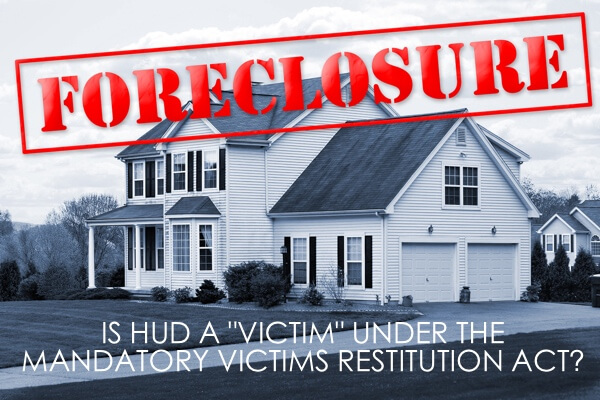
HUD MVRA Restitution Victim BennsUnited States v. Benns (5th Circuit, 2016) is a case regarding the Mandatory Victims Restitution Act (MVRA).  In this case, the US Court of Appeals for the Fifth Circuit held that HUD is not a victim of the defendant's crime, even though the HUD was out a considerable amount of money after defendant forged a credit application. Read more about USA v. Benns below.

Anxious Couple Seeks Help for Mortgage Default

Desperate for relief from a mortgage in arrears, Michael and Brenda Arnold conveyed ownership rights of their Arlington home to Rickey Benns. At the time of the conveyance, Benns agreed to rent the home and pay the mortgage from the profits made from future tenants. The mortgage loan, held by Bank of America and insured by the United States Department of Housing and Urban Development (“HUD”), remained in the Arnold family’s name. Unfortunately, Benns reneged on his agreement and failed to pay off the mortgage, triggering foreclosure proceedings against the Arnolds, unbeknownst to them.

Looming Foreclosure Leads to Desperate Acts of Forgery

In an attempt to prevent foreclosure of the property, Benns secretly tried to refinance the property. Benns forged Arnolds's signatures on loan modification documents and used a false pay stub to trick the bank into believing the Arnolds were creditworthy and still owned the property. After the application was denied by the bank, the property was eventually foreclosed on and sold below market value. Because Bank of America’s mortgage was insured by HUD, HUD paid the bank $54,906.59—the difference between what HUD paid Bank of America following foreclosure and the later sale price of the property.

A Plea is Entered and Restitution is Ordered

Benns plead guilty to one count of making false statement on a credit application, a violation of 18 U.S.C. § 1014. Upon entering the guilty plea, Benns “accepted the accuracy of a factual resume prepared by the government…author[izing] restitution to the victims of the community…includ[ing] restitution arising from all relevant conduct, not limited to that arising from the offense of conviction alone.” Benns was sentenced to twenty-seven months imprisonment, five years of supervised release, and ordered to pay restitution, totaling $544,602.42, under the federal Mandatory Victims Restitution Act (“MVRA”). Benns appealed to the United States Court of Appeals for the Fifth Circuit, arguing that HUD was not a victim of his convicted offense.

What is the Mandatory Victims Restitution Act (“MVRA”)?

The MVRA requires district courts to order restitution payments to crime victims during sentencing. 18 U.S.C. § 3663A. Under federal law, a victim is defined as, “a person directly and proximately harmed as a result of the commission of an offense for which restitution may be ordered.” Id. Typically, restitution is limited to losses arising from underlying conduct of a defendant’s offense of conviction. Hughley v. United States, 495 U.S. 411, 412-13 (1990); United States v. Espinoza, 677 F.3d 730, 732 (5th Cir. 2012); United States v. Maturin, 488 F.3d 657, 660-61 (5th Cir. 2007). To be a considered a victim under the MVRA, a person or organization must “suffer a foreseeable loss as a result of the conduct underlying the convicted offense.” Id. The government must establish, by a preponderance of the evidence, direct or proximate causation between the conduct underlying the offense and the actual loss suffered by the victim. United States v. Reese, 998 F.2d 1275, 1282 (5th Cir. 1993).

The Big Issue: Is HUD really a victim of Benns’s forgery scheme?

The United States Court of Appeals for the Fifth Circuit must determine whether HUD was a victim of Benn’s convicted offense. If the Court finds that HUD was a victim, then HUD will receive restitution under the MVRA. If the Court finds that HUD was not a victim, then Benns’ restitution award, which was imposed by the district court, could be amended or vacated altogether.

The Court of Appeals for the Fifth Circuit Weighs In with a Surprising Twist

Here, the Court weighs the argument made by the government against the facts of the case. The government argues that HUD’s loss was a direct result of Benn’s false credit application because the filing of the application itself delayed the foreclosure, which resulted in HUD selling the property at a loss. However, the Court states that the government did not produce evidence that the false credit application resulted in a delay, or that such a delay resulted in a greater loss for HUD than if HUD had sold the property any sooner than it actually did. The Court holds, because of the lack of evidence connecting the false credit application with the loss incurred by HUD, HUD is not to be considered a “victim” under the MVRA and, accordingly, cannot receive an award of restitution. “Benns was indicted and pleaded guilty to one count of filing a false credit application…it therefore does not follow that the behavior underlying Benn’s offense was the cause of HUD’s loss.”

Restitution could have only been awarded had the government established a direct or proximate causation between Benn’s false credit application and HUD’s loss when HUD sold the property at a foreclosure auction. The Court says the government failed to do so. Even though HUD was out $54,906.59, the Court does not consider HUD to be a victim of Benn’s convicted offense and vacates the restitution award.

Read full article
Pointers on Being a Judge Fort Worth Criminal Defense

7 Pointers on Being a Judge

By Brandon Barnett · Ethics

Some Words of Wisdom From the Top Military Appellate Bench

Pointers on Being a Judge Fort Worth Criminal DefenseThis week I am taking a break from my Fort Worth criminal defense cases to attend a Continuing Legal Eduction at the Air Force Judge Advocate General's School at Maxwell Air Force Base in Montgomery, Alabama. I am a reserve military judge in the Marine Corps and this is one of the annual training requirements for military judges. In one of our periods of instruction, the Chief Judge from the Court of Appeals for the Armed Forces (the highest court in the military justice system) gave us seven helpful tips on Being a Judge. I found them to be simple yet incredibly insightful. As you read these, you'll notice that they not only apply to military judges, but state judges, prosecutors, and criminal defense lawyers as well.

  1. Be Kind

  2. Be Patient

  3. Be Dignified

  4. Don't Take Yourself Too Seriously

  5. Don't Be Dismayed When You are Reversed* (*or overruled for the trial lawyers)

  6. Remember That There are No Unimportant Cases

  7. Don't Forget Your Common Sense

Simple, insightful, and easy to apply to our practice every day. We would all do well to observe these tips as often as possible. Practicing criminal defense in Fort Worth, I am fortunate to observe my colleagues, adversaries, and judges applying these pointers all the time. But sometimes there are cases or opposing counsel that tempt us to violate some of these rules (especially rules 1-3). I am thankful for the reminders and will continue to apply them to my practice both on the bench in the military and in the courtroom in Fort Worth.

Some of my other favorite quotes that tie in with this advice:

"Be polite, be professional, but have a plan to kill everybody you meet."

-General James "Mad Dog" Mattis, USMC (Retired)

"All you have to do is follow three simple rules. One, never underestimate your opponent. Expect the unexpected. Two take it outside. Never start anything inside the bar unless it's absolutely necessary. And three, be nice."

-Dalton (Patrick Swayze), Roadhouse

Read full article

Speak with a Fort Worth attorney

Call (817) 993-9249 or send us a message to discuss your case.